RETRO-REVIEW · 2026-07-27
Skipping Stones to Lonely Homes (2015) — Throwing Stones Across Islands, the Free PuzzleScript Game That Fathered Two Descendants
How one hobbyist release became a starting point for both A Monster's Expedition and Order of the Sinking Star
Introduction — An Archipelago Crossed by Thrown Stones
On 31 August 2015, London-based puzzle designer Alan Hazelden (Draknek) quietly published a free browser game on his own site: Skipping Stones to Lonely Homes. It follows a shipwrecked sailor crossing an unnamed archipelago, the Lilypad Isles, by treating lilypads as stepping-stone bridges, working toward repairing a sunken ship. Arrow keys to move, Z to undo, R to reset to a checkpoint — the whole of it, with no ornamentation.
No account, no ads, no download. Open the browser and you can play it on the spot, and close it just as easily. That ease was no accident: it is a product of the democratization brought by PuzzleScript, the free engine Stephen Lavelle released in 2013 — a game covered earlier in this column. In an era when a few dozen lines of rules were enough for anyone to ship a browser-playable Sokoban-lineage puzzle, this was one of the earliest harvests of that shift.
This piece traces a lineage that can be confirmed from official sources: how this one free game fathered two major descendants a decade later.
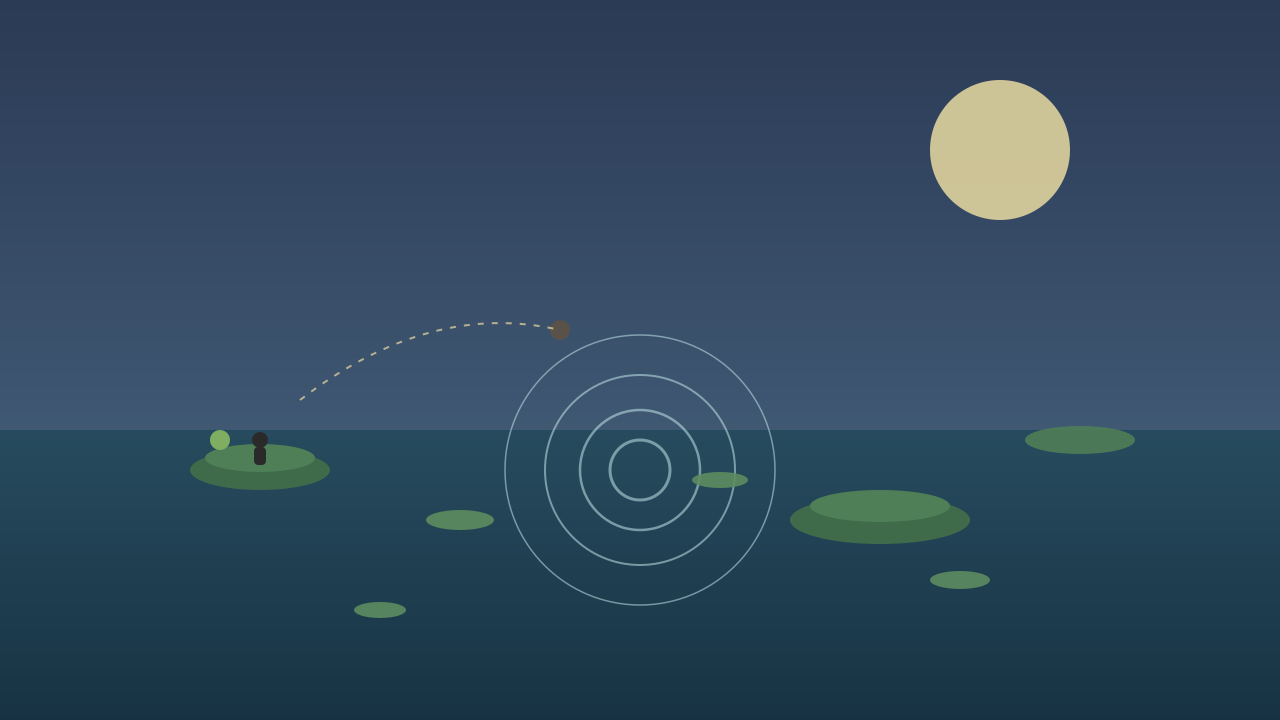 An uninhabited archipelago beyond the ripples (illustration, AI-generated)
The Context — Flash's Twilight, and a Designer Two Years Into Full-Time Work
The year 2015 needs to be placed carefully. Flash was not yet dead, but its end was already visible on the horizon. The main battleground of browser gaming was quietly shifting from Flash animation toward lightweight games written in JavaScript. PuzzleScript embodied that very shift, exposing its own source code on an in-browser edit page so that anyone could modify or fork it. Hazelden himself posted the source for this game to the PuzzleScript Google Group.
Looked at through Hazelden's own career, 2015 was also a transitional year for him personally. In his own interviews he has said he began making games as a student hobby in 2006, and only became a full-time developer after the July 2013 release of his commercial title Sokobond. This game, then, comes from a period barely two years into being a puzzle designer who could support himself — a time when he was still releasing small, free experiments while feeling his way forward. PuzzleScript, as a low-stakes personal testing ground, suited him well at the time.
The itch.io and PuzzleScript scenes of this era were full of small, unmonetized releases drifting by. Skipping Stones to Lonely Homes was, at the time, simply one more of them — before its later lineage came to light.
 Flash sinking beneath the surface as lightweight engines rise (illustration, AI-generated)
Mechanics — Throwing, Not Pushing
The core verb of this game is not pushing but throwing. Classic Sokoban-lineage puzzles have built their basic grammar on direct action: you walk up to an adjacent block and push it. In Skipping Stones to Lonely Homes, however, the player throws a stone into the water, and its ripple moves a distant lilypad. At the center of the design is the idea of moving something out of reach, indirectly, with a delay.
This notion of 'remote action' is a quiet but not insignificant fork in the grammatical history of the Sokoban lineage. By shifting the very constraint that a box must be adjacent to be pushed, the quality of a puzzle's legibility and planning changes. The player must construct, in their head, not the move directly in front of them but the several moves it will take for a ripple to arrive. The structure of stitching together a plan across fragmented views, island to island, is also a trait that carries into later exploration-based puzzle games.
For a small free release, it quietly anticipated part of the vocabulary that later 'indirect action' and 'remote activation' puzzles would build on.
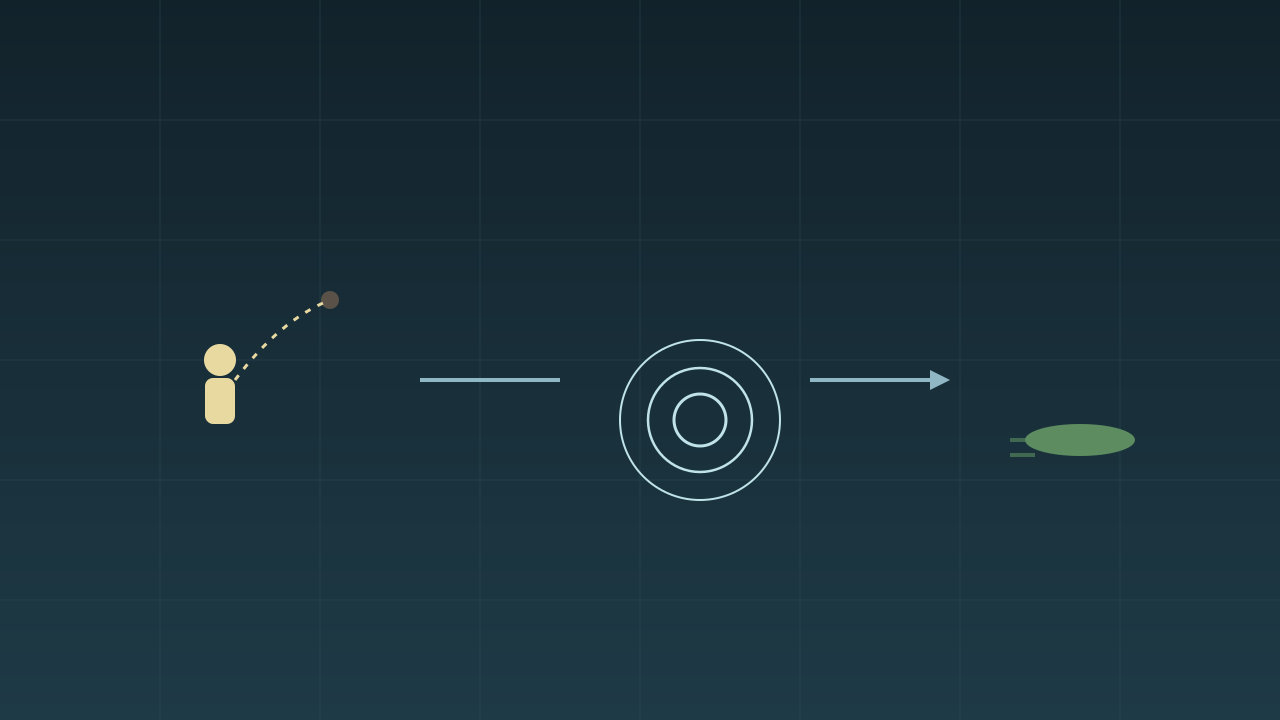 Throw, ripple, move — the three-step chain of indirect action (illustration, AI-generated)
The Lineage to Today — One Free Game, Two Major Starting Points
That this small game connects directly to two major works a decade later is stated plainly on Hazelden's own official site. The game's page reads: 'If you enjoyed this game, you might also like its spiritual successor A Monster's Expedition, or any of the other games released by my studio Draknek & Friends.' A Monster's Expedition (2020), a hit on Apple Arcade and Steam that scored a 92 Metascore on its 2021 Nintendo Switch release, took the prototype of exploring an uninhabited archipelago and refined it into the more elaborate grammar of rolling logs to cross waterways.
The same page adds a further line: 'This is one of the games used as the inspiration and starting point for Order of the Sinking Star.' Order of the Sinking Star is the third game directed by Jonathan Blow, of Braid (2008) and The Witness (2016), a decade in development and slated for release within 2026 as a massive work containing over 1,000 hand-crafted puzzles. That a free, anyone-can-play hobbyist game is named by its own creator as a starting point for both a beloved indie hit and a magnum opus by one of the industry's most exacting perfectionists shows that puzzle lineage does not necessarily flow in order of budget.
The soil itself — PuzzleScript — is a free engine Lavelle released in 2013. A free design tool produced a free experiment, and that experiment quietly prepared the ground for both a commercial smash hit and an industry-defining magnum opus. This three-step chain is one of the most concretely documented lineages left behind by the post-Flash history of browser puzzles.
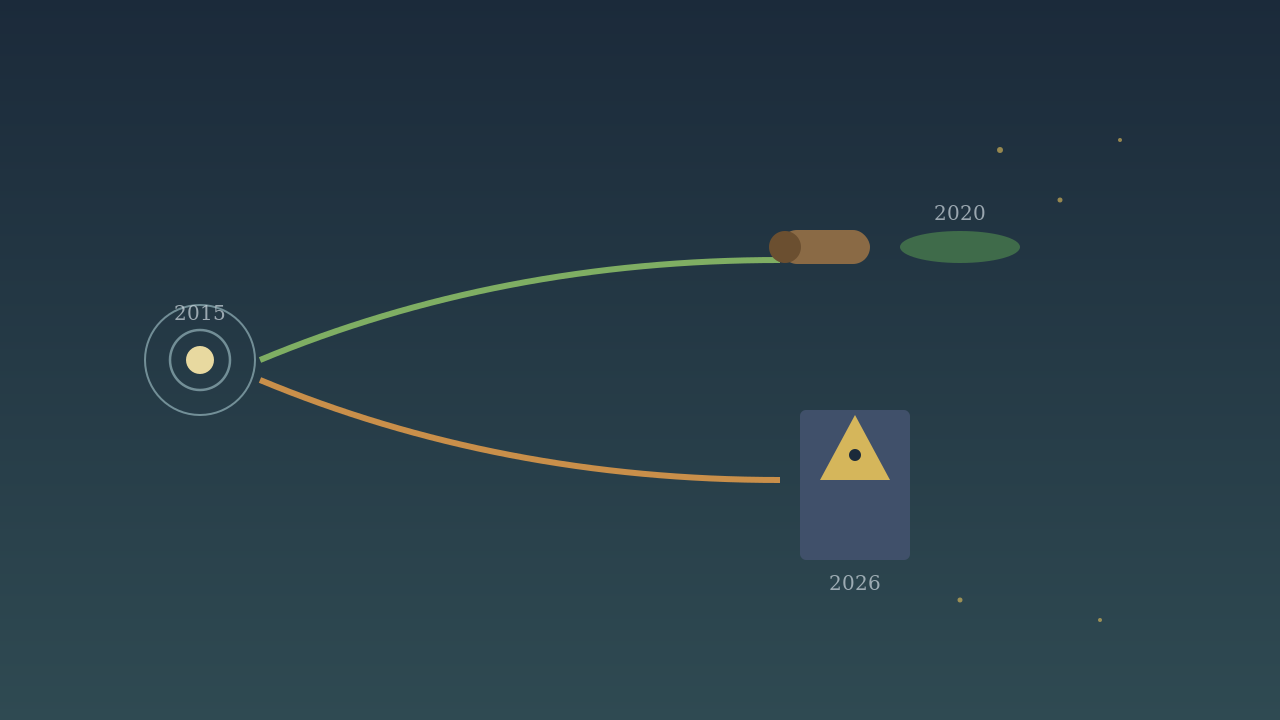 How one ripple grew into two great rivers (illustration, AI-generated)
Sources
Sources consulted for this article:
・Thinky Games: Skipping Stones to Lonely Homes (developer/release data)
・TouchArcade: Draknek Interview (Hazelden's own career account)
・Draknek & Friends official site
・A Monster's Expedition official site
・Wikipedia: Order of the Sinking Star
Closing — Ten Years to Reach the Shore
Skipping Stones to Lonely Homes is still playable for free, today, on Hazelden's own personal website. But that also means its preservation depends entirely on one developer's server bill and domain renewal. Where A Monster's Expedition sits on Steam shelves and Order of the Sinking Star ships on PlayStation 5 with some structural chance of surviving for decades, the free browser miniature at their source could quietly vanish at any time.
Many of the Flash-era works I have traced in this column carried the same fragility. But what this one game teaches is a kind of paradox: it is often the freely, casually released experiment that quietly lays the design groundwork for the major works that follow. The stone thrown in 2015 became the rolled log of 2020, and one of the starting points for the thousand-puzzle labyrinth of 2026. History, perhaps, is simply the process by which such small ripples take ten years to reach the shore.
 Ten years of ripples, still travelling toward the shore (illustration, AI-generated)
Reactions (no login)
Anonymous • one of each per visitor per day
Part of these series
Retro RevisitedEpisode 25 of 45

