RETRO-REVIEW · 2026-08-12
Skipping Stones to Lonely Homes (2015) — The Bridge of Thrown Stones That Reached a Cosmic Train
A free PuzzleScript shipwreck puzzle stretched its lineage through Cosmic Express to a 2026 flagship title
Introduction
This is the tale of a free browser puzzle, Skipping Stones to Lonely Homes, released on 21 August 2015 by the British puzzle designer Alan Hazelden on his own site. You search a scatter of unnamed islands — he called them the Lilypad Isles — for timber to repair a wrecked ship. That is the whole of its simple premise. But what interests me is not the premise; it is the decade-long voyage this single work went on to take.
The game was built in PuzzleScript, a free browser-based creation tool, and it never had a Steam store page. In its final stretch of development, a private build circulated for ten days among the hobbyist community on a Google Group, where bug reports and difficulty concerns were exchanged, as the surviving posts from that period show. Hazelden himself wrote, immediately upon release, that it was 'definitely the most ambitious Puzzlescript game I've made, probably the hardest too.' No one at that point could have known that this piece of freeware would one day become a component inside a major commercial puzzle game.
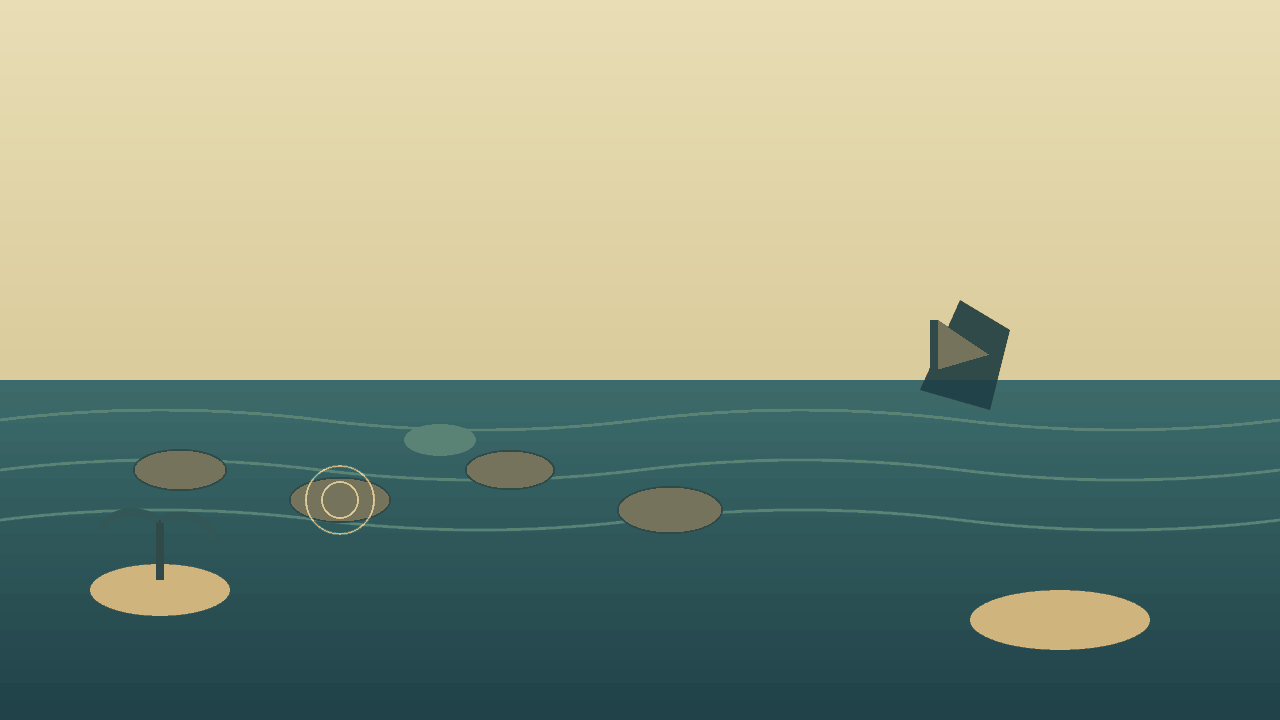 Stepping stones across the Lilypad Isles, a wreck in the distance (illustration, AI-generated)
The Context of the Era
Behind it stands PuzzleScript, released in October 2013 by Stephen 'increpare' Lavelle: a browser-based tool for grid puzzles, which let anyone mass-produce Sokoban-style pushing games from a short rule script. This let individuals build a puzzle in a few days and release it for free, and a culture built around short jams spread rapidly on that back. Hazelden was one of the developers working in PuzzleScript, and this game is a product of that culture.
Hazelden himself had been making games since 2006, and it was Sokobond, released in July 2013, that marked his turn to doing so full-time. Skipping Stones to Lonely Homes arrived in 2015, only around two years into that full-time career. Free PuzzleScript works served as a testing ground for ideas ahead of commercial titles — a premise essential to reading the lineage that follows.
The pre-release playtesting also speaks to the browser-puzzle culture of the time. Hazelden posted a link to a private build on a Google Group and asked the hobbyist community there, 'please let me know how far you get, and if you find any treasure.' Within days several players sent screenshots of stuck states, he adjusted levels in response, and redistributed what he called the 'hopefully final version.' A small but tight loop of verification, running entirely on a personal site and a mailing list.
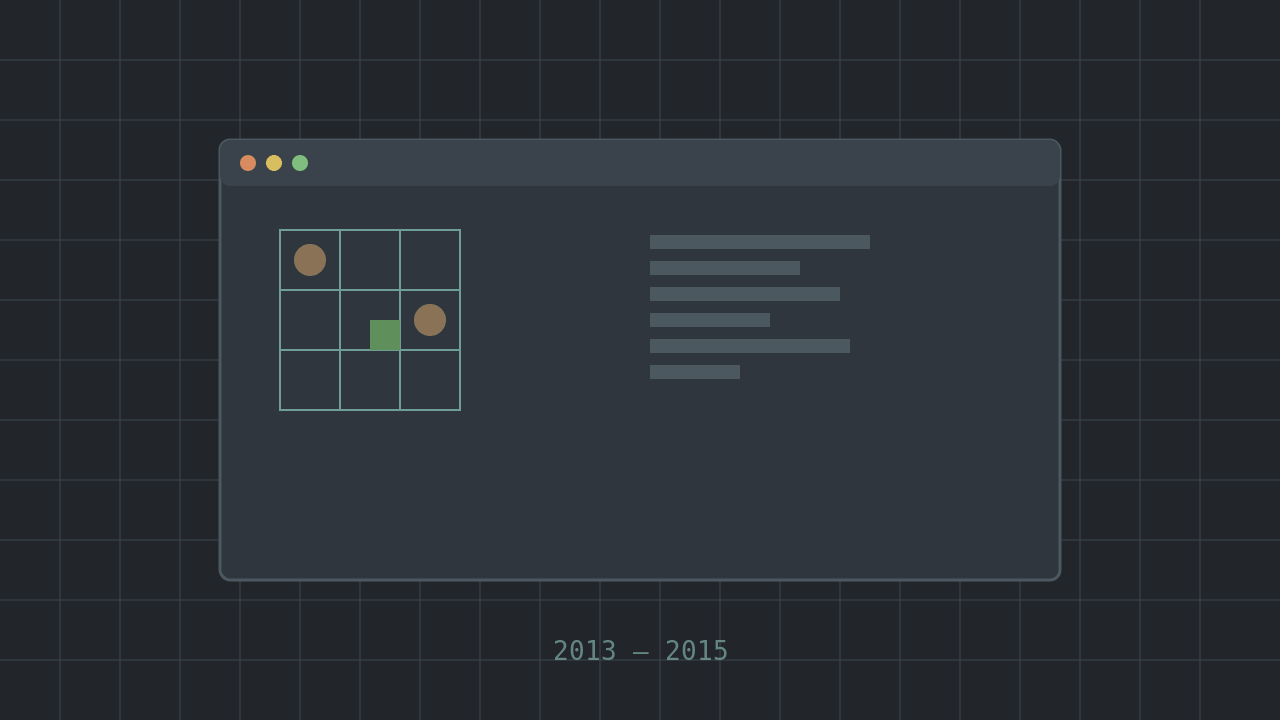 The window PuzzleScript opened for solo developers (illustration, AI-generated)
Mechanics
The core of play is simple: push a pebble into the water to build a bridge across a gap. A single stone alone will not span some gaps, but two stones placed together form a one-tile bridge — a rule players worked out for themselves in the comments, grumbling that 'the game could probably use one or two more instructions.' Bridges are not disposable; they often must be rebuilt depending on the situation, producing the familiar tension of irreversible placement found in pushing puzzles.
A sunken stone also functions as a device for redirecting the current. By diverting the flow, you can steer a lily pad to a desired position and hop onto it as it passes. That real-time, timing-sensitive movement coexists on the same screen with the discrete safety net of undo and checkpoints — an unusual combination for a PuzzleScript game of its time.
The islands are not divided into discrete stages but connected as one continuous map. Player posts show that at least one section had multiple valid bridge-building solutions, and Hazelden himself expressed surprise at a solution that diverged from his intended one. A hunt for seven hidden treasures is layered on top, so the goal is not merely to reach an exit but to fully read the islands.
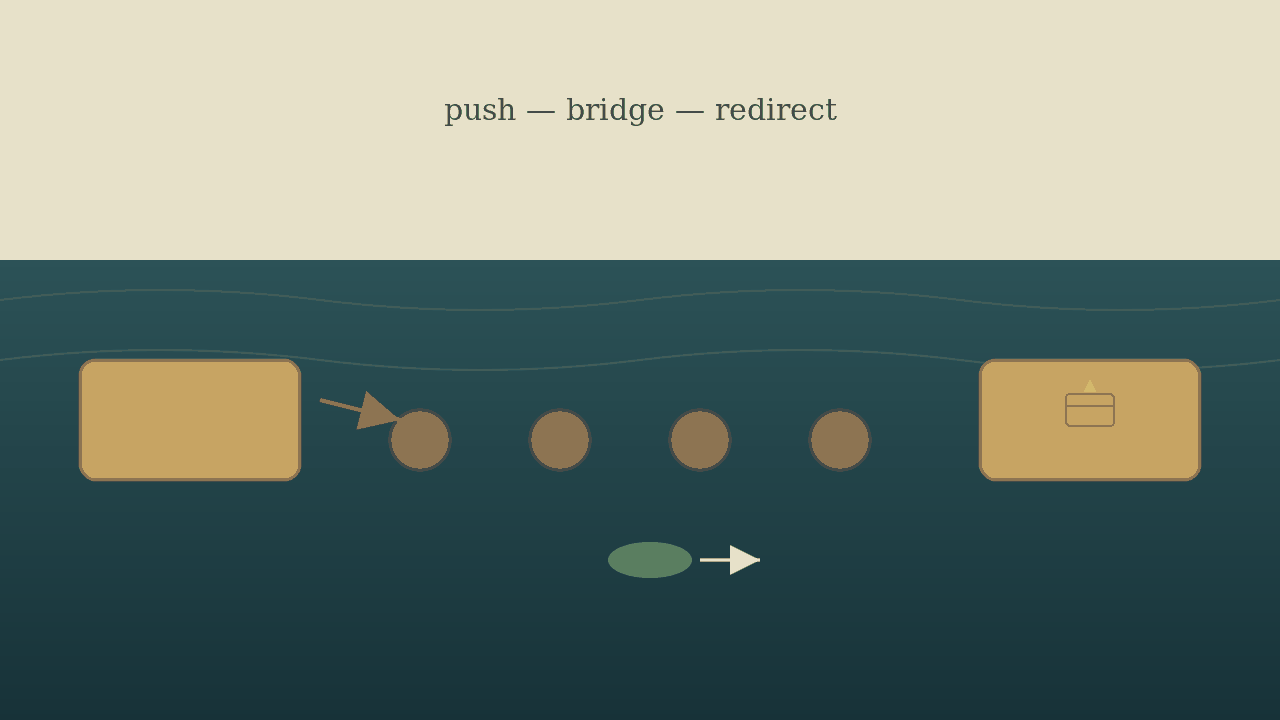 Push, bridge, redirect — three verbs (illustration, AI-generated)
Legacy Into the Present
That same year, 2015, Hazelden made another PuzzleScript work, Train Braining, for the railway-themed jam Train Jam. His own official page describes it plainly as 'the original prototype for the game Cosmic Express.' The verb changes from throwing stones to laying track, but the underlying skeleton — assembling a route within a constrained board — carries on from the same designer's hand.
That prototype became the commercial release Cosmic Express on 16 March 2017 for PC and mobile, with a Nintendo Switch port following on 2 September 2021. Hazelden's studio, Draknek & Friends, kept reusing the same core idea in new forms: Sokobond Express in 2024 and Spooky Express in 2025. A free jam game had, over eight years, grown into a commercial series.
The destination of Skipping Stones to Lonely Homes itself is just as notable. On his own site, Hazelden explicitly names its 'spiritual successor' as A Monster's Expedition. Further, regarding Order of the Sinking Star — the new title announced in December 2025 by Thekla, the studio of Jonathan Blow (Braid, The Witness), slated for 2026 — Hazelden wrote on his own page that this game 'is one of the games used as the inspiration and starting point' for it. That title's Wikipedia entry likewise records that its puzzle mechanics draw on Skipping Stones to Lonely Homes and Mirror Isles, both by Hazelden. A single stone thrown for free had, a decade later, become part of the blueprint for a flagship puzzle game — I set that fact down without exaggeration.
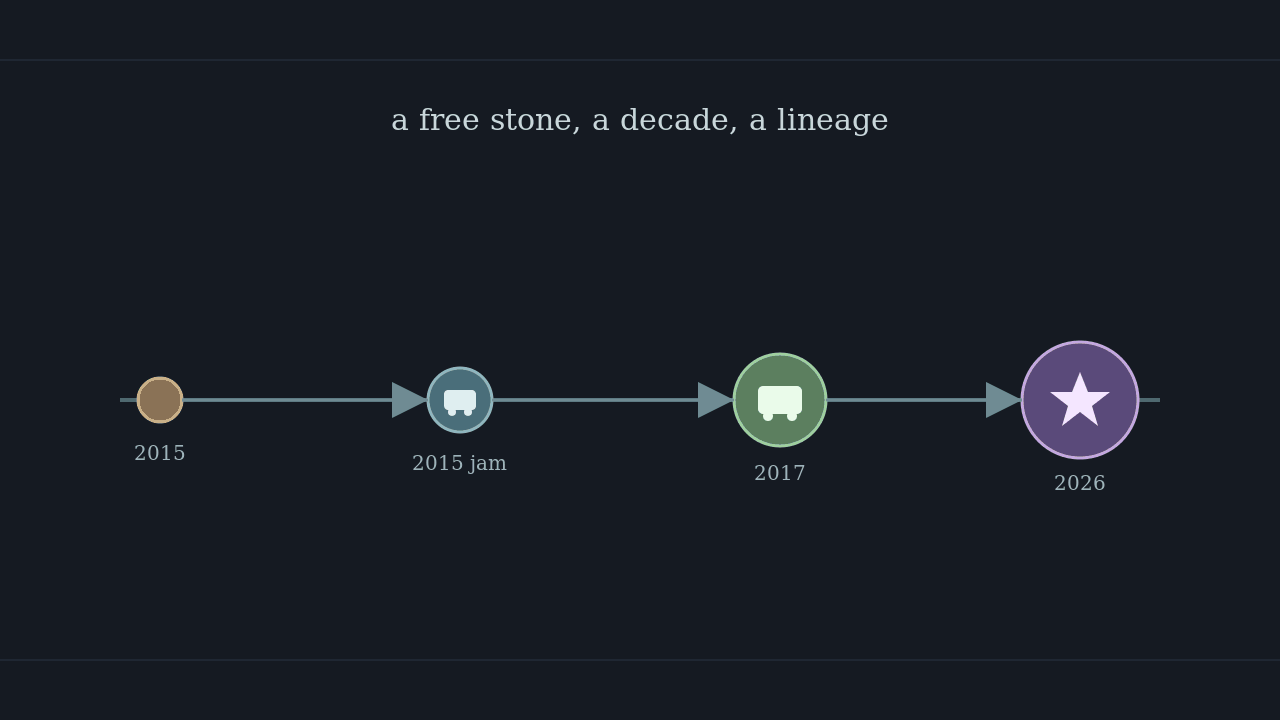 From a single stone to a decade-later flagship (illustration, AI-generated)
References
Sources referenced in this article:
・Alan Hazelden official: Skipping Stones To Lonely Homes
・Google Groups (PuzzleScript): Skipping Stones To Lonely Homes playtest thread (August 2015)
・bontegames blog: skipping stones to lonely homes (21 August 2015)
・Alan Hazelden official: Train Braining
・Wikipedia: Order of the Sinking Star
・increpare games: PuzzleScript (October 2013)
・TouchArcade: Draknek Interview — Alan Hazelden on Thinky Puzzle Games
Closing
What this work historically demonstrates is that freeware jam culture was never merely a byproduct of leisure; it was a testing ground that sharpened the design of commercial puzzles. Throwing a stone, building a bridge, redirecting a current — those three modest verbs were, by the same designer's own hand, replaced with laying track, then with charting a spaceship's corridors, and were finally carried into a flagship title made by an entirely different studio.
As one who traces lineages, what I want to hold onto is that nowhere in this chain is there mere coincidental resemblance. Train Braining is stated, on the designer's own page, to be the prototype for Cosmic Express; Skipping Stones to Lonely Homes is stated, likewise on his own page, to be one of the starting points for Order of the Sinking Star. A small waterside game released for free leaves its name, a decade on, in the blueprint of a major title — that is the quiet wake this one work leaves behind.
 Dusk settles over the Lilypad Isles, ripples stilled (illustration, AI-generated)
Reactions (no login)
Anonymous • one of each per visitor per day
Part of these series
Retro RevisitedEpisode 29 of 43