HISTORY · 2026-08-06
Mirror Isles / Skipping Stones to Lonely Homes (2014-2015) — How Two Free Jam Games Became Two Different Escape Islands, a Decade Later
The clearest example yet of what PuzzleScript made possible: make first, and cultivate whatever lands
Introduction — Two Experiments, Released Without Fanfare
In October 2014 and August 2015, London-based puzzle designer Alan Hazelden quietly posted two experiments to his own website, each built in a few weeks using the free puzzle-authoring engine PuzzleScript: Mirror Isles and Skipping Stones to Lonely Homes. Blog comments and forum reactions at the time were split evenly between praise and cries of "I can't solve this" — the kind of casual reception a jam game earns.
But in December 2025, both games resurfaced on Hazelden's own site. Under a "related games" heading now sit A Monster's Expedition, his 2020 commercial release, and Order of the Sinking Star, the new game from Jonathan Blow's studio Thekla, whose demo appeared in 2026 after a decade in development. In Hazelden's own words, the former is a "spiritual successor" to these two games, and the latter used them as "one of the inspirations and starting points."
This is the clearest concrete example I have found yet of the lineage I traced through PuzzleScript (2013) — a mode of production where a free engine lets anyone experiment, and whatever lands gets cultivated further. This piece follows what these two free jam games actually did, and how, a decade later, they fed into two very different commercial works, using only the developer's own statements as evidence.
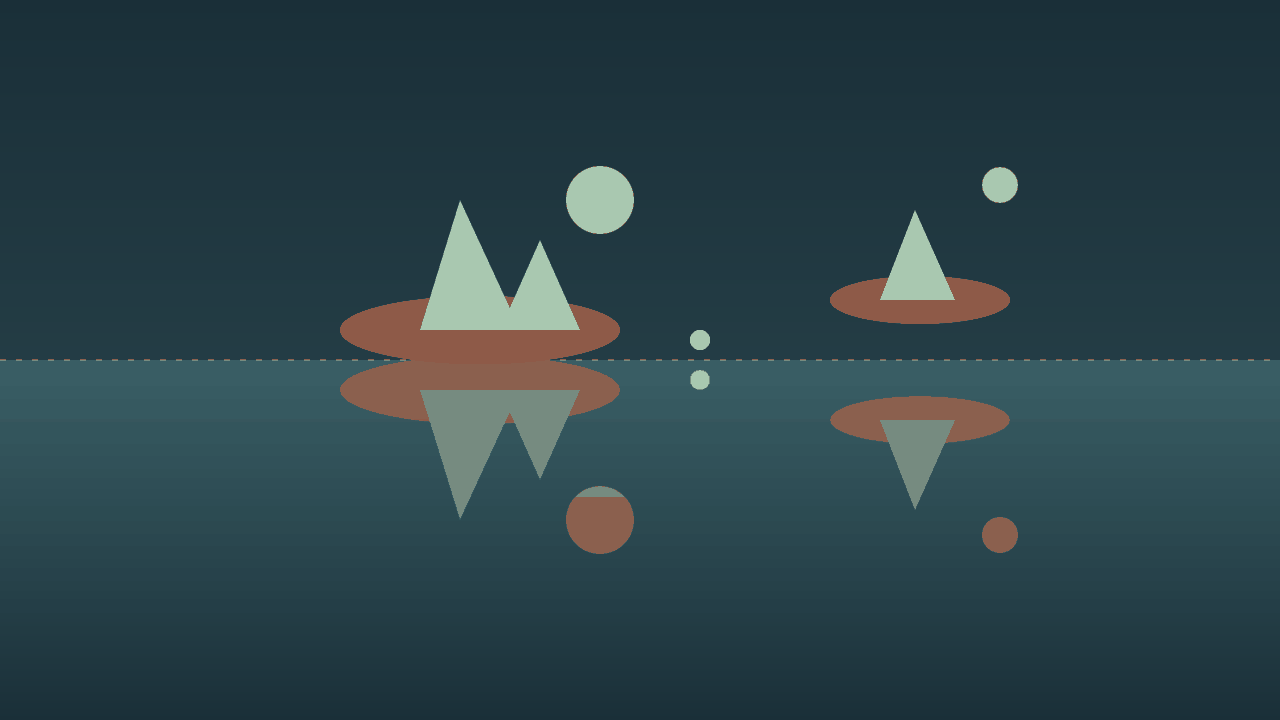 Across the mirror, another island floats (illustration, AI-generated)
The Context — A Burst of Output Right After PuzzleScript's Debut
First, the timing: 2013-2015. PuzzleScript had only just been released in October 2013 by Stephen Lavelle (handle increpare) — a free, browser-based JavaScript tool that let anyone write grid-based, turn-based puzzles using a short, regex-like rule syntax (as covered earlier on this site in puzzlescript-2013). Hazelden began posting PuzzleScript miniatures to his own site almost immediately afterward, and both Mirror Isles and Skipping Stones to Lonely Homes belong to that early run.
Hazelden himself had only just become a full-time developer in July 2013, on the strength of his breakout release Sokobond (as covered earlier on this site in designer-hazelden). In other words, 2014-2015, when these two games were made, was precisely the period when he was most actively living out the philosophy he has repeated ever since: make a large quantity first.
The browser-puzzle scene's reaction at the time is also on record. Belgian developer Bart Bonte covered Mirror Isles on his own blog the moment it appeared, and readers traded solutions in the comments. Skipping Stones to Lonely Homes was picked up by Boing Boing as well, showing that its premise — a shipwrecked sailor skipping stones between islands — reached beyond the dedicated puzzle community into general tech media.
 2014: small boards, mass-produced inside a browser tab (illustration, AI-generated)
Mechanics — A Mirror's Memory, a Stone's Plan
Mirror Isles' rule is simple. A duplicate of the player exists on the far side of a mirror; pressing an arrow key moves the player, and the mirrored duplicate moves in the reflected direction at the same time. Space swaps which of the two you are directly controlling. Reach the marked tile and the level ends — but late in the game, even rocks start obeying the mirror, and the load of holding "what reflects, and what doesn't" in your head rises sharply. Multiple players at the time reported that the difficulty spiked suddenly around level 15.
Skipping Stones to Lonely Homes, by contrast, is exploration-driven. You play a shipwrecked sailor who skips stones toward lily pads to form makeshift bridges and cross from island to island, hunting for parts to repair a broken ship. Judging from blog posts and reactions at the time, its structure of shuttling between multiple islands made it, by a wide margin, the most ambitious and difficult Hazelden game to date.
What the two share is this: working within the exact same constraint — a PuzzleScript grid and a handful of verbs — they generate two entirely different qualities of tension. Mirror Isles is a memory puzzle, forcing the player to hold a one-to-one correspondence in mind move after move; Skipping Stones to Lonely Homes is a planning puzzle, about how to redistribute a limited resource (stones, lily pads). The same phenomenon this site keeps rediscovering across different designers — the same tool producing different grammars — happens here inside a single author's output.
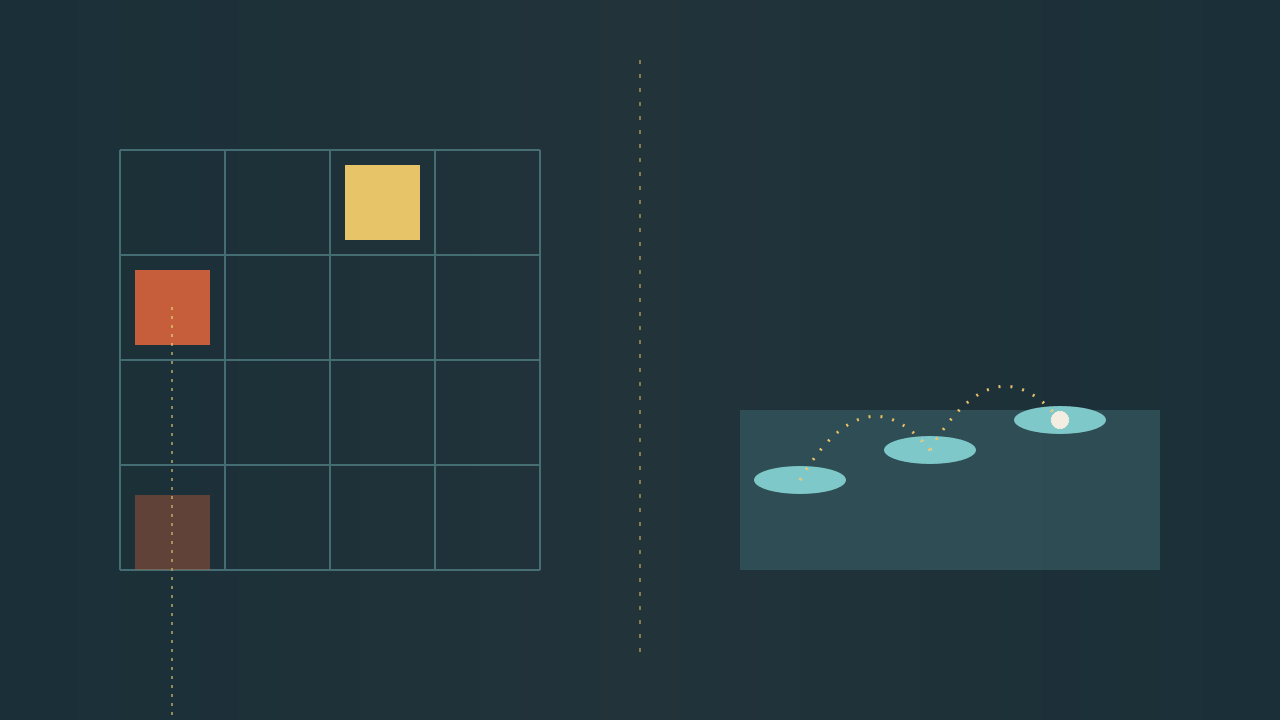 A flipping piece, a skipping stone — two grammars born of one board (illustration, AI-generated)
Legacy — One Path Home, One Path Elsewhere
What became of these two games is spelled out on Hazelden's own website. Both the Mirror Isles and Skipping Stones to Lonely Homes pages carry the same line: "If you enjoyed this game, you might also like its spiritual successor A Monster's Expedition" — linking to the 2020 commercial release from Draknek & Friends, which launched on 10 September 2020. Its core structure — knock down a tree, roll the log into water, use the resulting bridge or raft to cross — reads as Skipping Stones to Lonely Homes's skeleton, translated onto a much larger board with a nonlinear, exploratory structure.
The other line of descent happened somewhere else entirely. In December 2025, Hazelden reposted links to both games on Bluesky, and both game pages gained a further line: "This is one of the games used as the inspiration and starting point for Order of the Sinking Star." That game is the puzzle epic Jonathan Blow's studio Thekla — maker of Braid and The Witness — has spent a decade building, whose demo appeared at Steam Next Fest in June 2026 (covered earlier on this site in roundup-20260615). A case where the developer of a free jam game explicitly states it became a starting point for an unrelated, large-scale commercial project from a different studio is a rare one among everything this site has covered.
A careful line needs drawing here. Hazelden's own words are "one of the inspirations and starting points" — Thekla's side of the story has not been made public in any detail. So it would overstate things to say Order of the Sinking Star would not exist without Mirror Isles. What can be said with confidence is only this: a pair of free experiments, made in a few weeks in 2014, were named by their own creator, more than a decade later, as reference points for two entirely different commercial puzzle epics.
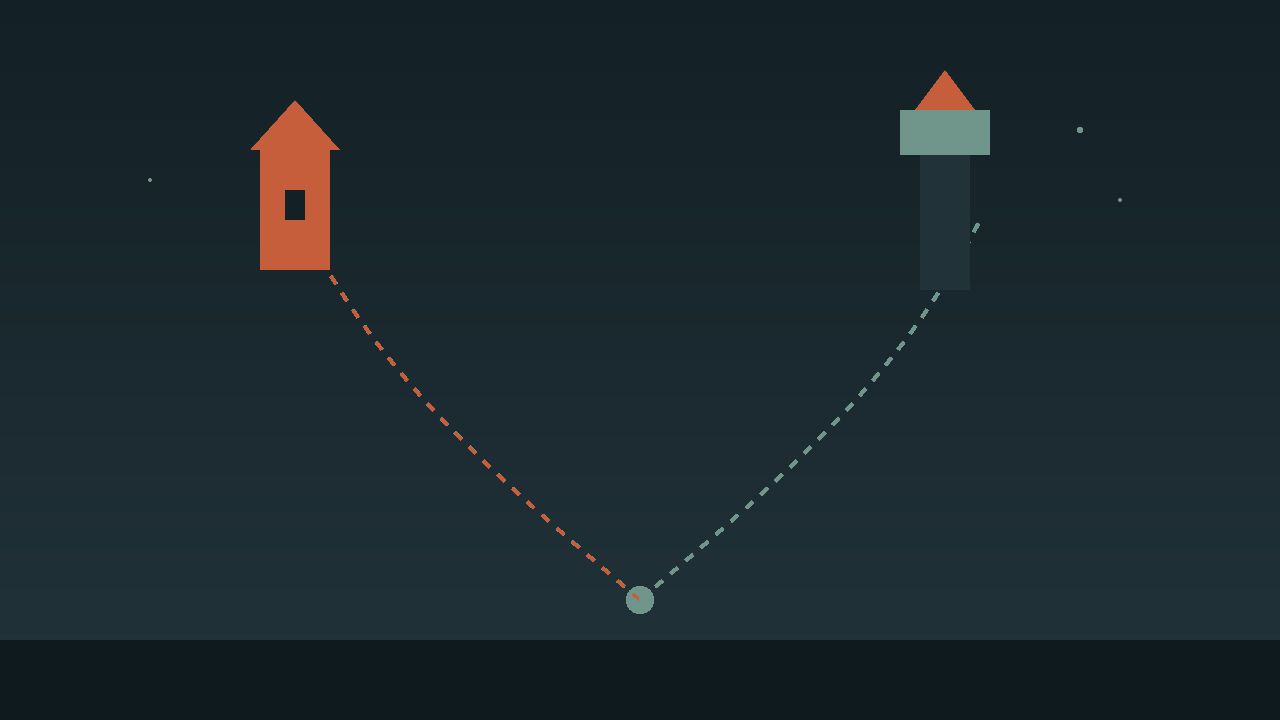 From one experiment, a road forks toward two distant towers (illustration, AI-generated)
Sources
Sources consulted for this article:
・Alan Hazelden's official site: Mirror Isles (2014) (source for the "spiritual successor" and "starting point for Order of the Sinking Star" statements)
・Alan Hazelden's official site: Skipping Stones To Lonely Homes (2015) (same statements)
・Draknek & Friends, official Bluesky post, 12 December 2025
・bontegames (Bart Bonte): mirror isles (31 October 2014)
・bontegames (Bart Bonte): skipping stones to lonely homes (August 2015)
・Boing Boing: Escape a shipwreck by skipping stones across the water (8 September 2015)
・Grinding Down: Hitting reset repeatedly in Skipping Stones to Lonely Homes (11 September 2015)
・Wikipedia: A Monster's Expedition
・On this site: PuzzleScript (2013), The Philosophy of Alan Hazelden, Design Roundup on Order of the Sinking Star (roundup-20260615)
Closing
What Mirror Isles and Skipping Stones to Lonely Homes demonstrate historically, I think, is the real function of a jam game. A jam's output isn't only for the scores or reactions it earns on the day. It also sits inside its creator as an unresolved design question, waiting to be picked back up, in some other form, years later.
What PuzzleScript (2013) made possible was doing this holding-in-reserve for free, and at the pace of a few weeks. Within a single author's body of work, a 2014 game about mirrors and a 2015 game about skipping stones flowed, by separate paths, into two commercial works of very different scale and genre context: A Monster's Expedition (2020) and Order of the Sinking Star (2026). That fact is among the most concrete pieces of evidence this site has found yet for a claim it keeps returning to: that small tools build lineages, given enough time.
 On quiet water, an island not yet crossed to (illustration, AI-generated)
Reactions (no login)
Anonymous • one of each per visitor per day
Learn — Curriculum
LearnPart 2 Lineage — Where Puzzles Came FromChapter 6 The 2000s Turn — Flash, Mobile, Jams14 / 15
Part of these series
Puzzle Incident HistoryEpisode 22 of 49