HISTORY · 2026-08-17
Minesweeper (1990) — The Logic Puzzle Microsoft Built Into a Billion PCs
How an OS/2 practice project became, without anyone designing it that way, the world's largest classroom in deduction
Introduction
This is a work distributed in 1990 — 8 October, to be precise. One of seven titles bundled in the Windows Entertainment Pack (WEP), an add-on software collection, under the name Minesweeper. The screen shows nothing but a grid. No protagonist, no story. Open a cell and a number appears, telling you how many mines hide among its eight neighbours. Flag suspected mines, read the numbers, clear every safe cell without detonating one — that is the entire rule set.
But the lineage of this small work tells a story larger than the birth of one game. From the moment it was built into Windows 3.1's standard installation in 1992, replacing Reversi, it became the most widely installed logic puzzle on Earth. There is no evidence any designer intended to teach deduction to the masses. And yet, as a matter of outcome, that is exactly what happened — and that gap between intention and effect is worth reading as a strange case study in the history of puzzle design.
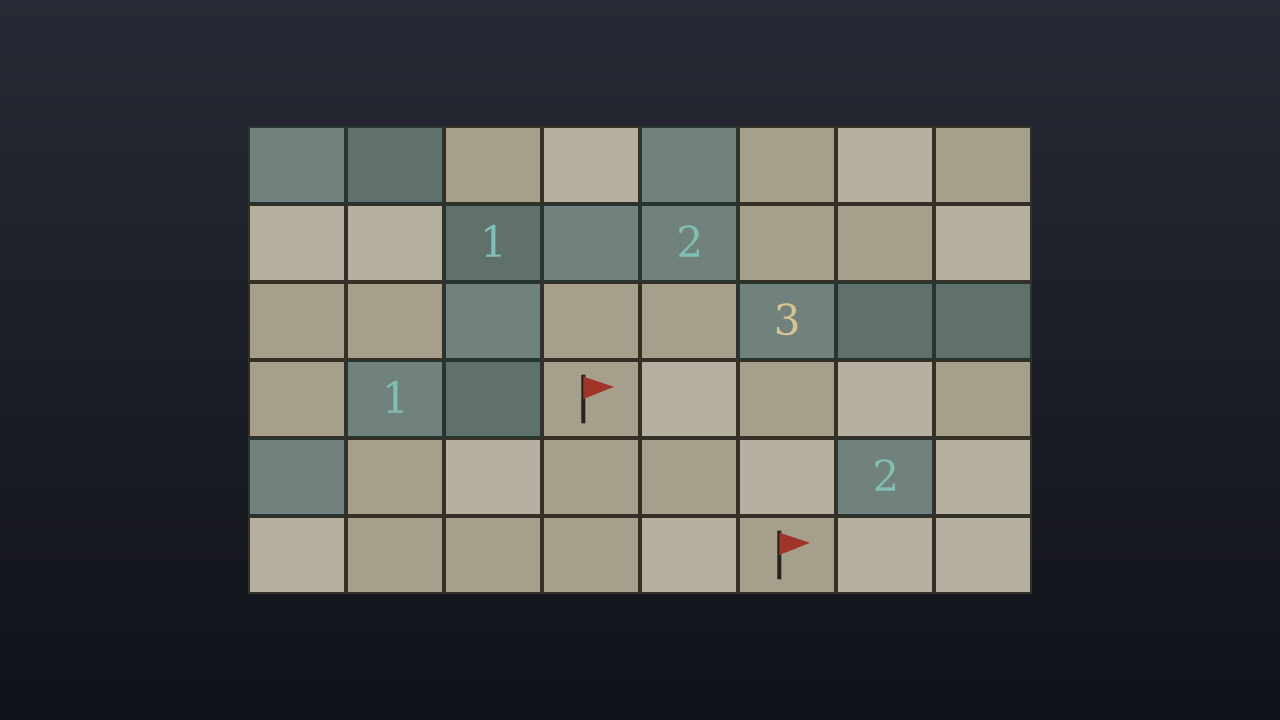 A board of nothing but a grid and numbers — the prototype of a logic puzzle distributed to the world (illustration, AI-generated)
The Context of Its Era
Tracing the lineage further back, 1983 saw British programmer Ian Andrew release Mined-Out, published by Quicksilva for the ZX Spectrum. The core idea — deducing mine locations from numbers — already existed there. In a 2014 Eurogamer interview, Andrew said he believes Microsoft copied his game. Microsoft programmer Curt Johnson, for his part, has said his own reference point was not Mined-Out but an unnamed Macintosh clone of a similar game. Neither claim is independently confirmed, and I record both testimonies here side by side rather than adjudicate between them.
What is documented is this timeline. In 1989, Johnson, then a Microsoft employee, wrote PM Mine as a practice project to learn OS/2's Presentation Manager (PM) graphical environment. In May 1990, Robert Donner released PM Mine 2.0. When Windows 3.0 launched on 22 May of that year, Donner rewrote it as Win Mine for Windows, and on 8 October it shipped as 'Minesweeper,' one of the titles in the WEP. The WEP's product manager, Bruce Ryan, reportedly had 20,000 copies of the manual printed at a local print shop — a detail preserved in a 4Gamer retrospective.
Distribution in that era looked nothing like today's Steam. The WEP was a separately sold floppy-disk add-on pack, and a game slipped in at the margins of the base software. That changed in 1992. Built into Windows 3.1's standard installation in place of Reversi, Minesweeper no longer required purchase or choice — it became part of the operating system itself, distributed to PCs across the world.
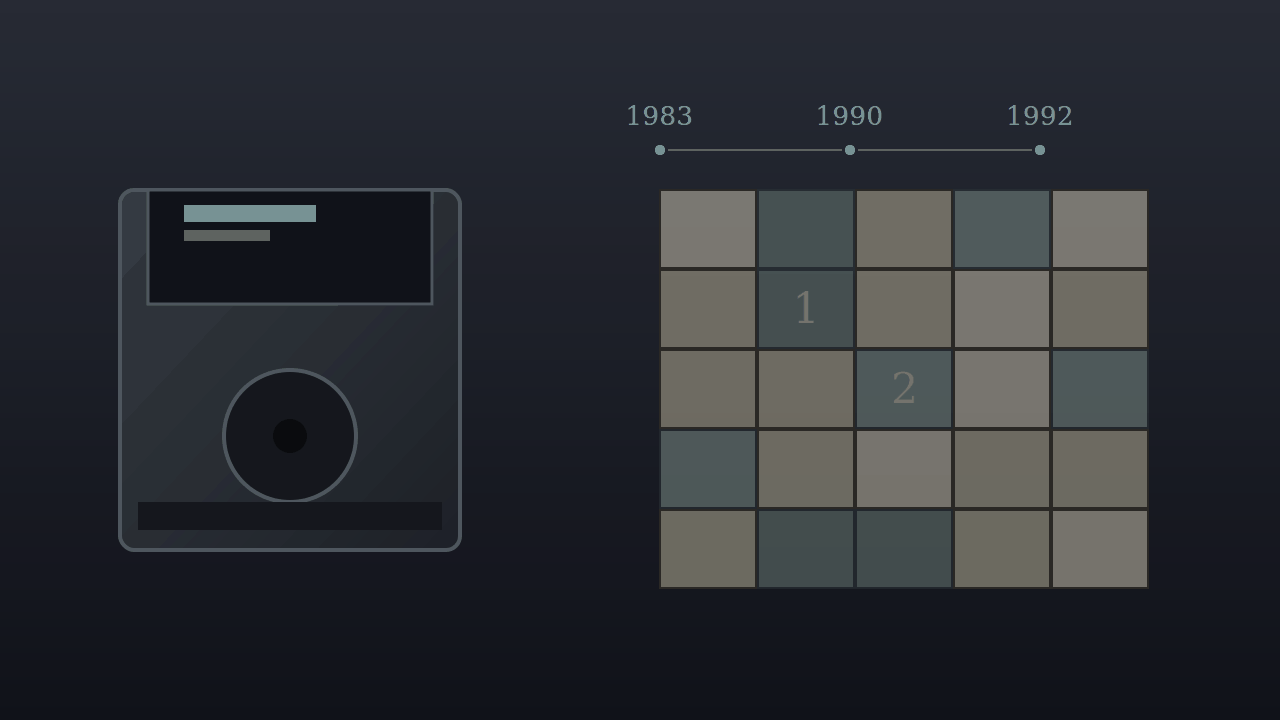 From floppy disk to a default OS component — an era when distribution itself changed shape (illustration, AI-generated)
Mechanics
The core of play is deduction. A number on an opened cell reports how many mines lie among its eight neighbours; a zero opens its neighbours automatically. Once the number of flagged neighbours matches a cell's number, the rest of its unopened neighbours are provably safe — that is the basic inference. A later, widely adopted shortcut — simultaneous left-right click, known as 'chording' — opens all unflagged neighbours of a satisfied number at once. With only two symbols, number and flag, the board becomes a set of logical statements.
Yet the game has a side that resists being called a pure logic puzzle. Early on, or wherever clues run short, deduction alone cannot always close out the board, and the player is forced into a probabilistic guess about which unopened region carries the lower mine density. The three difficulty tiers — Beginner, Intermediate, Expert — only change grid size and mine density; they never remove this element of probabilistic guessing. This is less a flaw than the exact tension that has kept the game alive for decades: the back-and-forth between certain deduction and a nervy bet.
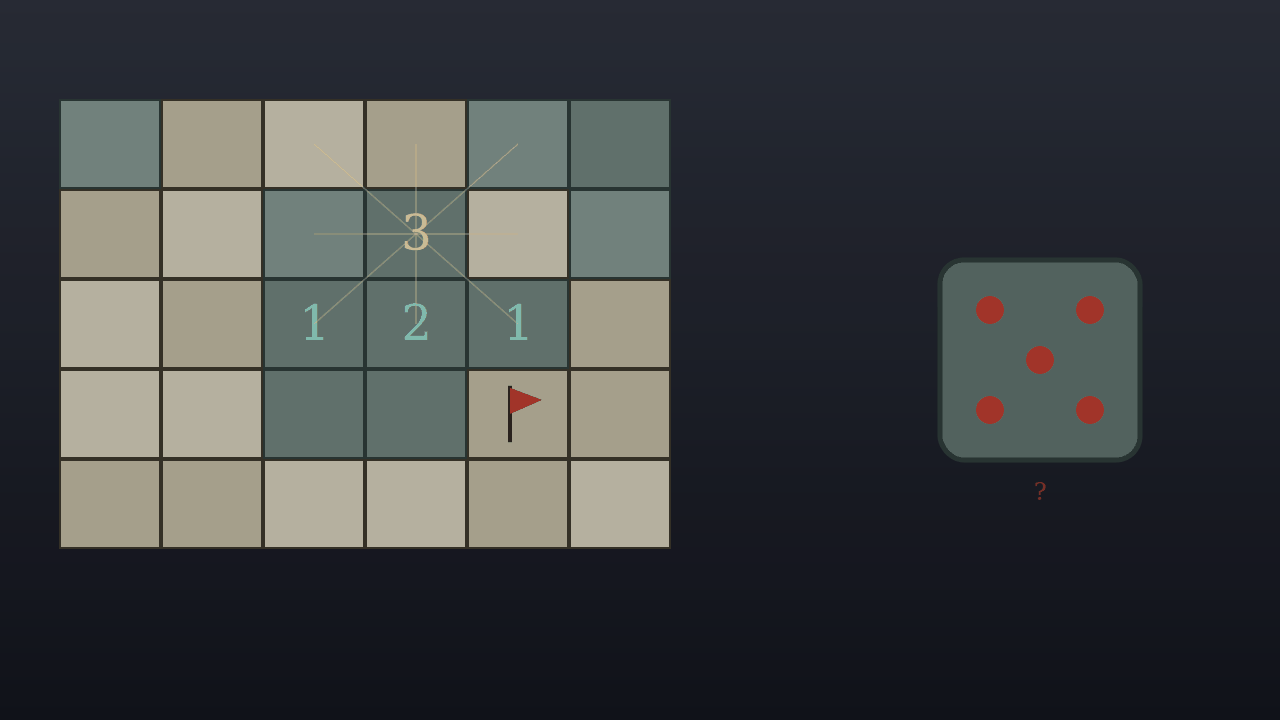 Numbers call for logic, blank cells call for a bet — a board caught between deduction and probability (illustration, AI-generated)
Lineage to the Present
The story of its ubiquity carries bitter episodes alongside the bright ones. In 1999, a satirical protest calling for the game's mine-themed name to be changed — informally dubbed the 'International Campaign to Ban Winmine' — drew attention, and around Windows Vista (2006), an Oberon Media overhaul added a 'Flower Garden' mode that swapped mines for flowers to pick. Then in 2012, with the move to Windows 8, Microsoft dropped Minesweeper from the standard install and shifted distribution to a free, ad-supported Store app developed by Arkadium. A small game that had been part of the operating system itself for over two decades was, for the first time, treated as a standalone app.
A direct response to this deduction-plus-probability design later appeared in explicit form. In 2017, Grip Top Games released Tametsi, whose own official description states that its gameplay 'will be familiar to anyone who has played Minesweeper,' while adding: 'unlike classic Minesweeper, the levels are designed so that they can always be solved using deduction alone.' In other words, Tametsi is a deliberate successor that strips out the very trait Minesweeper carried for nearly half a century — the moment where deduction runs dry and you have to gamble — and rebuilds the form as a pure logic puzzle. It is a rare case where this lineage can be confirmed in the developer's own words.
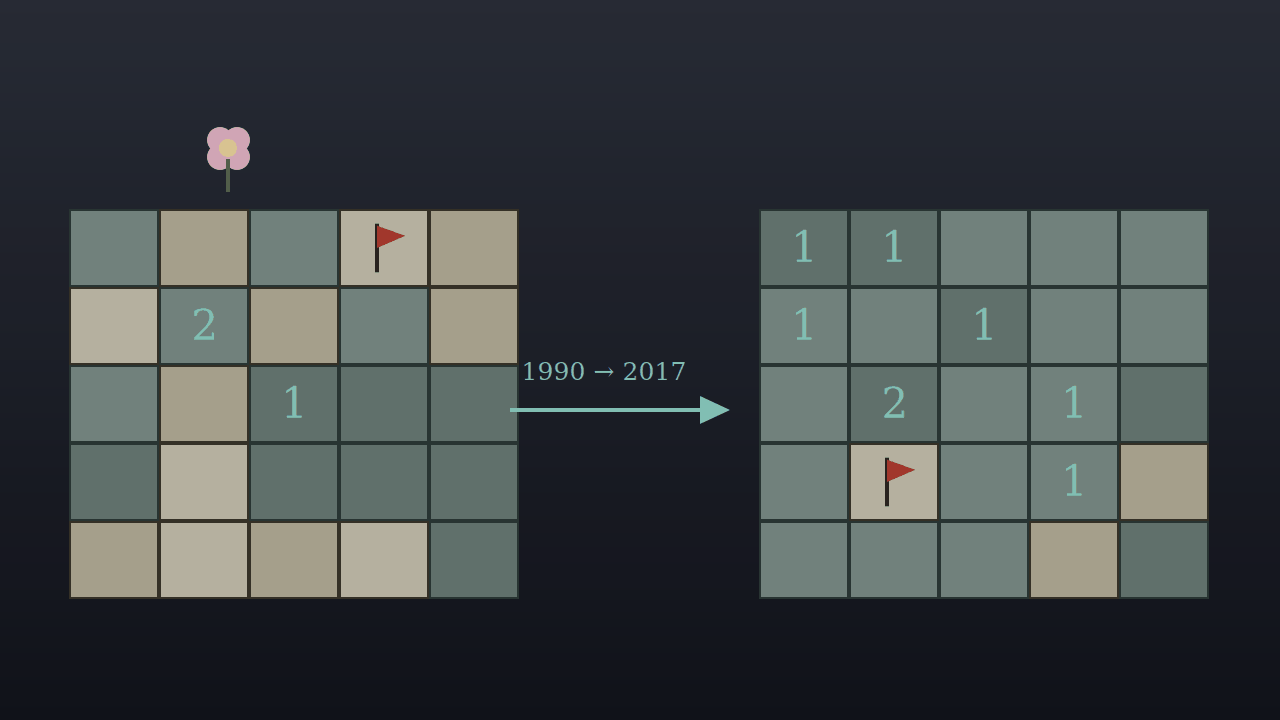 From a board mixed with probability to one with the gamble removed — a lineage across 27 years (illustration, AI-generated)
References
Sources referenced in this article:
・Wikipedia: Minesweeper (video game)
・Wikipedia: Microsoft Minesweeper
・minesweepergame.com: Curt Johnson
Closing
What Minesweeper demonstrates, historically, is that good puzzle design does not necessarily arise from a good puzzle designer's intent. A lone British programmer in 1983, a Microsoft employee's practice project in 1989, a decision to swap out one built-in app for another in 1992 — none of these aimed to teach deduction to the world. Yet through their accumulation, a board built from only two symbols, number and flag, ended up teaching hundreds of millions of people who had never heard the phrase 'puzzle game' what it feels like to derive a safe move from adjacent information. That successors like Tametsi still cite this game as their starting point, even while stripping out its probability, is a sign that today's puzzle makers remain aware of the weight of that almost accidental spread.
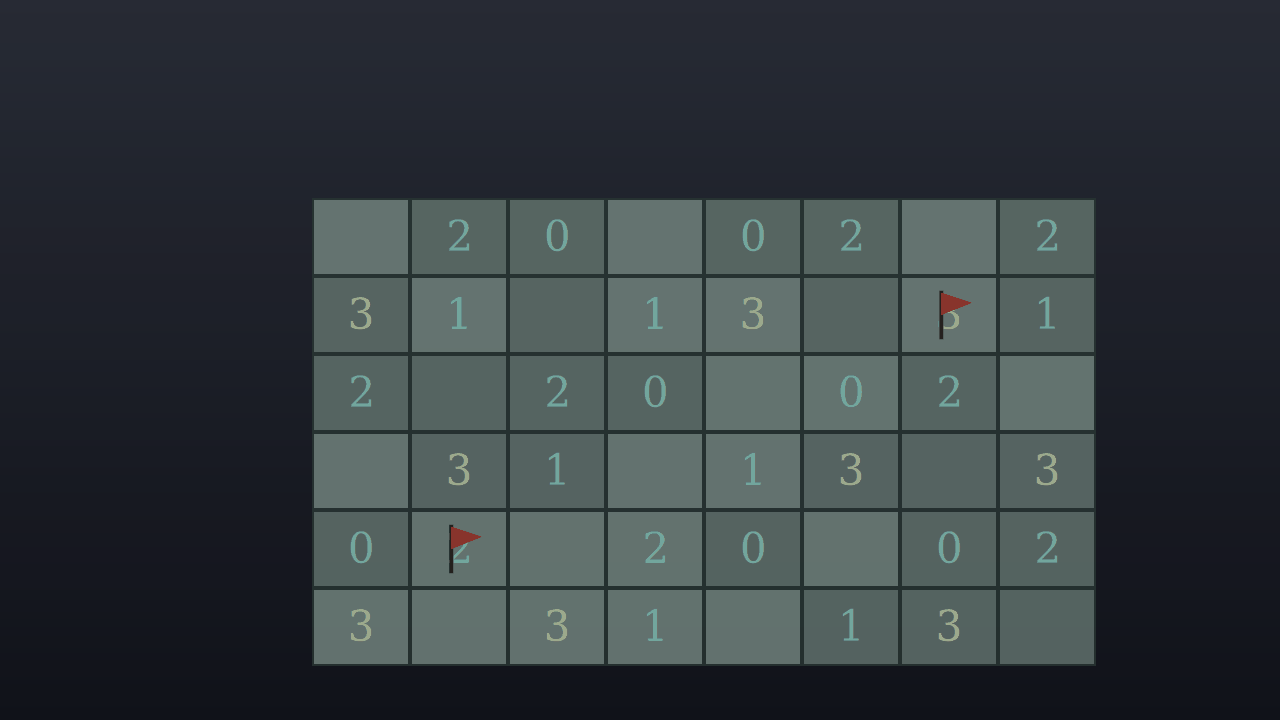 A board fully opened, only its flags remaining — a quiet close (illustration, AI-generated)
Reactions (no login)
Anonymous • one of each per visitor per day
Learn — Curriculum
LearnPart 2 Lineage — Where Puzzles Came FromChapter 4 Pencil Puzzles and Nikoli6 / 12
Part of these series
Puzzle Incident HistoryEpisode 23 of 48
