HISTORY · 2026-07-23
Slitherlink (1989) — Loop-Closing Logic Born From a Two-Player Paper Game
The rule Nikoli bet on as "the son of Sudoku": a discovery made of lines never drawn
Introduction
In June 1989, barely half a year after Japan's imperial era name changed from Showa to Heisei, a puzzle magazine introduced a new problem format. It appeared in Puzzle Communication Nikoli issue #26, the "Summer 1989" edition. The rule: connect dots with horizontal or vertical line segments so that the whole grid forms exactly one closed loop, while numbers indicate only how many of a cell's four edges belong to that loop — never the path itself. This family of puzzles would come to be called Slitherlink.
At the heart of solving it sits a small paradox: the grid fills faster once you stop asking where a line can go and start proving where a line absolutely cannot go. A 0 is the strongest foothold, since it forbids all four surrounding edges outright, and that certainty propagates outward to neighboring cells. Stacking up proofs of absence until a single loop is all that remains was, in 1989, a genuinely new kind of solving pleasure.
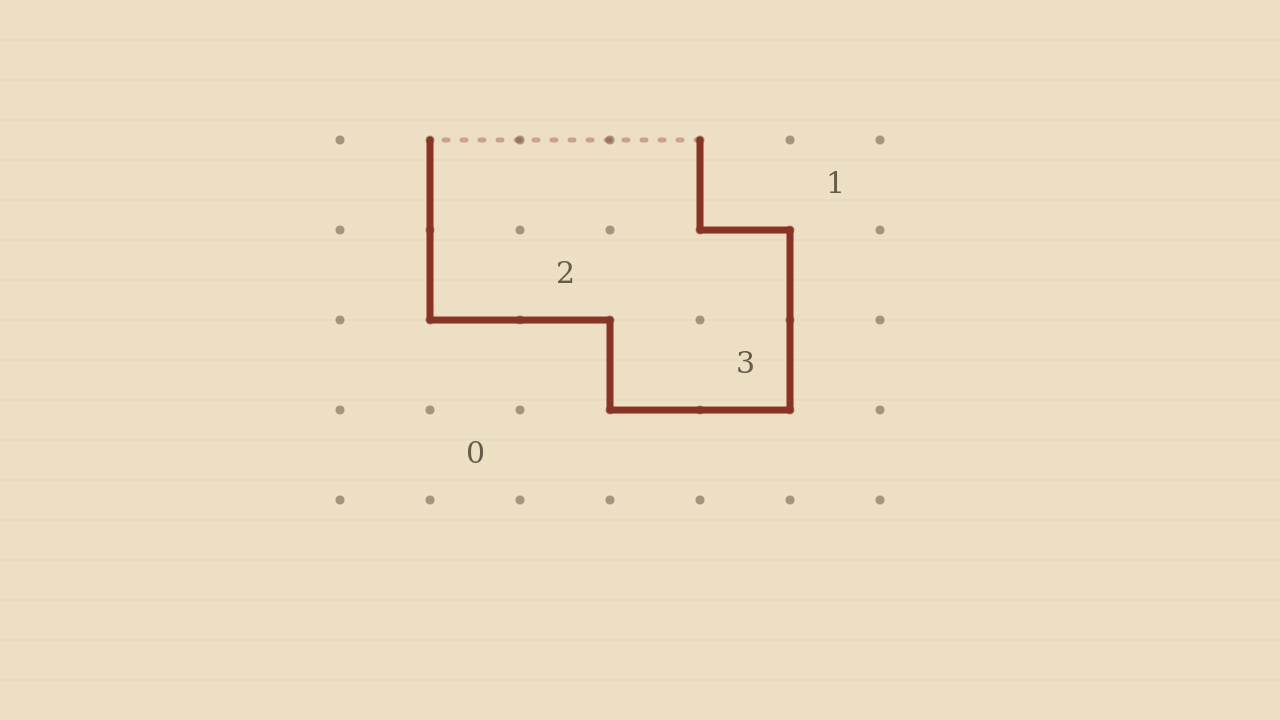 A loop just before it closes (illustration, AI-generated)
The Era
Nikoli in the 1980s was still a fanzine-like magazine experimenting with a cycle in which readers submitted puzzles, the editorial staff refined them, and readers solved them again. It had run "Number Place," the puzzle that would become Sudoku, only since 1984 — a mere five years earlier. The loop-drawing format grew out of that same soil of homegrown experimentation. Slitherlink in fact had a direct ancestor: a two-player paper game called Slither, in which players alternately drew line segments and whoever first closed a loop or created a branch lost. The standard account holds that Nikoli's editorial staff adapted that game's rule into a single-player pencil puzzle; the earliest versions filled every cell with a number and didn't even require the lines to form a single loop.
Puzzles of that era spread only by paper, pencil, and the postal system. There was no internet yet, and introductions abroad depended on imported magazines and private correspondence between puzzle authors. Because the name "Slitherlink" (and its Japanese form) later became a registered trademark of Nikoli, foreign publishers couldn't reuse it, and the puzzle splintered into regional names like dialects: Fences in the UK, Loop the Loop or Loopy in the US, Rundweg in German-speaking markets. A single loop born in 1989 crossed borders slowly, carried by nothing but printed magazines.
Domestically, dedicated hardware adaptations came fairly early. On April 20, 2000, Bandai released Slither Link for the WonderSwan handheld, bundling ninety puzzles supplied by Nikoli. Even the packaging and title screen echoed the design of Nikoli's own pencil-puzzle books, down to appearances by characters associated with the magazine — a conspicuously faithful adaptation. A handheld's small screen was, at the time, one of the few digital spaces that could reproduce a paper grid almost without alteration.
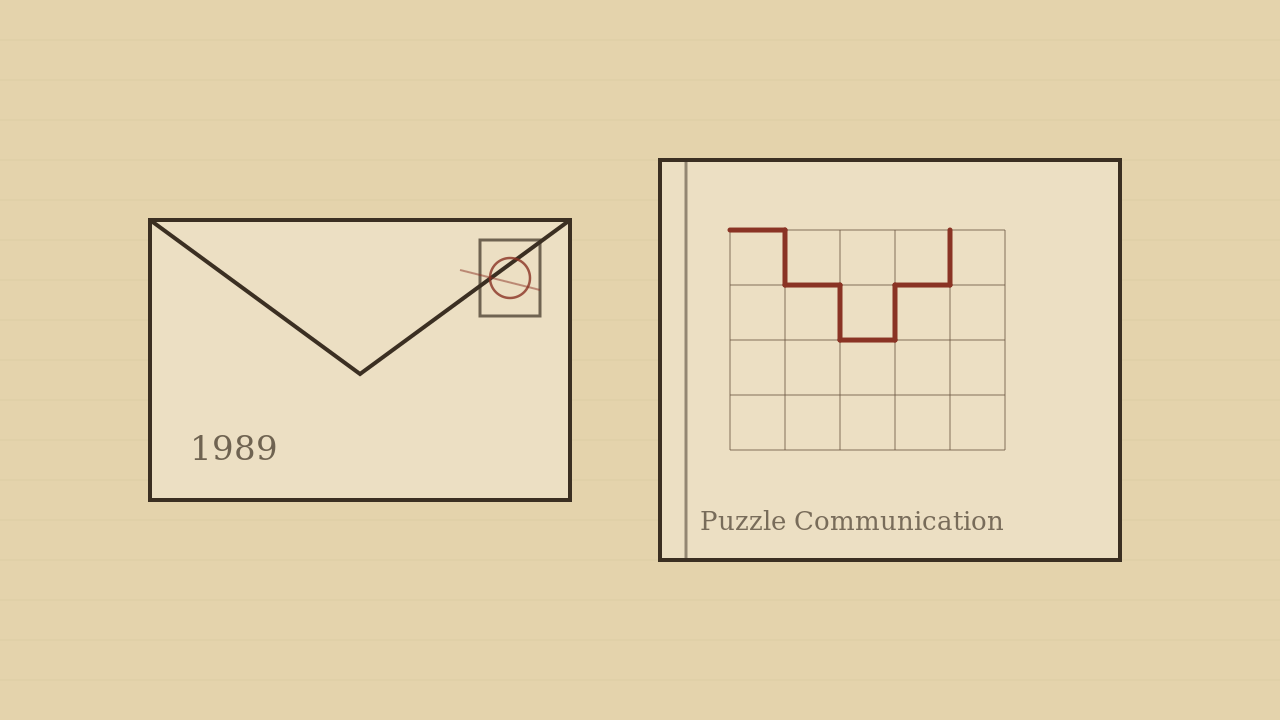 The paper-and-post puzzle culture of 1989 (illustration, AI-generated)
Mechanics
As noted above, the key to solving lies not in finding where a line can go but in proving where one absolutely cannot. A 0 is the strongest foothold, ruling out all four surrounding edges at once, and that certainty propagates to neighboring cells. Certain number combinations yield fixed patterns solvers call "theorems" — for instance, two adjacent 3s always force exactly three lines through the space between them. Experienced solvers memorize these theorems and leap across the grid rather than reasoning cell by cell.
This process of cornering a loop by elimination later became a textbook example in computational complexity theory. In 2000, Takayuki Yato showed that the Another Solution Problem for Slitherlink is NP-complete, and in a 2003 paper co-authored with Takahiro Seta, extended the same technique to Cross Sum (Kakuro) and Number Place (Sudoku). From that point on, a puzzle that had been played with paper and pencil for nearly forty years began being cited as teaching material in complexity theory.
The grid's shape eventually outgrew the plain square lattice as well. Variants appeared on Penrose tilings, honeycomb grids, and snowflake-like patterns, all while keeping the single rule of closing exactly one loop — turning the shape of the board itself into a variable. The rule fits in a single sentence, yet changing only the grid's geometry is enough to produce an entirely different puzzle in difficulty and strategy; that was this game's underlying strength.
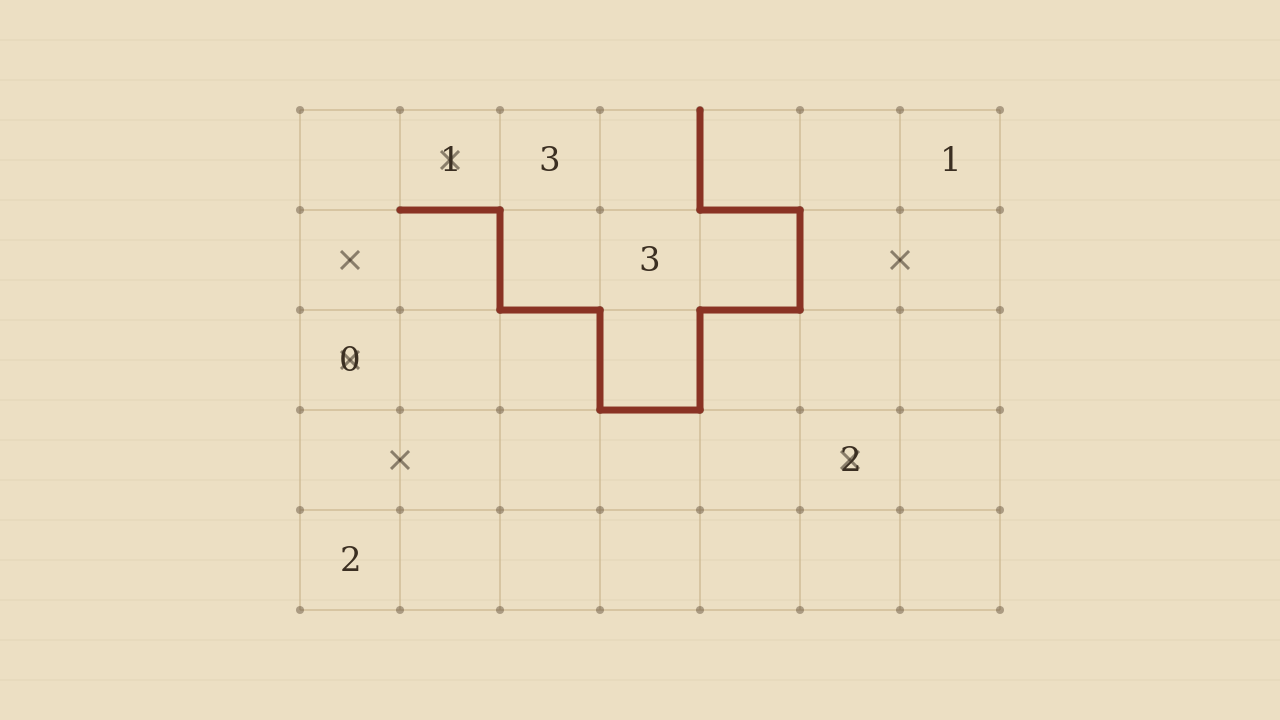 A board where confirmed lines and confirmed gaps interlock (illustration, AI-generated)
Lineage to the Present
Slitherlink's international spread rode on the coattails of Sudoku's global success. In 2007, Nikoli's founder Maki Kaji — introduced by the BBC as "the father of Sudoku" — named Slitherlink as puzzling's next big thing, suggesting it could become "the son of Sudoku." By his own account, its rules were as simple and approachable as Sudoku's. In the end it never matched Sudoku's worldwide mania, but it remains the puzzle publishers reach for first whenever they go looking for "the next Sudoku."
Its digital ports went beyond simple transcription. Simon Tatham's Portable Puzzle Collection, whose distribution began in 2004, includes Slitherlink under the name "Loopy" and has kept giving it away free for over twenty years, from Unix and Windows builds to a browser-based JavaScript version (I've traced this collection's own history in a separate piece). And today, in the 2020s, Steam's storefront carries titles like Slither Link Plus, selling this 1989-born rule directly as a standalone digital product.
Domestic console and handheld releases never really stopped, either. Hudson released Slitherlink as the fifth entry in its Nintendo DS "Puzzle Series" in November 2006; Agetec's Nikoli-supervised Brain Buster Puzzle Pak brought it to North America in June 2007; and Hamster reissued it again as the third entry in its "Nikoli's Puzzle S" line for Nintendo Switch in 2022. The grid's shape, the machines it runs on, and the channels that distribute it have all changed completely — keeping only the single rule of closing one loop intact. That this one rule has survived for nearly thirty-eight years, largely unchanged, is, I think, what this puzzle actually invented.
 A loop's lineage branching from paper to screen (illustration, AI-generated)
Sources
Sources consulted for this article:
・Wikipedia (Japanese): Slitherlink
・Nikoli official site: How to play Slitherlink
・Engadget: Father of Sudoku says Slitherlink is the next big thing (June 14, 2007)
・Yato, Takayuki: On the NP-completeness of the Slither Link Puzzle (2000)
Closing
Writing this, what stays with me is that Slitherlink isn't "the puzzle that failed to become Sudoku" — it's the puzzle that has quietly lived alongside Sudoku for nearly thirty-eight years. Measured only by the yardstick of a global mania, it may look unremarkable. But born from a two-player paper game, later turned into teaching material for NP-completeness proofs, and still sold today as a standalone digital product on Steam's shelves — that sheer duration of survival is itself proof of this board's strength.
A loop always has to close somewhere. But which path it takes still gets decided anew every time you solve one, even thirty-eight years later. Born just months after the start of the Heisei era in 1989, this simple rule will keep asking the same question no matter how many times its grid changes shape.
 A loop left quietly closed after the solve (illustration, AI-generated)
Reactions (no login)
Anonymous • one of each per visitor per day
Learn — Curriculum
LearnPart 2 Lineage — Where Puzzles Came FromChapter 4 Pencil Puzzles and Nikoli5 / 12
Part of these series
Puzzle Incident HistoryEpisode 13 of 40