HISTORY · 2026-07-02
Nikoli (1980) — The Reader-Grown Puzzle Magazine, and the Road Sudoku Took Around the World
How Japan's first puzzle magazine invented a mode of production built on submissions and handcraft
Introduction — A Magazine Named After a Racehorse
In 1980, a quarterly magazine was launched in Tokyo: Puzzle Communication Nikoli, Japan's first magazine devoted entirely to puzzles. Its founders were Maki Kaji and friends from his childhood, and the name was borrowed from the racehorse Nikoli, winner of that year's Irish 2,000 Guineas. A breezy piece of naming, fitting for a founder who loved the racetrack. Yet this breezy magazine would remain the wellspring of world puzzle culture for more than forty years.
I have traced the manias of paper puzzles before—the 15 Puzzle (1880), the crossword (1913). Nikoli stands in that lineage, but it brought something decisively new: a cycle in which readers invent puzzles, the magazine refines them, and readers solve them again. Slitherlink, Nurikabe, and Masyu were all born on its pages. Sudoku conquered the world because this soil existed first.
This essay digs into Nikoli, the 'laboratory of puzzles,' along two axes: how Sudoku went global, and how the grammar of pencil puzzles was codified—down to how a 1980 launch connects to today's digital logic puzzles.
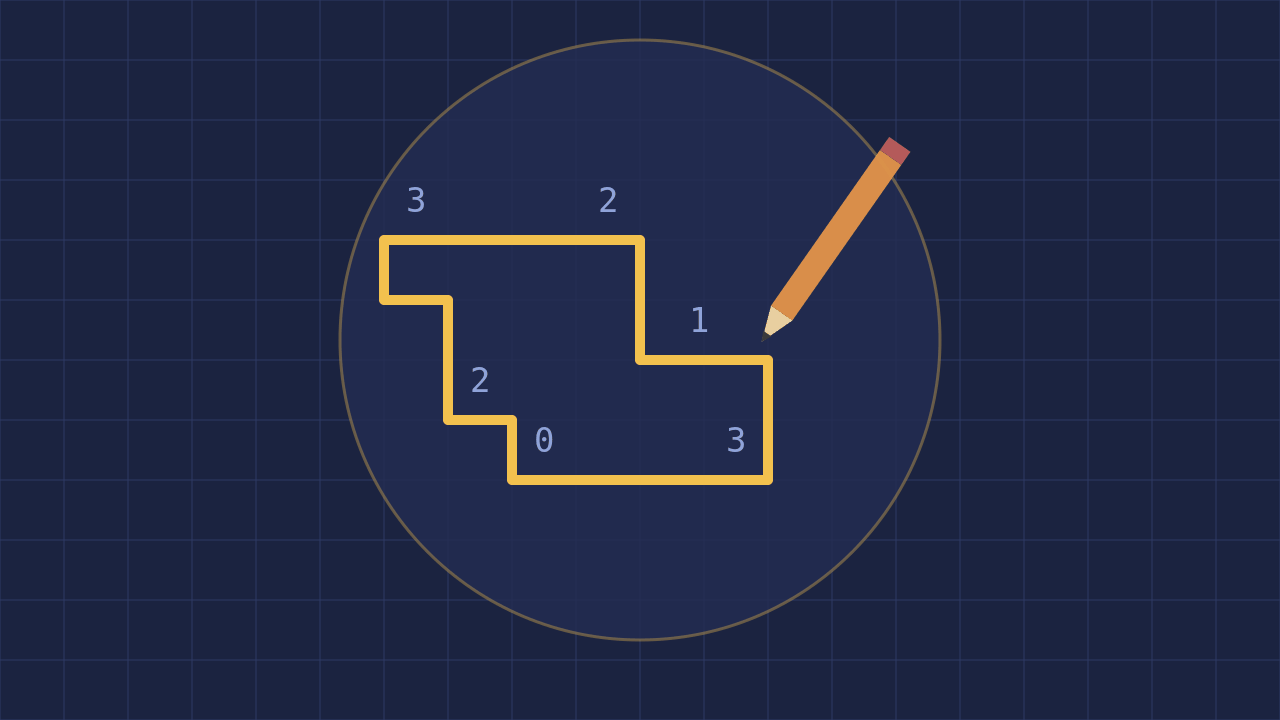 A single line running across graph paper—the wellspring of paper puzzles (illustration, AI-generated)
The Context — America in 1979, Tokyo in 1980
In the Japan of 1980 there was no magazine devoted to puzzles alone; a crossword in the corner of a newspaper or weekly was about all one could find. Maki Kaji, who had dropped out of university and drifted between jobs, founded the quarterly with two friends. Nikoli was incorporated as a company in 1983. The early issues were handmade in the most literal sense, and the print runs are said to have been modest.
The turning point came from across the ocean. In May 1979, Dell Pencil Puzzles & Word Games published 'Number Place,' devised by Howard Garns, a retired architect from Indiana. Nikoli brought this 9-by-9 puzzle—place 1 through 9 without repetition—to its Japanese pages in 1984, under the name Suji wa dokushin ni kagiru ('the digits must be single'). Kaji shortened it to Sudoku.
Sudoku, in other words, is not a Japanese invention. Nikoli adopted an American-born puzzle, gave it a name, and raised it. The aesthetics of symmetrical givens, the tuning of difficulty, the paring down of clues—these 'manners' were added during that upbringing. The adoptive culture remade the puzzle itself.
 1980: a quarterly born in a corner of the bookshop, and letters from readers (illustration, AI-generated)
Mechanics — Production by Submission, and the Handmade Creed
Nikoli's mode of production is singular. Most of the puzzles on its pages begin as reader submissions. A draft of a new rule appears in the readers' corner, other readers send in refinements and problems, and only what survives this forging is promoted to a series of its own. Slitherlink emerged from this process in issue 26, June 1989; Nurikabe began in 1991 with a submission from a reader writing under the pen name 'Lenin'; Masyu appeared in issue 90 in 2000, originally titled 'White Pearls and Black Pearls.'
The other pillar is an insistence on the handmade. Nikoli's puzzles are still composed one by one, by humans. The refusal of computer generation rests on a creed: the dialogue with the solver—easy deductions early to teach the grammar, a trap in the middle, a clearing view at the end—can only be designed by an author's intent. The grid itself is the tutorial, and the story.
Ironically, what carried Sudoku to the world was the opposite method. In 1997 Wayne Gould, a judge in Hong Kong, encountered Sudoku in a Tokyo bookshop and spent six years writing a program that generated puzzles automatically. On November 12, 2004, The Times of London ran his 'Su Doku,' and the global craze began. The handmade aesthetic versus generated mass production—that axis of tension is precisely the axis of modern puzzle design.
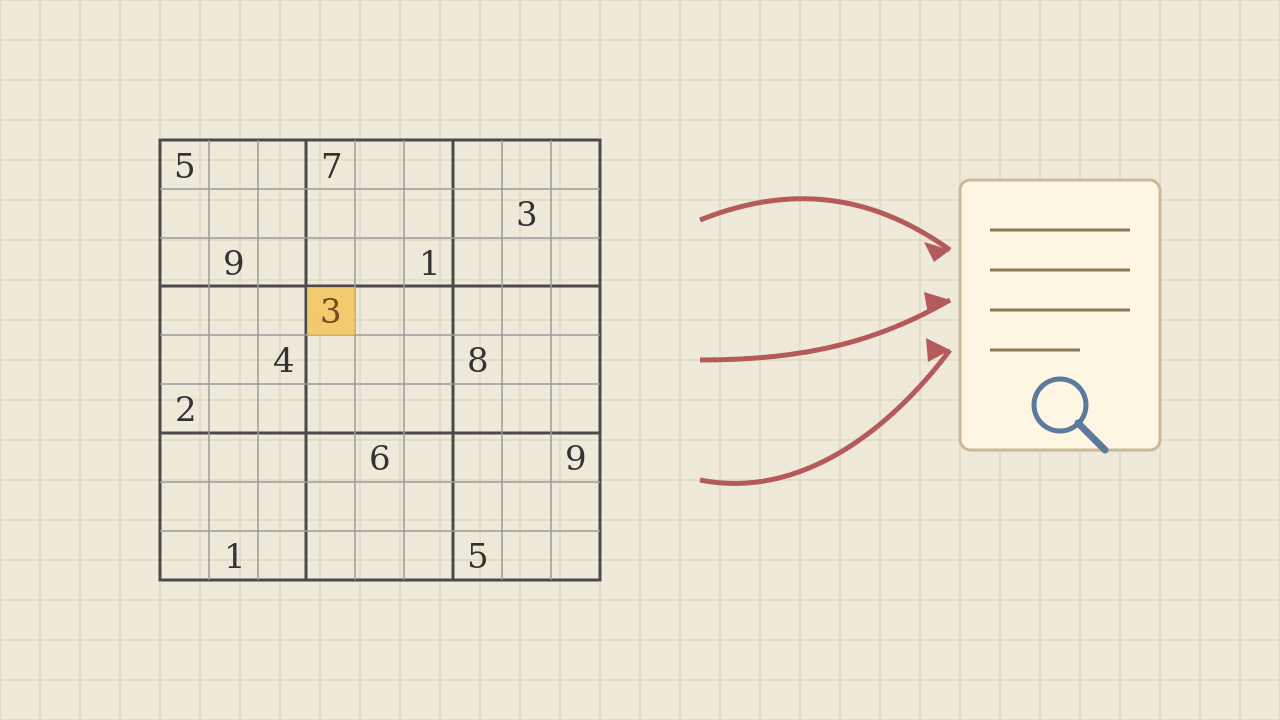 Submissions refined, cells resolved one deduction at a time (illustration, AI-generated)
The Lineage to Today — From Graph Paper to the Screen
The grammar of the pencil puzzle—hand the solver nothing but a grid and constraints, and let a chain of logic lead to a unique solution—runs deep in digital thinking games. Simon Tatham's puzzle collection ports Nikoli-style rules directly, and Nintendo carried pencil puzzles onto game hardware with Picross (1995), a path this site has already traced. The taciturn design in which the numbers on the board are the only statement of the rules anticipates the wordless ideal of today's indie puzzlers.
The handmade-versus-generated axis has been inherited too: Tametsi and Stephen's Sausage Roll as collections of problems placed one by one by hand, against the daily auto-generated puzzle apps. The two roads that Nikoli and Gould marked out between 1997 and 2004 still run in parallel, in altered forms. I will not casually assert causation; but it is certain that both sides face each other across the same question—who should make a good problem?
Maki Kaji died of bile duct cancer on August 10, 2021, at sixty-nine. The man called the 'Godfather of Sudoku' is said to have missed a fortune by not securing the Sudoku trademark abroad early on—yet by all accounts he took pride in the simple fact that the puzzle had spread. And so the name of a 1980 racehorse remains on pages and screens around the world.
 From graph paper to the screen—the grammar of constraints and unique solutions (illustration, AI-generated)
Sources
Sources consulted for this article:
・Wikipedia: Nikoli (publisher)
・Atlas Obscura: Inside Japan's Cult-Favorite Puzzle Laboratory
・Nippon.com: Remembering Kaji Maki, the "Father of Sudoku"
・NPR: Sudoku Creator Maki Kaji, Who Spread The Joy Of Puzzles, Has Died
Closing — Puzzles as Cultivated Plants
What Nikoli demonstrated is that a puzzle is not the invention of a solitary genius but a cultivated plant, selectively bred within a community. Slitherlink in 1989 and Nurikabe in 1991 both began as drafts from unnamed readers and were cross-bred over generations in the field of the magazine's pages into their present forms. Inventing a rule and composing problems are separate crafts, and it is the latter that demands a community—this is the insight Nikoli's four decades left to history.
Consider that the most admired thinking puzzles on Steam today are, almost without exception, collections of hand-placed problems, and a quarterly founded in a corner of Tokyo in 1980 turns out to be a textbook still in service. The quiet cycle on the graph paper continues today.
 A finished grid, and a pencil laid down (illustration, AI-generated)
Reactions (no login)
Anonymous • one of each per visitor per day
Learn — Curriculum
LearnPart 2 Lineage — Where Puzzles Came FromChapter 4 Pencil Puzzles and Nikoli4 / 12
Part of these series
Puzzle Incident HistoryEpisode 6 of 43