TAG
#history
0 reviews · 74 essays
Related essays
Nine Linked Rings (Baguenaudier) (1872) — The Year an Origin-Unknown Ring Puzzle Turned Out to Use Binary Math 81 Years Before a Telegraph Engineer Patented the Same Idea
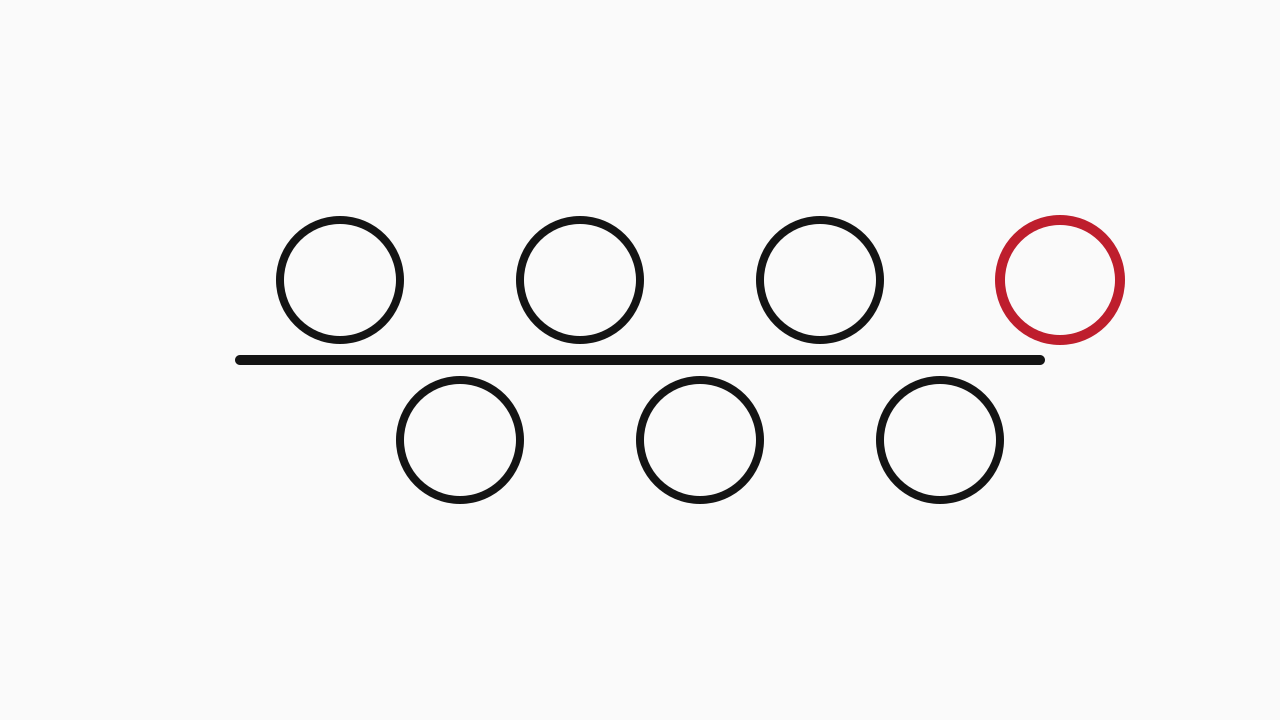
Nine Linked Rings, or Baguenaudier: remove rings from a bar one at a time until the last one slides free. Its origin is said to be China, but nothing is settled; the earliest confirmed records are a 16th-century Chinese text and, around the same time, the writings of Italian mathematician Luca Pacioli. In 1872, Lyon mathematics enthusiast Louis Gros became the first to theorize the puzzle's solution as a binary table. The same idea was independently reinvented 81 years later, in 1953, when telegraph engineer Frank Gray patented what communications engineers now call the "Gray code." As a physical puzzle, a 1970 patent by William Keister became "Spin-Out," an early product of Binary Arts (founded 1985, now ThinkFun), still sold today. This piece follows the 150-year lineage of a single ring mechanism.
The Seven Bridges of Königsberg (1736) — The Year Euler Erased the Map to Solve a Sunday Puzzle
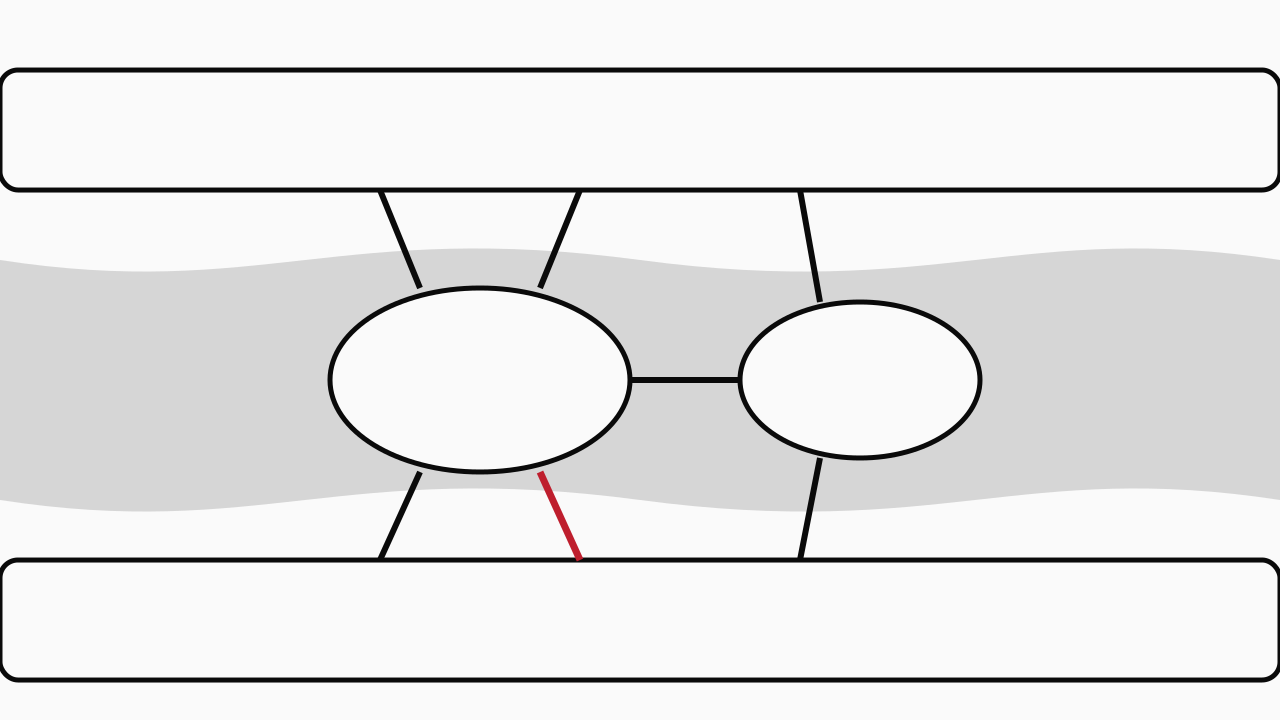
The answer is simple. In 1736, the mathematician Leonhard Euler proved that no walk existed that crossed all seven bridges of the Prussian town of Königsberg exactly once and returned to its start. The town's four landmasses were connected by 5, 3, 3, and 3 bridges respectively — all odd numbers. His paper, "Solutio problematis ad geometriam situs pertinentis," was presented on August 26, 1735, and published in 1741. By reducing landmasses to points and bridges to lines, Euler founded what became graph theory — the same logic taught in schools today as the rule for "one-stroke" drawing puzzles. This article traces how that 290-year-old proof still shapes the design of today's routing puzzle games, from Cosmic Express to Lyne to Mini Metro.
Peg Solitaire (1697) — The Day a Game With No Inventor Became the Math of Proving "Unsolvable"
On a cross-shaped board of pegs, you jump one peg over its neighbor and remove it, again and again, hoping to end with a single peg left. The earliest record of Peg Solitaire appears in 1697, in the French court periodical Mercure Galant under Louis XIV. No inventor is known. The popular legend that a prisoner in the Bastille devised it traces back no further than an English book from 1801, and puzzle historian John Beasley calls it unsupported by any earlier French source. In 1912 Ernest Bergholt found an 18-move solution to the classic problem; in 1982 Winning Ways for Your Mathematical Plays introduced the "pagoda function," a tool for proving certain positions mathematically unreachable. In 2007 the board resurfaced as puzzles inside Professor Layton and the Diabolical Box. This piece traces a single ruleset that has been played for over three centuries without ever needing a named inventor.
Hitori (1990) — Why a Puzzle Too Hard to Catch On for 8 Years Is Still an AI Test Case in 2025
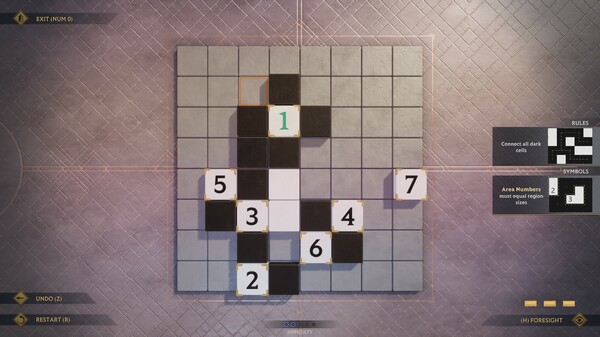
Hitori — first published as a reader submission in Puzzle Communication Nikoli issue #29 in March 1990 — is a logic puzzle built from just three rules: no duplicate numbers, no adjacent black cells, and no disconnection. It was too hard to catch on at first, taking eight years to find its footing. Yet it was ported to the Nintendo DS in 2007, proven NP-complete by Robert Hearn and Erik Demaine in 2009, and in 2025 became the subject of an AI research paper on explaining puzzle solutions. This traces how far three reader-submitted rules have carried across 35 years.
Mastermind (1970) — A Telecoms Engineer's Four Colors, Later Reborn as Fallout's Hacking Screen
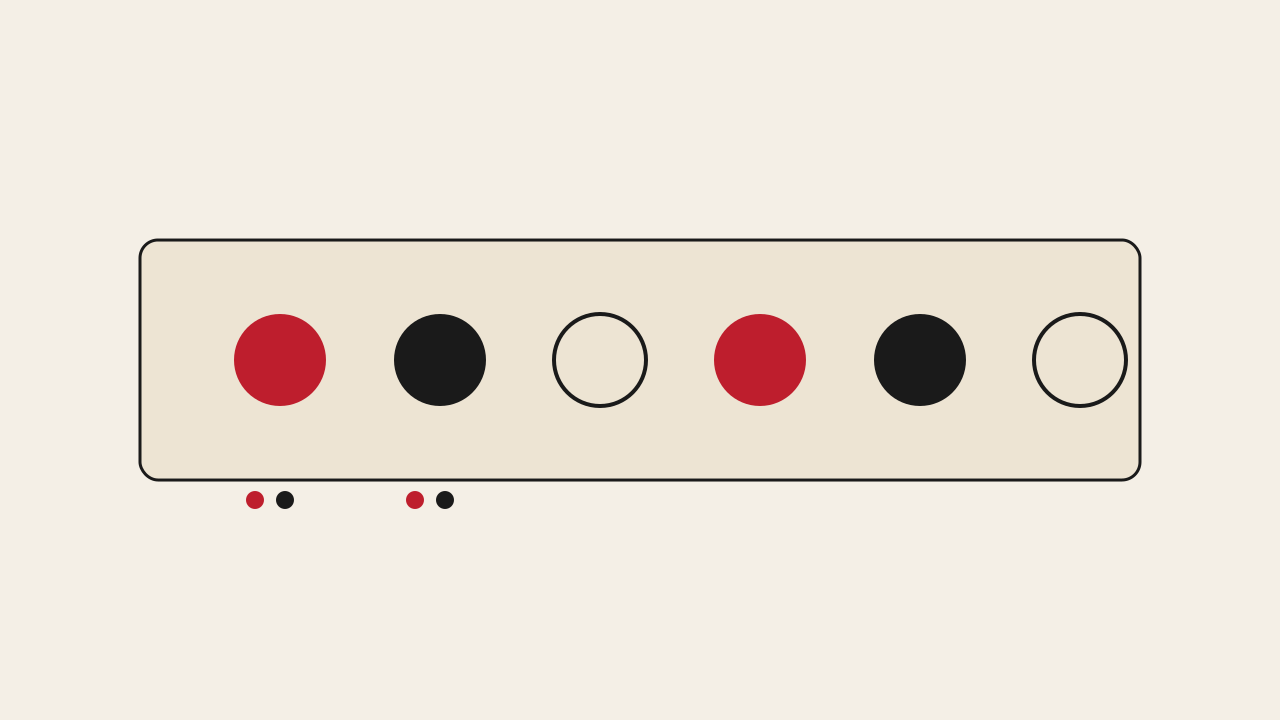
In 1970, Israeli telecommunications engineer Mordecai Meirowitz devised Mastermind, a game that reveals only a count of hits and near-misses from four hidden color pegs. Rejected by major toy companies, it was released by Invicta Plastics in 1971 and sold over 30 million sets within the decade. In 1976 Donald Knuth showed it could be solved in five moves or fewer, and in 2007 a Bethesda programmer built it directly into Fallout 3's hacking minigame. This piece traces how a half-century-old constraint — telling the player only a number, never the answer — still shapes puzzle design in the age of Wordle.
The Decagon House Murders (1987) — The Debut That Answered Knox's Decalogue
In 1987, Yukito Ayatsuji's debut novel The Decagon House Murders trapped university students - each bearing the name of a Golden Age Western mystery writer - inside a ten-sided mansion on a deserted island, igniting Japan's "Shin Honkaku" (new-orthodox) mystery movement. Behind it lies a rulebook for fair play with the reader: S. S. Van Dine's 1928 Twenty Rules and Ronald Knox's 1929 Decalogue. That same rulebook is still cited today, down to Ryukishi07's Umineko no Naku Koro ni, a mystery game sold on Steam.
SameGame (1985) — The Grammar of Clearing Same-Colored Clusters, Born From a Reader Submission
In 1985, a program called Chain Shot!, submitted to the Japanese magazine Monthly ASCII, wrote the rule of clearing adjacent same-colored blocks in one tap. Over the next forty years the rule kept changing its name — SameGame, Clickomania!, Jawbreaker — while becoming the subject of a solving algorithm in 2012 and an AI-reasoning benchmark in 2024. Its author's name has nearly been forgotten, but the rule itself lives on.
Himitsu-bako (1894) — The Souvenir That Never Explains How to Open It
In 1894, in a hot-spring town in Hakone, a wooden box took its familiar form. Under its geometric marquetry sat a mechanism that only opened through a fixed sequence of moves — with no instructions attached. This piece traces the same design grammar found in today's escape rooms back to a single 132-year-old box.
Pigs in Clover (1889) — A Tilting Wooden Box That Stalled the U.S. Senate for a Season
In 1889, a single wooden box brought the United States to a standstill. Under a sheet of glass, four tiny marble "pigs" sat in a spiral maze; the only tool was gravity, tilting the board to herd all four into the center pen. Senators and newspapermen alike stopped mid-sentence for it. The inventor was Charles Martin Crandall, who patented it on September 10, 1889. Two years later, puzzle writer Sam Loyd claimed he'd invented it himself, and for decades the record blurred. A craze that got itself mocked in a White House political cartoon deserves, I think, to be read again as one of the first mobile games.
Lode Runner (1983) — The Allowance He Paid the Neighborhood Kids
In 1983, Douglas E. Smith shipped Lode Runner with an 'edit mode' he added because he couldn't design 150 levels alone. That mode gave Japan Bomberman, and its 'turn players into designers' idea still echoes in Portal 2's Puzzle Maker.
Eggerland (1985) — The Original One-Room Puzzle Where You Push Your Enemies as Eggs
In 1985, a modest puzzle game appeared for the MSX home computer: Eggerland Mystery. Shoot an enemy to turn it into a pushable egg, then collect hearts to open the treasure box — a design built from just a handful of verbs, contained entirely within one room. HAL Laboratory refined that grammar across a run of Famicom Disk System titles, and in 1989 it crossed the ocean as Adventures of Lolo. Sitting in the producer's chair for those two years was a young Satoru Iwata, years before he became Nintendo's president.
Puzzle Boy / Kwirk (1989) — The Day Atlus Walked a Potato Under Its Own Name
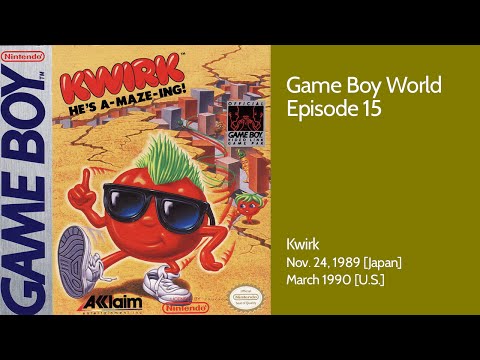
On November 24, 1989, Atlus released Puzzle Boy for the Game Boy, sold overseas as Kwirk. For a studio that had spent years working as an uncredited contractor for other publishers, this was the first game to carry its own name. A maze puzzle built from just three verbs — turn, push, fill — it quietly draws a line all the way to Catherine, the block-stacking puzzle the same company released in an entirely different form 22 years later.
Torneko's Great Adventure: Mystery Dungeon (1993) — A Dragon Quest Shopkeeper Wears Rogue's Cruelty
On September 19, 1993, Chunsoft released Torneko's Great Adventure: Mystery Dungeon for the Super Famicom, smuggling the punishing design of 1980's Rogue into Japanese living rooms wearing the face of a beloved Dragon Quest shopkeeper. The Mystery Dungeon lineage it launched is still running today — as of December 2024, playable on Steam in Shiren the Wanderer: The Mystery Dungeon of Serpentcoil Island.
Sleep Is Death (2010) — The Move That Swapped the AI Opponent for a Human One
In 2010, Passage creator Jason Rohrer released Sleep Is Death, a two-player tool with no script and no AI — just a living person on the other side of the screen. That idea carried through MoMA's 2011 Talk to Me exhibition and into his own 2018 game, One Hour One Life.
Columns (1990) — When a Hewlett-Packard Engineer's Practice Code Became Jewels in Sega's Hands
In 1990, Sega released Columns, a falling-block puzzle sharing Tetris's silhouette but a completely different clearing grammar. It wasn't made by a game studio — it was written by a Hewlett-Packard engineer as practice code, which reached home consoles worldwide after six months of licensing talks.
Shanghai (1986) — The Rules a Hospital PLATO Terminal Wrote
In 1986, Activision released Shanghai, a simple puzzle of clearing mahjong tiles two at a time. But its roots trace to 1981, when a paralyzed student coded it on a hospital PLATO terminal. A historian's look at the 45-year lineage that followed.
Book of Lenses (2008) — A Hundred Ways to Look at a Game
Published in 2008, The Art of Game Design: A Book of Lenses introduced 100 questions for looking at a game. A historian's look at where that idea came from, and how it still reaches today's puzzle designers.
Sokobond (2013) — A Rule Made Only of Bond Counts, Thirty-One Years After the Warehouse
On August 27, 2013, Alan Hazelden and Harry Lee released a small puzzle game called Sokobond. Its skeleton is 1982's Sokoban, unchanged, with exactly one constraint added: each element has a fixed number of bonds it can form. That modest mutation — an IndieCade 2013 finalist, an IGF Excellence in Audio honorable mention — turned Hazelden into a full-time puzzle designer. This piece traces how the push-rule carried through to A Monster's Expedition (2020), a decade later.
The MDA Framework (2004) — Three Words Puzzle Designers Still Use
In 2004, a few-page paper presented at an AAAI workshop reshaped the vocabulary of game design. Robin Hunicke, Marc LeBlanc, and Robert Zubek formalized Mechanics, Dynamics, Aesthetics. This piece follows those three words from Doug Church's unfinished 1999 homework, through a GDC workshop room, into the real project Oasis, and onto the shelf we now call Steam.
Sudoku (1979) — How a Nameless Invention Conquered the World's Morning Papers
In 1979, a puzzle called 'Number Place' appeared, uncredited, in an American magazine. This piece traces the 25 years it took to become Sudoku — refined by Japan's Nikoli, carried by a retired Hong Kong judge's homemade program, and finally landing in a London newspaper in 2004 — and the 'logic only, no guessing' design principle that still lives on in the 2024 Steam puzzle collection Islands of Insight.
The Art of Computer Game Design (1984) — The First Book That Tried to Define What a Game Is
In 1984, Chris Crawford — a game designer who had just been laid off by Atari — wrote a book: The Art of Computer Game Design. It was the world's first serious attempt to define a game itself, through four elements: representation, interaction, conflict, and safety. This essay traces the early-1980s context that produced the book, the small living-room gathering he started the following years that grew into today's GDC, and why his definition still fuels academic debate today.
Hakoiri Musume / Klotski (1930s) — The Lineage of Blocks That Trapped Cao Cao
In the West as a patent drawing, in China as a paper cutout re-enacting Cao Cao's defeat, and in Japan as a wooden toy called Hakoiri Musume — nearly the same sliding-block puzzle arose independently in three places between the 1890s and the 1930s, with no evidence any referenced the others. Martin Gardner published its 81-move optimal solution in Scientific American in 1964; Microsoft's Windows Entertainment Pack carried it to PCs worldwide in 1991. This is the record of that parallel evolution, up to 2021's Blockee on Steam, which names Klotski as its inspiration in its own words.
Hashiwokakero (1990) — Thirty-Six Years of Logic Grown from Numbers Joined by Lines
In 1990, Hashiwokakero debuted in Puzzle Communication Nikoli #31. Its rule — connect numbered islands with bridges until everything forms one network — grew out of an earlier prototype, "Ketsugoshu," that the same contributor "renin" had published in issue #28 the year before. In 2009 it was proven NP-complete; in 2004 it reached Simon Tatham's Portable Puzzle Collection ahead of any Steam release; and in 2023 Nikoli itself ported it to Switch, PC, and Xbox. This article verifies a 36-year lineage.
Minesweeper (1990) — The Logic Puzzle Microsoft Built Into a Billion PCs
On 8 October 1990, a small game shipped as one of seven titles in the Windows Entertainment Pack. From 1992's Windows 3.1 onward it came preinstalled on nearly every PC running Windows, and its lineage is said to trace back to Mined-Out, a 1983 ZX Spectrum game by British programmer Ian Andrew. This article follows the genealogy of a logic puzzle nobody set out to design as one — up to 2017's Tametsi, which stripped out the probability and returned the form to pure deduction.
A Dark Room (2013) — The Single Fire Lit in a Room Made Only of Words
On June 10, 2013, a browser game with no images and no sound was released: A Dark Room. All it showed was a line of text and a button. Built by Michael Townsend, this experiment arrived amid the same season that produced Candy Box! and Cookie Clicker, but set itself apart with a hidden narrative. Ported to iOS by a stranger, Amir Rajan, it rose in 2014 to the top of Apple's official paid games chart. This piece traces how a single hobby project, running on nothing but imagination, climbed to the top of the market.
Lara Croft GO (2015) — A Board Where Distilled Memory Still Moves
In 2015, Square Enix Montreal followed Hitman GO with a second Go-series title, Lara Croft GO. Its method was to distill only the idealized feeling of an old game, remembered rather than replayed, onto a board of nodes and lines — a method that swept critical honors even as the studio itself was shut down in 2022. Because the game shipped as offline, server-independent software, it outlived the company that made it. This piece traces that method, and where it ended up.
Chip's Challenge (1989) — The Maze That Outlived Its Handheld on Office Desks
In 1989, Epyx shipped Chip's Challenge, a top-down tile puzzle designed by Chuck Sommerville, as a launch title for the Atari Lynx handheld. The hardware lost its war and the developer collapsed, yet the game spread to office Windows PCs through the 1992 Microsoft Entertainment Pack, survived on fan-made level editors, outlasted a rights freeze that shelved its finished sequel, and finally returned to Steam on May 28, 2015. Few games argue so eloquently that a puzzle's true body is not a machine but a set of rules.
Skipping Stones to Lonely Homes (2015) — The Bridge of Thrown Stones That Reached a Cosmic Train
On 21 August 2015, British puzzle designer Alan Hazelden released Skipping Stones to Lonely Homes, a free browser game. In it you throw stones to build bridges and search a shipwreck for timber, all built in PuzzleScript. This small work, born outside Steam, is linked — in the designer's own words — through that year's prototype Train Braining and the 2017 commercial release Cosmic Express, all the way to Order of the Sinking Star, a major puzzle title announced for 2026. I trace this decade-long voyage.
Panel de Pon (1995) — The Name Was Taken Away Again and Again, But the Grammar of Play Survived
On October 27, 1995, Nintendo and Intelligent Systems released Panel de Pon for the Super Famicom: a competitive puzzle where a bracket cursor swaps two adjacent panels to line up three or more of the same color. It was produced by Gunpei Yokoi. The Western release, retitled Tetris Attack, replaced fairy protagonist Lip with Yoshi's art, erasing her from the West. Over the following three decades the design survived under Pokémon branding, the official Puzzle League line, and Nintendo first-party content — and in December 2025 a free Steam release called Panel Attack openly describes itself as being in the "Panel de Pon / Tetris Attack style." A record of one work whose name kept being taken away, while only the grammar of its play survived.
Klax (1990) — The Idea of "Matching Three" Was Invented Twice
In February 1990, Atari Games released Klax to North American arcades: catch colored tiles sliding down a conveyor and clear them by lining up three or more, horizontally, vertically, or diagonally. Born right after Atari's Tetris lawsuit, it is often cited as the origin of the match-three genre. But in 2020, Bejeweled co-creator Jason Kapalka himself described a lineage that never passes through Klax. This piece traces a case where the same idea was invented twice, independently, using the developers' own words.
Mirror Isles / Skipping Stones to Lonely Homes (2014-2015) — How Two Free Jam Games Became Two Different Escape Islands, a Decade Later
In 2014 and 2015, London puzzle designer Alan Hazelden wrote two free PuzzleScript jam games, Mirror Isles and Skipping Stones to Lonely Homes. By his own account on his website, the former is the spiritual ancestor of his 2020 commercial release A Monster's Expedition, and both games are also credited as one inspiration and starting point for Jonathan Blow's new game Order of the Sinking Star, whose demo appeared in 2026. This piece traces, using only the developer's own words, how two weeks-long free experiments fed into two very different commercial puzzle games over more than a decade.
Nurikabe (1991) — A Ban on Two-by-Two, Borrowed from a Yōkai's Name
In 1991, Nurikabe debuted under the pen name "renin" in the reader-development column of Puzzle Communication Nikoli #33. Its four rules — size islands by number, connect the rest into a single black sea, and never allow a two-by-two black block — weren't even expected to catch on by the magazine's own editors. In 2004 it was proven NP-complete; its "no two-by-two" rule was inherited by LITS; and in 2025, Steam's Nurikabe World brought the puzzle back under its own name. This article verifies a 34-year lineage.
Masyu (2000) — The Loop of Black and White Pearls Born from a Misreading
In April 1999, Puzzle Communication Nikoli issue #84 published a puzzle format called "Pearl Necklace," using nothing but white circles. In 2000, issue #90 added black circles and renamed it "White Pearl, Black Pearl," completing the logical skeleton Masyu still uses today. The official name "Masyu" wasn't settled until 2003 — the result of Nikoli's president misreading a kanji, an accident that simply stuck. With sources, we trace how a grid using no numbers or letters survived 26 years across an NP-completeness proof, official console ports, and an open-source implementation.
Soma Cube (1933) — Twenty-Seven Fragments Born in a Quantum Mechanics Lecture
In 1933, half-listening to a lecture on quantum mechanics in Copenhagen, Piet Hein enumerated every non-convex fragment that could be made by joining four or fewer unit cubes by their faces, and produced the seven-piece, 27-cube Soma cube. Popularized worldwide by Martin Gardner's 1958 column and commercialized by Parker Brothers in 1969, its 240 solutions were later hand-solved by John Conway and Michael Guy, and its debt is acknowledged by none other than Rubik's Cube inventor Erno Rubik. This piece traces ninety years of a solid-dissection puzzle lineage.
Get Off the Earth (1896) — The Patent Sam Loyd Took Out on a Miscount
In 1896, puzzle columnist Sam Loyd patented a rotating vanishing puzzle called Get Off the Earth. This piece traces the real mechanism behind its disappearing figure, its 1880 predecessor The Magic Egg Puzzle, its roots in Loyd's 1858 Trick Mules, and the trail this rearrangement trick has left in optical-illusion puzzles today.
Numberlink (1897) — From a Newspaper Puzzle Column to the Age of Flow Free and Zip
In 1897, puzzle-maker Sam Loyd printed 'The Puzzled Neighbors' in the Brooklyn Daily Eagle. In 1917, Henry Ernest Dudeney refined it into a motorist's puzzle in his own book; in the 1980s, Nikoli gave it a home in Japan as Arukone and Numberlink. In 2012, Big Duck Games' Flow Free turned it into colored dots and pipes and passed 100 million downloads; by 2025, the lineage reaches LinkedIn's daily puzzle Zip. This essay traces how a 120-plus-year-old rule — draw a single line without crossing — has survived.
Pentomino (1965) — How Solomon Golomb's Five-Square Shape Became Tetris
In 1965, American mathematician Solomon W. Golomb published Polyominoes, a book that gathered the theory of the twelve five-square shapes known as pentominoes. The naming traces back to a 1953 Harvard lecture; Martin Gardner's column carried it to general readers in 1957; a Russian translation appeared in 1975. Then in 1984, a young Moscow computer scientist named Alexey Pajitnov, drawing on his own childhood memories of pentominoes, moved shapes on an experimental computer, and Tetris was born. This piece traces the more than thirty years it took a five-square shape to travel the world.
Yajilin (1999) — A Board Where Two Rule-Systems Were Grafted Together
In July 1999, Puzzle Communication Nikoli issue #86 introduced Yajilin, a hybrid pencil puzzle that grafted the "draw exactly one loop" grammar established by 1989's Slitherlink onto a black-cell-counting rule. It reused the arrow-and-number cell from a puzzle published just before it, Yajisan-Kazusan, and by 2005 had already been adopted, as "Arrow Ring," into the US qualifying round of the World Puzzle Championship. From official Xbox and PS Vita ports to a dedicated 2025 mobile app called Loopr, we trace, with sources, 26 years of this grid's survival.
Skipping Stones to Lonely Homes (2015) — Throwing Stones Across Islands, the Free PuzzleScript Game That Fathered Two Descendants
On 31 August 2015, London-based puzzle designer Alan Hazelden quietly published a free browser game on his own site: Skipping Stones to Lonely Homes. A Sokoban-lineage puzzle built on indirect action — throwing stones whose ripples move distant lilypads — it is, by Hazelden's own account, the prototype behind the 'spiritual successor' A Monster's Expedition (2020), and one of the starting points for Jonathan Blow's decade-in-the-making Order of the Sinking Star (2026). This piece traces how one free hobbyist game fed into two major descendants a decade later.
Kakuro (1966) — From Cross Sums to Addition Cross, Sixty Years of an Unmoved Grid
Kakuro, known in English as Cross Sums, began in 1966 as a Dell Magazines feature. Nikoli brought it to Japan in the 1980s and renamed it 'kasan kurosu' (addition cross); in 2005 it was re-exported to the world via The Guardian. This essay traces why this grid of arithmetic — neither crossword nor Sudoku, but a hybrid of both — kept its rule unchanged across sixty years of shifting media, from paper magazines to a Nintendo DS cartridge to today's Steam store pages.
Slitherlink (1989) — Loop-Closing Logic Born From a Two-Player Paper Game
In June 1989, barely half a year into the Heisei era, Puzzle Communication Nikoli #26 introduced a new puzzle format. Adapted from a two-player paper game called Slither into a single-player pencil puzzle, Slitherlink offers a paradoxical solving pleasure — proving where lines cannot go rather than where they can — and carries a nearly 38-year lineage running through NP-completeness proofs to Steam storefronts in the 2020s. We trace, with sources, the loop-logic Nikoli founder Maki Kaji once called "the son of Sudoku."
English Country Tune (2011) — Where an Egg Falls Changes Every Time It Moves
On November 25, 2011, Stephen Lavelle (increpare) — a developer who had already released over 500 free games — put a price on one for the first time: English Country Tune. Its Sokoban-like opening, pushing eggs into incubators, quickly collapses into a rule where gravity itself rewrites with every move. Nominated for Design Excellence at IGF 2012, it precedes the free PuzzleScript engine (2013), 2016's Stephen's Sausage Roll, and — by the creator's own account — Baba Is You. We trace, with sources, the origin of Lavelle's uncompromising design philosophy.
Hitman GO (2014) — The Year an Assassin Became a Board-Game Piece
In 2014, after its console Hitman project collapsed, Square Enix Montreal shipped Hitman GO, a turn-based puzzle played across a board of nodes and lines. Born from paper prototypes, this "distilling" design method spawned Lara Croft GO (2015) and Deus Ex GO (2016), and eventually reached Steam. This piece traces the lineage of a method that turned a AAA brand into a board-game piece.
PuzzleScript (2013) — The One-Line Rule That Mass-Produced the World's “Pushing Games”
In October 2013, indie developer Stephen Lavelle (increpare) released PuzzleScript, a free browser-based puzzle engine whose Sokoban-style push rule fits on a single line of code. Traced forward, it runs through Alan Hazelden's early jam games into A Good Snowman Is Hard to Build, and — by Hempuli's own account — into the block-pushing puzzle revival that fed Baba Is You. Here the lineage is checked against the record.
Hanayama Cast Puzzle (1983) — How One Designer Linked Metal Toys to Digital Escape Games
In 1983, Japanese toy maker Hanayama released Cast Puzzle, a line of metal disassembly puzzles. Nob Yoshigahara (1936-2004), who oversaw the series, unknowingly bridged this wordless metal-puzzle experience to two later landmarks: the 1996 sliding-block puzzle Rush Hour, and Fireproof Games' The Room (2012), whose puzzle-box design later reached Steam. This piece traces a four-decade lineage of a puzzle that still refuses to fully close.
The Legend of Zelda (1986) — The Grammar of Exploration Set by Treasure and Labyrinth
Released 21 February 1986 as the launch title for the Family Computer Disk System, The Legend of Zelda was built by Shigeru Miyamoto and Takashi Tezuka around a one-directional chain: obtain a treasure, and a path opens. Forty years later, that structure stands as an ancestor of today's exploration-based puzzle games. I reread this design, born from the era's disk-capacity constraints, through a historian's eyes.
Simon Tatham's Portable Puzzle Collection (2004) — 40 Puzzles, Freshly Generated for 22 Years
In 2004, British engineer Simon Tatham — also known as the author of PuTTY — released a free collection of single-player logic puzzles. From Sudoku and Minesweeper to the loop-drawing Loopy and the bridge-building Bridges, all 40 puzzles are freshly generated by computer on every run. Written purely to solve a portability annoyance, this hobby project became, twenty years later, the foundation of an AI algorithmic-reasoning benchmark.
Auditorium (2008) — The Birth of a Puzzle That Paints With Sound, in a Browser
In April 2008, Philadelphia studio Cipher Prime released the music puzzle Auditorium as a browser Flash game. Players redirect streams of light particles through control points to fill color-matched audio containers, completing a soundtrack as they solve. This article traces its detour through iOS, PS3, and PSP before it finally reached Steam in 2012.
This is the Only Level (2009) — A Mischievous Loop on a Single Screen, from the Flash Era
On 8 August 2009, John Cooney (jmtb02) released This is the Only Level on Armor Games: a meta puzzle-platformer that replays the same single screen across 30 stages, rewriting only its rules each time. This article traces its rare path of preservation, surviving Flash's technical extinction to return, by the creator's own hand, as part of The Elephant Collection on Steam in 2023.
Mini Metro (2013) — A Transit Map Born from a 48-Hour Game Jam
In April 2013, the Curry brothers of New Zealand built a weekend prototype called 'Mind the Gap' for Ludum Dare 26. This article traces how a minimalist transit puzzle, born from admitting what its makers couldn't do, became a Steam Early Access title in 2014 and shipped as Mini Metro in 2015.
Tangram (Qi Qiao Ban) — Around 1810, Seven Pieces of Lies and Truth
Seven shapes, five triangles, one square, one parallelogram, enough to form countless silhouettes. The tangram's origin lies in late-18th-century China, but its history was long distorted by a fabricated chronicle puzzle maker Sam Loyd wrote in 1903. I dig up both the toy's true voyage and the fiction that obscured it.
The Real Escape Game (2007) — Two Rooms in Kyoto That Grew Into a Worldwide Locked Room
On July 7, 2007, at the Inspiblo gallery in Kyoto, Takao Kato split roughly 100 guests into 14 teams across two rooms as entertainment for the third-anniversary party of his free paper SCRAP. That night became the first installment of what would be called the 'Real Escape Game' — a phenomenon that grew into a worldwide commercial industry. Kato has testified himself that the spark was watching a staffer get hooked on web escape games. I read this night as a rare documented case of a puzzle walking out of the screen and into physical space.
Monument Valley (2014) — Walking Impossible Architecture in Mobile's Golden Hour
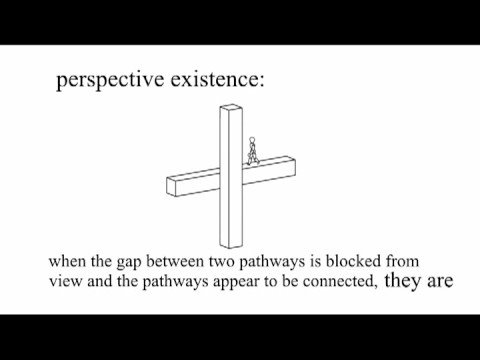
Released for iOS on April 3, 2014, Monument Valley was made by a six-person team spun out of a London design agency, who turned Escher's impossible figures into architecture you could walk. Arriving when freemium apps dominated the App Store, it sold millions by betting on the opposite: paid, short, and dense. I re-read it as both a record of mobile gaming's golden hour and a node in the lineage of perspective puzzles.
Henry Dudeney (1907) — Four Hinged Pieces That Turn a Triangle Into a Square
In 1907, English puzzle maker Henry Dudeney published, within The Canterbury Puzzles, the Haberdasher's Puzzle: cutting an equilateral triangle into just four pieces that reform into a square. Hinged together, the pieces could transform with a single fold, and the dissection drew attention in its day -- yet the proof that four pieces were truly minimal remained unresolved for a surprisingly long time, settled only by a 2024 computational-geometry paper. Tracing Dudeney's rivalry with Sam Loyd and his rediscovery through Martin Gardner, this piece rereads how a paper puzzle took 117 years to reach computer science.
The Birth of the Jigsaw Puzzle (1760s) — The Man Who Cut Up Maps, and a Verb Unchanged for 260 Years
In 1760s London, the map engraver John Spilsbury mounted printed maps on wood and cut them apart along national borders, selling them as 'Dissected Maps' — the commercial starting point of what would later be called the jigsaw puzzle. This essay revisits the context in which the format was born as a tool for teaching geography, the structural insight that where you cut is itself the design, and the lineage that runs from Depression-era die-cut cardboard to the 2021 VR title Puzzling Places — a format that survived 260 years without ever changing its verb.
Crimson Room (2004) — The Day a Red Room Made 'Escape' a World Word
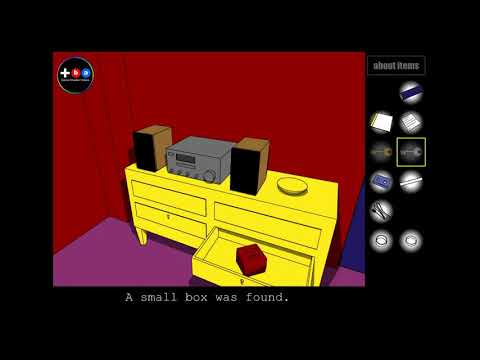
On March 4, 2004, Japanese developer Toshimitsu Takagi released a small free Flash game. You wake in a crimson-walled room, gather keys and tools, and leave through a locked door — nothing more. Yet Crimson Room spread the 'escape the room' genre worldwide, gave Asia the genre name 'Takagism' after its author, and by its instigator's own testimony triggered the world's first real escape game in Kyoto, 2007. I read this red room as a rare junction where digital play flowed back into physical space.
Pipe Mania (1989) — Betting the Route Before the Flow Arrives
In June 1989, Britain's The Assembly Line released Pipe Mania for the Amiga. In North America Lucasfilm Games distributed it as Pipe Dream, and in Japan Video System's arcade version was carried by Namco. Lay the pipe before the green flooz starts to flow - this single verb cast the template of the real-time spatial-connection puzzle.
Mole Mania (1996) — What a Two-Layer Board of Surface and Underground Taught Us
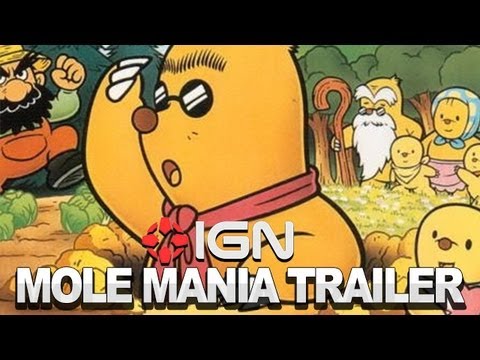
On July 21, 1996, Nintendo released Mole Mania for the Game Boy, developed by Nintendo EAD and Pax Softnica and produced by Shigeru Miyamoto. With four verbs — push, pull, throw, dig — you carry an iron ball to each screen's gate, across a board that exists in two layers: surface and underground. I dig up this forgotten work as an ancestor of the spatial reasoning found in today's multi-layer puzzles.
Cursor*10 (2008) — Ten of Me Climb One Tower: The Origin of Self Co-op
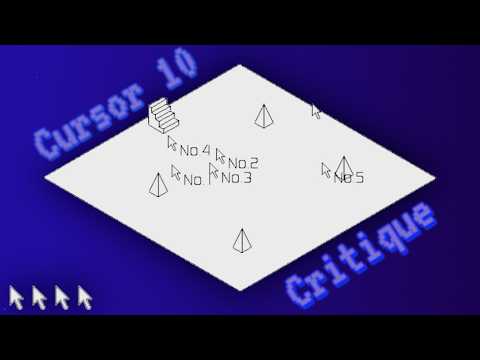
In January 2008, Yoshio Ishii of Nekogames posted a single Flash game on his site: Cursor*10. You control the mouse cursor itself; when one life runs out, its recorded actions replay in the next, and you climb a sixteen-floor tower in cooperation with your past selves. I read this small work, built over a single Japanese New Year's holiday, as an origin point of the 'self co-op' grammar in modern puzzle design.
Nikoli (1980) — The Reader-Grown Puzzle Magazine, and the Road Sudoku Took Around the World
Puzzle Communication Nikoli, launched in 1980, was Japan's first magazine devoted to puzzles. Its name came from a racehorse; the prototype of Sudoku came from America. This essay traces forty years in which Nikoli's mode of production—reader submissions and handmade problems—gave birth to Slitherlink (1989) and Nurikabe (1991), and sent Sudoku around the world via Hong Kong judge Wayne Gould's generator program, rereading the source of a question at the heart of modern puzzle design: who should make a good problem?
Professor Layton and the Curious Village (2007) - A Vessel That Carried 1966's Riddles onto a Handheld
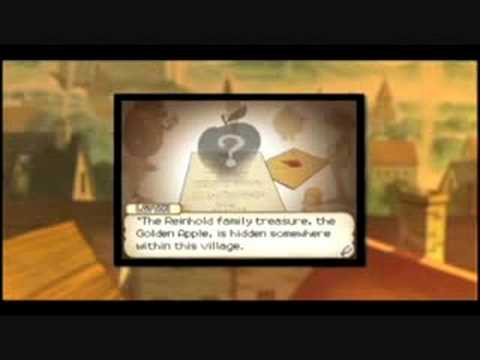
On February 15, 2007, Level-5 released Professor Layton and the Curious Village for the Nintendo DS. Its bundle of riddles derives directly from Akira Tago's Atama no Taisou (Kobunsha, 1966), the puzzle books producer Akihiro Hino adored as a child. This essay traces, from a historian's view, how Layton's stance of sinking a paper puzzle collection into a narrative vessel connects a forty-year-old book to a handheld, and onward to today's deduction puzzles.
The Crossword (1913) — The Grid Lineage That Began with Arthur Wynne's Diamond
On December 21, 1913, Arthur Wynne's "Word-Cross" was printed in the entertainment supplement of The New York World. Renamed "crossword" by a typesetting error, the pastime spread explosively through Simon & Schuster's 1924 book and went global via The Times in 1930 and The New York Times in 1942. This essay traces how the three inventions of grid, crossing and clue still live as a design vocabulary for thinking puzzles, from paper cells to Nikoli's pencil puzzles and modern digital works.
Tower of Hanoi (1883) — The 64 Disks That Never End, and the Legacy of Recursion
In 1883 the French mathematician Édouard Lucas released a small wooden toy under the pseudonym 'N. Claus (de Siam).' Three pegs, disks of differing size, and just two rules. Yet beneath that plain surface lay the mathematics of recursion: moving n disks demands a minimum of 2^n−1 moves. This essay revisits the toy's true origin, the fabricated Benares legend in which the world ends when 64 disks are moved, and what the ideas of 'recursion' and 'state space' bequeathed to later computer science and to puzzle design today.
echochrome (2008) — A Puzzle Where Perspective Becomes the World's Physics
Released for the PSP on March 19, 2008, echochrome translated the 'OLE Coordinate System' — an illusion principle researched by Jun Fujiki at Kyushu University — directly into play. The physics of the world a wooden mannequin walks through is rewritten by the angle you view it from. I re-read this work, which turned the impossible objects of Escher and Reutersvard into a rotating puzzle, within the lineage of perspective puzzles.
The Lost Vikings (1993) — A Classic of Cooperative Puzzling, Three Bodies Moved One at a Time
Released in 1993 by Silicon & Synapse (later Blizzard Entertainment) through Interplay, The Lost Vikings is a cooperative puzzle in which the player controls three differently-skilled vikings one at a time and must lead all of them to the exit. In Japan it was distributed by T&E Soft under the title Viking no Daimeiwaku. This essay re-reads its era, the quality of thought its three-way cooperation produced, and the lineage that runs from Lemmings and Gobliiins to today's cooperative puzzles.
Threes! (2014) — One Last Board That Grows by Three
Threes! arrived on the iPhone in 2014. Prototyped in a single night and polished over fourteen months, it lived through a strange reversal when, a month later, the 2048 craze left the original accused of being the copy. We trace the origin of the merge-slide puzzle through the developers' own testimony.
Rubik's Cube (1974) — A Labyrinth of 43 Quintillion States, and a Single Solution
In 1974, the Budapest architect Ernő Rubik carved a small cube as a teaching aid—and ended up placing an entire 'state space,' some 43 quintillion configurations with exactly one solved form, into the palm of a hand. This piece traces the object's precise provenance through primary and secondary sources—its 1974 invention, its 1980 global debut, and the 2010 proof that 'God's Number is 20'—and reads, as history, how an object with no screen and no power supply embodied half a century early the vocabulary modern puzzle designers now take for granted: reversibility, a unique solution, and a space to be searched.
Submachine (2005) — A Door into the Subnet, and the Lineage of Flash Escape Puzzles
On 15 September 2005 the Polish cartoonist Mateusz Skutnik posted a single Flash game on his own website. It was simply called Submachine. Later renamed Submachine 1: The Basement, it became the seed of a ten-part escape-puzzle lineage. I read this hand-drawn browser work, one that never sat on Steam at the time, as a chapter in the history of escape puzzles.
Adventures of Lolo (1989) — The Emerald Framer and the Single Solution
In 1989 HAL Laboratory released Adventures of Lolo on the NES, distilled from the 1985 MSX title Eggerland Mystery. On an 11x11 board, pushable framers and moving enemies converge on a single solution. I read this Sokoban-descended single-screen logic puzzle as a node in a long genealogy, one that codified its ideas well before the modern grid-puzzle wave.
Lemmings (1991) — The Source of Indirect-Control Puzzling, Where You Move the World and Never the Creature
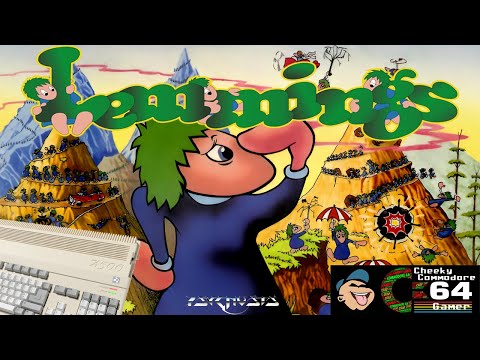
On 14 February 1991, DMA Design of Scotland released Lemmings and, with it, established 'indirect control': the player never steers a character directly but assigns roles and shapes the world to guide a crowd to safety. This essay re-reads its era, the quality of thought its eight skills produced, and its lineage toward RTS and modern puzzle design.
The 15 Puzzle (1880) — The Unsolvable Move with Which Sam Loyd Fooled the World
In early 1880 a craze for the '15 Puzzle' swept America and Europe. But Sam Loyd, whom the world believed to be its inventor, was an impostor who only claimed authorship sixteen years after the craze had ended. This essay traces the box's true origin and the 1879 proof that the 'swapped 14-and-15' board Loyd staked his prize on is mathematically unsolvable, and rereads the legacy sliding puzzles left to modern digital puzzle design: the guarantee of solvability.
The Incredible Machine (1993) — The Toy Box That Made Rube Goldberg Playable
Released in 1993 by Dynamix and Sierra, The Incredible Machine laid gears, balls, fans and cats across a single screen and asked players to build Rube Goldberg contraptions. Assembled in nine months on a $36,000 budget, this toy box—together with its Free Form sandbox mode—became a headwater of the modern physics-and-contraption puzzle. This essay traces the twenty-one years until its own creators put Contraption Maker on Steam in 2014.
Mario's Picross (1995) — Picture Logic, a Form Born in 1987
Released for the Game Boy on March 14, 1995, Mario's Picross translated into play the 'picture-logic puzzle' that two inventors had independently created in Japan eight years earlier. From newspaper puzzle to game, and on to today's Steam nonograms, this is the lineage of a single logic puzzle that survived almost half a century without changing its core.
Sokoban (1982) — The 44-Year-Old Prototype of Meta-Puzzles
In 1982, Hiroyuki Imabayashi of Thinking Rabbit released Sokoban. Forty-four years later, walk-and-push is still the bedrock of Baba Is You and Patrick's Parabox. Reading the lineage backward from period context.