HISTORY · 2026-07-08
Henry Dudeney (1907) — Four Hinged Pieces That Turn a Triangle Into a Square
A problem sleeping inside The Canterbury Puzzles was only proven in 2024 — 117 years later
Introduction
Let us open an old book of riddles dated 1907. Its cover reads The Canterbury Puzzles. Among its 114 problems, voiced through Chaucer's pilgrims, sits a dissection problem later known as the Haberdasher's Puzzle: cutting an equilateral triangle into just four pieces that reassemble into a square. Its author was Henry Ernest Dudeney (1857-1930), an English former civil servant who spent his life inventing puzzles.
What I wish to exhume this time is a peculiar property this single problem carried. The triangle, cut into four pieces, could be joined by hinges so that a single folding motion collapsed it into the outline of a square. This 'hinged dissection' drew attention in its day, and a working model is said to have been demonstrated at the Royal Society in London in 1905. Yet the proof that four pieces truly were the minimum possible remained unresolved for a surprisingly long time.
In this essay I trace Dudeney's life, the strange alliance he built and broke with Sam Loyd, and how one geometric puzzle was finally proven mathematically, 117 years later, in 2024. I want to reread, from history's side, why a paper-cutting game survived all the way into modern computer science.
 1907, a problem from The Canterbury Puzzles (illustration, AI-generated)
The Context of the Era
Dudeney was born in 1857 in the Sussex village of Mayfield, in southern England. While working as a young civil servant, he began contributing puzzles to newspapers and magazines under the pen name 'Sphinx' from the 1890s. Britain at the time had popular weeklies such as Tit-Bits and The Strand Magazine, where reader-submitted puzzle columns were becoming an established form of entertainment.
Across the Atlantic in the same period, Samuel Loyd (1841-1911) was making a name for himself in similar puzzle columns. The two began corresponding in the 1890s and cooperated, sending each other puzzles. But the relationship broke down after Loyd published Dudeney's work under his own name without credit, and Dudeney reportedly never forgave him for the rest of his life. Posterity's verdict is that Dudeney was the better mathematician, Loyd the better showman.
In 1907 Dudeney published his signature work, The Canterbury Puzzles and Other Curious Problems. Framed as 114 problems narrated by Chaucer's pilgrims, it contained the geometric problem later generations would call the Haberdasher's Puzzle. He went on to publish Amusements in Mathematics (1917) and Modern Puzzles (1926), cementing his reputation as Britain's foremost puzzle author.
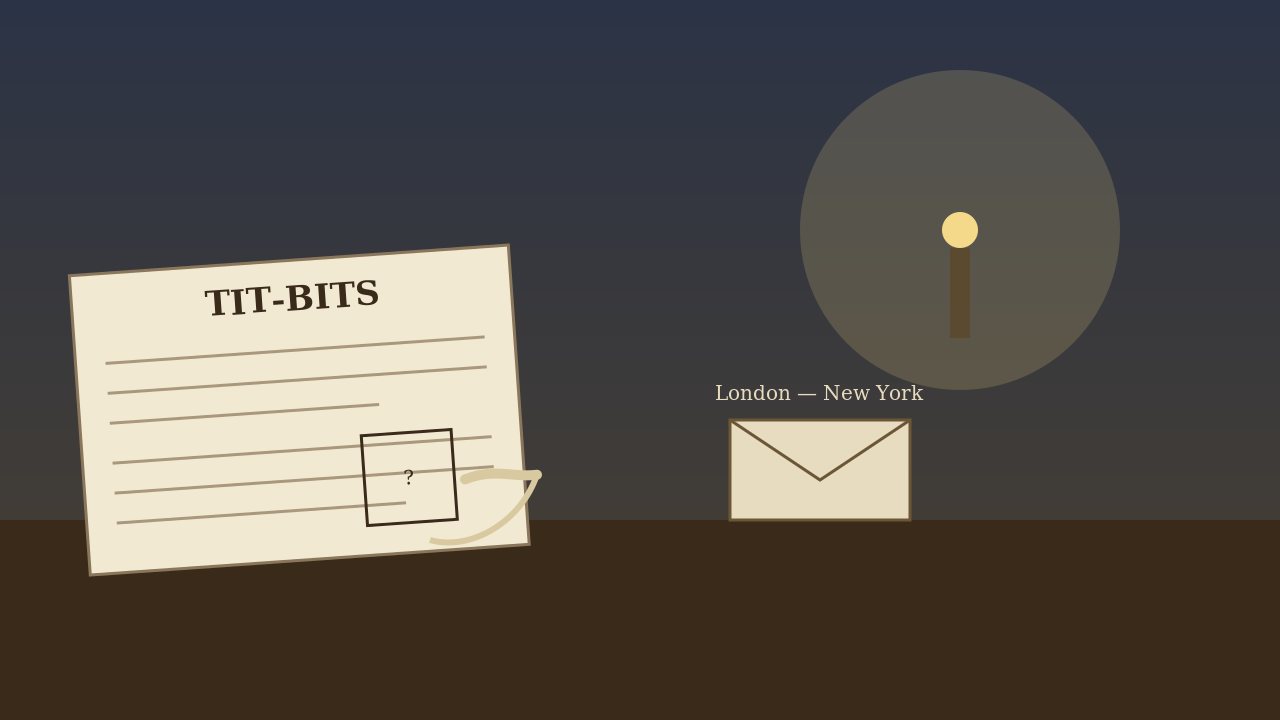 A Tit-Bits puzzle column and letters crossing London to New York (illustration, AI-generated)
Mechanics
The problem itself is simple: cut any equilateral triangle into as few pieces as possible so that, rearranged, they form a square. Dudeney posed this in his column in 1902 and is recorded as having produced a four-piece solution shortly after. What made his four pieces remarkable was not merely that they could be rearranged, but that, joined by hinges, a single folding motion turned the triangle directly into the square.
This idea of 'hinged dissection' raised the vocabulary of planar dissection puzzles a notch. By adding the constraint that the pieces remain connected while transforming continuously, the puzzle shifted from a static geometric problem into a device for admiring motion itself. The anecdote that a working model was demonstrated at the Royal Society in London in 1905 shows how fresh this discovery felt even to the era's scholarly community.
What is striking is that neither Dudeney himself nor the mathematicians who followed him could offer a rigorous proof, for a very long time, that four pieces truly were the minimum. The question of whether fewer pieces might suffice smoldered as an unresolved problem in computational geometry throughout the 20th century.
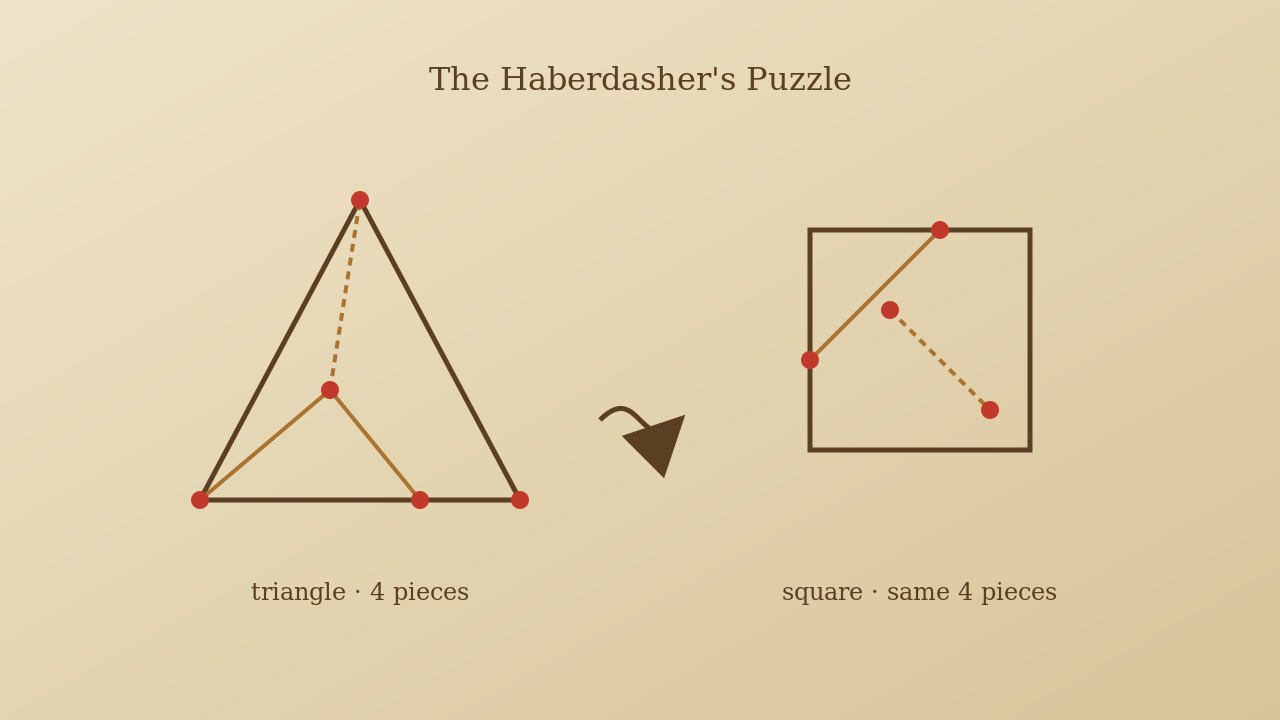 The Haberdasher's Puzzle: four hinged pieces, triangle to square (illustration, AI-generated)
Legacy into the Present
Dudeney's legacy first blossomed widely after his death. The American math journalist Martin Gardner repeatedly featured Dudeney's problems in his famous Scientific American column 'Mathematical Games' (running 1956-1981), and in 1967 edited a posthumous collection, 536 Puzzles and Curious Problems, in which he called Dudeney 'England's greatest maker of puzzles.' Gardner's column is widely credited with establishing 'recreational mathematics' as a genre for general readers in the latter half of the 20th century.
And the Haberdasher's Puzzle itself still had a sequel. In 2024, computational-geometry researchers published a paper titled 'Dudeney's Dissection is Optimal,' formally confirming at last that the four-piece dissection Dudeney demonstrated in 1907 was indeed the mathematically provable minimum. A paper puzzle was settled as a computer-science paper 117 years later. Few puzzles born as entertainment remain an active open problem for so long.
The taxonomy Dudeney laid out in Amusements in Mathematics (1917) -- moving-counter problems, route problems, dissection problems, magic squares -- overlaps strikingly with the genre categories used to describe puzzle games today. This is not evidence that he directly influenced modern puzzle games, and I will not claim that. But the outline of the 'map of puzzles' he drew over a century ago still looks largely undrawn-over even now.
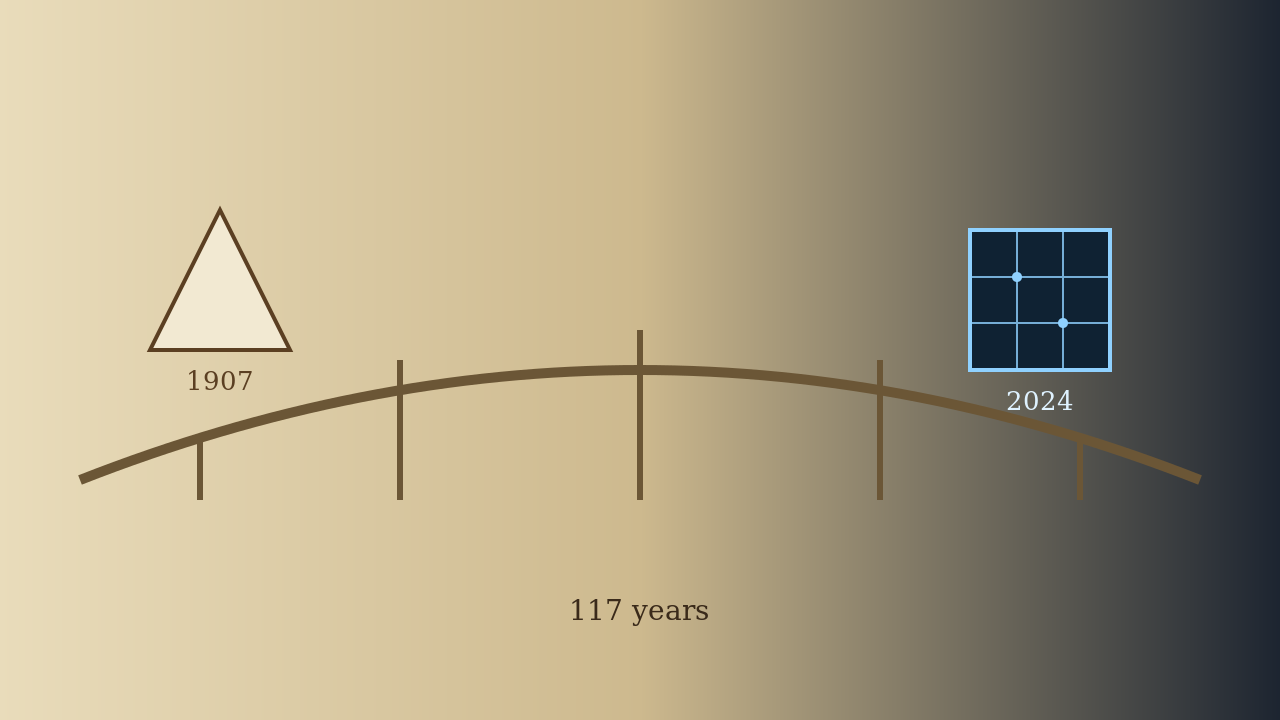 A bridge across 117 years, from an 1907 paper puzzle to a 2024 proof (illustration, AI-generated)
References
Sources consulted for this article:
・Wikipedia: Henry Dudeney (dates, career, pen name Sphinx, the rift with Loyd)
・MacTutor History of Mathematics: Henry Ernest Dudeney (biographical detail)
・Wikipedia: The Canterbury Puzzles (1907 publication, its 114 problems)
・Wikipedia: Dissection puzzle (the Haberdasher's Puzzle timeline, the 1902 column, McElroy's solution)
・Wolfram MathWorld: Haberdasher's Problem
・Wikipedia: Sam Loyd (correspondence and dispute with Dudeney)
・arXiv: Dudeney's Dissection is Optimal (2024) (formal optimality proof of the four-piece dissection)
・Scientific American: Math Games of Martin Gardner Still Spur Innovation
・Dover Publications: 536 Puzzles and Curious Problems (edited by Gardner, source of the "England's greatest" verdict)
Closing
Dudeney kept calling himself not a mathematician but a 'puzzle maker.' The fact that a former civil servant with no degree or title carved open an unresolved corner of geometry through problems made for play shows that puzzle-making can be both entertainment and serious intellectual inquiry at once.
When I picture the Haberdasher's four pieces, still joined by their hinges, quietly folding from triangle into square, I see a lesson in it. A good problem does not end the moment an answer appears. This single question, born in 1907, was still quietly changing shape in researchers' hands as late as 2024.
 Quietly, still folding, even now (illustration, AI-generated)
Reactions (no login)
Anonymous • one of each per visitor per day
Learn — Curriculum
LearnPart 2 Lineage — Where Puzzles Came FromChapter 3 Puzzles of Paper and Wood5 / 11
Part of these series
Puzzle Incident HistoryEpisode 8 of 53