RETRO-REVIEW · 2026-07-14
This is the Only Level (2009) — A Mischievous Loop on a Single Screen, from the Flash Era
How 30 stages of rule-rewriting born in a browser found their way back to Steam two decades later
Introduction
On 8 August 2009, a strange little browser game appeared on Armor Games, a long-running Flash portal. Its creator was John Cooney, then going by jmtb02. The title was This is the Only Level, and true to its name, the entire game consists of a single screen replayed over and over in changing guises. The protagonist is a small blue elephant who runs right and leaps into a pipe. Players perform that same motion nearly thirty times, each time under a different set of rules.
What first drew my attention was the work's austerity. Most puzzle-platformers extend their length by adding new rooms and new gimmicks. Cooney gambled on the opposite: reusing the same terrain, the same goal, the same elephant, and building thirty stages purely by rewriting the rules. Gravity flips, controls swap, the screen shrinks, and at one point the game even jokes that 'there is no level.' Wringing every possible idea out of a single box is an invention born of constraint, not despite it.
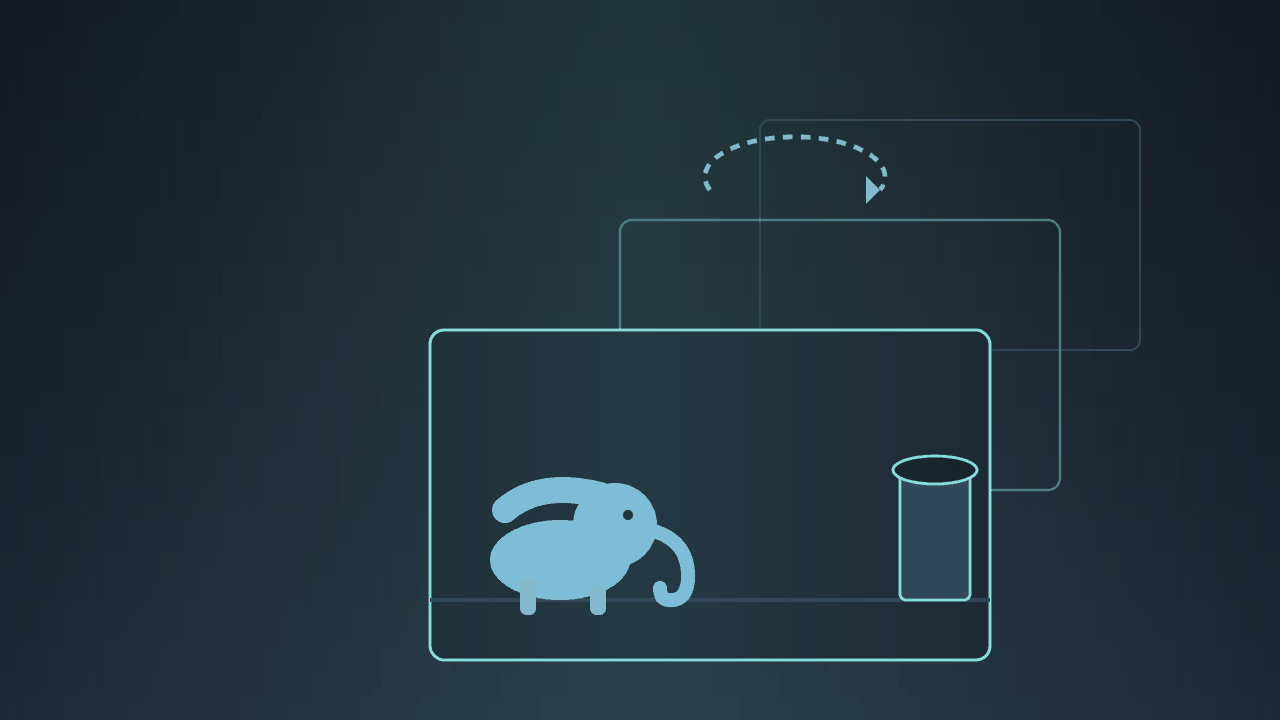 The same door, the same elephant, rules rewritten (illustration, AI-generated)
The Context of the Era
To understand the soil that produced this work, one must touch on the Flash-portal culture of the 2000s itself. Newgrounds, Kongregate, and Armor Games built a distinct economy in which developers published games for free and earned income through advertising and sponsorship deals. Cooney himself joined Armor Games in 2007 as its first employee, and later recalled: 'Flash was magic... These Flash games were tiny. You'd have a pretty robust fun gameplay experience.' By his own account, a hit of that era could reach a million plays within twenty-four hours of release.
Cooney's own background is emblematic of the era. He was not a formally trained programmer but someone who, while making animations in an environment resembling a drawing program, gradually stumbled into scripting. In his own words, 'Flash taught me how to program.' That one could become a creator through play, without formal training, is, I think, the greatest legacy of 2000s browser-game culture.
 Newgrounds, Kongregate, Armor Games: an era of ads and a free economy (illustration, AI-generated)
Mechanics
The structure of This is the Only Level is astonishingly simple. Steer the elephant, run right, leap into the pipe, and the stage is cleared. Yet the same terrain rises up under a different rule each time. Jump height changes, the view flips, the control keys swap, and at times the screen itself breaks apart and becomes unreadable. The player is not exploring a new room but re-questioning a new premise inside a room already known.
What operates here is less level design than 'rule design': the space is fixed, and only the verbs and physical laws are moved as variables. This approach, in effect, anticipated on a different axis the thinking this site discussed in 'Designing Within a Single Screen.' Where Sokoban and Baba Is You pursued the density of simultaneous visibility within one screen, this work stacked a single screen along the axis of time, producing a different kind of density: teaching, one at a time, what to doubt in the same place.
This self-referential construction, which Wikipedia classifies as a 'metagame,' is also a device that mocks the very conventions of the medium of games. But self-reference is a means, not an end. Among the thirty stages, Cooney planted a hidden stage that continues infinitely but cannot be won, a mischievous move that shakes even the tacit promise that 'a game must end.'
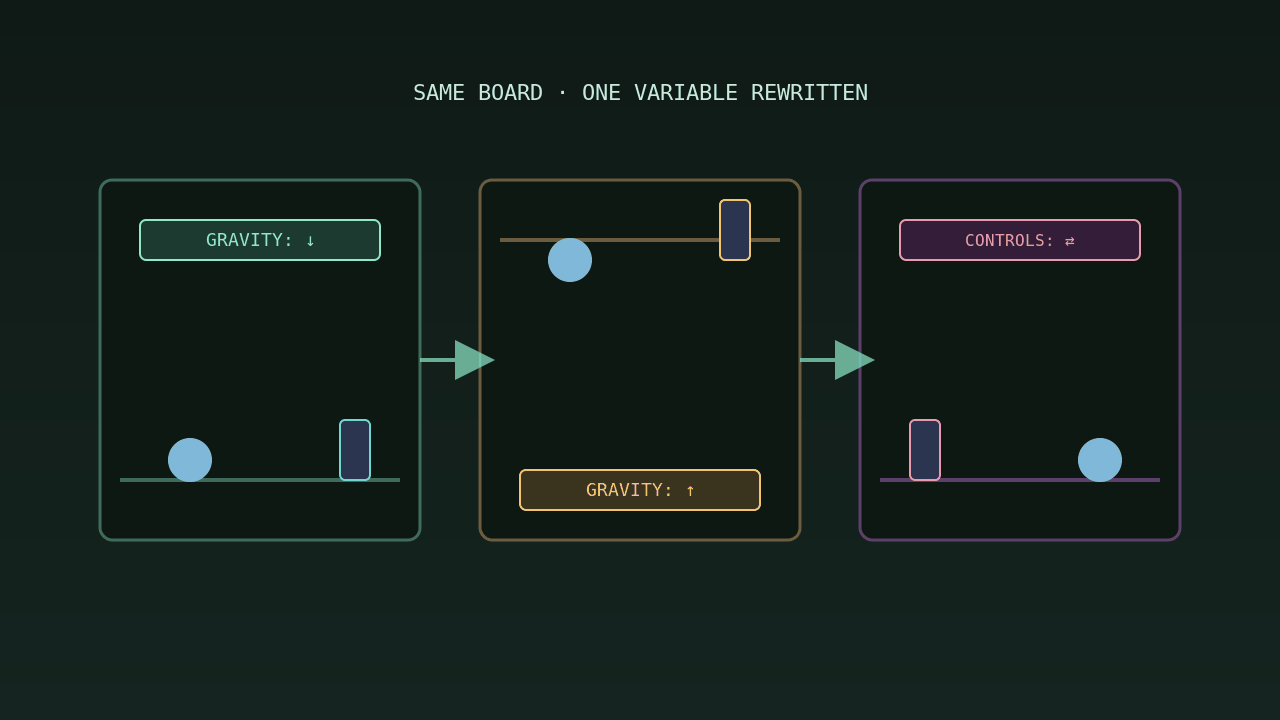 The same board, the same piece, one variable rewritten (illustration, AI-generated)
Lineage to the Present
On 31 December 2020, Adobe officially ended support for Flash Player. The following January, major browsers uniformly blocked Flash playback, and the great majority of browser games accumulated over two decades became, in effect, unplayable. Armor Games, the home of This is the Only Level, was no exception. That same month, December 2020, the company adopted the open-source Flash emulator Ruffle as its playback engine, barely keeping its catalogue alive.
Cooney did not watch this extinction passively. On 6 November 2023, he selected ten of his own games, roughly tripled their resolution, and added achievements and developer commentary, releasing The Elephant Collection simultaneously on Steam, GOG, itch.io, and Humble. This is the Only Level and its two sequels are included. In an interview with Game Developer, he said: 'Preservation efforts for games are critical to our industry... my concern is kind of what happened to the film industry.' Tellingly, he deliberately left certain bugs unpatched. Aware that the speedrunning community around the game remains wildly active, Cooney chose to preserve its flaws as heritage, so that players could once again 'do what they effectively felt was a cheat code twelve years ago.'
Cooney also spoke to the fact that developers who came up through Flash went on to make today's biggest hits. In the GOG interview, he names Among Us, Cult of the Lamb, Super Meat Boy, Samorost, and Kingdom of Loathing, all children of Flash culture, several of which remain flagship Steam titles today. 'So many devs (including myself) came from Flash, and their modern hits are informed by the trail of Flash games that got them there,' Cooney states. This is testimony from the developer himself, not speculation. I read this single remark as primary evidence of how thoroughly Flash, a now-vanished vessel, was the very soil of today's puzzle and indie culture.
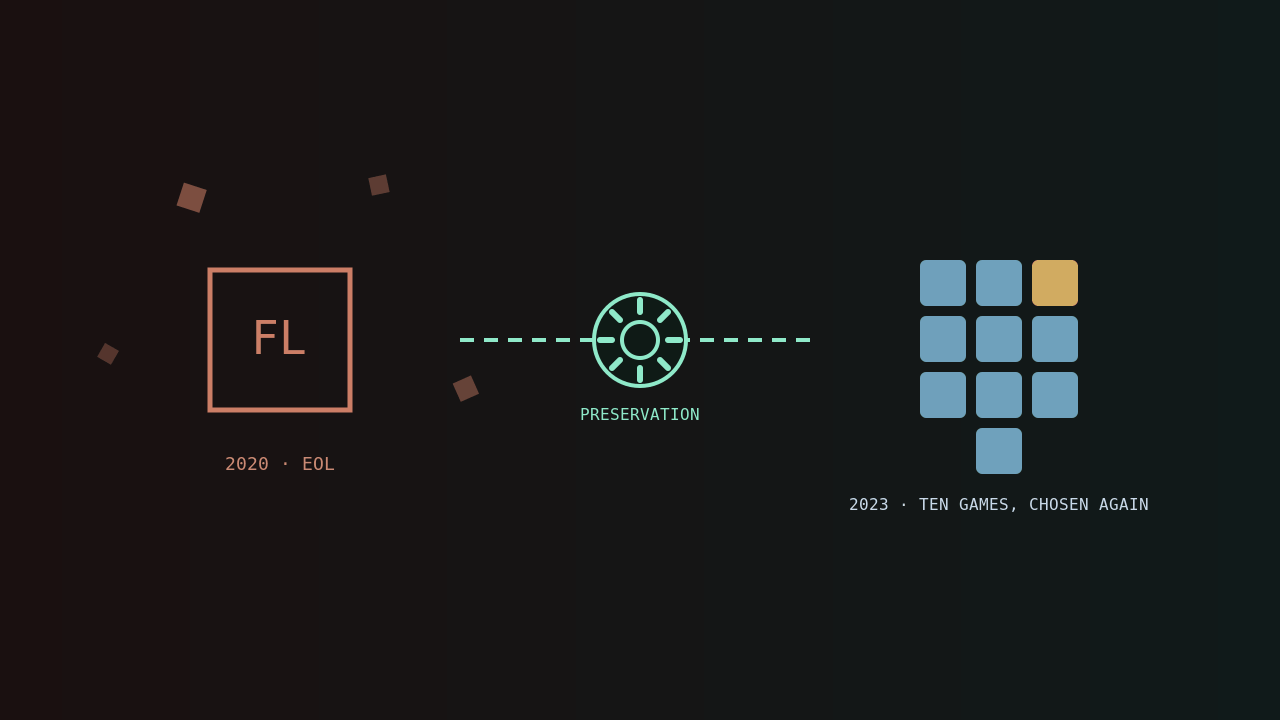 From a vanished vessel to ten games chosen anew (illustration, AI-generated)
References
Sources referenced in this article:
・Wikipedia: This is the Only Level
・Wikipedia: John Cooney (video game developer)
・Armor Games Blog: This is the Only Interview (John Cooney)
・Game Developer: Flash game preservation evolves with The Elephant Collection
・GOG.com: Interview with John Cooney on Flash games' impact and The Elephant Collection
・Saving Content: The Elephant Collection is out now on PC via Steam, GOG, Itch.io, and Humble
Closing
This browser game, released for free in 2009, was a mischievous trick that betrayed its own rules every time you played. Yet nearly twenty years on, that mischief was carried back to the present as a paid Steam product, by the creator's own hand. A work born of a free economy, moved into a paid vessel for the purpose of preservation: that shift itself marks one more way in which the browser-game era came to a close.
My conclusion as a historian comes down to one point. The idea of 'changing only the rules on the same screen' was already practiced with great polish in Flash in 2009. If Sokoban taught us the design of verbs, and Baba Is You taught us the manipulation of rules, then this work sits between them, an example that anticipated, from outside Steam, the technique of making players doubt the premise itself on a fixed stage. I set this down here as a historian's record.
 The elephant still runs toward the same pipe (illustration, AI-generated)
Reactions (no login)
Anonymous • one of each per visitor per day
Learn — Curriculum
LearnPart 2 Lineage — Where Puzzles Came FromChapter 6 The 2000s Turn — Flash, Mobile, Jams7 / 15
Part of these series
Retro RevisitedEpisode 17 of 45
Read next

Related reviews
Escape Goat
A 2D puzzle platformer in which a goat escapes a prison, collecting keys and opening doors with a mouse that fits small gaps and a magic hat that swaps their places. By MagicalTimeBean.
Mushroom 11
A 2D puzzle-platformer in which a green fungal mass is moved by erasing it: whatever you delete grows back somewhere else, so choosing what to cut is how you travel. Untame's descent through an emptied ruin, scored by The Future Sound of London.
BOKURA
A two-player-only co-op puzzle adventure about two runaway boys walking one road while seeing different worlds — a forest for one, a machine city for the other. Because neither player sees what the other sees, talking is the solution. By tokoronyori.


