REVIEW · 2024-11-13
Mind Over Magnet
Reading the Steam reviews of a gentle magnetic puzzle-platformer made by a design critic
First Impressions
A monitor-headed little robot named Uni climbs a factory one floor at a time with a cast of magnet companions: place a magnet on a pressure plate, throw it into a magnetic field, flip its polarity to rise or fall, and solve one single-screen puzzle after another. It was released on 13 November 2024 by Mark Brown, who runs the YouTube channel Game Maker's Toolkit. I write from the pool of Steam reviews: Very Positive, 89% of 1,326 reviews, and 84% of 19 in the last 30 days (2026-07-10 snapshot).
Line up the helpful positive reviews and the words rhyme: cute, cozy, polished, relaxing, a chill afternoon. Most praise how clearly the game communicates itself — you know what to do without being told — and how gently it welcomes beginners and kids.
The negative and qualified reviews keep returning to: easy, short, cautious, the training wheels never come off. Often the praise and the complaint point at the exact same thing: one reviewer's clear and kind is another's too easy to matter. My job isn't to stage that as a fight but to translate where the opinions fork into design terms.
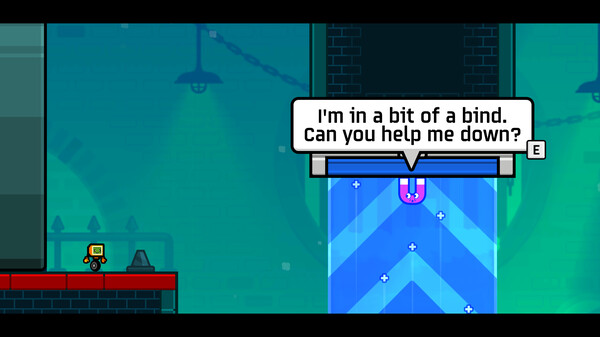 Key art: Uni at the base of the factory — Steam store
Putting the Mechanics into Words
What the positive reviews praise most is how small and legible the system is. Uni can do little jumps, pick things up, place a magnet, throw it, and flip its polarity — that is the verb set, and every puzzle fits on one screen. In Puzzlebyrinth terms the verbs are subtracted to a handful and the board is fully visible: observation resolution is wide open from the start.
Few verbs, but the grammar builds in steps. Magnets are pulled up or down by fields, hold down pressure plates, and flip between rising and falling when you switch polarity. The puzzle reviewers cite most — zig-zagging over spikes by flipping polarity mid-air — is where that grammar tightens. New verbs arrive one per chapter, the opposite of Patrick's Parabox: rather than mining one idea to its combinatorial floor, it adds small verbs in sequence, Portal-style.
Even the recommendations carry a caveat: the core magnetic idea isn't as novel as Portal's, so it needed more supplementary ideas around it. Clean subtraction, under-explored expansion. In design terms the combinatorial explosion is deliberately held back — and that restraint runs through both the teaching and the difficulty below.
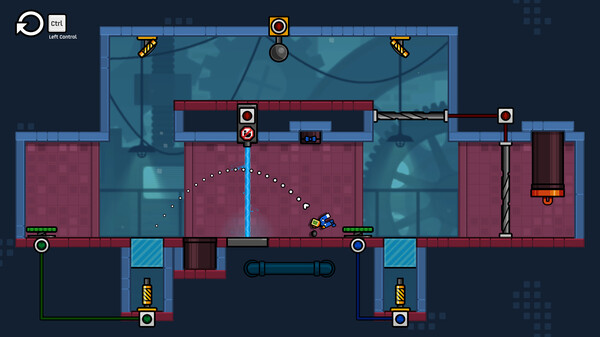 A magnetic-field puzzle in motion — Steam store
Teaching
When people talk about this game, the most frequent proper noun in the review pool isn't a genre or a character — it is the creator, Mark Brown, and his channel Game Maker's Toolkit. For years he has been the critic explaining how games teach their mechanics and shape difficulty curves. Reviewers measure his single-screen puzzler against the very principles he has spent years articulating, and you understand what to do without words is testimony that the learning curve is drawn with textbook precision.
But the same precision flips sign on the negative side: the training wheels never come off, every new idea arrives too timidly. Smoothness read as a virtue, or as a lack of bite — two faces of one decision. If The Witness teaches by scattering wordless hints and then pushing you off a cliff, this game never lets go of the handrail. Not right versus wrong, but a difference in who the teaching is aimed at.
Tellingly, it ships with developer commentary and a self-awareness about its own construction. Here teaching is both the method and the subject — which lets you read even too easy as the shadow of a design that leaned all the way into teaching.
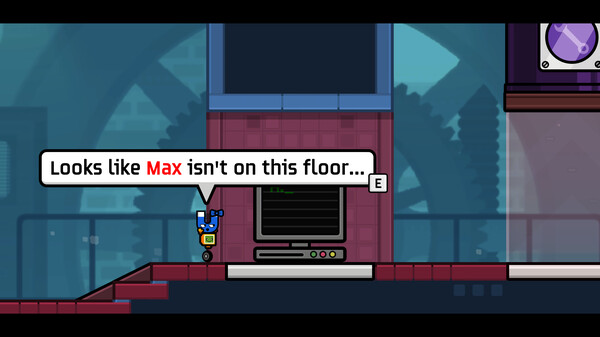 Each world introducing one new idea at a time — Steam store
The Texture of Difficulty
On difficulty, users and press line up unusually well: no puzzle stumped me for more than a couple of minutes, about an hour before it gets interesting, and under four hours total. Recent reviews don't move the point, and even across price changes (normally $9.99, as low as $2.99) the qualified buy-it-on-sale framing holds.
Let me dissect the difficulty one notch. The puzzles aren't unfair; the ceiling is low. Subtracted verbs and a single-screen frame hold the combinatorial explosion down from the start. The satisfying aha only arrives around chapter three, when polarity-switching enters — reviewers who say it suddenly got good there are marking the point where the grammar finally gains enough freedom. The developer has said accessibility was the priority, so this is intent, not failure: a generous floor, a low ceiling.
Which makes the difficulty verdict a statement about design range. For newcomers and players wanting a calm evening, the feel is finely calibrated; for genre veterans, the low ceiling reads as thin. I take that as a declaration of who it is for, not a fight to referee.
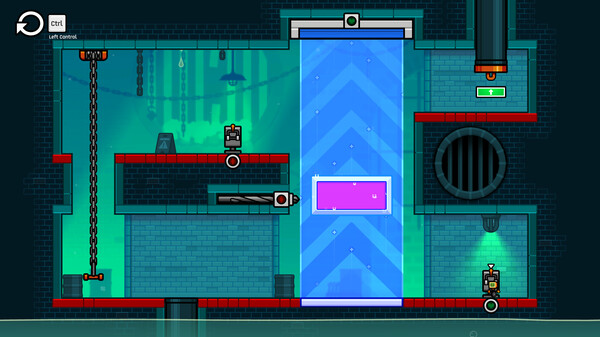 The mid-game texture once polarity-switching arrives — Steam store
Sources
This piece was written by reading the user reviews on the Steam store page as of 2026-07-10. No review text is quoted directly; typical claims are reconstructed.
- Steam: Mind Over Magnet (Very Positive, 89% of 1,326 reviews; 84% of 19 in the last 30 days)
- Read via WebFetch: the top ~10 helpful positive reviews, representative negative complaints, several recent reviews, and feedback threads in General Discussions
- Press: Thinky Games (Rick Lane); aggregate and asset data via SteamDB
Closing
Across the review pool, one picture emerges: a small game that deliberately chose polish over ambition. It is warm, tactile, and its screen-by-screen communication is close to flawless. That same care also holds the combinatorial explosion down and keeps the ceiling low. The praise and the complaint are, to the end, two views of a single decision.
Steam's overall sits high at 89% of 1,326. From a design standpoint I land at 7.5. The gap is simple: full marks for the precision of the teaching, a deduction for the low ceiling it set for itself. An 89% score measures did it play nicely to the end; I am measuring how far the verbs and grammar were pushed, and here the game held back on purpose.
So the audience is clear. For newcomers, for makers who want to study how a game teaches, and for anyone after a calm evening, it is about as finely tuned as they come. Players who want to dive to the combinatorial floor will be better served by something that pushes back, like Stephen's Sausage Roll. For either reader, the reviews aren't inconsistent — only the distance from which they view the same design.
 Store capsule art — Steam store
Where are you with this game?
Press one and the game goes on your shelf. You can see it on your account page.
Reactions (no login)
Anonymous • one of each per visitor per day
Read next
Related reviews
Wilmot Works It Out
A puzzle-building game: open the weekly package, pull out square pieces, assemble the pictures, and hang the finished ones on your walls. Each package mixes pieces from several pictures, so sorting comes before building. The sequel to Wilmot’s Warehouse, from Hollow Ponds and Richard Hogg.
Sokobond Express
A grid puzzle in which you draw one unbroken path for a single atom, bonding it to the atoms it passes until the target molecule is assembled — a minimalist crossbreed of Sokobond and Cosmic Express, published by Draknek & Friends.
The Operator
A first-person investigation adventure worked entirely from one FDI computer console — video analyzer, databases, ChemScan, terminal — connecting evidence as the 'man in the chair' to unravel a conspiracy. Bureau 81's 2024 desktop thriller.


