RETRO-REVIEW · 2026-09-05
Puzzle Boy / Kwirk (1989) — The Day Atlus Walked a Potato Under Its Own Name
Spin doors, stones, and pits — a subcontractor's graduation piece, built from three verbs
Introduction
What I'm laying on my desk today is a game Atlus released for the Game Boy on November 24, 1989: Puzzle Boy. Overseas, it was sold under the title Kwirk.
The star is a potato-shaped hero, nicknamed Poterin. All you do is guide it through walled-in mazes to a staircase. No flashy set pieces, no long story — plain, even modest, as puzzles go.
But this one modest game carries more weight than its looks suggest. It was the first title Atlus ever released under its own name.
 Push a stone, turn a door, aim for the stairs — the shape of Puzzle Boy (illustration, AI-generated)
The Context of Its Time
In 1989, the Game Boy was still a newcomer, barely six months old in Japan. That April, Tetris had already shipped and proven that puzzle games could sell on a handheld.
Atlus itself was young too. Founded in 1983, the company had spent its early years developing games as a contractor for other publishers, without a title that carried its own name on the box.
Into that situation, it released this modest maze puzzle. No flashy characters, no sweeping story — just three verbs, push, turn, and fill, carried on the back of a potato.
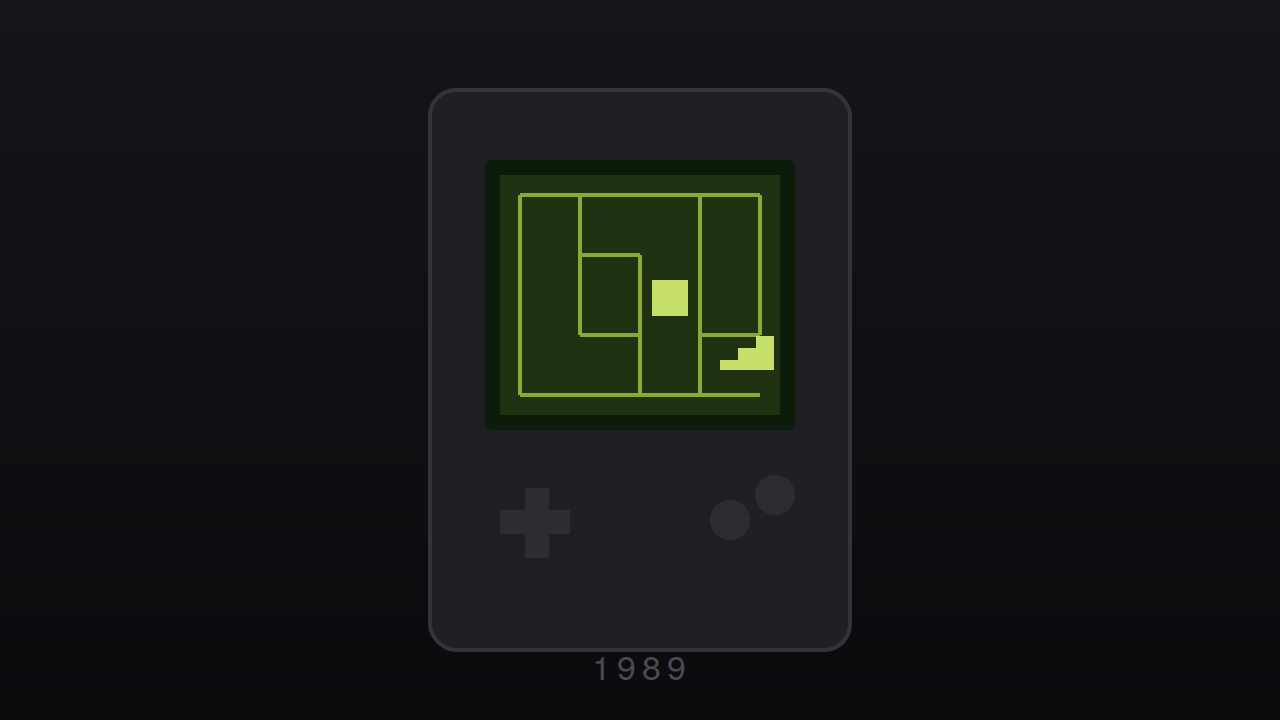 A maze in a single shade of green, on a handheld barely six months old (illustration, AI-generated)
Mechanics
The system looks simple, but for its time it was carefully built. Each floor has "spin doors," wall segments fixed on an axis that rotate 90 degrees every time you push them — the shape of the corridors itself changes with every move.
"Stones" can be pushed one at a time. They're not walls blocking your path but more like luggage whose resting place you get to choose. "Pits" are normally impassable, but drop a same-sized stone into one and it becomes solid floor.
There were three modes, three difficulty levels, and a choice between a diagonal 3D-style view or a top-down 2D one. Certain stages even let you swap which character you controlled with the Select button, a feature called "Veggie Friends." For a 1989 handheld title, the sheer number of options stands out.
The "push and fill" skeleton itself wasn't new. Sokoban, released in 1982, had already opened that grammar. What Puzzle Boy adds, in my reading, is a set of handheld-native touches on top of it: rotating wall segments and switching between multiple characters.
 Turn it, push it, fill it — the structure of the three mechanics (illustration, AI-generated)
Legacy: A Line to the Present
In North America, Acclaim released it in March 1990 under the title Kwirk: He's A-Maze-Ing! The hero, for reasons unexplained, had turned from a potato into a tomato. Nintendo published the European release the same year.
The series continued: a Famicom Disk System version on November 16, 1990, and a PC Engine version on February 22, 1991. On August 2 that year, the sequel Puzzle Boy II (released in North America as Amazing Tater in 1992) added new puzzles and a scenario mode, and that same year an action-adventure spin-off, Spud's Adventure, branched off in a completely different direction.
Domestic reception at the time was middling. Famicom Tsūshin's cross review gave it 25 out of 40 points, and Family Computer Magazine's reader poll scored it 20.65 out of 30. Western press was, if anything, kinder: the UK's Mean Machines gave it 85%, Germany's Video Games magazine also 85%, and Console XS 81%.
Atlus itself went on to walk a very different path, building its name on dense RPGs like Shin Megami Tensei. And yet in 2011, the same company released Catherine, a puzzle-action game where you climb a tower by stacking blocks. In 2019 it arrived on Steam too, as Catherine Classic (released January 10) and Catherine: Full Body (released September 3). A company that first put its own name on a push-and-fill puzzle in 1989 came back to block-pushing puzzle grammar 22 years later — I want to record that here not as something a developer has said in words, but as a coincidence sitting plainly in the same company's own body of work.
 From a single stone, to a tower that keeps climbing (illustration, AI-generated)
Sources
Sources referenced for this article:
・Hardcore Gaming 101: Puzzle Boy / Kwirk
・Wikipedia: Catherine (video game)
・YouTube: Game Boy World #015: Kwirk (Jeremy Parish / Video Works)
Closing
What makes Puzzle Boy interesting isn't the richness of its mechanics, but the fact that it was a first act of naming itself. A company that had spent years working under other companies' names entrusted its own signature to a single potato.
That signature would go on to carry the weight of names like Shin Megami Tensei and Persona. And yet 22 years later, the same company came back to stacking blocks and climbing a tower. After a long detour, it looks almost as if it arrived back at the same place.
In 1989, a company moved a single stone across a screen lit in one shade of green. Somewhere, it may still be rewriting that same verb today — and once you notice that, this modest maze puzzle starts to look a little different.
 Beyond the last step, a quiet light still waits (illustration, AI-generated)
Reactions (no login)
Anonymous • one of each per visitor per day
Part of these series
Retro RevisitedEpisode 42 of 43