RETRO-REVIEW · 2026-07-04
Mole Mania (1996) — What a Two-Layer Board of Surface and Underground Taught Us
This Miyamoto-produced Game Boy puzzler already designed, in 1996, the tension of a single irreversible dig that permanently changes the board
Introduction
This is a game Nintendo released for the Game Boy on July 21, 1996: Mole Mania, known in Japan as Moguranya. It was developed by Nintendo EAD and Pax Softnica, produced by Shigeru Miyamoto, directed by Masayuki Kameyama, with music by Taro Bando. A mole — Muddy Mole in the West — digs through seven worlds to rescue his wife and seven children, kidnapped by the farmer Jinbe.
At first glance it looks like a Sokoban variant. The skeleton — carry a black iron ball to each screen's exit gate to advance — indeed belongs to the block-transport lineage. But the essence of this game lies elsewhere, in its two-layer structure of surface and underground. I want to reread it as a quiet but important step in the mid-1990s, when the single-screen puzzle stepped into three-dimensional spatial reasoning.
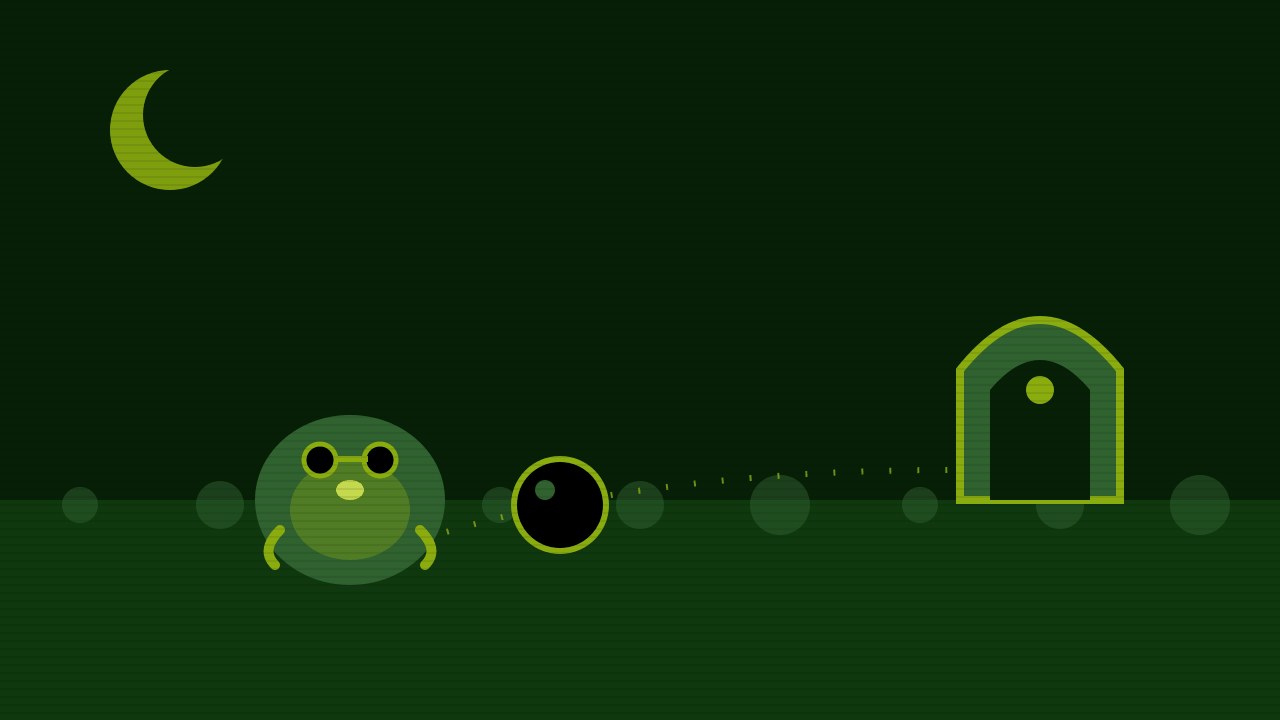 The ball must reach the gate — the premise of Mole Mania (illustration, AI-generated)
The Context of Its Era
Recall the year 1996. The Game Boy was already seven years old. Since Tetris in 1989, the four-shade monochrome handheld had remained the main battlefield of puzzle games, but public attention was shifting to next-generation consoles like the PlayStation and the Nintendo 64. Pokémon Red and Green had shipped in Japan that February; this was the lull just before the Game Boy market reignited.
Into that lull, a handheld puzzle bearing Shigeru Miyamoto's name as producer was quietly placed. Pax Softnica, the studio behind it, had long supported Nintendo's software, and here chose a room-based, one-screen-one-problem design suited to the tiny display. It is telling that Nintendo Power compared the game to HAL Laboratory's Eggerland (Lolo) line: this was an attempt to transplant the grammar of 1980s single-screen puzzles onto a mid-90s handheld.
 A small four-shade screen was the main stage for puzzles (illustration, AI-generated)
Mechanics
The rules are simple: on each screen, bring the black iron ball to the exit gate. The verbs are push, pull, throw — and dig. Where Sokoban (1982) gained its depth by restricting you to pushing alone, Mole Mania permits pulling and throwing, and instead introduces a different kind of irreversibility: holes you dig change the board permanently.
A hole is a door to the underground and a trap at once. If the ball falls in, it returns to its starting point; dig in the wrong place and a screen can become outright unsolvable, forcing you to leave and re-enter to reset it. That reset ritual can be read as the handheld-era prototype of the Undo and Restart buttons that modern puzzles treat as standard equipment.
And then the underground. A path blocked on the surface connects by tunneling beneath it. The player constantly overlays two maps in their head — the visible layer and the hidden one. As the German magazine Total! put it, the idea of puzzles unfolding above and below ground was 'not only new, but also surprisingly good'; this was one of the earliest two-layer boards realized on a handheld.
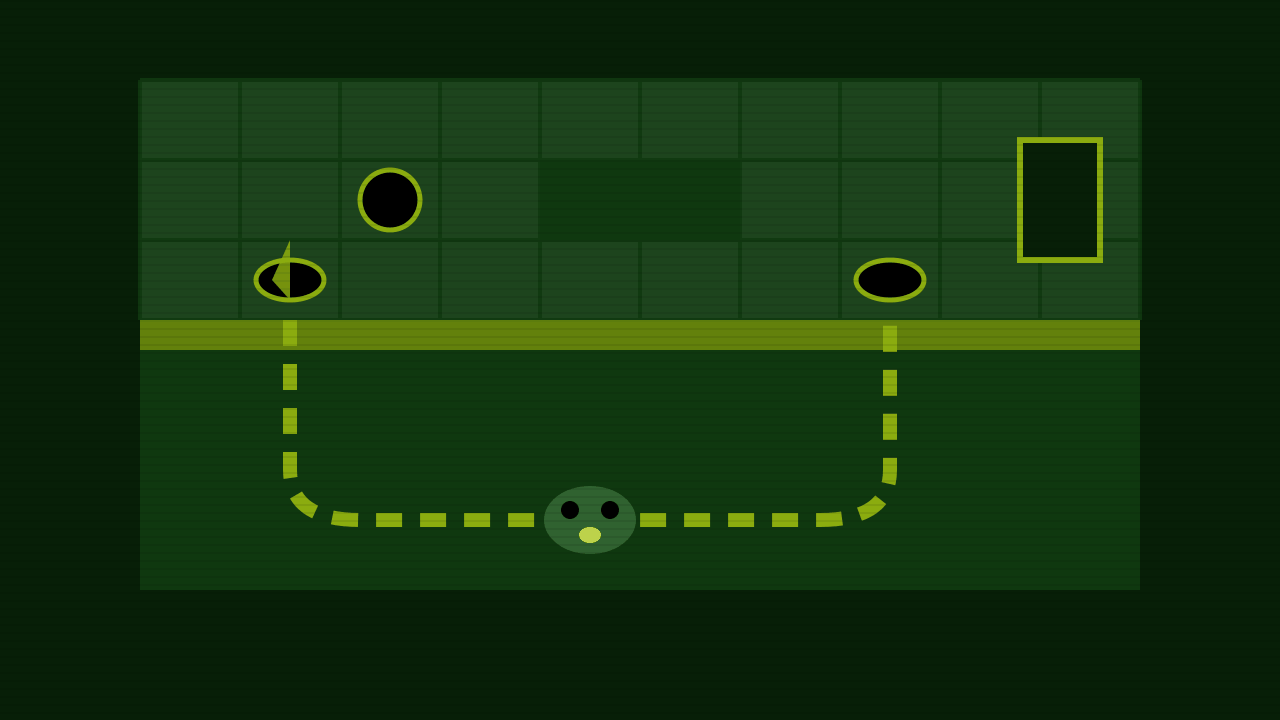 The surface board and the tunnels beneath — reading two maps at once (illustration, AI-generated)
Lineage to the Present
Commercially the game remained quiet, and no sequel was ever made. But its 2012 re-release on the Nintendo 3DS Virtual Console brought reappraisal. Charles P. Gill of Hardcore Gaming 101 called it 'the result of what happens when smart game developers take a very simple premise and think of how to expand it in millions of smart ways,' and retrospectives such as 1UP.com's likened its play to Adventures of Lolo.
In the lineage of the genre, the game demonstrated two things. First, adding verbs does not make puzzles easier — it widens the problem space. With pull, throw and dig joining push, the one-screen problem became dramatically more layered. Second, the very idea of a two-layer board. No developer testimony documents a direct line of influence, so I will not claim causation. But anyone who plays it will recognize that switching between surface and underground to route a path exercises the same muscles as today's multi-layer puzzles — the nesting of Patrick's Parabox (2022), the world-hopping of Cocoon (2023).
 Two-layer thinking continues into today's multi-layer puzzles (illustration, AI-generated)
Sources
Sources consulted for this article:
・Wikipedia: Mole Mania (release dates, staff, reception; the Total!, Nintendo Power and 1UP.com assessments are drawn from citations collected there)
・Wikipedia (Japanese): Moguranya
・Hardcore Gaming 101: Mole Mania (Charles P. Gill, 2017)
・MobyGames: Mole Mania (credits and platform data)
・Nintendo Life: Mole Mania Review (3DS eShop / GB, 2012)
・Nintendo Life: Mole Mania, Miyamoto's Forgotten Game Boy Classic (2021)
Closing
Among the works Shigeru Miyamoto touched, this one is rarely discussed. Yet inside that monochrome screen of 1996, the tools modern puzzles still rely on were already assembled: the tension of an irreversible move, room-by-room problem setting, and two-layer spatial reasoning. Digging up forgotten works — my line of work — is, come to think of it, rather like a mole's. What this game demonstrated historically is that a single verb, 'dig,' can give depth to a flat board.
 To dig something up is also to remember it (illustration, AI-generated)
Reactions (no login)
Anonymous • one of each per visitor per day
Part of these series
Retro RevisitedEpisode 11 of 45
