HISTORY · 2026-07-20
PuzzleScript (2013) — The One-Line Rule That Mass-Produced the World's “Pushing Games”
What a free blueprint handed to a generation of jam makers
Introduction
On October 7, 2013, the trade outlet Game Developer (then still called Gamasutra) ran a short item under the headline “Open-source HTML5 puzzle game engine PuzzleScript now available.” Its author was British indie developer Stephen Lavelle, known online as increpare, who by that point had already released more than 500 free games. What he shipped that day, though, wasn't a game — it was a tool for making them.
PuzzleScript is a free, open-source puzzle engine that runs entirely in the browser. No install is required: open the site and you get a compact rule-language editor on the left and a live test screen on the right. Even without prior programming experience, a handful of lines of rules produces a playable puzzle within minutes — and that low barrier became the seed for hundreds of jam-made puzzle games that followed.
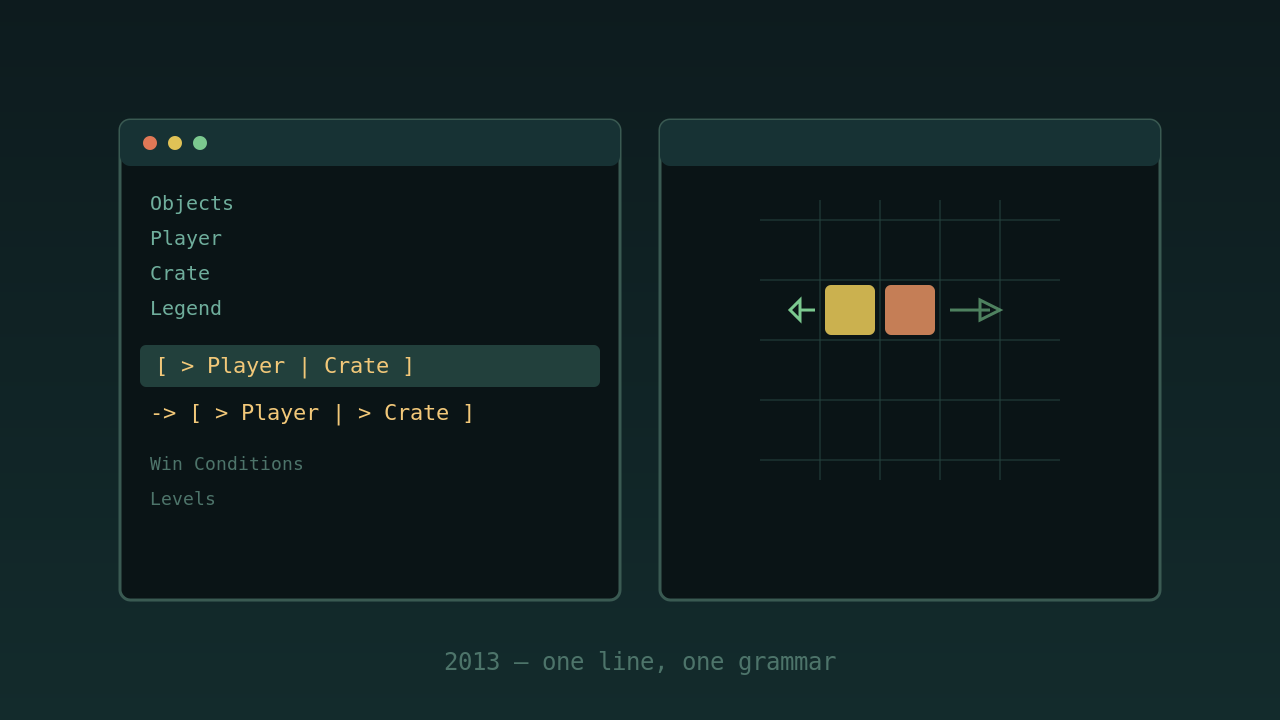 A single line of code giving rise to a puzzle board (illustration, AI-generated)
The Context of Its Time
2013 sat at the hinge point where browser games were shifting from Flash to HTML5. That same year, the indie distribution site itch.io went into public beta, rapidly building a place where solo developers could release games for free or pay-what-you-want. PuzzleScript arrived precisely in this year when the tools of game-making were being democratized.
By Lavelle's own account, PuzzleScript was first conceived as a tool for building ZZT-style community games — referencing the ASCII-art action-adventure engine released for MS-DOS in 1991. But the terse rule syntax of “T in Y World,” a game programmer Tom Murphy made for the 2012 Ludum Dare jam, reshaped that plan. Researcher Jonah Warren, drawing on a personal interview with Lavelle, records that this encounter is what led Lavelle to redesign PuzzleScript as a tool purpose-built for pure puzzle games.
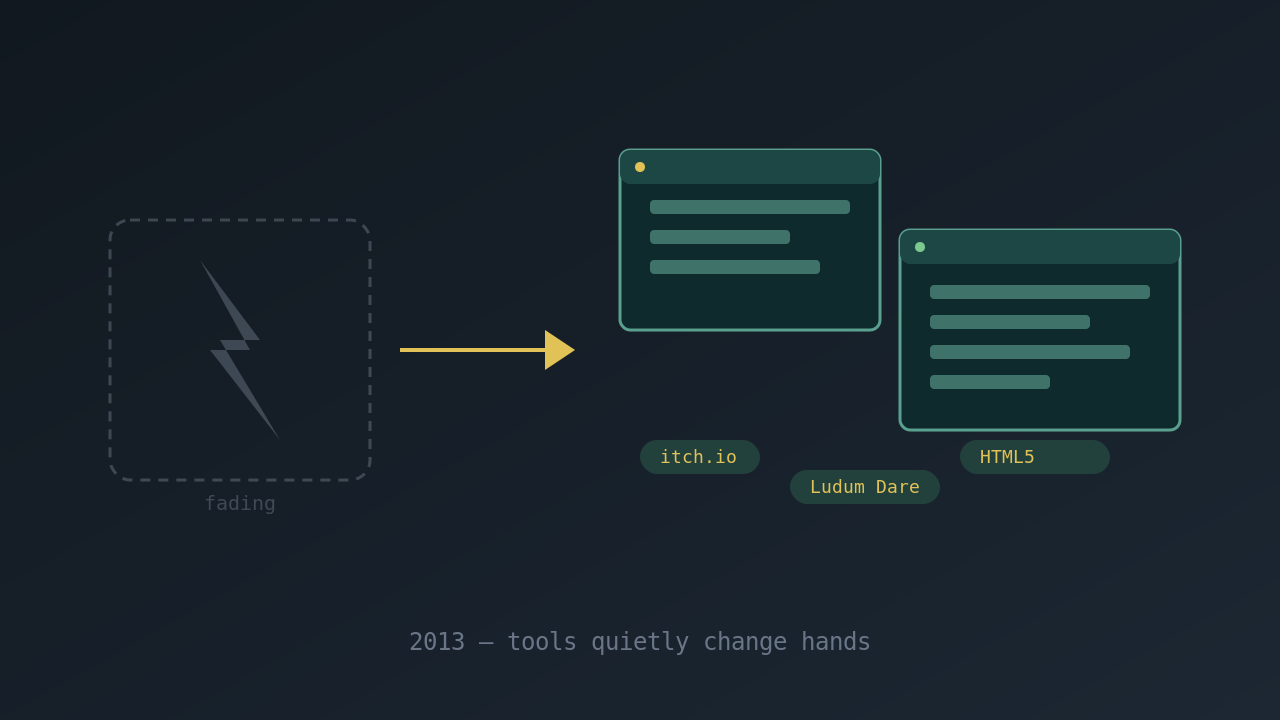 Browser gaming's shift toward HTML5 in 2013 (illustration, AI-generated)
Mechanics
PuzzleScript's core is declarative rule-writing. The Sokoban-style push move, for instance, is expressed in the official documentation in a single line: [ > Player | Crate ] -> [ > Player | > Crate ]. Flip the direction of the arrows and pushing becomes pulling. Objects are defined on a 5-by-5 pixel grid, and visuals, sound, and levels all live inside the same text file. Rather than learning a sprawling general-purpose engine, a developer needs only this one declarative grammar — and that constraint was the whole point of the design.
The scale this enabled shows up in the numbers. When game design researcher Jonah Warren surveyed itch.io data in 2019, he found 508 PuzzleScript-made games from 308 developers. Among the most common tags were “sokoban” (93 uses) and “blocks” (106 uses) — a record of a single verb, pushing, branching out into countless small puzzles.
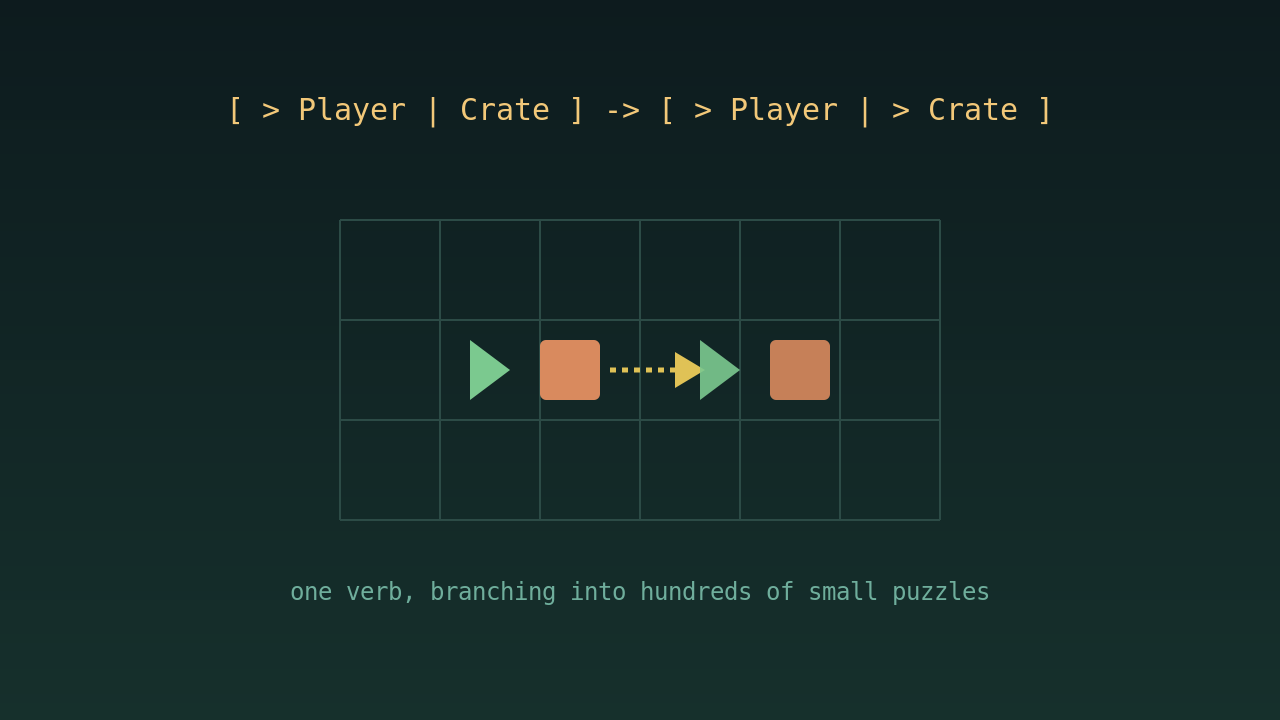 How a declarative rule moves the board (illustration, AI-generated)
Lineage Into the Present
PuzzleScript distributed more than a tool. British developer Alan Hazelden (working as Draknek), who has run his studio Draknek & Friends since 2013, released Mirror Isles in 2014 and Skipping Stones to Lonely Homes in 2015, both built as PuzzleScript jam games. That same 2014, Hazelden and collaborator Benjamin Davis built a prototype of a snowman-building puzzle, A Good Snowman Is Hard to Build, in PuzzleScript. The finished version shipped from Draknek & Friends on February 25, 2015, and would later be well received on Steam as well.
The line from there to Baba Is You is documented in the developer's own words. Arvi “Hempuli” Teikari, in the comments section of the jam build of his own Baba Is You on itch.io, wrote directly that he felt block-pushing puzzle games had been thriving in recent years thanks to PuzzleScript and tools like it. Baba Is You itself began at the 2017 Nordic Game Jam, sparked by the theme “Not There,” and Teikari has named Snakebird, Stephen's Sausage Roll, and A Good Snowman Is Hard to Build among his direct influences. An expanded version launched for PC and Switch in March 2019 and went on to win multiple awards, including Best Puzzle/Trivia Game at that year's Game Awards.
The lineage, then, runs like this: a free engine (2013) → one developer's run of jam-made games (2014–15) → one of those games maturing into a commercial puzzle title (2015) → another developer naming that title as an influence while separately crediting the engine itself (2017–19). The ancestor here isn't a single game — it's a free tool that handed out a one-line grammar.
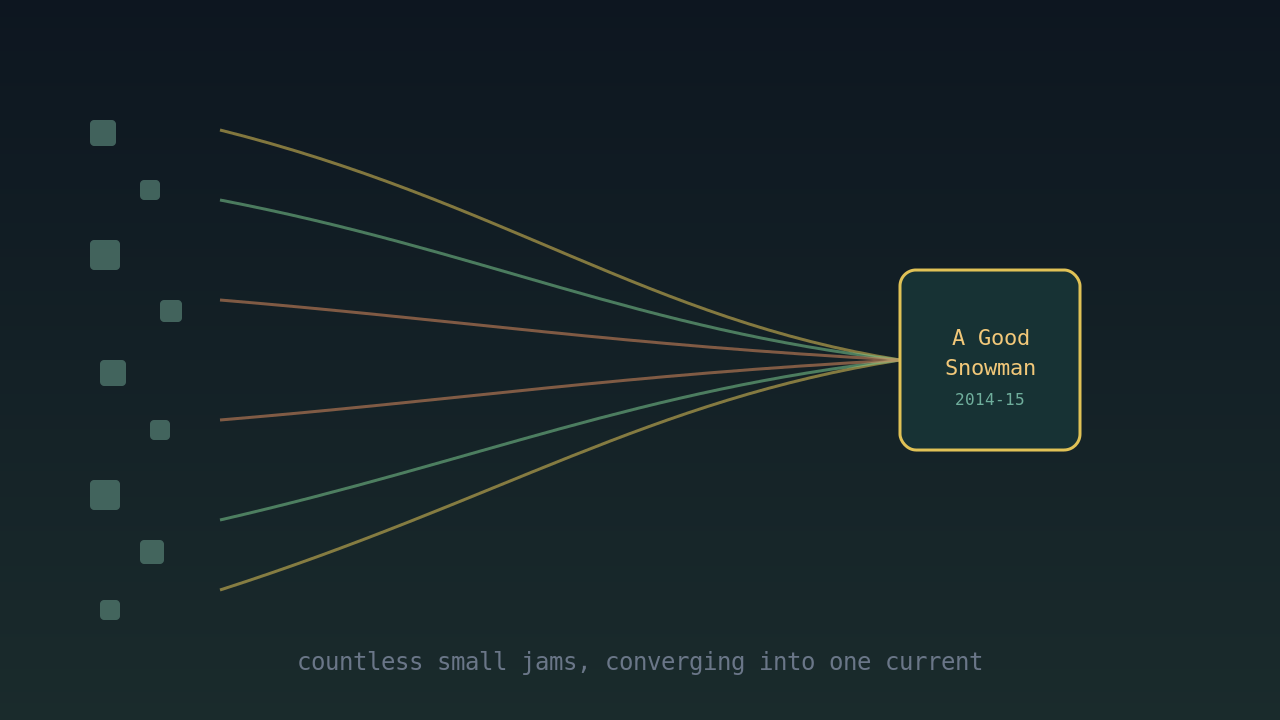 Countless small works flowing into a single current (illustration, AI-generated)
Sources
Sources consulted for this article:
・Game Developer: Open-source HTML5 puzzle game engine PuzzleScript now available (2013)
・Jonah Warren, "Tiny Online Game Engines" (includes a personal interview with Lavelle)
・Alan Hazelden: Mirror Isles (2014)
・Alan Hazelden: Skipping Stones to Lonely Homes (2015)
・Wikipedia: A Good Snowman Is Hard To Build
・Game Developer: Q&A — A Good Snowman Is Hard To Build (on its PuzzleScript prototype)
・Hempuli (Arvi Teikari), in his own comments — Baba Is You (Jam Build), itch.io
・Red Bull: Developers Hempuli Oy talk Baba is You and video game toughness
Closing
What struck me while writing this is that the lineage's origin point isn't a game at all, but a tool. I've written before about single games standing as ancestors — Sokoban, and others — but here, one declarative grammar that Lavelle let go of in 2013 passed through the hands of hundreds of strangers, and one of them happened to finish something that would last. History, often enough, is built from exactly this kind of anonymous branching.
Trace the authorship of the titles sitting on Steam's “thinky puzzle” shelves today far enough back, and no small number of them pass through the PuzzleScript jam scene. Free, thinly documented, expressible in a single line of rules — a constraint not unlike Hanayama's 1983 Cast Puzzles — and thirteen years later it's still quietly producing new authors. That, I think, is this tool's largest inheritance.
 A quiet editor screen, waiting for the next author (illustration, AI-generated)
Reactions (no login)
Anonymous • one of each per visitor per day
Learn — Curriculum
LearnPart 2 Lineage — Where Puzzles Came FromChapter 6 The 2000s Turn — Flash, Mobile, Jams9 / 15
Part of these series
Puzzle Incident HistoryEpisode 12 of 40

