HISTORY · 2026-07-07
The Birth of the Jigsaw Puzzle (1760s) — The Man Who Cut Up Maps, and a Verb Unchanged for 260 Years
From John Spilsbury's 'Dissected Maps' to Depression-era cardboard and the light of VR
Introduction
This is a pastime born in 1760s London. The map engraver John Spilsbury (1739–1769) mounted copper-plate printed maps on thin boards and cut them apart along national borders. Putting the scattered countries back into a single sheet — he sold these as 'Dissected Maps.' It is the commercial starting point of the format that would later be called the jigsaw puzzle.
The jigsaw puzzle has become so ordinary that we forget it was ever invented. Yet consult the timeline: it predates the crossword (1913) by roughly 150 years and the 15-puzzle (1880) by about 120. A game that has never once required a rules explanation, surviving 260 years with its format essentially unchanged — across the whole history of puzzles, this is the only one.
This essay traces the context in which the format was born as an educational toy of maps, the structure in which 'where to cut' is itself the design, and the lineage that runs from wooden boards to 3D photographs inside VR. Not for nostalgia's sake — but to confirm where two inventions that modern puzzles use unconsciously, 'the picture is the progress bar' and 'if it fits, it is correct,' actually came from.
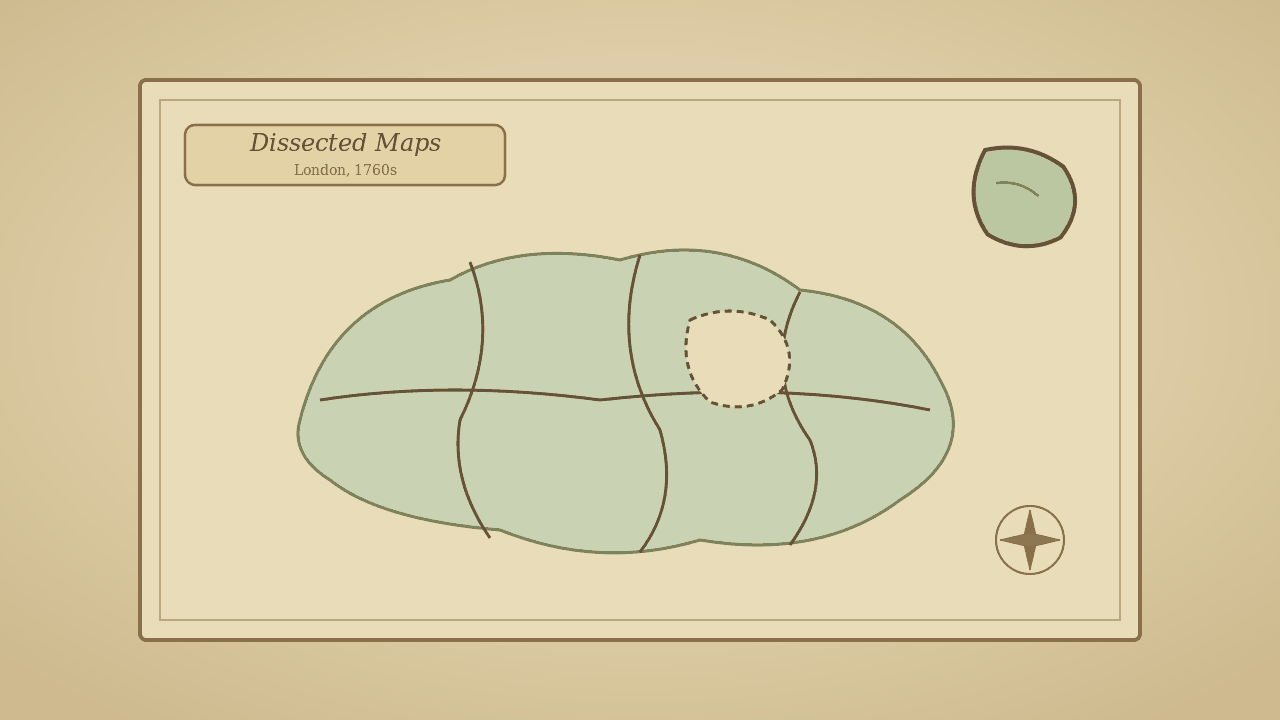 A single map cut apart along its borders — the 'Dissected Maps' of the 1760s (illustration, AI-generated)
The Context of Its Era
In late-18th-century London, a map was not cheap print matter but a luxury good embodying the knowledge of empire. Spilsbury was an engraver trained under Thomas Jefferys, Royal Geographer to King George III, and by 1763 he was advertising himself as an 'engraver and map dissector in wood.' The pastime was born precisely where the craft of making maps and the craft of cutting them coexisted.
What must not be forgotten is that these were sold not as entertainment but as tools for education. For the children of the upper classes, geography was essential learning, and returning the dissected countries to their correct positions was geography study itself. Sensing a business opportunity, Spilsbury stocked eight themes: the World, Europe, Asia, Africa, America, England and Wales, Ireland, and Scotland. It is a case of a play format entering the market first as curriculum.
As is always the case in history, 'the first person' is not straightforward. Letters from 1759 and 1762 record that the French educator Madame de Beaumont was already using wooden maps for teaching, predating Spilsbury's sales. Whether he was the 'inventor' or the 'first commercial producer' is phrased differently by different researchers. What is certain is that he established the format as a product, and that after his early death in 1769 at around thirty, his widow Sarah and his apprentice Harry Ashby carried the business — and the format — forward.
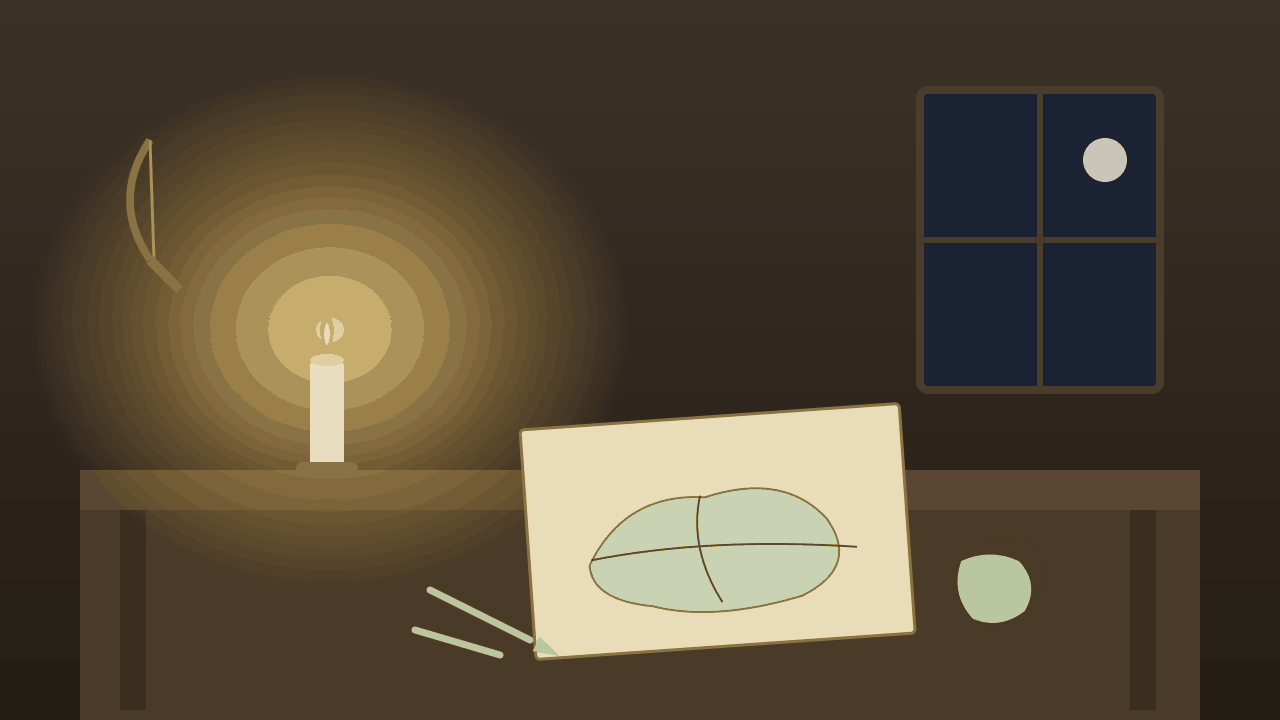 A candle-lit engraving workshop — where map-making and map-cutting shared a bench (illustration, AI-generated)
Mechanics
What kind of puzzle, structurally, is a dissected map? Its first peculiarity is that no rules explanation is ever needed. The goal state is shown by the finished picture itself; the shape of each piece supplies a local constraint, while the artwork supplies global information. The solver searches by moving back and forth between two independent information channels — 'shape' and 'picture.' This dual-channel structure is exactly why the jigsaw can be played, unexplained, by children and the elderly alike.
More important still: the early cuts followed 'lines of meaning' — national borders. Because each piece's outline was the shape of a country, the act of reassembly was directly an act of learning geography. Where you cut determines what the solver thinks about — an idea of the same type as modern level design guiding thought by 'where to place walls,' already implemented as a commercial product in the 1760s.
And then the sensation of the fit. A correct piece physically clicks into place; a wrong one does not. Verification of the solution is performed neither by a rulebook nor by a grader but by the object itself. Moreover, a placed piece never collapses; progress increases monotonically. No deadlock exists, and not even Undo is needed. If Sokoban (1982) refined the tension of 'a state you can ruin,' the jigsaw had established the reassurance of 'a state you cannot ruin' 180 years earlier. Incidentally, the name 'jigsaw' was borrowed around 1880, once the fretsaw (jigsaw) became the standard cutting tool, and the phrase 'jigsaw puzzle' is recorded only from 1906. The tool gave the format its name — 120 years late.
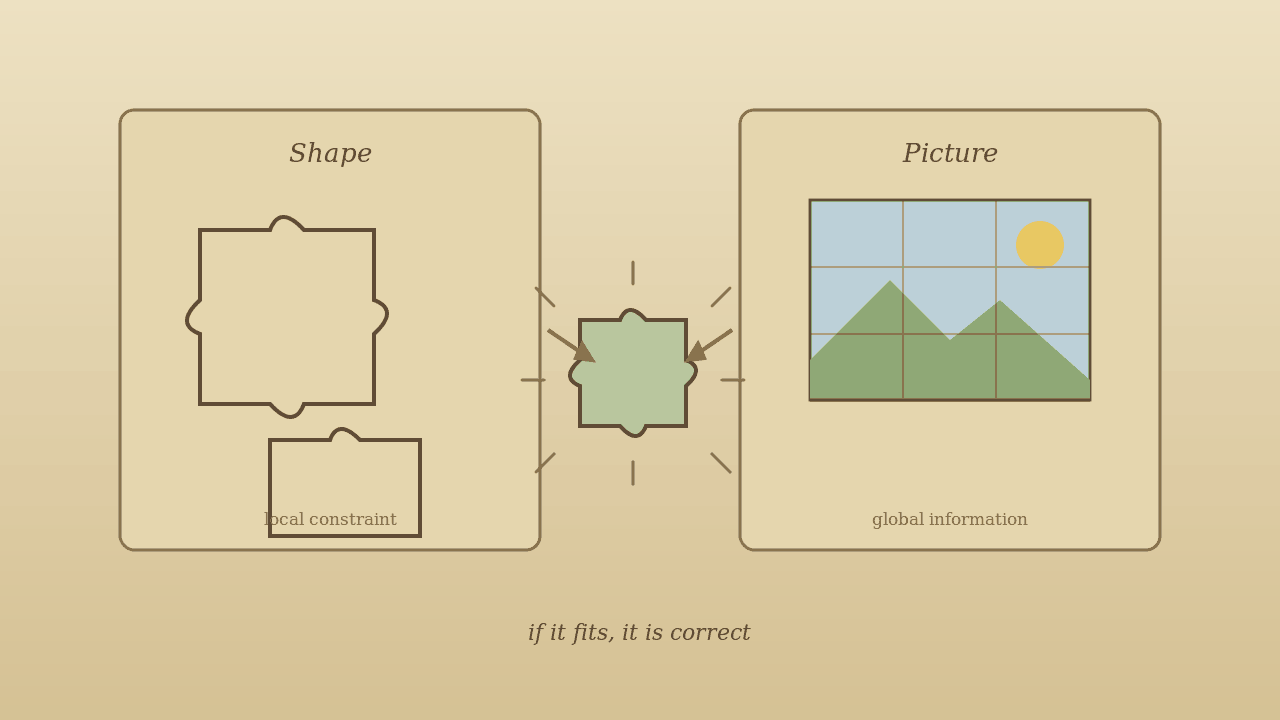 Shape as constraint, picture as information — self-verification by fit (illustration, AI-generated)
Lineage to the Present
The format's robustness was proven by two later explosions. In the 1930s, under the Great Depression in America, die-cut cardboard puzzles were mass-produced at a scale of millions per week, and local-history research reports that 100 million had been sold by March 1933. Cheap, complete without leaving the house, and guaranteed to deliver a sense of accomplishment — whenever recession and recreation are discussed, the jigsaw is always the first witness. And in 2020, under the pandemic, a third boom arrived, still fresh in memory.
The port to digital, too, succeeded without changing a single rule. In 2021, realities.io's Puzzling Places had players assemble photogrammetry-captured 3D models of real buildings and townscapes as volumetric jigsaws inside VR; a 3D jigsaw edition now sits on Steam as well. Between the wooden maps of the 1760s and the VR of 2021, the verb — 'return scattered fragments to their original whole, guided by shape and picture' — never changed once. I know of almost no other game design that switched materials and tools so many times without ever needing a spec revision.
Its legacy to today's thinking puzzles can be narrowed to two items. First, 'the picture is the progress bar' — a design in which the sight of approaching the finished image is itself the reward, inherited wholesale by today's cozy puzzles. Second, 'self-verification of the solution' — the physical feedback of the correct fit is the ancestral form of the snap-into-place effects of digital puzzles. Historically speaking, the jigsaw is the oldest mass-produced example of the design philosophy of embedding the verifier inside the problem itself.
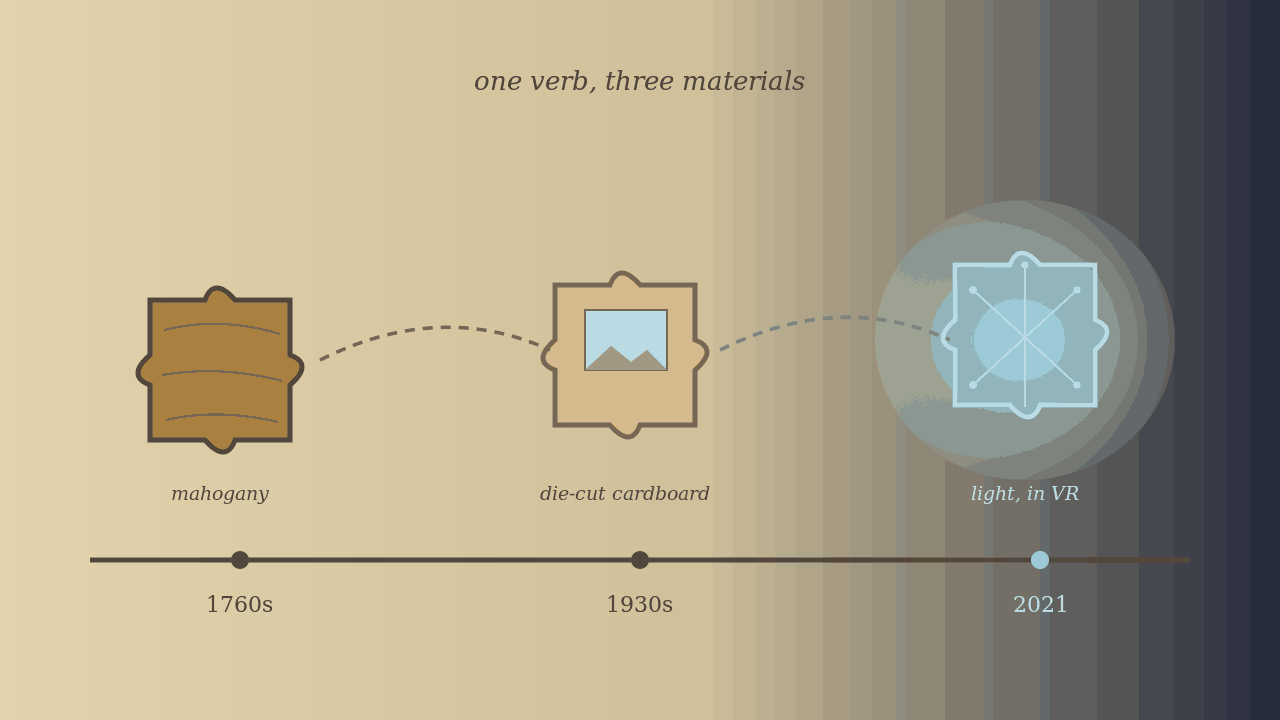 From mahogany board to cardboard to the light of VR — 260 years of transfers (illustration, AI-generated)
Sources
Sources consulted for this article:
・Wikipedia: John Spilsbury (cartographer)
・Geography Realm: Dissected Maps: the First Jigsaw Puzzles
・Historic Geneva: Dissected Maps: The Origins of Jigsaw Puzzles
・Historic Geneva: Puzzling During a Pandemic: America's 3rd Puzzle Craze
・British Library: Jigsaw puzzle, 1766 (archived)
・Guinness World Records: First jigsaw puzzle
・PlayStation.Blog: Puzzling Places, the 3D jigsaw puzzle game is coming to PS VR (2021)
Closing
Spilsbury died in 1769, at around thirty — roughly 110 years before the name 'jigsaw' was born. He never knew what his product would come to be called. The tool changed from fretsaw to die, the material from mahogany board to cardboard, and now the matter itself has vanished into the light of VR. Yet the format remained. Outliving its maker, its tools, and its materials, only the design — the way of cutting — survived 260 years.
What this format demonstrated, historically, is plain: the body of a puzzle is neither its material nor its board, but a single line — where to cut. Cut along borders and it becomes a geography lesson; cut ignoring the picture and it becomes a fiend; cut through a photographed space and it becomes VR meditation. The cutting line drawn in a 1760s London workshop still runs across our drafting tables today.
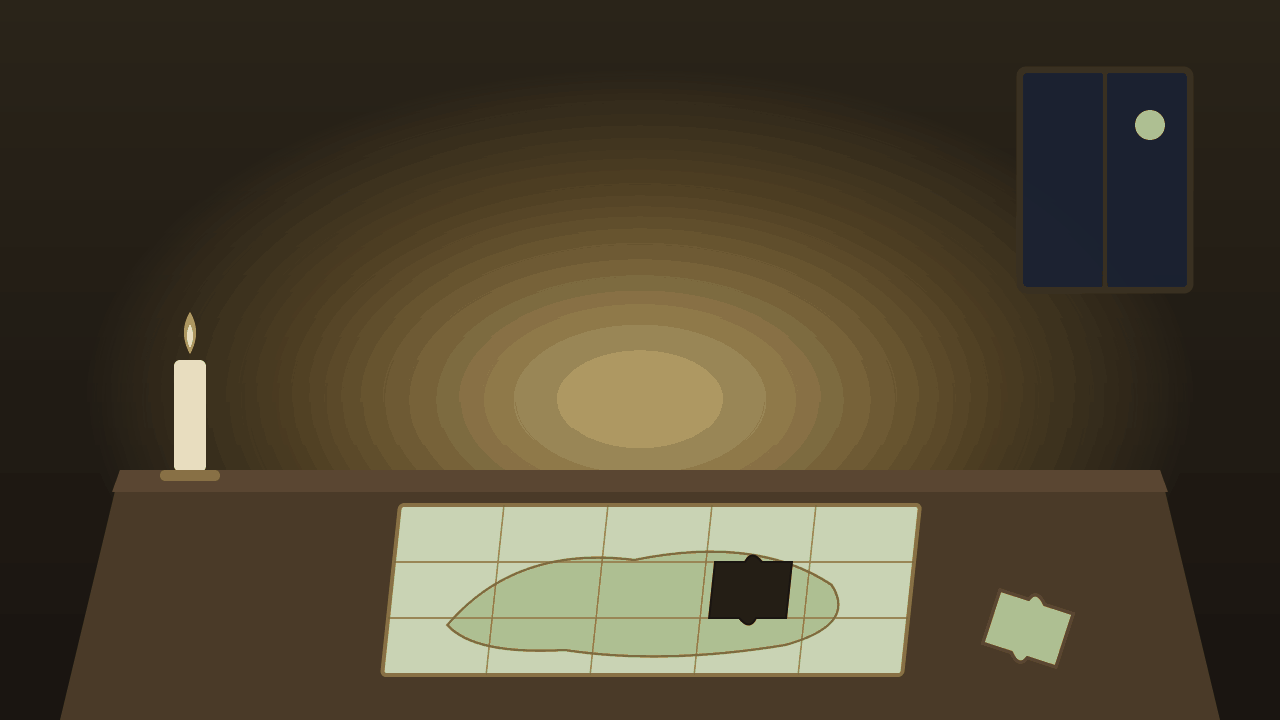 A desk awaiting its final piece — the same stillness as 260 years ago (illustration, AI-generated)
Reactions (no login)
Anonymous • one of each per visitor per day
Learn — Curriculum
LearnPart 2 Lineage — Where Puzzles Came FromChapter 3 Puzzles of Paper and Wood1 / 11
Part of these series
Puzzle Incident HistoryEpisode 7 of 52