HISTORY · 2026-08-23
The MDA Framework (2004) — Three Words Puzzle Designers Still Use
Mechanics, Dynamics, Aesthetics — sharpened in a GDC workshop room
A Paper for Three Words Alone
This is a paper published in 2004, only a few pages long. It isn't a game. But the words "mechanics" and "dynamics" that I've used throughout this column all trace back to it.
Three people wrote it: Robin Hunicke, Marc LeBlanc, and Robert Zubek. They named it "MDA." Today I want to dig into those three letters as part of puzzle history.
The 1999 Homework Doug Church Left Unfinished
The story goes back to 1999. In the trade magazine Gamasutra, designer Doug Church wrote an article titled "Formal Abstract Design Tools." His proposal: game design needed a shared toolkit, the way architecture or engineering already had one.
Church was then at Looking Glass Studios, a small company. Ultima Underworld, System Shock, Thief — names still remembered today — came out of that studio one after another.
But his proposal never grew into concrete tools. The homework he left behind was picked up by a slightly later designer: Marc LeBlanc. Thief, from Church's Looking Glass Studios years (Steam official header image)
Designers Walk It Backwards — Mechanics, Dynamics, Aesthetics
From 2001 to 2004, LeBlanc taught an annual course at GDC called the "Game Design and Tuning Workshop." In 2004, with Hunicke and Zubek as co-authors, he turned the material into a paper for an AAAI workshop on game AI.
The paper laid out three layers. Mechanics are the rules and data themselves — the size of a board, how a piece moves. Dynamics are the behavior that emerges once those rules actually run.
Aesthetics are the emotions a player feels. The paper also defined "eight kinds of fun": sensation, fantasy, narrative, challenge, fellowship, discovery, expression, and submission.
What makes the paper sharp is a specific claim: designers and players walk it in opposite directions. A designer builds mechanics first, then dynamics, then aesthetics. A player feels the aesthetics first, passes through the dynamics, and only reaches the mechanics last.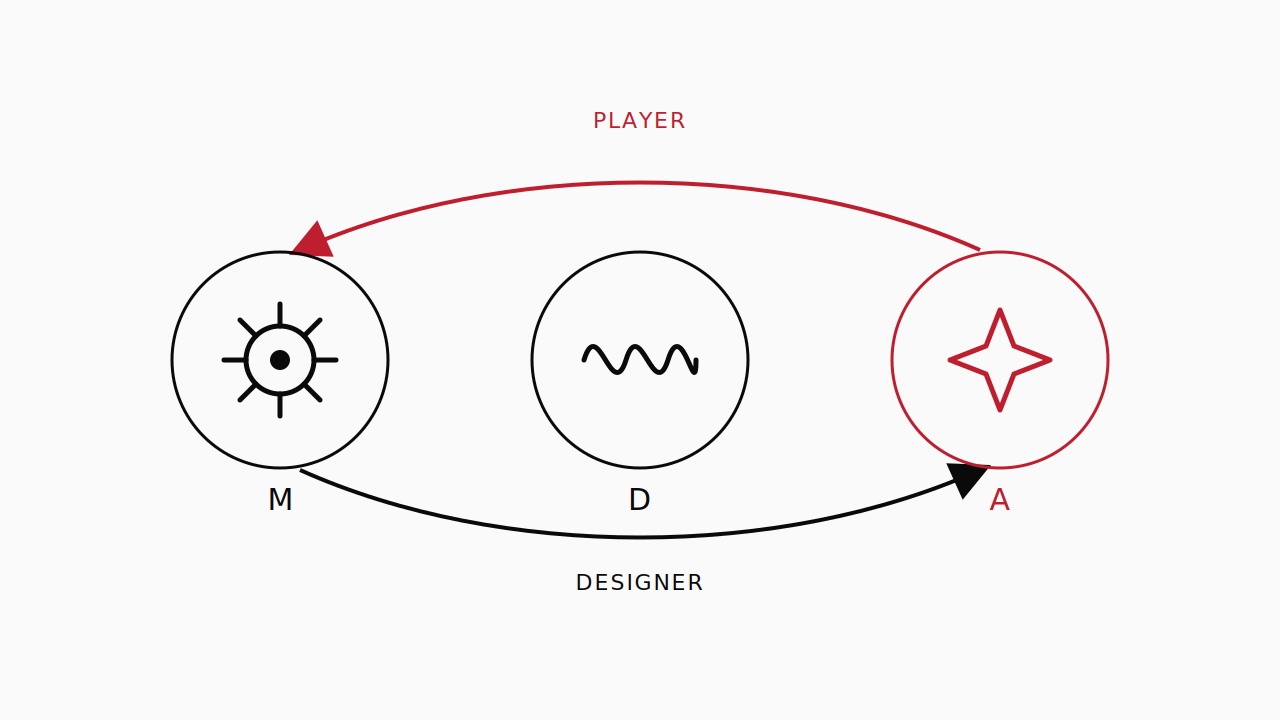 Building order and playing order run in opposite directions (illustration)
The Testimony Called Oasis, and the Road to Valve
One person actually tested this theory in a real project: Andrew Leker. In 2003, at his own studio Mind Control Software, he and Marc LeBlanc built Oasis, a browser-based strategy puzzle game.
Leker himself later said, looking back on the development, that he used Formal Abstract Design Tools and the MDA framework as design guides. Oasis shipped in 2005 and, the following year, won two Independent Games Festival awards, including Game of the Year.
Doug Church, who first left the homework unfinished, kept moving too. In 2011 he joined Valve — the company that today runs Steam, where most of the puzzles this column covers now live.
System Shock, which Church helped design, was remade by Nightdive Studios in 2023 and is still playable on Steam today. A piece of 1999's homework is still running, on the shelf we call Steam. System Shock, the 2023 remake (Steam official header image)
References
Sources referenced in this article:
- AAAI: MDA paper listing (AAAI Workshop, 2004)
- Game Developer (formerly Gamasutra): Formal Abstract Design Tools (Doug Church, 1999)
- Game Developer: Indie Postmortem: Mind Control's Oasis
- Game Developer: Revisiting the MDA framework (Luiz Claudio Silveira Duarte, 2015)
This Column's Own Vocabulary Comes From Here
That said, this framework isn't a universal answer. Critics have long argued that narrowing emotion down to eight kinds of fun is arbitrary. Others note it fits poorly with board games, where experience begins before the rules are even learned.
Even so, the vocabulary of "mechanics" and "dynamics" has outlived the paper itself, still serving as a shared language for design talk today. Sokoban's push, sudoku's point symmetry — both can be placed somewhere in these three layers. What this paper shows historically isn't a correct theory. It's the record of one attempt to put play into words.
Reactions (no login)
Anonymous • one of each per visitor per day
Learn — Curriculum
LearnPart 1 Introduction — Play and PuzzlesChapter 2 Words for Talking About Puzzles2 / 6
Part of these series
Puzzle Incident HistoryEpisode 28 of 54
