HISTORY · 2026-08-03
Masyu (2000) — The Loop of Black and White Pearls Born from a Misreading
The year between a board of white circles alone, called "Pearl Necklace," and the addition of black
Introduction
In April 1999, Puzzle Communication Nikoli issue #84 introduced a puzzle format in which only white circles were placed on the grid, to be connected by a single loop. It was named Shinju no Kubikazari — "Pearl Necklace" — and its only rule, at that early stage, was to draw exactly one loop passing through every circle. In the spring of 2000, issue #90 added black circles to the grid and renamed it Shiroshinju Kuroshinju ("White Pearl, Black Pearl"). That is where the paired rule still in use today — white circles force a straight pass-through, black circles force a turn — first came together.
The official name "Masyu," however, didn't arrive until three years later, in issue #103 (2003). According to English Wikipedia, the name traces back to an in-house misreading: Nikoli's president read the kanji 真珠 (shinju, "pearl") as "mashu." What began as a simple slip of the tongue became an inside joke in the editorial office, and was eventually promoted to the puzzle's official name.
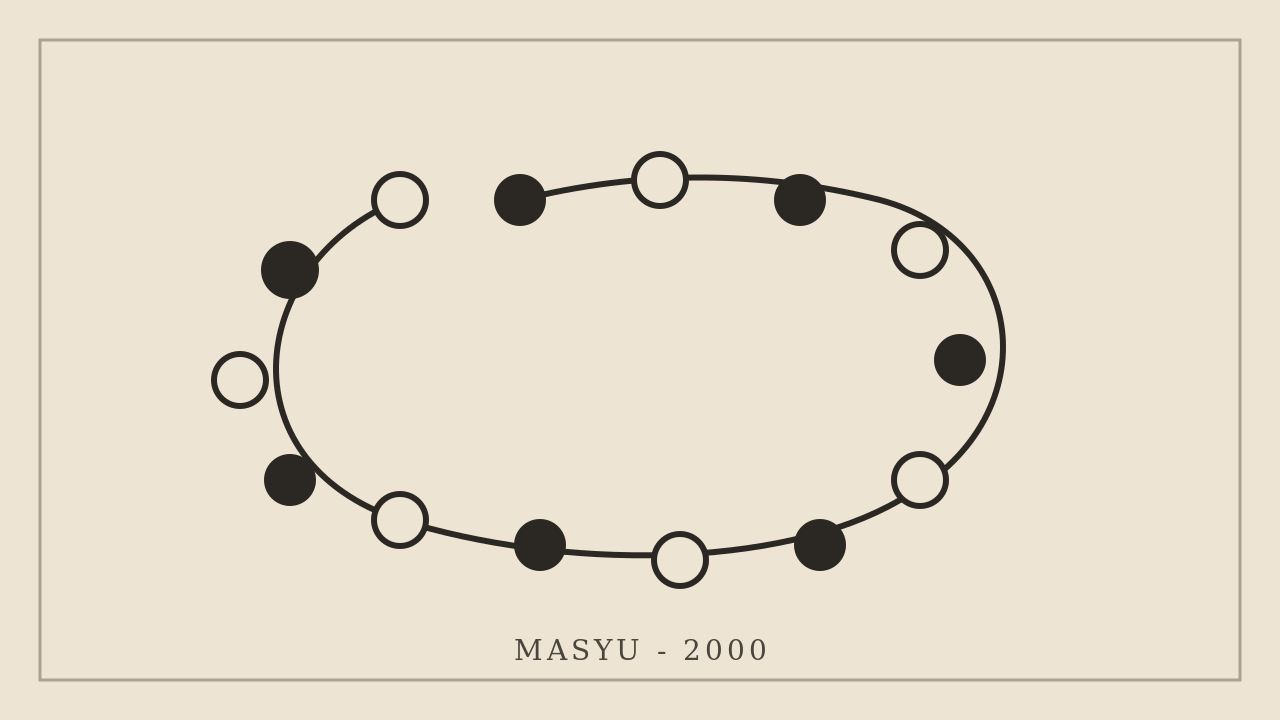 A loop connecting black and white pearls (illustration, AI-generated)
The Era
Place 1999–2000 within Nikoli's own history. More than fifteen years had passed since the magazine began running "Number Place," the puzzle that would become Sudoku, and ten years since Slitherlink's debut. But Sudoku's worldwide craze in the English-speaking world was still more than four years away — it was in 2004 that Wayne Gould found the puzzle in a Japanese bookstore, mass-produced grids by computer, and brought them to a London newspaper. At the time, Nikoli was still a workshop where puzzle craftspeople refined new formats using nothing but domestic reader submissions and their own quarterly print pages.
The path from "Pearl Necklace" to "Masyu" is itself an example of the gradual development typical of Nikoli in this era. As Japanese Wikipedia records, issue #84 first published the simple, white-circles-only form, which was then deepened in issue #90 — after reader feedback — by adding black circles. Building a puzzle with real depth out of nothing but the color of a circle, without a single digit or letter, was in fact the stated goal from the start: English Wikipedia notes the puzzle's purpose was "to present a puzzle that uses no numbers or letters and yet retains depth and aesthetics."
That goal of "depth without characters" wasn't fully realized by the white-circle-only board. Only once a second symbol — the black circle — was added did a grid emerge where two opposing rules could genuinely pull against each other. This year-long gap before the design deepened shows that Nikoli's new formats didn't arrive complete in a single announcement; they were polished through back-and-forth with readers.
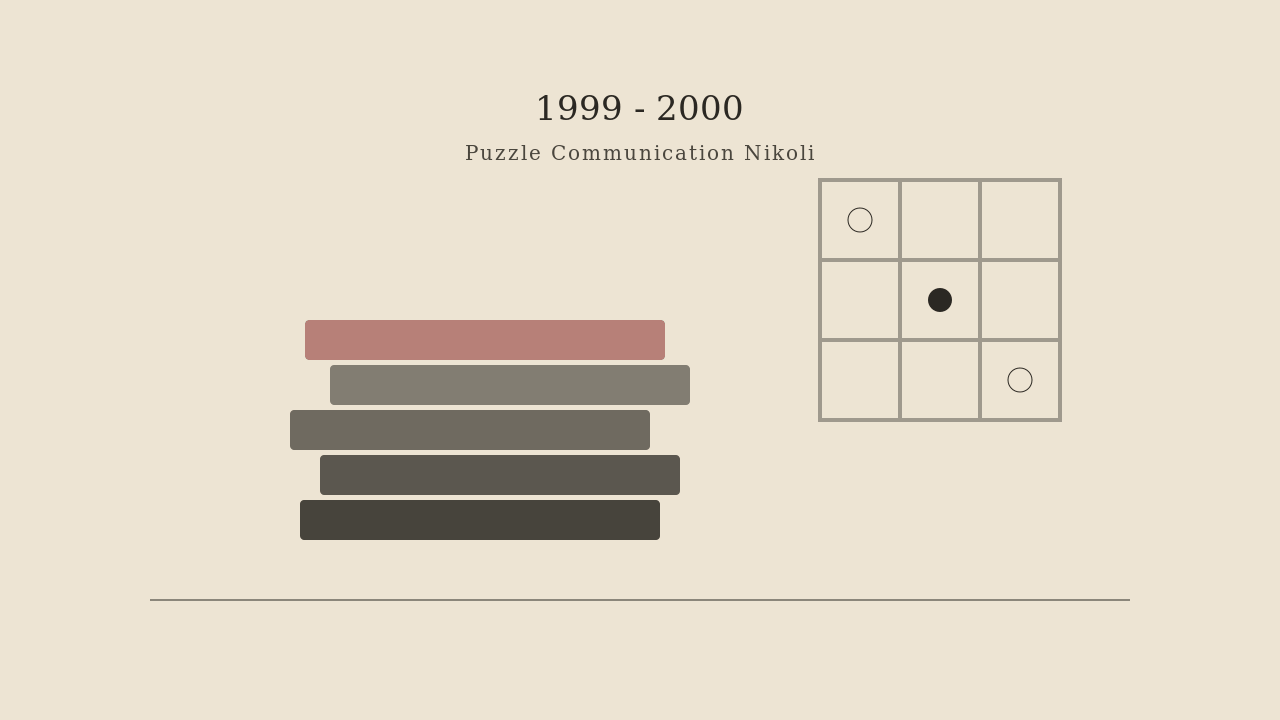 A 1999-2000 puzzle culture built purely from reader submissions and a quarterly print magazine (illustration, AI-generated)
Mechanics
Masyu's rule is simple. Some cells on the grid carry a white or black circle, and the solver connects the centers of cells to draw a single closed loop — one with no branches and no self-intersections. A cell with a white circle must be passed straight through by the loop, but the loop must turn in the cell immediately before or after it. A cell with a black circle, conversely, must be a turn, and the loop must go straight through the cells immediately before and after it. With no digits or letters at all — just one bit of information, whether a circle is black or white — this pair of constraints ripples across the entire grid.
Despite the visual simplicity of that rule, Masyu has been shown to carry genuine difficulty in the sense of computational complexity as well. Mathematician Erich Friedman, in the paper "Pearl Puzzles are NP-complete," showed that any cubic planar graph can be converted into a Masyu grid, reducing the puzzle to the already-known NP-complete question of whether that graph has a Hamiltonian circuit. In other words, solving Masyu at general grid sizes carries real, provable difficulty in a computational sense, not just an intuitive one.
Compared with other loop-drawing Nikoli puzzles like Slitherlink, Masyu's distinctiveness lies in the fact that the information on its grid is purely binary — the color of a circle. Unlike Slitherlink, which uses numbers, or Yajilin, which counts black cells, Masyu's symbols are visually self-contained in what they mean. From this minimal clue, chains of deduction radiate outward around each white and black circle until the entire grid is filled with a single closed loop — that chain of local deduction is the core of Masyu's mechanics.
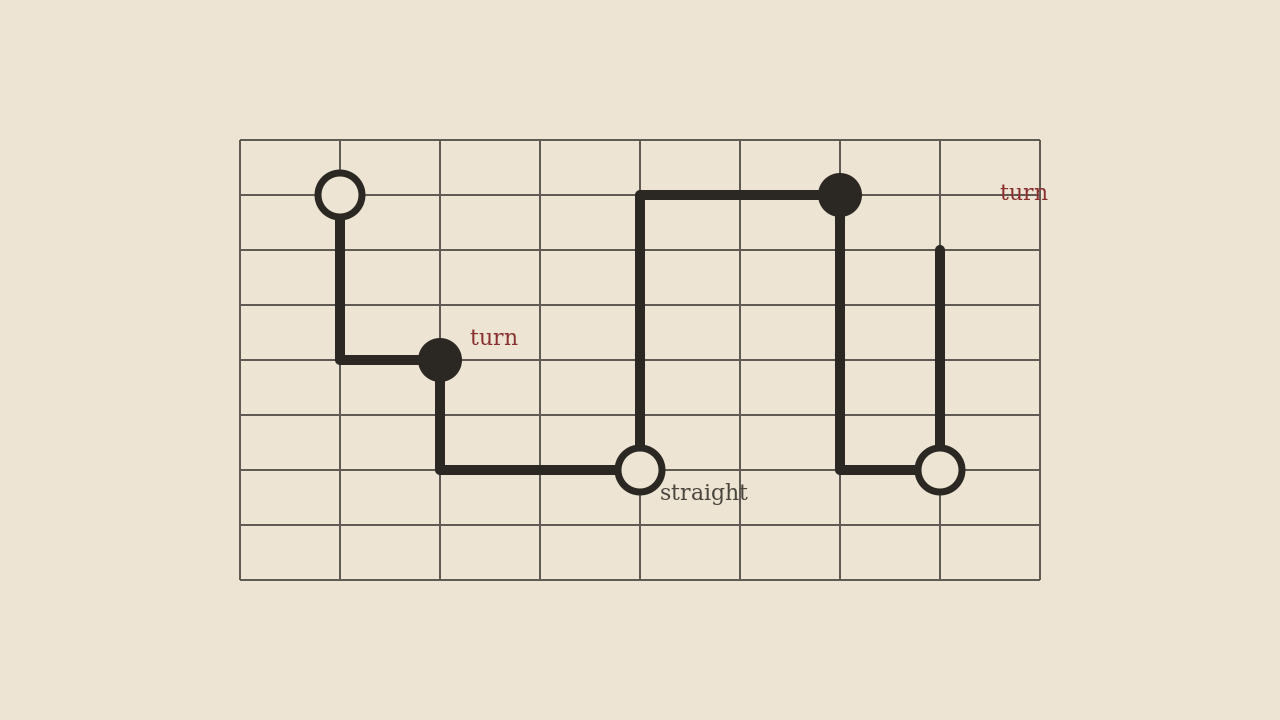 A loop turning at black circles, straight through white ones (illustration, AI-generated)
Lineage to the Present
Nikoli itself has kept carrying Masyu off the printed page. "Nikoli no Puzzle: Masyu" was released for the Nintendo 3DS, "Puzzle by Nikoli S: Masyu" followed on the Nintendo Switch, and "Nikoli no Puzzle W: Masyu" was officially released for Xbox. All were produced under Nikoli's supervision, turning the paper grid into something that could be mechanically mass-produced and auto-generated.
At the same time, Masyu has survived in the non-commercial world of open-source software as well. Simon Tatham's Portable Puzzle Collection includes a puzzle called "Pearl," which is a direct implementation of Masyu. Tatham's own official site describes it in language that is Masyu's rule verbatim: "draw a single closed loop... so that every square containing a black circle must be a corner not connected directly to another corner; every square containing a white circle must be a straight which is connected to at least one corner." Released under the Expat license, this implementation has been freely distributed for over two decades across Windows, Linux, Android, iOS, and even a browser-based WebAssembly version.
On the academic side too, Nikoli's puzzles, Masyu included, have drawn the interest of computer science. Beyond Friedman's NP-completeness proof mentioned above, computer scientist Donald Knuth discussed Nikoli's puzzles in his book Selected Papers on Fun & Games (CSLI Publications, 2011) — a fact recorded in a footnote on English Wikipedia. A notion born on paper has, over a quarter century, gone on to survive independently in three quite different places: an international console market, a volunteer open-source project, and academic papers on computational complexity.
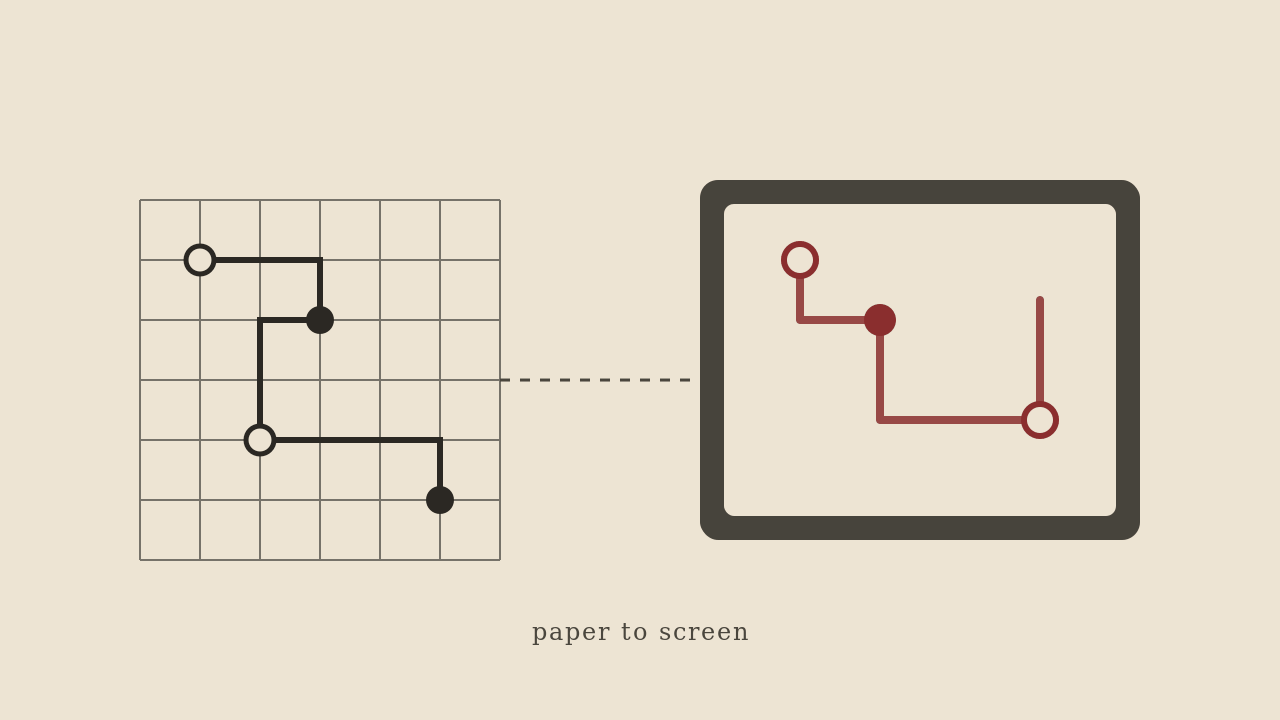 A paper grid's lineage branching toward the screen (illustration, AI-generated)
Sources
Sources consulted for this article:
・Nikoli official site (Japanese): How to play Masyu
・Nikoli official site (English): Masyu
・The Art of Puzzles: Masyu Rules and Info
・Erich Friedman: Pearl Puzzles are NP-complete
・Simon Tatham's Portable Puzzle Collection: Pearl
・Nintendo: Puzzle by Nikoli S Masyu (Switch)
Closing
Revisiting Masyu's history, what remains is less a story of invention than one of refinement and naming. A year passed between the simple white-circle-only form and the addition of black circles that completed the paired rule. Three more years passed before the official name was settled. A president's misreading of a kanji — an event with nothing to do with puzzle design — became, unaltered, the face of the grid.
The constraint of using no numbers or letters at all seems, at first glance, to allow for very little information. But it was precisely that minimalism that let the same rule travel unchanged into three very different places: console ports, a volunteer open-source implementation, and a proof of computational complexity. That depth can be built not from the quantity of symbols but from the strength of a paired rule — this is what Masyu has kept proving for twenty-six years.
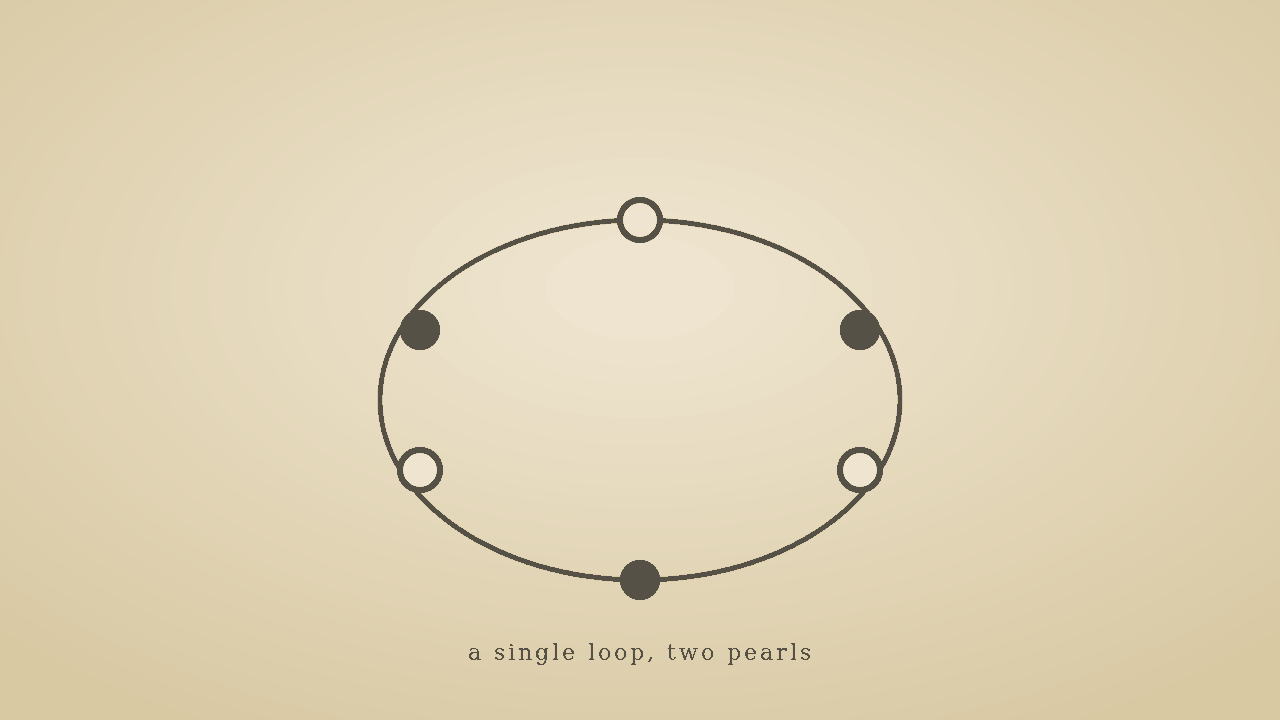 A single closed loop resting quietly on the board (illustration, AI-generated)
Reactions (no login)
Anonymous • one of each per visitor per day
Learn — Curriculum
LearnPart 2 Lineage — Where Puzzles Came FromChapter 4 Pencil Puzzles and Nikoli10 / 12
Part of these series
Puzzle Incident HistoryEpisode 20 of 40