HISTORY · 2026-09-15
Hitori (1990) — Why a Puzzle Too Hard to Catch On for 8 Years Is Still an AI Test Case in 2025
Puzzle Communication Nikoli #29, and the three rules a reader named Takeyutaka left behind
Introduction — Three Lines from a Reader That Became an Unerasable Logic
Hitori is a logic puzzle that Nikoli, the Japanese puzzle publisher, printed as a reader submission in Puzzle Communication Nikoli issue #29 in March 1990. Its inventor survives today only as a pen name: Takeyutaka. The name itself is plain enough. It comes from the rule's demand on any row or column with a repeated number: leave only one, and make the rest "alone" (hitori).
The play is simple to state. You black out some of the numbers packed into the grid. Once you're done, no row and no column may still hold two of the same number. But there are limits on how you black them out. No two black cells may touch, horizontally or vertically. And every remaining white cell must stay joined into a single connected group.
This modest blackout puzzle has kept changing shape for 35 years. It was ported to a handheld console in 2007, proven NP-complete by a complexity theorist in 2009, and in 2025 became the subject of a research paper that has an AI explain its own solving steps. Today I want to trace that lineage.
 Impression of a grid being sorted into black and white cells (illustration, AI-generated)
The Era — Nikoli Issue #29 in 1990, and Why It Took 8 Years to Sell
By 1990, when Hitori appeared, Nikoli was already a decade into publishing. Its founder, Maki Kaji, had started the company in 1980 and named it after a racehorse he loved, Nikoli, winner of the 1980 Irish 2,000 Guineas. Like Sudoku and Kakuro, Hitori wasn't dreamed up by the editorial staff — it came in as a reader's submission.
According to the Japanese Wikipedia, early Hitori puzzles were punishingly hard, and the format struggled to catch on. The turning point came around 1998. Puzzles built around the theme of never letting the board split apart became the mainstream style, difficulty settled into a fairer range, and popularity finally climbed. From invention to real traction: eight years.
It became its own standing feature in Puzzle Communication Nikoli from issue #33. Around the same time, Nikoli kept producing puzzles like Sudoku and Kakuro that resolve entirely through numbers, with no reliance on language. That same borderless, language-independent design is what let Nikoli's Sudoku cross into English-speaking markets in 2005. Hitori grew up under that same philosophy.
 Impression of the era of paper puzzle magazines (illustration, AI-generated)
Mechanics — Three Pillars: No Duplicates, No Adjacency, No Disconnection
Hitori runs on exactly three rules. First, whichever numbers you leave unblackened must never repeat within the same row or the same column. Second, no two black cells may sit next to each other, horizontally or vertically. Third, every white cell must stay connected to every other white cell, forming a single unbroken group.
The first two are what I'd call "neighborly" rules — you can check them just by scanning the board. The third, the connectivity rule, is different. Blackening one cell can sever a connection clear across the board. You can't solve it by looking only at what's local; it demands a view of the whole grid at once.
That difficulty is no accident. The English Wikipedia catalogs eleven distinct solving techniques for deciding which cells must be blackened and which must stay. If Sudoku is an additive rule — never repeat a digit — Hitori is a subtractive one: erase what doesn't belong. Two logic puzzles from the same publisher, pointed in opposite directions.
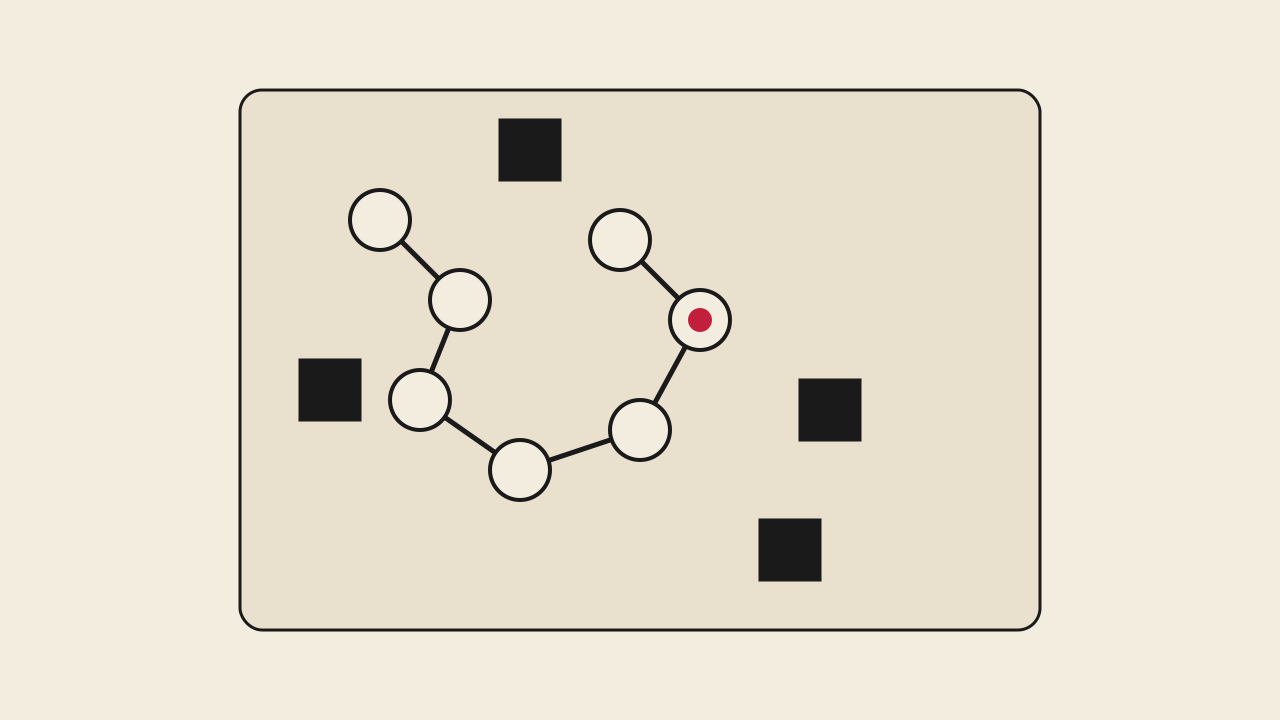 Impression of connected white cells versus isolated black cells (illustration, AI-generated)
Legacy Today — A DS Port, an NP-Completeness Proof, and a 2025 AI Paper
Paper logic puzzles making their way onto game consoles is a well-worn path for Nikoli's output. Hudson released Puzzle Series Vol. 10: Hitori for the Nintendo DS on March 8, 2007. The same Puzzle Series lineup already held Vol. 4, an August 2006 port of Kakuro (1966). Between those two entries, you can watch an entire era of paper puzzles settling onto handheld screens.
There's an academic lineage running through this rule set too. In 2009, complexity theorists Robert A. Hearn and Erik D. Demaine proved Hitori NP-complete in Section 9.2 of their book Games, Puzzles, and Computation. That confirmed something concrete: the three-pillar rule set, and especially the connectivity requirement, produces a computational hardness that brute force can't shortcut.
It hasn't run out of digital afterlives either. Simon Tatham's Portable Puzzle Collection (2004) includes this ruleset under the name "Singles," and the project's own documentation credits it plainly: the puzzle belongs to Nikoli, who call it Hitori. Then, in August 2025, AI researchers picked this exact grid as their test case in a paper titled "Explaining Hitori Puzzles," having an AI solve the board and explain its reasoning to a human reader — proofs for the local rules, pictures for the connectivity rule, as the paper puts it. A rule set a reader mailed in back in 1990 is, 35 years later, teaching material for research into explainable AI.
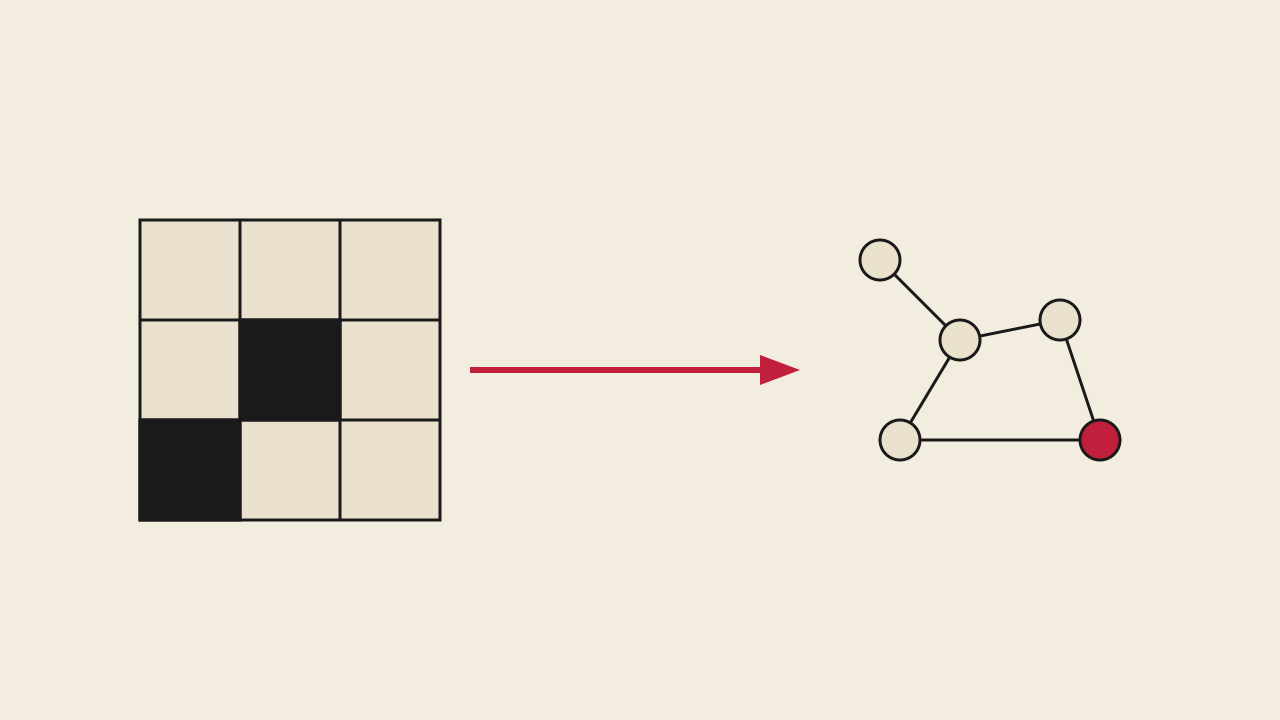 Impression of a paper puzzle's lineage into modern research (illustration, AI-generated)
Sources
Sources consulted for this article:
・Wikipedia (Japanese): Hitori ni shite kure
・Nikoli official site: how to play Hitori
・Wikipedia: Nikoli (publisher)
・Robert A. Hearn & Erik D. Demaine, "Games, Puzzles, and Computation" (A K Peters, 2009)
Closing — What a Puzzle Too Hard for Its Own Good Left Behind
Hitori isn't a flashy invention. It's a modest blackout puzzle built from nothing more than filled-in squares — and one that took eight years to find an audience after it was born.
And yet these three rules have survived 35 years without changing shape. Ported to a handheld, cited in a proof of computational hardness, now serving as teaching material for a paper that makes an AI explain itself. Looking back, what stands out isn't spectacle — it's how sturdy a rule set can be. Three lines a reader mailed in rarely keep working this long.
 A quiet impression of the one cell left behind (illustration, AI-generated)
Reactions (no login)
Anonymous • one of each per visitor per day
Part of these series
Puzzle Incident HistoryEpisode 37 of 40