HISTORY · 2026-08-02
Soma Cube (1933) — Twenty-Seven Fragments Born in a Quantum Mechanics Lecture
How a digression by Piet Hein began the lineage of solid dissection puzzles, and the thread that reached the Rubik's Cube
Introduction
This is the story of something born in Copenhagen in 1933. The Danish poet and mathematician Piet Hein (1905-1996) was sitting in on a lecture on quantum mechanics given by Werner Heisenberg. But his mind was occupied by something other than the lecture: a different thought experiment, namely, what happens if you enumerate every 'non-convex' fragment that can be made by joining four or fewer unit cubes at their faces, where at least one inside corner is formed?
Seven answers emerged. One shape made of three cubes (an L/V-shaped bend at a right angle), and six shapes made of four cubes. The total, 3 + (6 x 4) = 27, was exactly the number needed to fill a 3x3x3 cube without gaps or overlaps. Hein assembled the seven pieces at home and named the result 'Soma,' after the fictional drug in Aldous Huxley's novel Brave New World. He filed a patent for the invention in Denmark on December 2 that same year, though it took three years, until September 28, 1936, to be granted.
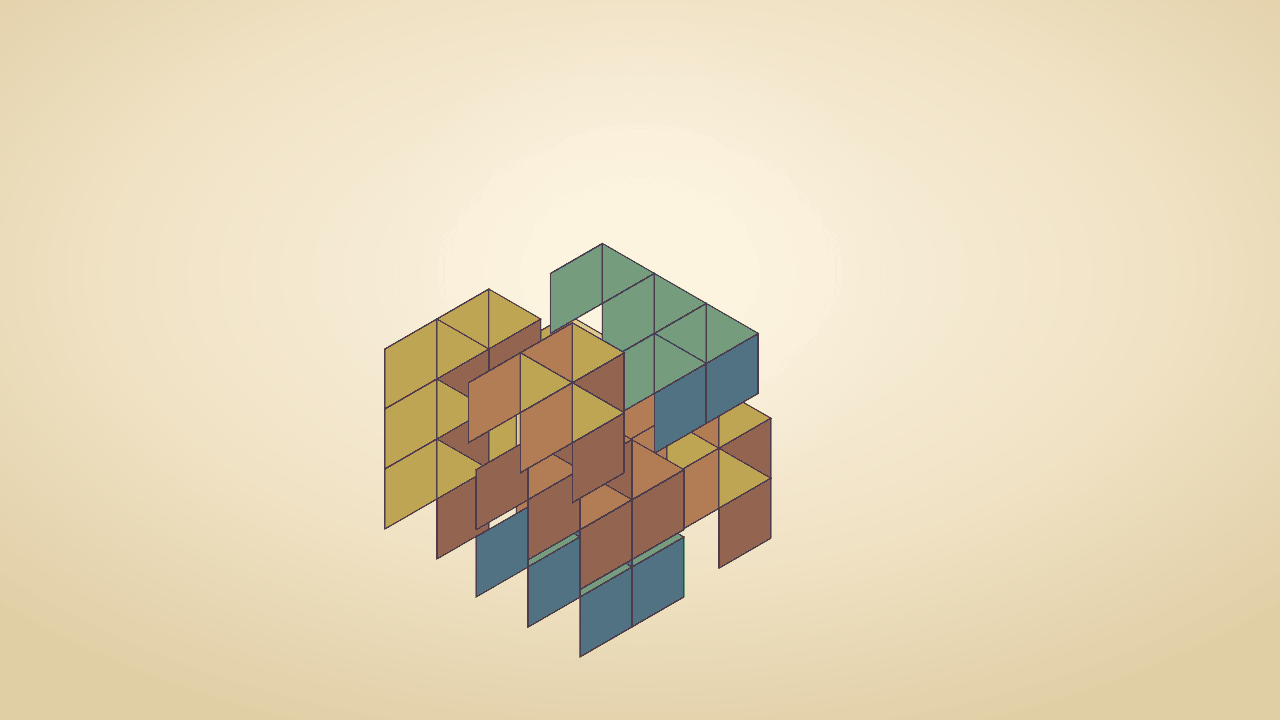 Seven color-coded fragments gathering together (illustration, AI-generated)
The Context of the Era
In 1930s Europe, it took time for a puzzle conceived by one individual to become widely known. Even after Hein's patent was granted, the Soma cube did not immediately reach the market as a product. Mass production is generally dated to around 1967, when the Danish furniture and woodworking company Skjode Skjern produced a fine rosewood edition. For roughly three decades after its invention, the puzzle remained in the hands of a limited circle.
The turning point came in September 1958. In the pages of Scientific American, Martin Gardner featured the Soma cube in his signature 'Mathematical Games' column. At the time, such general-interest science magazines were nearly the only channel through which a new mathematical puzzle could reach readers beyond specialists. Gardner's piece introduced the puzzle to readers worldwide and laid the groundwork for its later commercialization.
Commercialization arrived in earnest in the summer of 1969, when the American toy maker Parker Brothers released a plastic version in four colors: blue, red, white, and orange, and it became a considerable hit. The included booklet listed 36 shapes to build, though, as the story goes, only 33 of them were actually possible. That same year, Edward Deci, then a graduate student at Carnegie Mellon University, used the Soma cube as the task in an experiment examining how reward affected motivation, laying groundwork for the later theory of intrinsic motivation. That a wooden toy had made its way into a psychology lab's hands speaks to how far the Soma cube had spread by this era.
 A magazine page and a toy box (illustration, AI-generated)
Mechanics
The rule underlying the Soma cube is astonishingly simple. Enumerate every shape that can be made by joining four or fewer unit cubes at their faces, keeping only those with at least one concave (interior) corner, that is the sole generating rule. Among three-cube shapes, only one such 'non-convex' form exists, the L/V-shaped bend. Among four-cube shapes, there are six. Seven shapes in total, and 27 unit cubes, exactly the number needed to fill a 3x3x3 cube without gaps or overlaps. That the counting rule itself dictates the size of the board, this near-coincidence is what makes the Soma cube such a singular invention.
There are 240 distinct ways to assemble these seven pieces into a 3x3x3 cube, excluding rotations and reflections. The first to work out all of them by hand were the mathematician John Horton Conway and his collaborator Michael Guy. On one rainy afternoon in 1961, the two are said to have enumerated every one of the 240 solutions, and even built what became known as the 'SOMAP,' a diagram showing how to move pieces from any one solution to reach another. That the full shape of a solution space was mapped out by hand, in an age before computers, remains a suggestive precedent for later research into search algorithms.
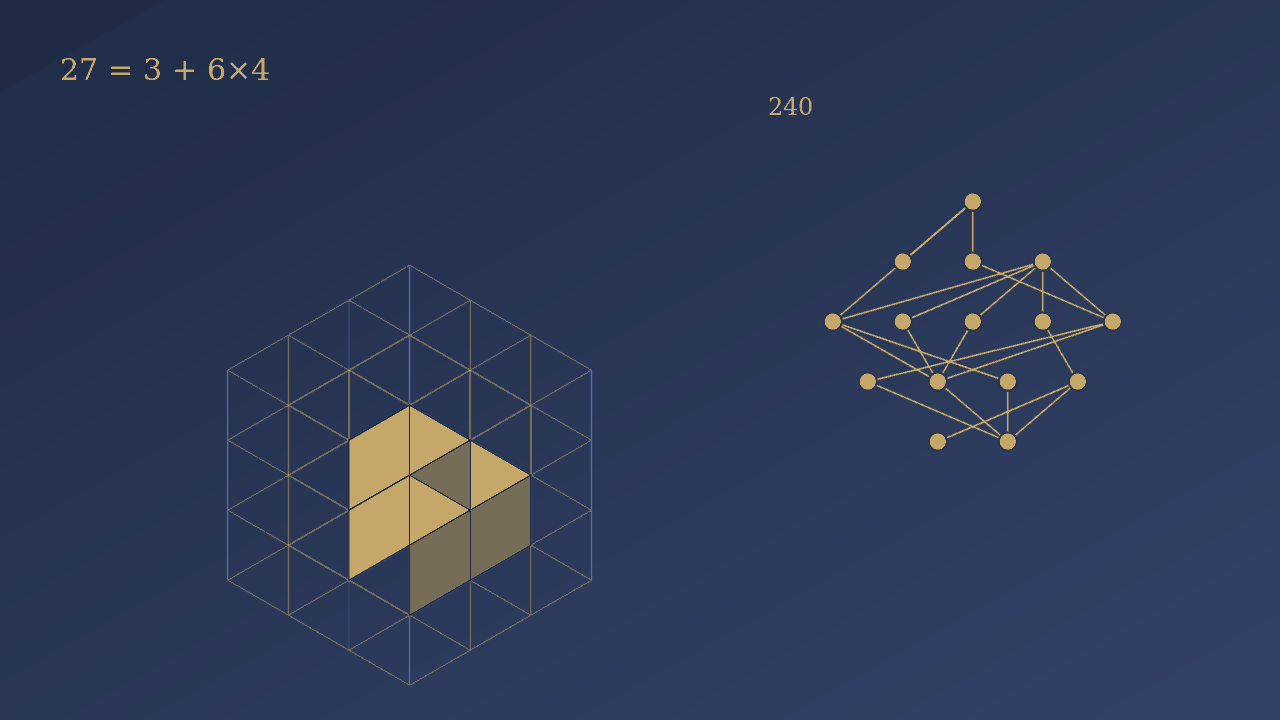 A grid, a piece, and a branching solution graph (illustration, AI-generated)
Legacy to the Present
How does this solid puzzle connect to present-day puzzle design? The most direct testimony, perhaps surprisingly, comes from another legendary puzzle maker's own words. Erno Rubik, inventor of the Rubik's Cube, devoted several pages to the Soma cube in his 2020 memoir Cubed: The Puzzle of Us All. As quoted by a book-review blog covering the memoir, Rubik called Hein's invention 'a work of art' and confessed that he 'created my own version of it long before I even imagined making the [Rubik's] Cube.' The Soma cube, together with MacMahon's colored cube puzzles, is said to have been one of two sources that shaped the very form of the Rubik's Cube. Readers may wish to pair this with our earlier piece on the Rubik's Cube (1974) elsewhere in this series.
The Rubik's brand itself has released a puzzle closely related to the Soma cube, called 'Rubik's Bricks.' It is made of fragments formed by joining cubes at faces or edges, and, using the fact that there are exactly nine ways to join three cubes this way, it too assembles into a 3x3x3 cube. Different name, same root idea.
The Soma cube itself remains active as a toy today. The Hein family's company, Piet Hein Trading, still sells the original, and ThinkFun continues to sell it under the name 'Block by Block.' Digital ports have appeared too, an iPad app called SomaBox and a VR assembly app called ARSoma among them. Successor solid-dissection puzzles carrying the same idea forward have followed, including the Bedlam cube, which fills a 4x4x4 volume with twelve pentacubes and one tetracube, and the Diabolical cube, which fills a 3x3x3 volume with six pieces. Designing a state space with a single solution, or only a handful, to be searched with a limited set of pieces, this design vocabulary had already appeared in a digression in a lecture hall more than ninety years ago.
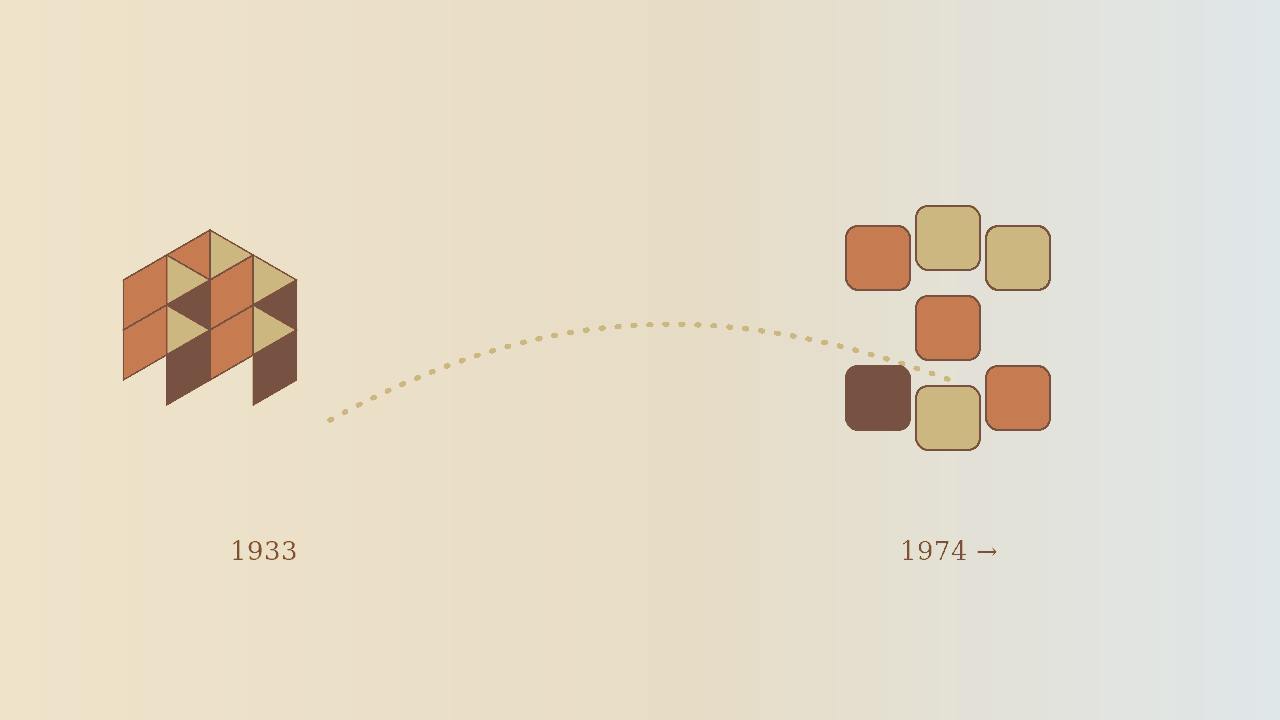 A thread connecting an old cube to a new one (illustration, AI-generated)
References
Sources referenced in this article:
・Wikipedia: Piet Hein (scientist)
・Thorleif Bundgaard (ed.), Ole Poul Pedersen: "The birth of SOMA"
・Toy Tales: SOMA Cube from Parker Brothers (1969)
・Siam Mandalay: What is the Soma Cube? A History of the World's Favorite Puzzle
Closing
A digression by a poet who could not quite focus on a quantum mechanics lecture became 27 wooden pieces, then a patent, then a magazine column, then a shelf in a toy store, then a task in a psychology lab, and half a century later, one of the foundations for another puzzle maker's invention. What the history of the Soma cube teaches me is that the rules of a great puzzle often outlive their inventor's original intent, taking new form in the hands of a different era and a different maker. Just as Sokoban was read forty-four years later as the ancestor of meta-puzzles, the Soma cube, too, continues to move through a living lineage ninety years on.
 A cube resting under moonlight (illustration, AI-generated)
Reactions (no login)
Anonymous • one of each per visitor per day
Learn — Curriculum
LearnPart 2 Lineage — Where Puzzles Came FromChapter 3 Puzzles of Paper and Wood8 / 11
Part of these series
Puzzle Incident HistoryEpisode 19 of 40