HISTORY · 2026-07-31
Get Off the Earth (1896) — The Patent Sam Loyd Took Out on a Miscount
One turn of a disc, and thirteen people become twelve
Introduction
In 1896, American newspaper columnist and puzzle maker Sam Loyd (1841-1911) patented a piece of cardboard engineering. A round disc, styled after a globe, is pinned to the center of a rectangular backing card and spins freely. An arrow printed on the disc points northeast, and around its rim you can count thirteen Chinese figures. Turn the disc just slightly, so the arrow points northwest instead, and only twelve figures remain. The title was Get Off the Earth. The disc has kept turning ever since, leaving only the question of where the missing man went.
This site has previously examined the 15 Puzzle of 1880, and how Loyd spent his later years falsely claiming to have invented it — a claim traced back to a documented fabrication. This time the story runs the other way. Get Off the Earth is one of the rare cases where Loyd genuinely devised the mechanism himself, patented it, and sold enormous quantities of it for the rest of his life. To place Loyd correctly in puzzle history, you need both faces: the fraud, and the genuine inventor.
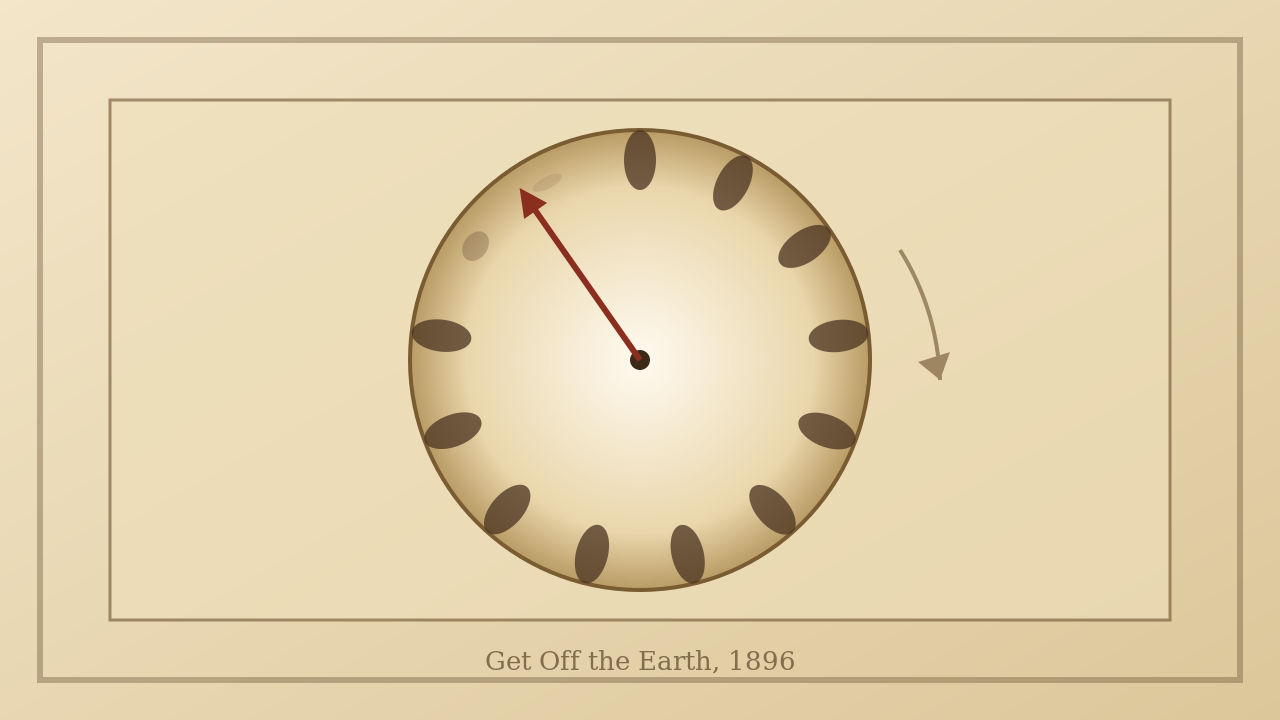 A figure quietly vanishing with every turn of the disc (illustration, AI-generated)
The Era
The America in which Loyd released this puzzle in the 1890s fought its puzzle battles mainly in newspapers and print advertising. Loyd himself ran a puzzle column in the Brooklyn Daily Eagle for years, soliciting reader solutions and offering prize money in a running two-way exchange. When Get Off the Earth appeared, he reportedly offered prizes from $5 to $100 for the best explanation of the vanishing figure — but published only the winners' names, withholding the actual explanations. Building suspense without answers, a marketing habit familiar from today's spoiler etiquette, was already Loyd's trade a hundred and thirty years earlier.
But the trick itself wasn't purely Loyd's invention. In 1880, New York's Wemple & Company sold an advertising card called The Magic Egg Puzzle, in which cutting a rectangular card into four strips and rearranging them made the egg count appear to shift between eight, nine, and ten. What Loyd patented in 1896 wasn't the cut-and-rearrange trick itself, but a more refined mechanism — a circular disc pinned at the center and rotated. It would be more accurate to call it a better device for an existing principle than an invention outright.
Nor was this Loyd's first fortune built on this kind of illusion. In 1858, a young Loyd devised a card showing two mules and two riders that, when cut and rearranged, made the riders appear correctly seated on the mules — Trick Mules. In 1871, P.T. Barnum reportedly paid $10,000 to attach his name to it, and it later sold as Famous Trick Donkeys, with more than 100 million copies said to have been sold over Loyd's lifetime. Running through Loyd's whole career is a single principle, sold again and again in different costumes: rearranging the pieces throws off the count.
 The era of puzzle columns and advertising cards crossing paths (illustration, AI-generated)
Mechanics
The trick behind Get Off the Earth is simple but well built. The thirteen figures are actually drawn across two sheets of paper — the disc and the backing card. Each figure — arms, legs, torso, head, sword — is assembled from several small fragments, with tiny slivers hidden just inside and outside the boundary between the two sheets. Rotating the disc from northeast to northwest shifts these boundary-crossing fragments just enough that the parts once shared among thirteen bodies get redistributed among only twelve. No one vanishes. Everyone gets very slightly thinner, until there isn't enough material left to outline one whole extra person.
This same illusion — mistaking a count of objects for a count of area or parts — reappears in another Loyd classic: the Chessboard Paradox (also called the Paradox of Loyd and Schlömilch), in which an 8×8 chessboard is cut into four pieces and reassembled into a 5×13 rectangle, apparently growing from 64 to 65 square units. In fact, what looks like a single straight diagonal line in the rectangle is very slightly bent, and the missing square unit of area hides in that sliver.
It's worth noting that this figure is still in active use today, known as the Missing Square Puzzle, taught in math classrooms. What it teaches students is not to trust a drawn figure by eye, but to reason from axioms and numbers alone. The trap Loyd set more than a century ago — don't trust what you see — is still doing classroom duty today.
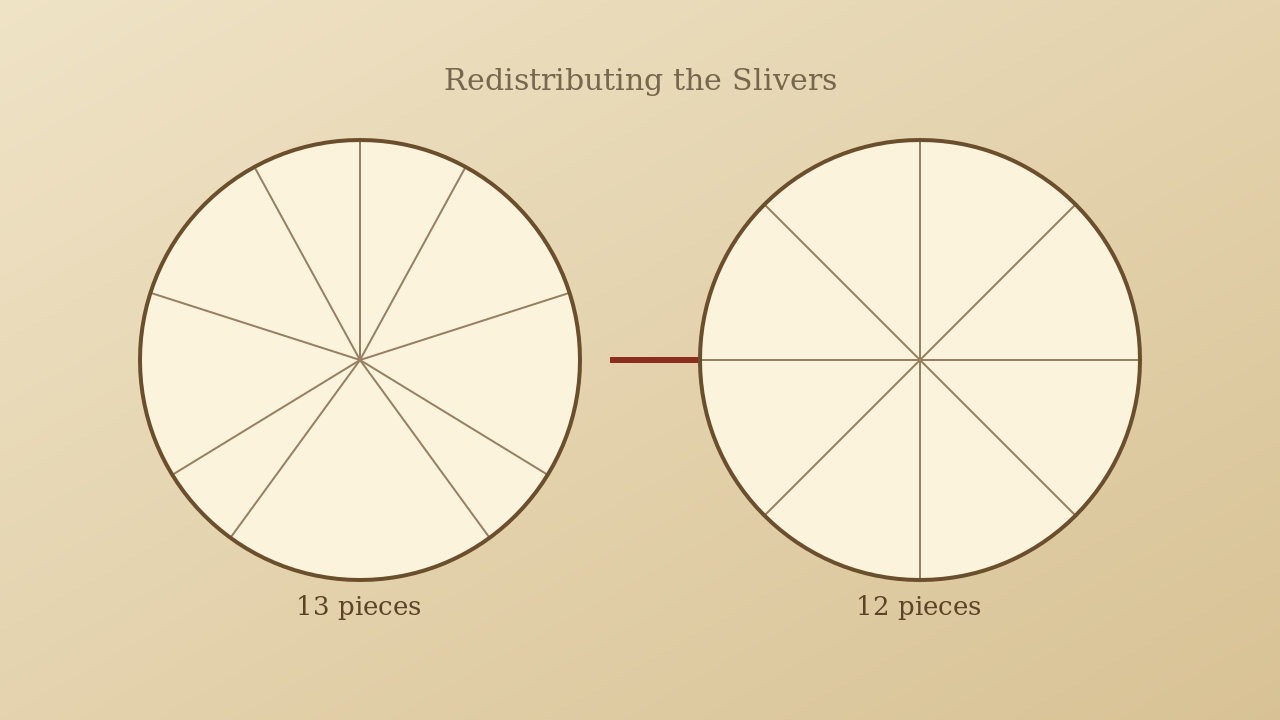 The mechanism of parts redistributing to change a count (illustration, AI-generated)
A Modern Lineage
It was mathematics popularizer Martin Gardner who carried Loyd's reputation into the twentieth century. In his August 1957 column for Scientific American, Gardner called Loyd "America's greatest puzzlist," and in his 1959 book Mathematical Puzzles and Diversions devoted the entirety of Chapter 9 to him. But Gardner also called him "obviously a hustler." It was his own admirer's pen that fixed Loyd in memory as both a fraud and a genuine inventor at once.
The principle Get Off the Earth planted — that cutting and rearranging throws off a count — kept surviving in new forms. In 1968, Pat Lyons produced the same geometric trick as The Vanishing Leprechaun, and in 2014 the Guardian's Alex Bellos wrote about modern digital illusions built on the same principle. The math education site cut-the-knot.org still hosts an interactive version you can rotate with a mouse to verify for yourself. The physical card disappeared, but the mechanism survived inside the browser.
You can find puzzles in the same family on Steam today. Gorogoa (2017) changes the meaning of an image by rearranging panels; Superliminal (2020) distorts perceived size by manipulating perspective. Both belong, in spirit, to the same lineage as Get Off the Earth: rearrangement or framing throwing off a count or a perception. But as far as I could determine, neither game's developers have cited Loyd by name. I can't claim a confirmed lineage here — only that the same principle appears to have survived independently, which is worth recording as such.
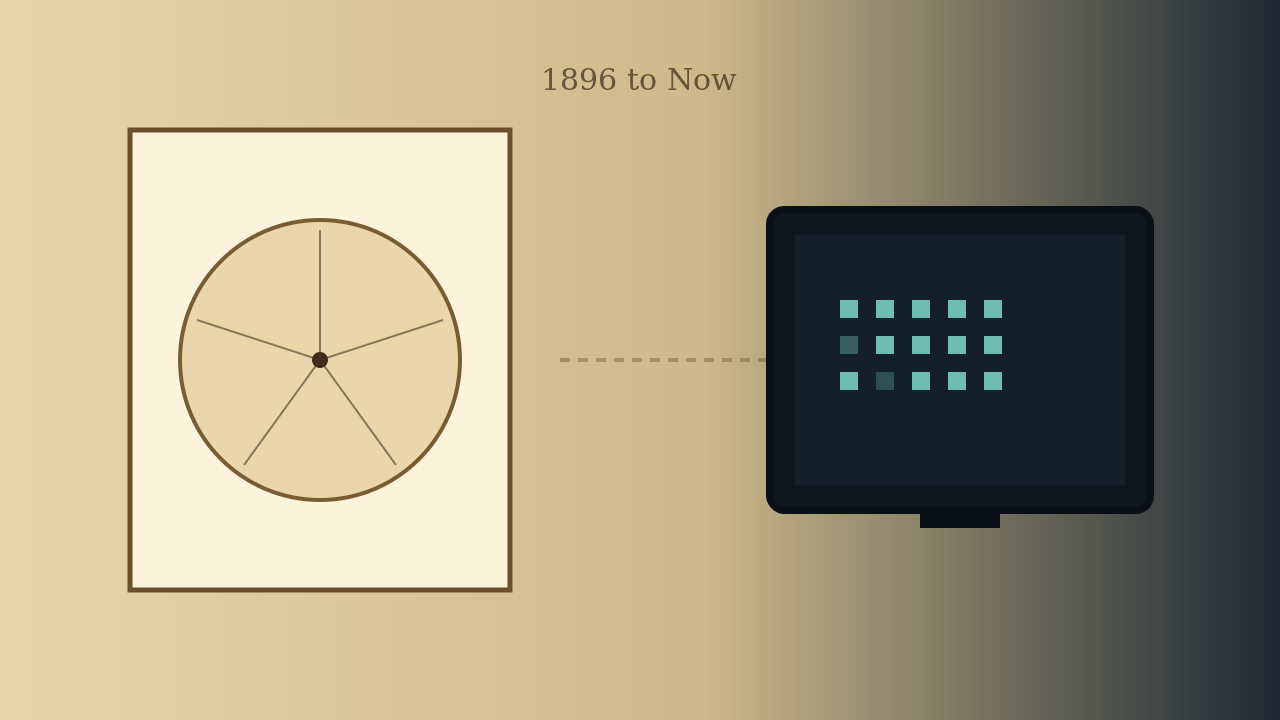 The trick surviving across a hundred and thirty years (illustration, AI-generated)
Sources
Sources consulted for this article:
・Wikipedia (Japanese): Sam Loyd
・Wikipedia: Missing square puzzle
・Wikipedia: Famous Trick Donkeys
・MacTutor History of Mathematics: Samuel Loyd (1841-1911)
・The Worlds of David Darling: Get Off the Earth
・Cut the Knot: Sam Loyd's Fifteen, the history of the puzzle
・The Guardian (Alex Bellos, 2014): Empire State Building vanishes
・Games Learning Society: How does the missing square puzzle work?
Closing
What Loyd lied about with the 15 Puzzle was claiming someone else's invention as his own. What he did with Get Off the Earth was the opposite: refining an existing principle into a more elegant device, patenting it, selling it in enormous numbers, and living off the profits for the rest of his life. You can't measure Sam Loyd's place in history without holding both of these in the same hand.
The disc he set spinning in 1896 still asks the same question, a hundred and thirty years later: should you trust the number or the outline you can see with your own eyes? Loyd's habit of dangling prize money without ever giving the answer survives today in spoiler etiquette, and in a math education that teaches you to trust axioms over pictures. Every time the disc turns, we're made to recount, once more, in the palm of a hustler dead for over a century.
 A card at rest after its turning is done (illustration, AI-generated)
Reactions (no login)
Anonymous • one of each per visitor per day
Part of these series
Puzzle Incident HistoryEpisode 18 of 40