HISTORY · 2026-07-30
Numberlink (1897) — From a Newspaper Puzzle Column to the Age of Flow Free and Zip
From Sam Loyd's Puzzled Neighbors to Nikoli's Arukone, and on to a pipe with 100 million downloads traced by fingertip
Introduction — The Neighbors' Pipes
In 1897, puzzle composer Sam Loyd printed a column titled 'The Puzzled Neighbors' in the Brooklyn Daily Eagle in New York. It asked readers to connect neighboring houses to their water and gas supplies without letting any of the pipes cross. This is the earliest confirmed ancestor of what we now call Numberlink. Newspaper puzzle columns of the era had little room for photographs or illustration, so a grid had to be built from type and rule lines alone — a constraint that suited the simple visual rule of never letting a line cross another.
Strictly speaking, Loyd's column is not identical in form to today's Numberlink. A closer version appeared in 1917, when England's Henry Ernest Dudeney published Problem 252, 'A Puzzle for Motorists,' in his book Amusements in Mathematics. There, letter pairs are connected by lines — a form quite close to what Nikoli would later name Arukone ('Alphabet Connection').
This rule — connect paired symbols with a single line, without crossing — reached Japan through Nikoli's magazine pages in the 1980s, where it was named Arukone for letters and Numberlink for numbers. This essay traces the long journey of that single line: from a late-19th-century newspaper column, to more than 100 million smartphones in 2012, to a business social network's daily puzzle in 2025.
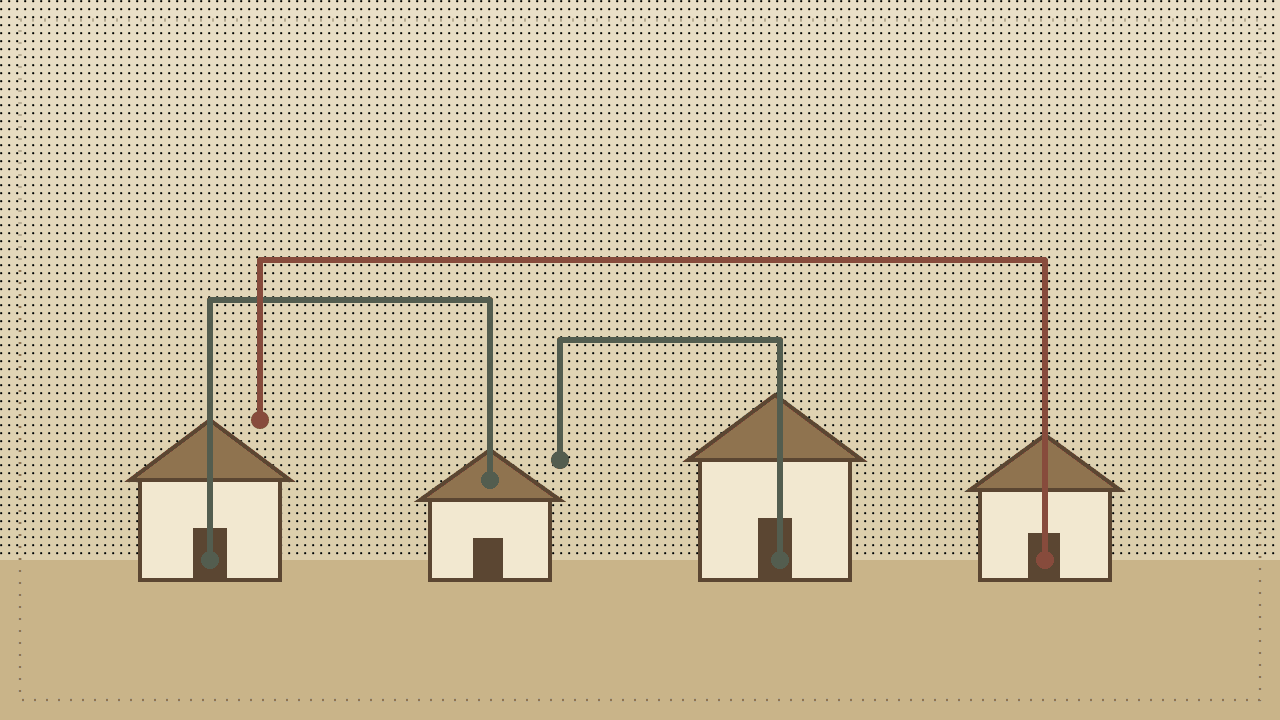 1897, a story of pipes connecting neighboring houses (illustration, AI-generated)
Context — A 1897 Newspaper Column and 1980s Nikoli
In 1897, American newspapers' puzzle columns were a centerpiece of mass entertainment. Sam Loyd — now best remembered, somewhat unfairly, for a 15 Puzzle legend he did not actually originate — was the most prolific and famous puzzle composer of his day, running a regular column in dailies like the Brooklyn Daily Eagle. In an age before radio or television, a single puzzle in the morning paper could become the talk of the family table.
Dudeney, writing in 1917, was Britain's leading puzzle composer of the same era. His Amusements in Mathematics was published in the middle of the First World War, and the subtitle of Problem 252, 'A Puzzle for Motorists,' reflects a moment when the automobile was spreading as a new luxury pastime. Connecting pipes or roads without crossing captured the spirit of an age rapidly building out urban infrastructure.
This 'connect the pairs' puzzle type took root in Japan through the pages of Nikoli, founded in 1980. Nikoli is a publisher known for culture-independent logic puzzles such as Sudoku, and its catalog includes both Arukone and Numberlink — identical in rule, differing only in whether the pairs are letters or numbers. A New York newspaper column from 1897 and a Tokyo puzzle magazine from the 1980s turn out to share the very same rule for a single line.
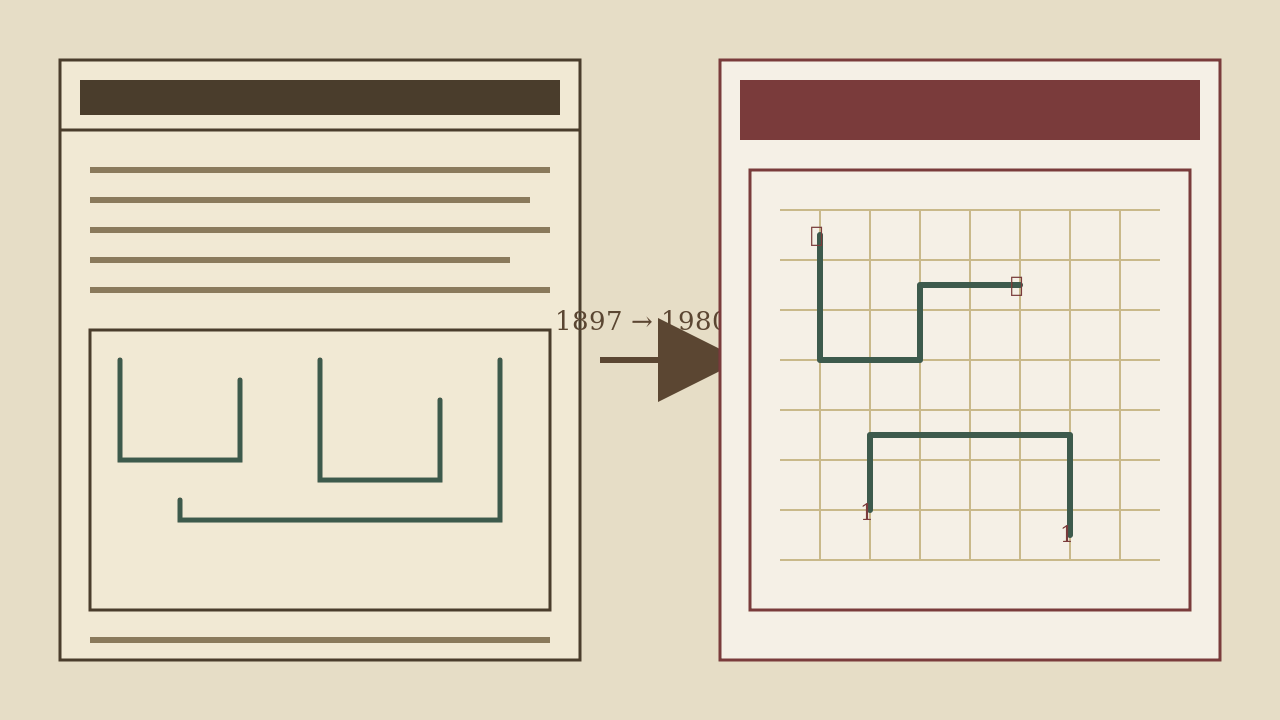 From a newspaper column to a specialist magazine's pages (illustration, AI-generated)
Mechanics — The Difficulty Born From One Uncrossable Line
Numberlink's rule is astonishingly simple. Pairs of numbers (or letters, or colors) scattered on a grid must each be joined by a single line along the grid lines. Lines may never cross, and in many variants every cell of the grid must be covered by some line. The rule takes under a minute to learn. Because there is so little to memorize, what a solver actually confronts is not rule complexity but pure spatial reasoning — scanning the whole board and working paths out backward.
But hard mathematics hides behind that simplicity. In 1982, Mark R. Kramer and Jan van Leeuwen published a paper showing that wire-routing is NP-complete, laying groundwork for thinking about Numberlink's computational complexity. Later, Kouichi Kotsuma and Yasuhiko Takenaga in 2010, and a team including Aaron Adcock and Erik Demaine in 2014, separately proved that the standard and zig-zag variants of Numberlink are each NP-complete. It's easy to underestimate by hand, but the larger the grid, the harder this problem becomes for a computer.
From this single constraint — no crossing — puzzle authors can generate an enormous range of difficulty and solving patterns. Just as Kakuro built a combinatorics of addition from the single rule of 'no repeats,' Numberlink builds a maze of graph theory from the single rule of 'no crossing.' Both embody the same design aesthetic: a minimal rule set opening onto a vast space of possibility.
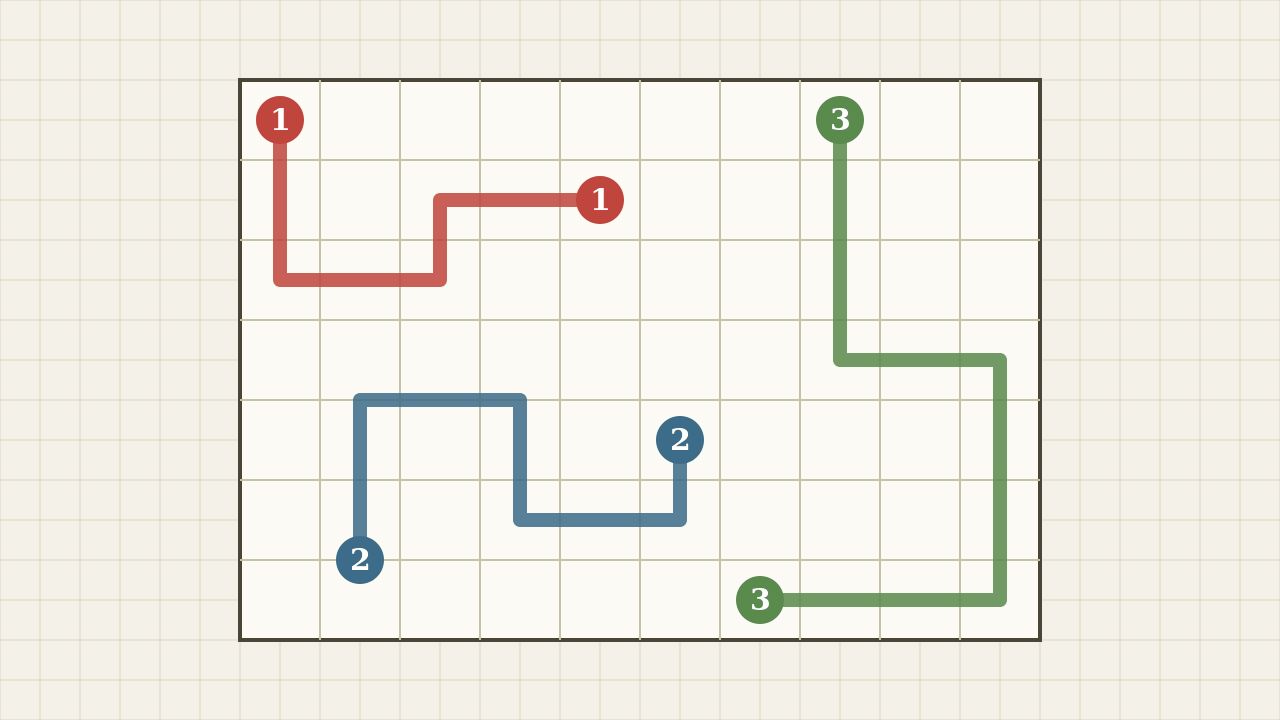 Two lines that never meet, paths narrowing down — the skeleton of Numberlink (illustration, AI-generated)
Legacy — From Flow Free to Zip
This newspaper puzzle, more than a century old, was reborn as a fingertip mobile app in 2012. Flow Free, developed by the American studio Big Duck Games, launched on iOS on June 7, 2012, and on Android on June 29 of the same year. By replacing number pairs with pairs of colored dots and having the player draw a 'pipe' between them, a purely visual change turned Numberlink into a puzzle playable with a single finger.
According to the English Wikipedia, Flow Free had, by 2022, surpassed 100 million downloads for the base game alone — a figure Wikipedia attributes to a 2022 paper by Eammon Hart and Joshua A. McGinnis. The series has kept expanding for over a decade: Flow Free: Bridges in 2012, Hexes in 2016, Warps in 2017, and Shapes in 2024. Neither Sam Loyd nor Dudeney could have imagined a newspaper column from 1897 becoming this long-lived a mobile franchise.
And the lineage hasn't stopped. LinkedIn's own help page describes its daily puzzle Zip as a 'Hamiltonian path puzzle' — draw a single line that passes through numbered checkpoints in order while filling the entire grid — and groups it, in the same breath, with Hidato, Numbrix, Numberlink, and Flow Free as games sharing the idea of 'drawing one line through the grid.' A line problem born in a newspaper column in 1897 is, in 2025, still moving the fingers of office workers checking their phones before the workday starts.
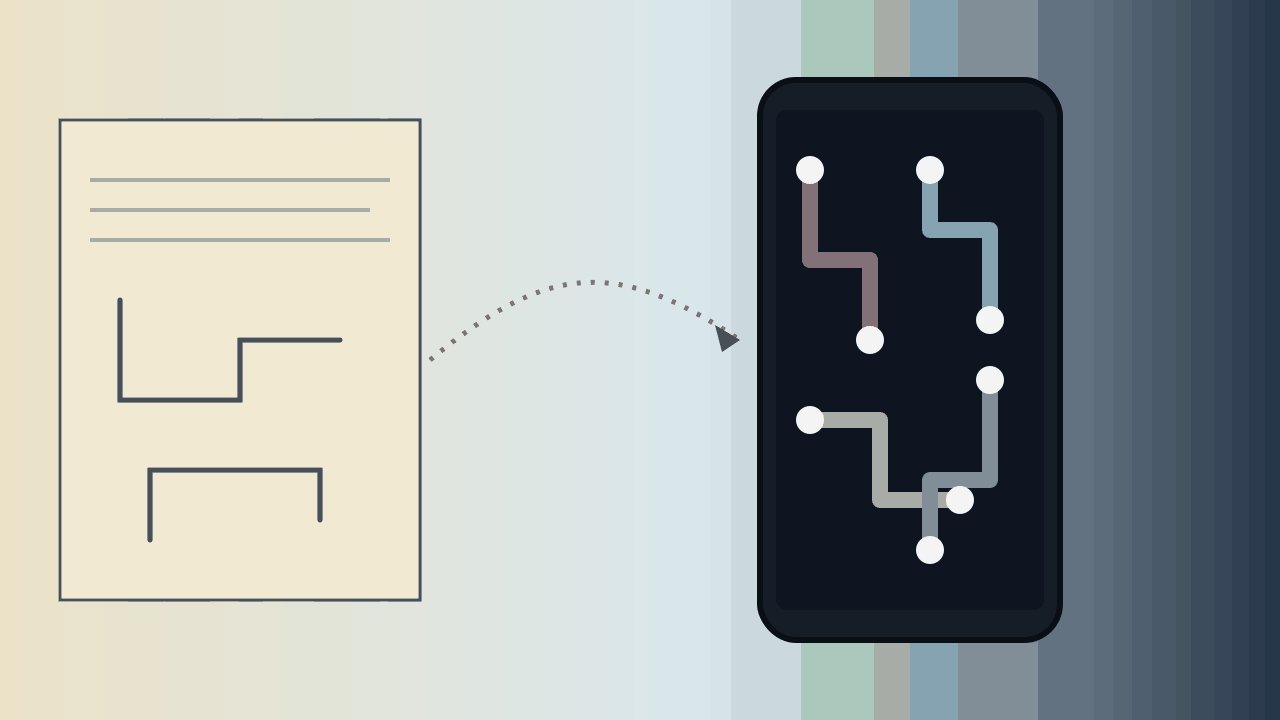 From newspaper type to colorful pipes traced by fingertip (illustration, AI-generated)
Sources
Sources consulted for this article:
・Wikipedia: Nikoli (publisher)
・Dudeney, H. (1917). Amusements in Mathematics, Problem 252
・Pegg Jr., E. (2007). Beyond Sudoku. Mathematica Journal 10(3) (archived)
・Kramer, M.R. & van Leeuwen, J. (1982). Wire-routing is NP-complete. Univ. Utrecht technical report
・Kotsuma, K. & Takenaga, Y. (2010). NP-Completeness and Enumeration of Number Link Puzzle
・Adcock, A. et al. (2015). Zig-Zag Numberlink is NP-Complete. Journal of Information Processing 23(3)
・The Washington Post: Flow Free app review
・Big Duck Games: Flow Free — Shapes (official)
・Hart, E. & McGinnis, J.A. (2022). Physical Zero-knowledge Proofs for Flow Free. arXiv:2202.04113
Closing — 128 Years of an Uncrossable Line
There is no dramatic invention story in Numberlink's history. Sam Loyd's newspaper column, Dudeney's motorist puzzle, Nikoli's renaming in its magazine, Flow Free's 100 million downloads, LinkedIn's daily puzzle — cut into the timeline at any point, the rule itself remains only this: connect paired marks with a single line, without crossing. That it survived more than a century without a single dramatic event is, in itself, proof of how sturdy this rule is.
As a historian, what I can say is that this type of puzzle is simply a branch of graph theory translated directly into play. That is precisely why it can move from era to era and medium to medium — newspaper type, magazine grid, smartphone screen — without the rule ever breaking. Numberlink has survived 128 years not through luck or fashion, but because the rule itself is mathematically sturdy. Whatever screen draws this line next, the rule itself will almost certainly stay the same.
 The last line drawn, still uncrossed (illustration, AI-generated)
Reactions (no login)
Anonymous • one of each per visitor per day
Learn — Curriculum
LearnPart 2 Lineage — Where Puzzles Came FromChapter 4 Pencil Puzzles and Nikoli1 / 12
Part of these series
Puzzle Incident HistoryEpisode 17 of 40
