RETRO-REVIEW · 2026-06-27
The Lost Vikings (1993) — A Classic of Cooperative Puzzling, Three Bodies Moved One at a Time
An invention that stands precisely inverted to the herd-guiding of Lemmings
Introduction
This is the story of The Lost Vikings, a 1993 puzzle-platform game made by Silicon & Synapse — later Blizzard Entertainment — and published by Interplay Productions. In Japan it was distributed by T&E Soft under the title Viking no Daimeiwaku. I want to re-read it not as a curiosity of Blizzard's prehistory but as a milestone that settled, on the home-console screen, the grammar of a cooperative puzzle in which the player operates several bodies by switching between them one at a time.
Three vikings — Erik the Swift, Baleog the Fierce, and Olaf the Stout — are abducted by the alien Tomator, and the player takes charge of them one by one, guiding each from entrance to exit. No single one of them can finish a level alone. Erik smashes walls with his helmet, Baleog shoots distant switches with his bow, and Olaf spreads his shield to become a platform. Three distinct abilities are meshed together within a single space. In this structure I feel a texture of intelligence unlike the side-scrollers of its day.
In this essay I will first verify the 1991-93 context in which the work was born, then break down the quality of thought its three-way cooperation produced, and finally trace, against primary and secondary sources as far as possible, the lineage that runs from Lemmings (1991) and Gobliiins (1991) toward today's cooperative puzzles.
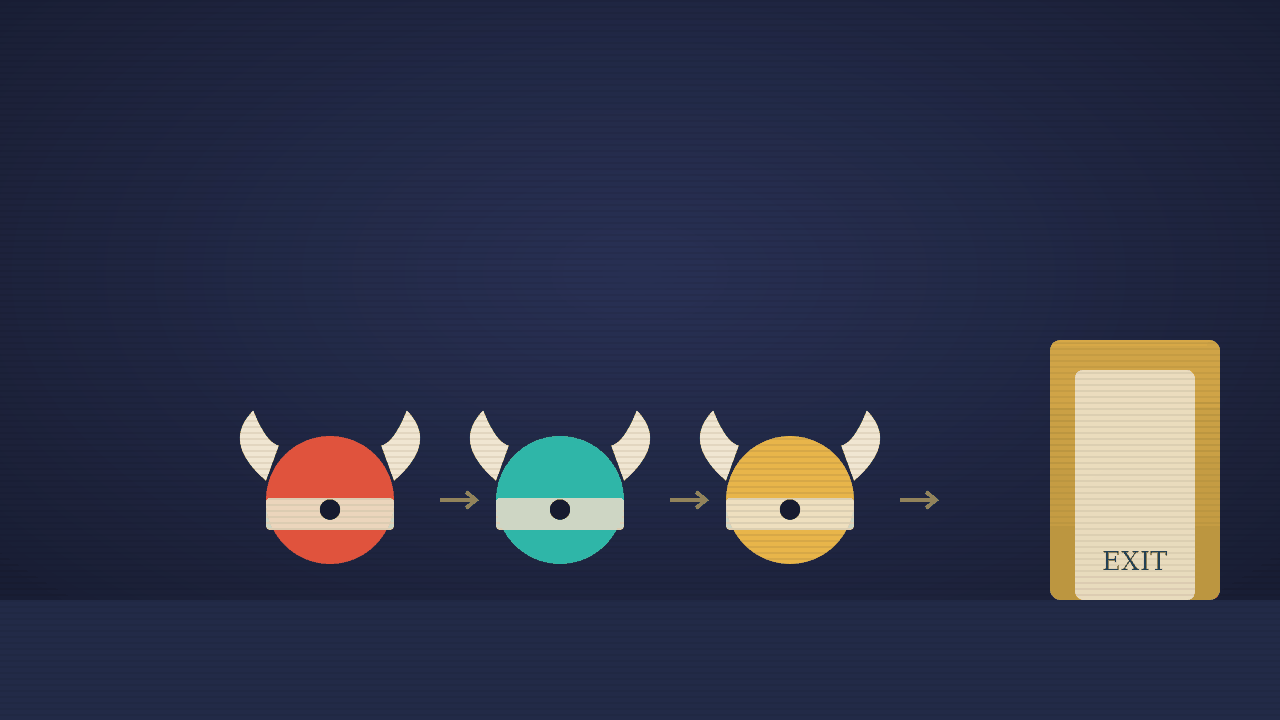 Three bound for one exit - an impression of the work (illustration, AI-generated)
The context of its time
In the early 1990s the air of indirect-control puzzling was unmistakably set by Lemmings (1991). DMA Design's crowd game had blanketed the world with the invention of granting roles without ever touching the characters directly. Silicon & Synapse was a young studio founded in 1991, and The Lost Vikings is one of its earliest works; Ron Millar is credited among its designers.
What interests me is the starting point. According to a 2025 retrospective published by Blizzard itself, the original concept was Lemmings-like — managing hundreds of tiny vikings. But as development turned toward consoles, the team realized that larger characters read better on a television and that players wanted direct control of their characters. So they narrowed the count to five, then to three. From managing a herd to directly operating a few — this inversion is the core of the work.
A note on distribution and hardware. The game appeared first on the Super NES in 1993, reached the Amiga and MS-DOS the same year, and the Amiga CD32 and Mega Drive/Genesis the following year. It comprises 37 levels, 42 in the Mega Drive/Genesis version alone. The developers have also testified that color and screen constraints shaped its vivid palette.
 1993, color vivid on the cathode-ray tube - an impression of the era (illustration, AI-generated)
Mechanics
The three skills are designed to fill one another's gaps. Erik is the fastest of the three, can jump, and with a running start can break certain walls and enemies with his helmet. Baleog cuts with his sword, shoots distant enemies with his bow, and can strike far-off switches with the same arrows. Olaf blocks enemies and projectiles with his shield, holds it overhead to glide, and raises it as a platform for his comrades. The abilities never overlap; what one lacks, another supplies.
The victory condition is strict. A stage ends only when all three reach the exit. If even one loses his health and falls, the level becomes unwinnable — you may proceed with the survivors, but you will end up restarting. Each viking has three health points and continues are unlimited. The cheapness of failure encourages trial and error.
The handoff grammar is clever too. Items such as keys, bombs, and food can pass from hand to hand when two stand close. Olaf raises his shield, Baleog walks across it, and Erik leaps into the opened gap to reach a height — such linkages are assembled as pure spatial puzzles. You move one at a time, but you always think for three.
The Mega Drive/Genesis version added simultaneous cooperative play for two (and, configured a certain way, three). Solving by switching among them alone and moving several at once are wholly different in quality: the former is a problem of order and procedure, the latter of simultaneity and division of labor. The same board demands different wisdom according to the number of hands — and here lies the depth of the design.
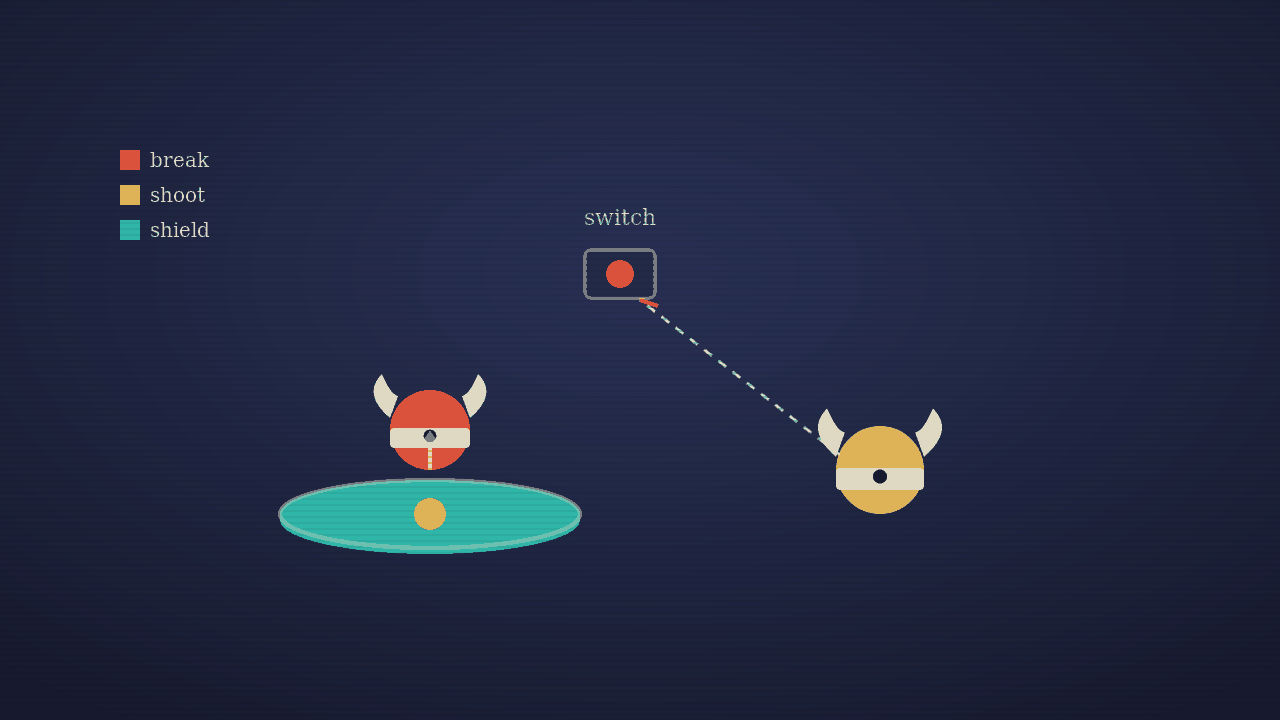 Shield as platform, arrow to a distant switch - an impression of the structure (illustration, AI-generated)
Lineage to the present
The root of the lineage is admitted by the developers themselves. As noted, The Lost Vikings was born with Lemmings (1991) as its starting point, then steered away from indirect herd-control toward the direct operation of a few. Reaching further back, Coktel Vision's Gobliiins (1991) had already shown, a step earlier, the idea of making three differently-skilled characters cooperate. The work thus stands not as an invention from nothing but at the intersection of two predecessors.
Let me state the modern connection carefully, as a historian. The design vocabulary of 'switching among several characters and meshing complementary abilities to solve a single space' runs onward into cooperative puzzles such as Frozenbyte's Trine series, widely played on Steam. I hold no evidence to declare a causal 'because of this, that'; what is certain is that the same skeleton recurs along the lineage. Blizzard itself revived the three as a single hero in Heroes of the Storm (2015), commemorating the origin of its own house.
What did this work show historically? I take it to be the spatialization of the division of labor. Where Lemmings was a problem of time and the herd, The Lost Vikings folded a problem of ability and order onto a single side-scrolling screen. The constraint of moving only one at a time is precisely what forces you to think 'who, when, where.' That question lives on, unchanged, in the cooperative puzzles of today, thirty years later.
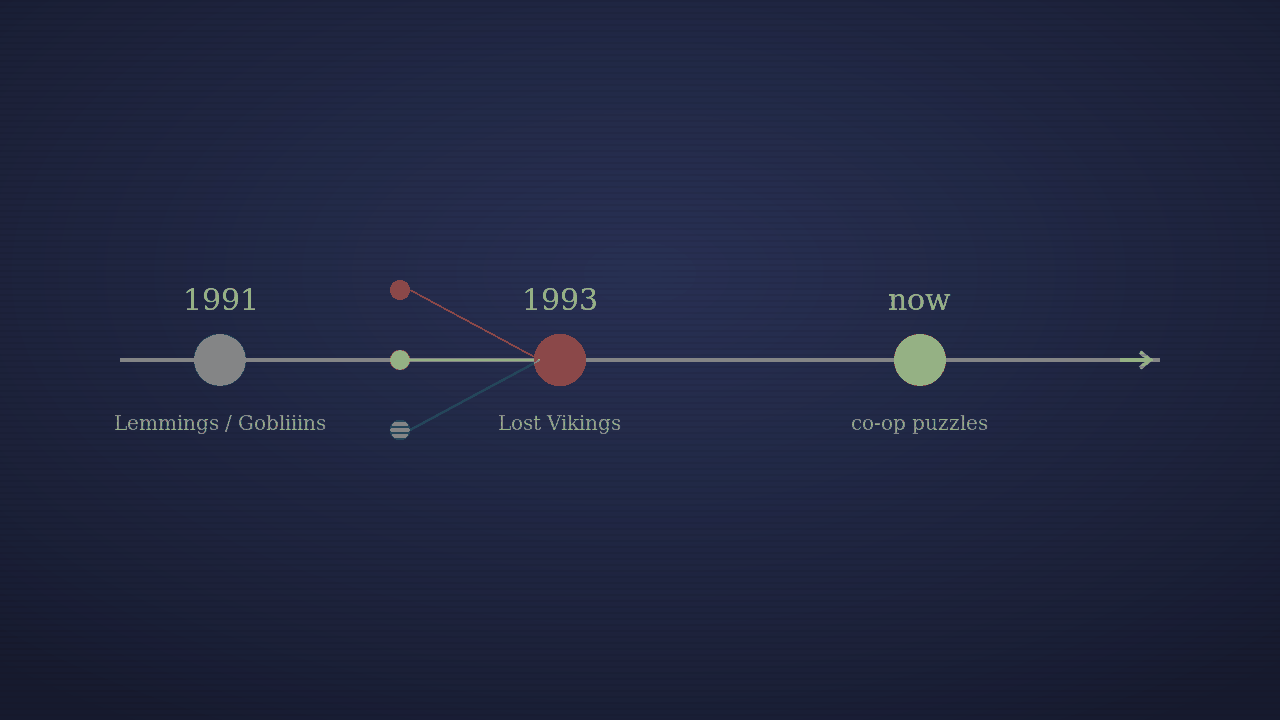 From Lemmings and Gobliiins to today - an impression of the lineage (illustration, AI-generated)
References
Sources referenced in this article:
・Computer Gaming World (1993): Vikings Just Wanna Have Fun
・Polygon (2021): on the Blizzard Arcade Collection re-release
In closing
You can move only one at a time, yet you cannot advance unless all three arrive. This seemingly vexing constraint is precisely what lifted The Lost Vikings a notch above the ordinary side-scroller. The player holds one in the hands and three in the head, untangling the contrivance of ability and order. In 1993, on the television screen of a home console, cooperation had truly become a form of play.
An invention standing precisely inverted to the herd-guiding of Lemmings — that is how I place this work. From the pole of the indirect to the few of the direct. Within that swing of the pendulum, the design of today's cooperative puzzles keeps oscillating still. The feel of solving one space by switching among three bodies has not aged, even thirty years on.
 Three silhouettes, at last at the same exit (illustration, AI-generated)
Reactions (no login)
Anonymous • one of each per visitor per day
Part of these series
Retro RevisitedEpisode 8 of 43
Read next
Related reviews
Teslagrad 2
A 2D puzzle-platformer that climbs an abandoned tower above a northern fjord by flipping magnetic poles and carrying momentum. Rain Games keeps the wordless storytelling and painted backdrops of the original, but steers from stop-and-think puzzles toward sliding and flow.
Escape Goat 2
A 2D puzzle platformer about escaping a trap-filled stronghold with a goat and its mouse companion. Each room is a single screen, solved with jumps, an immortal mouse that crawls walls and stands on switches, and a magic hat that swaps the goat's position with the mouse's. Over a hundred rooms across ten zones, from MagicalTimeBean in 2014.
RiME
A boy wakes on an unfamiliar island after a storm and runs, climbs, swims and shouts at the stonework, guided by a red fox toward the peak of a distant tower — a five-chapter puzzle adventure with no combat, no HUD and no dialogue, released by Tequila Works in 2017.


