RETRO-REVIEW · 2026-07-16
Simon Tatham's Portable Puzzle Collection (2004) — 40 Puzzles, Freshly Generated for 22 Years
A hobby project written for portability's sake became the foundation of an AI reasoning benchmark
Introduction
In 2004, British programmer Simon Tatham published a collection on a quiet corner of his personal website. Its name was plain: Simon Tatham's Portable Puzzle Collection. Inside were dozens of single-player logic puzzles — familiar faces like Sudoku (Solo), Minesweeper (Mines), and the Fifteen puzzle, alongside the loop-drawing Loopy, the bridge-building Bridges, and Undead, where you place monsters to match mirror-reflection counts.
Its one defining trait: every puzzle instance is freshly generated by the computer each time you play. There are no pre-built levels. Every generated puzzle is verified to have a unique solution, and the same binary runs identically on Windows and Unix. Today the official page lists 40 puzzles. I want to dig into the history of this plain, ad-free, logo-free HTML page.
 Impression of a newly generated board (illustration, AI-generated)
The context of its time
2004 sat in the high era of the desktop, before smartphones. Freeware authors distributed software from personal web pages, and the lack of compatibility between Windows and Unix (people still commonly said "Unix" rather than "Linux" at the time) was a routine annoyance. Tatham was already known by then as the author of PuTTY, a free SSH/Telnet client he had written in 1998 during breaks from university exam revision — later documented in a dedicated chapter of O'Reilly's SSH, The Secure Shell: The Definitive Guide.
In his own words, still on the official page, the motive was simple: he thought there should be more small desktop toys you could pop up and play for two or three minutes on a break, and he was annoyed that a good game found on Unix wasn't available the next time he sat at a Windows machine, or vice versa. That is why every puzzle in the collection was written to run on both platforms — and why "portability," a software-engineering concern, sits right in the project's name.
In the same period, Sudoku — nurtured for decades by Japan's Nikoli — was exploding in the English-speaking world after Wayne Gould placed it in The Times of London in 2004. That Tatham's collection includes Solo, functionally Sudoku, is no coincidence; it reflects the puzzle climate of the moment.
 Impression of mid-2000s desktop culture (illustration, AI-generated)
Mechanics
The technical core of the collection is a simple generate-then-verify procedure. The computer first builds a random grid that stands as a valid solution, then strips clues away from it. At each stripped-down state, an internal solver checks whether the solution remains unique; if not, the generator tries again. This loop guarantees a puzzle that is both new and solvable every time you play. Its central invention was turning existing paper pencil-puzzle genres (Nikoli-style Sudoku, Slitherlink, Masyu, and others) into something a computer could generate without limit.
Loopy corresponds to Slitherlink, Pearl to Masyu, Bridges to Hashiwokakero, Net is a rotate-the-tile network puzzle, and Keen and Towers add arithmetic constraints to Latin squares. Tatham himself states on the site that most of these are not his invention but reimplementations of existing puzzle concepts. The project's value, then, lies not in inventing new rules but in encoding the generative logic of existing pencil puzzles into working software.
Each puzzle exposes a difficulty parameter, and grid size can be freely adjusted. Rather than a fixed number of levels, the parameter space itself is the play space — an approach that anticipated the now-standard practice, in digital puzzle design, of treating difficulty as a near-continuous dial rather than a discrete level list.
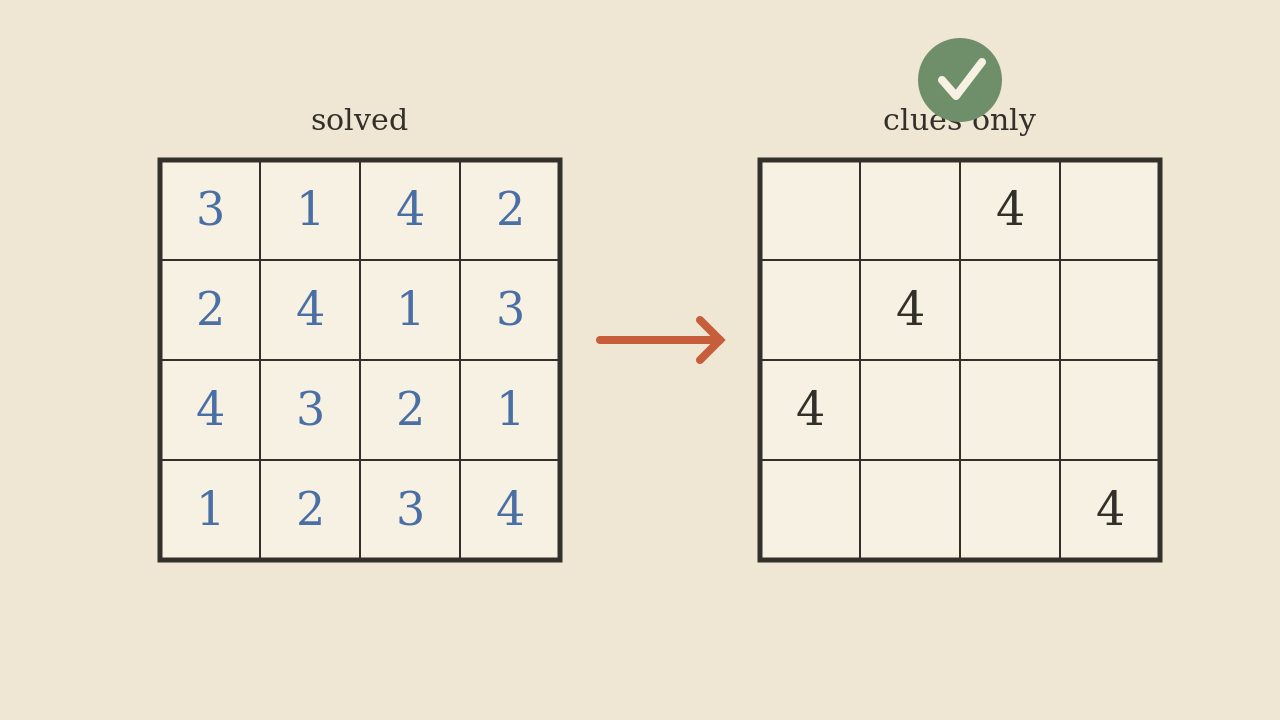 Impression of a uniqueness-guaranteeing generation algorithm (illustration, AI-generated)
Through to today
The obsession with portability outgrew Tatham's own intentions. Volunteer ports alone include Palm (James Harvey), Android (Chris Boyle), Symbian S60 (Tiago Donizio), iPhone/iPad (Greg Hewgill), Windows Store (Lennard Sprong), and even Rockbox, third-party firmware for portable music players (Franklin Wei). A single engineer's irritation at Windows/Unix incompatibility ended up producing a puzzle collection that runs almost anywhere a computer can run — made possible only because the code was released under the MIT licence.
In 2024, Benjamin Estermann, Luca Lanzendörfer, Yannick Niedermayr, and Roger Wattenhofer at ETH Zurich published "PUZZLES: A Benchmark for Neural Algorithmic Reasoning," building a reinforcement-learning benchmark environment directly on top of Tatham's collection. The paper states explicitly that it adopted all 40 puzzles from the collection as-is, extending the original C source code and wiring it into Python's Gymnasium framework. Code a freeware author wrote twenty years ago as a "generator that guarantees unique solutions" is still, today, in active use as a ruler for measuring AI's logical reasoning ability.
Many of today's Sudoku- and Slitherlink-themed smartphone apps and Steam logic puzzles inherit this generate-then-verify design as an unspoken default. A technical problem Tatham solved on his own time in 2004 is still being cited as the foundation of puzzle-generation theory itself.
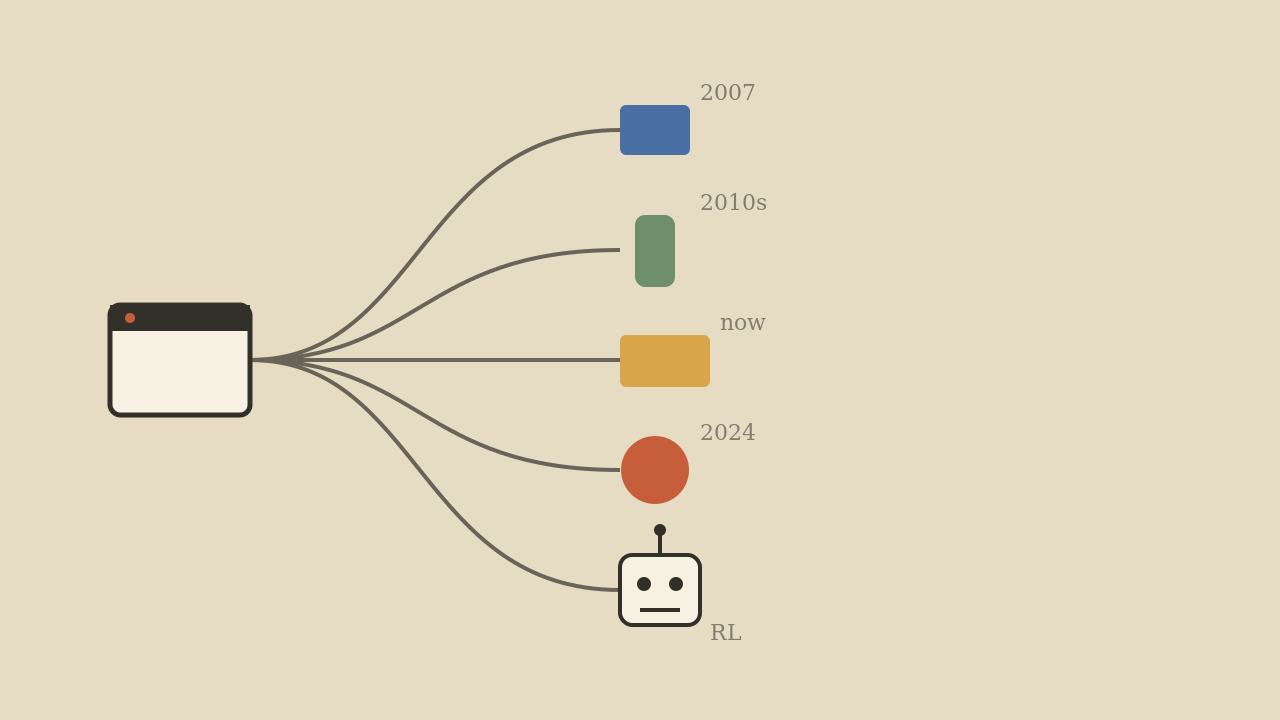 Impression of one codebase branching into devices and research (illustration, AI-generated)
Sources
Sources referenced in this article:
・Official site: Simon Tatham's Portable Puzzle Collection
・All About Symbian: Review of Simon Tatham's Puzzle Collection (2007)
・Set Side B: Simon Tatham's Puzzle Collection
・GIGAZINE: Free puzzle game collection running on Windows/Mac/Unix (2017)
Closing
The bottom of the official page reads "last modified" as recently as 23 May 2026. With no marketing and no social media account, Tatham has kept the page looking almost the same for twenty-two years, and still updates it today — even apologizing, in a dutiful paragraph, for no longer being able to build the Mac version.
While fashionable puzzle apps come and go, this plain grey page keeps generating 40 puzzles, driven by nothing more than one engineer's insistence on portability. If Imabayashi's Sokoban is an ancestor in the lineage of verbs, Tatham's collection is an ancestor in the lineage of generation. History sometimes preserves quiet accumulation longer than it preserves loud announcements.
 Impression of a page quietly still being maintained (illustration, AI-generated)
Reactions (no login)
Anonymous • one of each per visitor per day
Part of these series
Retro RevisitedEpisode 19 of 36
