RETRO-REVIEW · 2026-06-23
Adventures of Lolo (1989) — The Emerald Framer and the Single Solution
How HAL's single-screen logic puzzle established the idea of an answer that does not fade
Introduction
This is the tale of Adventures of Lolo, which HAL Laboratory released on the NES in 1989 (North America saw it that April). Yet for one who traces lineages, accuracy demands a correction: the true origin lies in 1985, in the MSX title Eggerland Mystery. Lolo was the fifth entry counting from there, but because it was the first to reach North America, the West remembers it as 'the first Lolo.' I wish to treat the work together with this fold in time.
If I must name in a single phrase what this work demonstrated, it is the singularity of the solution. Each board is fixed in advance; there is no element of chance. What the player must find is the one correct sequence. Beneath a coat of action lies a pure logic puzzle, and this duality is precisely why I dig Lolo up again today.
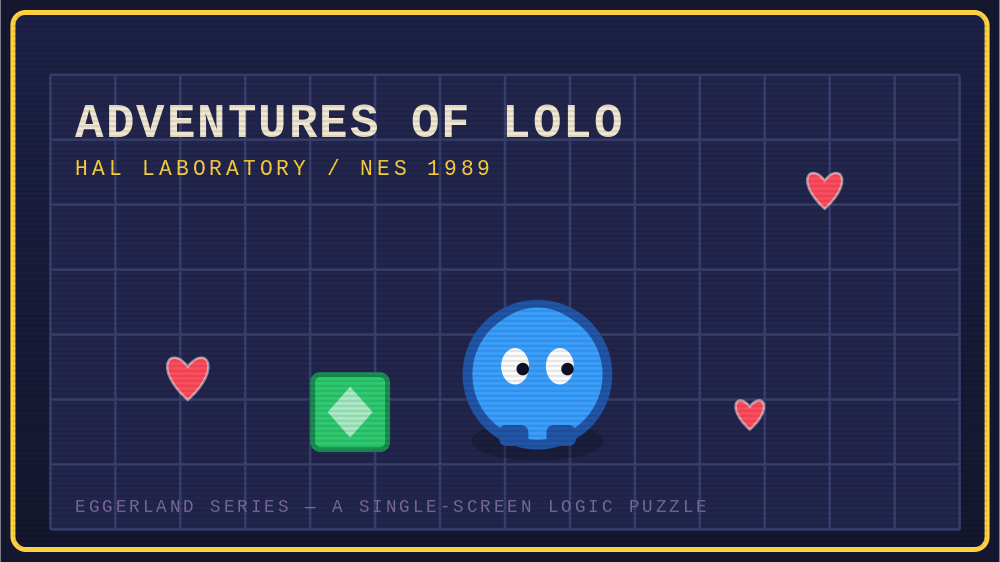 Key-visual impression of Adventures of Lolo (1989) (original illustration)
The Context of the Era
Let me recall the year 1985. It was the time when the 1982 Sokoban I discussed earlier had opened new puzzle territory with a single verb: pushing a box. HAL Laboratory inherited that idea, a logical labyrinth built around 'push,' added enemies and action, and released Eggerland Mystery on the MSX. Its 125 stages were no small volume for a home-computer title of the era. Weaving a temporal axis of moving threats into Sokoban's static logic was the invention of the Eggerland line.
The matter of distribution is worth recording too. The MSX and the Famicom/NES differed in market and storage medium, so Eggerland's stages were reshuffled and ported per release. The NES Adventures of Lolo, a curated set of 50 rooms drawn from Japan's Eggerland: Meikyu no Fukkatsu and Eggerland: Sozo e no Tabidachi, is the textbook case. Recombining one design asset to fit the vessel of distribution is a fact that mirrors the development culture of the time.
A word on the makers. HAL Laboratory was the workshop that would later birth Kirby, the firm where Satoru Iwata, who joined in 1983, served as president from 1993 to 2000. IGN counts Lolo among Iwata's successes, praising it as a work that embodied 'fun, appeal and simplicity over an abundance of bells and whistles.' The notion of treating simplicity as an asset already dwelt in this single-screen puzzle.
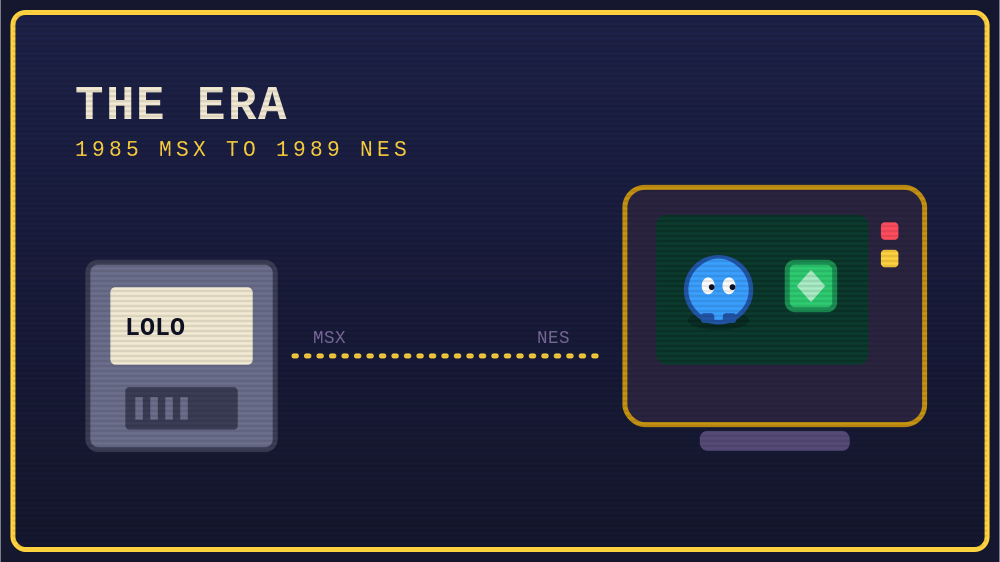 From 1985 MSX to 1989 NES — an impression of the era (original illustration)
Mechanics
The board is cut into 11x11 tiles, viewed top-down as a single screen. Each room's task is plain: collect every scattered Heart Framer and the jewel box opens, which wipes out the enemies on the board and reveals the exit, a door or a staircase down to the next room. The order of collection, the route, and one's conduct in between are all arranged toward this one point. The board resolves within a single screen, and rooms follow one another like the turning of pages.
The core verb is, again, 'push.' The player can push an Emerald Framer one tile at a time. The constraints, however, are strict: you cannot push two adjacent framers at once, nor can you pull. This single-direction, single-block restriction is exactly what sets the logical hardness of untangling each layout. Because the available moves are so limited, the board tightens, without wavering, toward a unique solution. Here I see the blood of Sokoban with perfect clarity.
The other axis is the enemies. Foes such as Medusa and Snakey can be turned into eggs by a Magic Shot usable after the Heart Framers are gathered, and those eggs become pushable obstacles. Even the enemies, then, are pieces on the board. This inversion of threat into resource brought dynamic reading into a static pushing puzzle and layered on something the 1982 Sokoban lacked. Mixing in only the minimum of moving elements is the very essence of the Eggerland line.
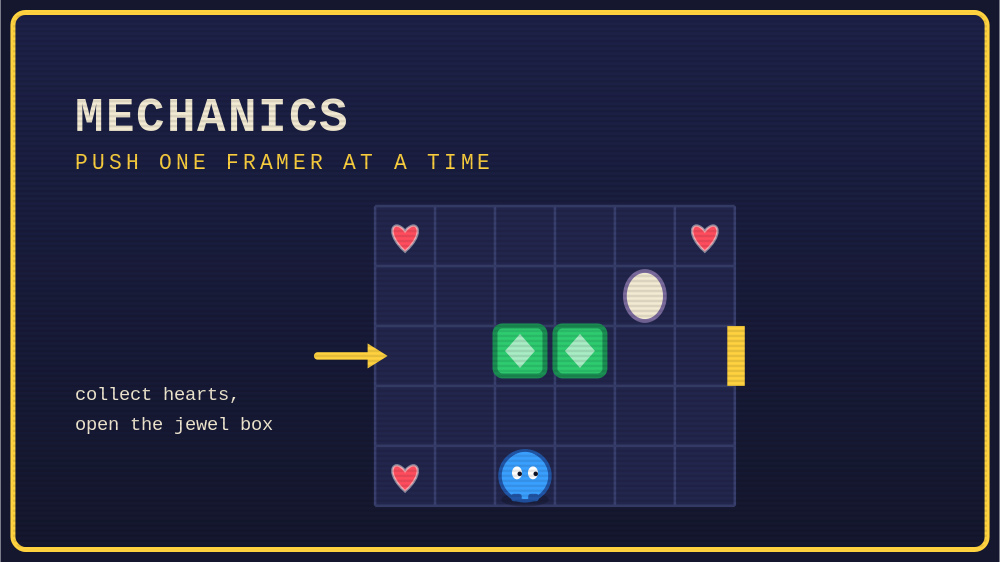 Collect Heart Framers and push Emerald Framers one tile at a time — a diagram of the play (original illustration)
Legacy to the Present
What Lolo historically established was an alloy of four points: single-screen, deterministic, the verb of pushing, and enemies-as-pieces. If Sokoban carried the logic of pushing and Lemmings the time of the crowd, the Eggerland line showed the middle ground between them, a recipe that mixes the minimum of moving elements into a deterministic board. Close the world to one screen, banish chance, and ask deeply with a small vocabulary. I regard this as one of the foundations on which the modern single-screen logic puzzle stands.
Today works such as Baba Is You and Patrick's Parabox are highly praised on that same lineage of deterministic logic contained within a single screen. I will not short-circuit this into 'they were born because Lolo existed.' To assert causation without the creators' own testimony is something a historian must refrain from. Yet that they belong to the same family by structural blood becomes self-evident once you set the boards side by side. The eras differ, but the shape of the question is the same.
What I would rather stress is the inheritance of a design thrift. Lolo deliberately kept the pushing constraint narrow, and it was from that narrowness that it drew the singularity of its solutions. To pose a deep question with a small vocabulary: this thrift is the very attitude HAL called treating simplicity as an asset, and a principle the finest single-screen puzzles have rediscovered across generations. A room from 1989 remains worth reading as an early demonstration of that principle.
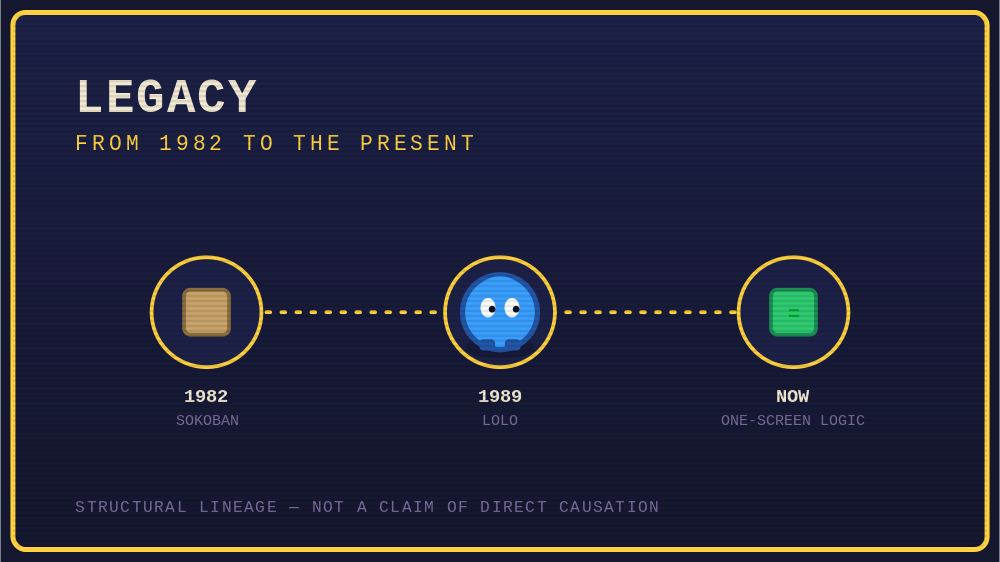 From 1982's Sokoban to modern single-screen logic puzzles — a structural lineage (original illustration)
References
Sources referenced in this article:
・Wikipedia: Adventures of Lolo
・Wikipedia: Adventures of Lolo 3
・MobyGames: Adventures of Lolo (1989)
・Generation MSX: Eggerland Mystery (1985)
・StrategyWiki: Adventures of Lolo gameplay
Closing
A single-screen logical labyrinth that budded in 1985 and bore fruit on the NES in 1989. What Lolo left to history was neither flashy technology nor vast volume, but the smallest vocabulary, a pushable framer, and the idea of a single answer that does not fade. The layouts are fixed in advance and do not waver with chance. For that very reason, nearly four decades on, those boards still wait, quietly, to be solved.
Let me close as one who travels back through time. A fine puzzle does not age. So long as the layout is deterministic, a room from 1989 tests the solver with hardness not a hair different from a room of today. Technology grows obsolete; logic does not. In this I see the quietest, and surest, virtue this medium holds.
 An impression of a single, solved room (original illustration)
Reactions (no login)
Anonymous • one of each per visitor per day
Learn — Curriculum
LearnPart 2 Lineage — Where Puzzles Came FromChapter 5 Origins of the Digital Puzzle8 / 13
Part of these series
Retro RevisitedEpisode 5 of 43