HISTORY · 2026-06-30
The Crossword (1913) — The Grid Lineage That Began with Arthur Wynne's Diamond
What the "Word-Cross," born in a corner of a newspaper, passed from paper cells to the modern screen
Introduction
This is an invention of 1913. On December 21 of that year, inside the "Fun" supplement of the New York Sunday paper The New York World, a small figure was printed: cells arranged in a diamond, a hollow center, and only the three letters F-U-N already filled in. Its author was Arthur Wynne, a Liverpool-born editor, who called it the "Word-Cross." This is the earliest recorded form of the crossword puzzle, a pastime still being solved more than a century later.
Wynne's figure did not appear from nothing. Word games such as the "word square" and "word diamond," in which terms interlock vertically and horizontally, already existed in Victorian children's magazines. But Wynne drew a grid of cells over them, giving the solver a vessel in which to write one letter per box, and set that board beside a numbered list of clues. Placing those two things side by side became the archetype for every grid-based word puzzle that followed.
This essay traces how a pastime born in a corner of a newspaper grew, within the strata of its era, into a worldwide fever, and how it passed from paper to today's screens. Not as nostalgia, but as one lineage in the genealogy of thinking puzzles, I want to reread that 1913 diamond.
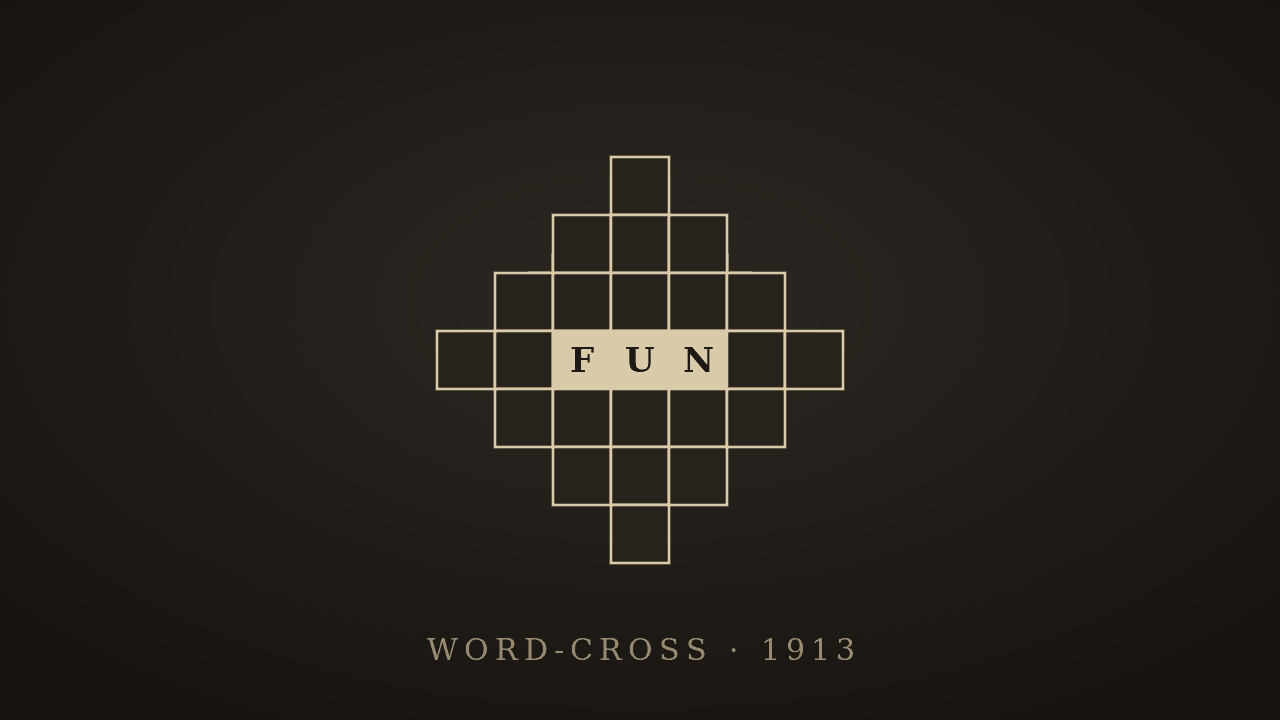 The first Word-Cross, laid out as a diamond (illustration, AI-generated)
The Context of Its Era
The stage on which the crossword spread was the American popular newspaper of the early twentieth century. Sunday editions competed with thick supplements and wanted light entertainment to hold their readers. Wynne's "Word-Cross" began as one such item. A few weeks after its debut, a typesetter transposed the words of the heading and the page read "Cross-Word." Ironically, that accidental name stuck, and the pastime has been called the crossword ever since.
The decisive turn came in 1924. The young firm Simon & Schuster gathered puzzles previously sent to The World and published The Cross Word Puzzle Book. It was edited by three people including the paper's Margaret Petherbridge (later Margaret Farrar), and the company, fearing failure, reportedly issued it under a different imprint. The book sold explosively. According to Smithsonian Magazine and Literary Hub, before Christmas 1924 some 150,000 copies left the shops in a single day, and in that year alone the firm took in roughly 600,000 dollars (about 10 million in today's money). A startup publisher gained its foothold among the majors on this one book of wordplay. A fever that began in the paper's fun pages (illustration, AI-generated)
The fever soon crossed the Atlantic. In Britain, The Times ran its first crossword on February 1, 1930, with Adrian Bell establishing its distinctive style. A manner of loading clues not only with definitions but with anagrams, classical allusions and double meanings developed, and setters such as Torquemada (Edward Powys Mathers) established the purely "cryptic" form from the late 1920s. America's own authority, The New York Times, at first dismissed the puzzle as a frivolous fad and did not carry one until February 15, 1942. The editor entrusted with it was Farrar herself.
Mechanics
The crossword's structure was essentially complete by 1913. Several words cross vertically (down) and horizontally (across), and at each intersection a single letter is shared by two words. The solver fixes that letter from one word and uses it as a foothold to enter the perpendicular word. This chain, in which one correct answer illuminates the unknown beside it, is the very heart of the grid puzzle.
Two stylistic inventions were added after Wynne. One is placing the "black squares" that separate words symmetrically across the board. The other is numbering the cells so they correspond to the clue list. With these two, the board changed from mere wordplay into a designed object with rules. The maker must simultaneously solve for the crossability of vocabulary and the placement of black squares, and here a second kind of puzzle is born: crossword construction, distinct from solving.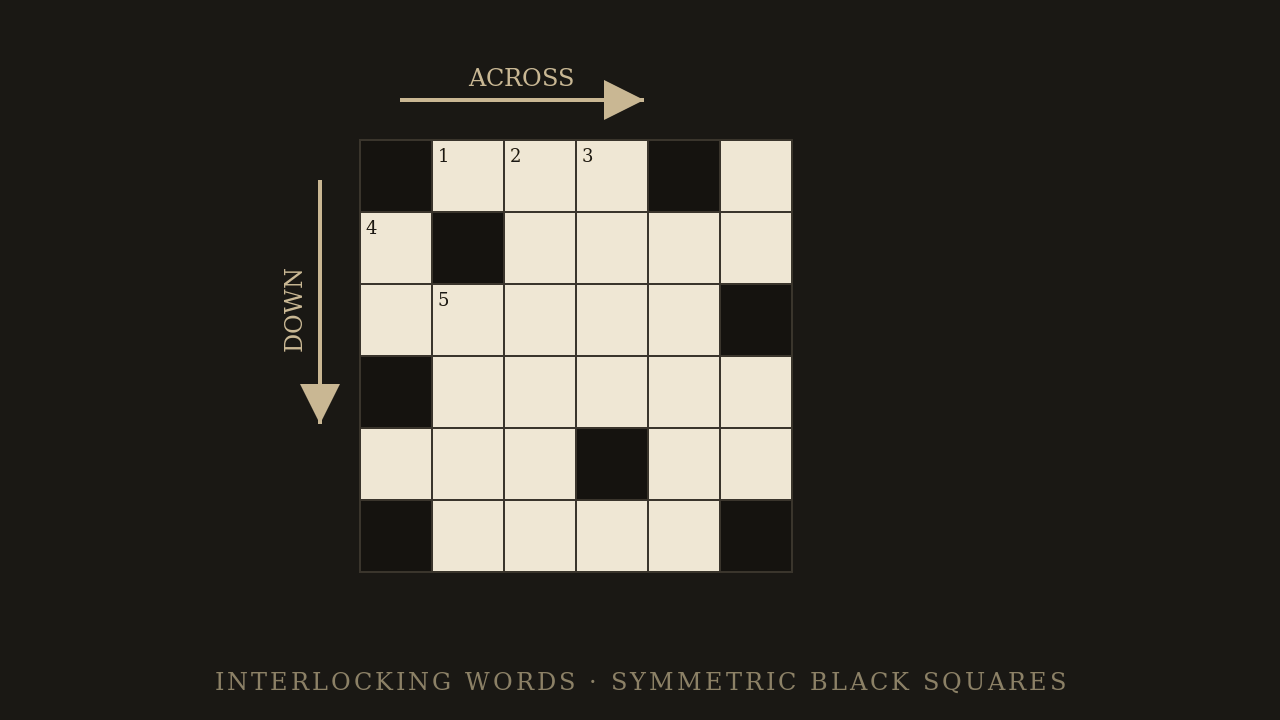 Interlocking words, symmetric black squares (illustration, AI-generated)
The character of the clues also diverged over time. The American style favored plain, definition-based clues that test knowledge, while the British style turned toward the cryptic, making a game of decoding language itself. The same vessel, the grid, came to hold two different sports of the mind.
Lineage to the Present
The 1913 vessel of grid-and-clue survived a century on paper. The New York Times crossword still appears daily and, while moving to digital editions and dedicated puzzle apps, retains a vast readership. The medium has changed, but the basic practice, the solver filling one cell at a time as each crossing illuminates the next, is essentially unchanged from Wynne's diamond.
Seen through the lens of lineage, this vessel reaches beyond language too. The "pencil puzzles" such as Slitherlink and Nurikabe that Japan's Nikoli has refined since the 1980s take logic, not vocabulary, as their clues, yet they share with the crossword both a distribution form, the newspaper and magazine, and the feel of inscribing constraints into a grid. The pleasure of a chain in which one certainty breeds the next is, I read, an inheritance passed on in altered form.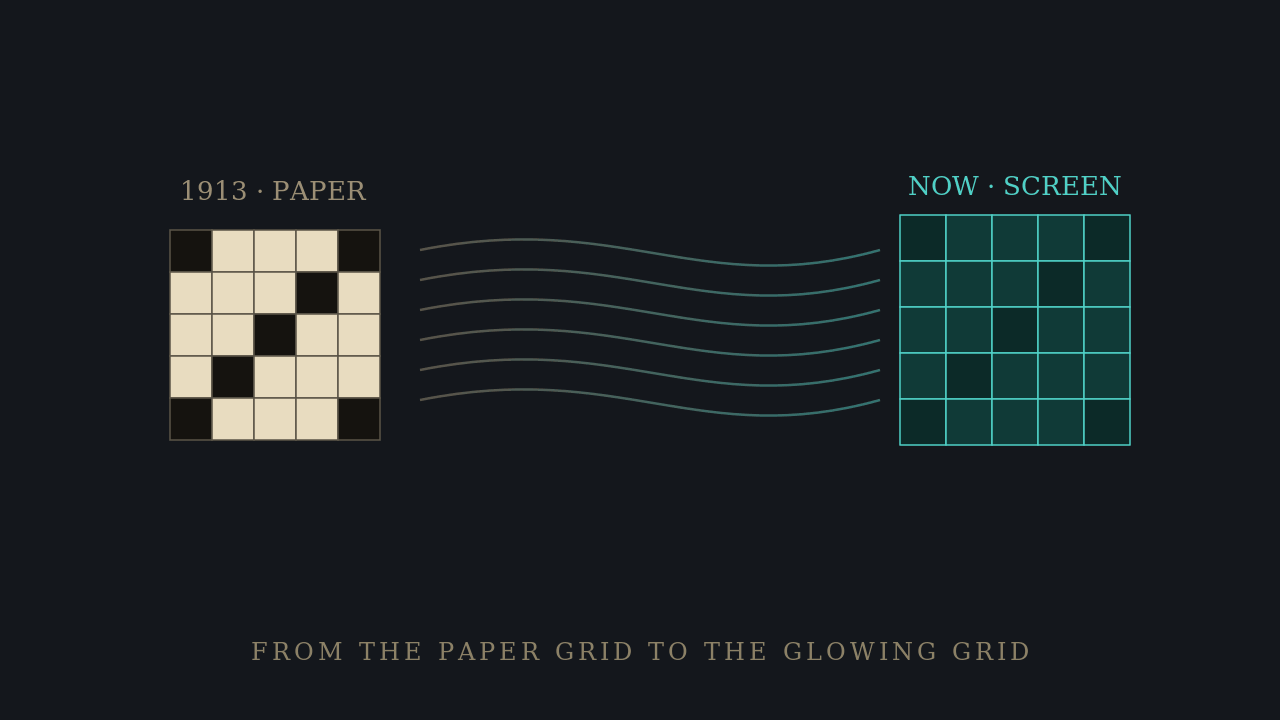 From the paper grid to the glowing grid (illustration, AI-generated)
The shadow of this vessel falls on modern digital works as well. Many of the word-based and logic-grid puzzles distributed on Steam inherit the same structure: placing one symbol per cell to satisfy constraints on a board, where an error contradicts the other clues. I will not assert that they descend directly from a Sunday supplement in century-old New York. But it is certain that the three-part invention of grid, crossing and clue still lives as a design vocabulary for thinking puzzles.
References
Sources referenced in this article:
・Smithsonian Magazine: How the Crossword Became an American Pastime
・Literary Hub: How Crossword Puzzles Underwrote Three of America's Major Publishers
・Look and Learn: The Times crossword first appeared in 1930
・American Crossword Puzzle Tournament: A Brief History of the Crossword Puzzle
Closing
Arthur Wynne gained almost no patent or fortune from his invention. The grid he drew spread across the world as a public plaything belonging to no one, its very origin easily forgotten. Yet trace the history back and you find that much of the vocabulary modern puzzles take for granted, the blank to be filled, the crossing constraint, the numbered clue, was already budding in a single diamond from December 1913.
The ancestors a designer of new play should consult are not always inside a screen. A century ago, a small figure with only "FUN" printed in its letterpress cells defined the pleasure of solving with the most minimal of tools. That lightness, I am reminded each time I dig through the strata, is precisely the condition for a puzzle that endures.
 Still being solved, a century on (illustration, AI-generated)
Reactions (no login)
Anonymous • one of each per visitor per day
Learn — Curriculum
LearnPart 2 Lineage — Where Puzzles Came FromChapter 3 Puzzles of Paper and Wood6 / 11
Part of these series
Puzzle Incident HistoryEpisode 4 of 43