RETRO-REVIEW · 2026-07-06
Crimson Room (2004) — The Day a Red Room Made 'Escape' a World Word
How a one-room Flash game coined 'Takagism' and pulled the trigger on Kyoto's first real escape game in 2007
Introduction
This work went public on March 4, 2004. Crimson Room, built in Macromedia Flash by Japanese developer Toshimitsu Takagi and released for free on his own site, has you wake in an unfamiliar room walled in crimson, click around to investigate, gather keys and tools, and escape through a locked door. There is barely a story, and only one room. Yet this miniature became the emblem of what we now call the 'escape the room' genre, and in Asia even spawned a genre name derived from its author: 'Takagism'.
I want to read this red room not merely as a milestone of browser-game history, but as a rare junction where digital play flowed backward into physical space. The real escape game — born in Kyoto in 2007 and now a worldwide commercial phenomenon — has an instigator who wrote, himself, that this game was his origin. That is not speculation; the testimony is on record.
 A crimson room — everything began here (illustration, AI-generated)
The Context of Its Era
Recall the year 2004. Broadband was spreading into homes, and Flash Player shipped with nearly every browser. A small game made by one person could circle the globe through forums and email, publisher-free and payment-free, on the strength of a single URL. Crimson Room was a child of that pass-it-along culture: newspapers' web columns in the English-speaking world picked it up soon after release, and it is reported to have accumulated 800 million views.
The locked-room-escape format itself, however, was not this game's invention. Its credits acknowledge MOTAS (Mystery of Time and Space), released by Jan Albartus in November 2001, along with the earlier Droom and Chasm. The lineage begins there. Crimson Room's achievement was purification rather than invention: by stripping away story and staging down to one room, first person, and clicking alone, it laid the skeleton of the format bare.
And because the skeleton was bare, imitation and variation came easily. After this game, countless web escape games sprouted on Japanese personal sites, and Takagi himself continued the format with Viridian Room and Blue Chamber (both 2004) and White Chamber (December 2005). The genre's grammar hardened within just a few years.
 The 2004 browser-game culture that traveled the world one URL at a time (illustration, AI-generated)
Mechanics
You wake on a bed. Click the door and you are told 'It is a strong door'; the knob will not turn. Under the pillow lies a golden key; the key opens a desk drawer; inside is a power cord; the cord plugs into a stereo — and so the game advances purely through a chain of finding and using items. The single verb is 'click'. You survey the room through fixed camera angles, and poking one particular spot on the mattress's edge reveals a new view: the gap between bed and wall.
That 'one particular spot' is both the light and the shadow of the design. Siliconera later called the game a 'glorified pixel hunt', and Wireframe magazine wrote in 2019 that its unreasonable click-hunting may not hold up to modern tastes. Fair judgments, I think. The era's marks remain intact — hint design and gaze guidance were crafts not yet established.
And yet the sensation that everything in the room is suspect was precisely the inventive experience this game delivered. No explanation, no tutorial; only observation, hypothesis, and verification. A puzzle with no problem statement — a puzzle where the room itself is the question — compressed into a miniature of a few dozen clicks.
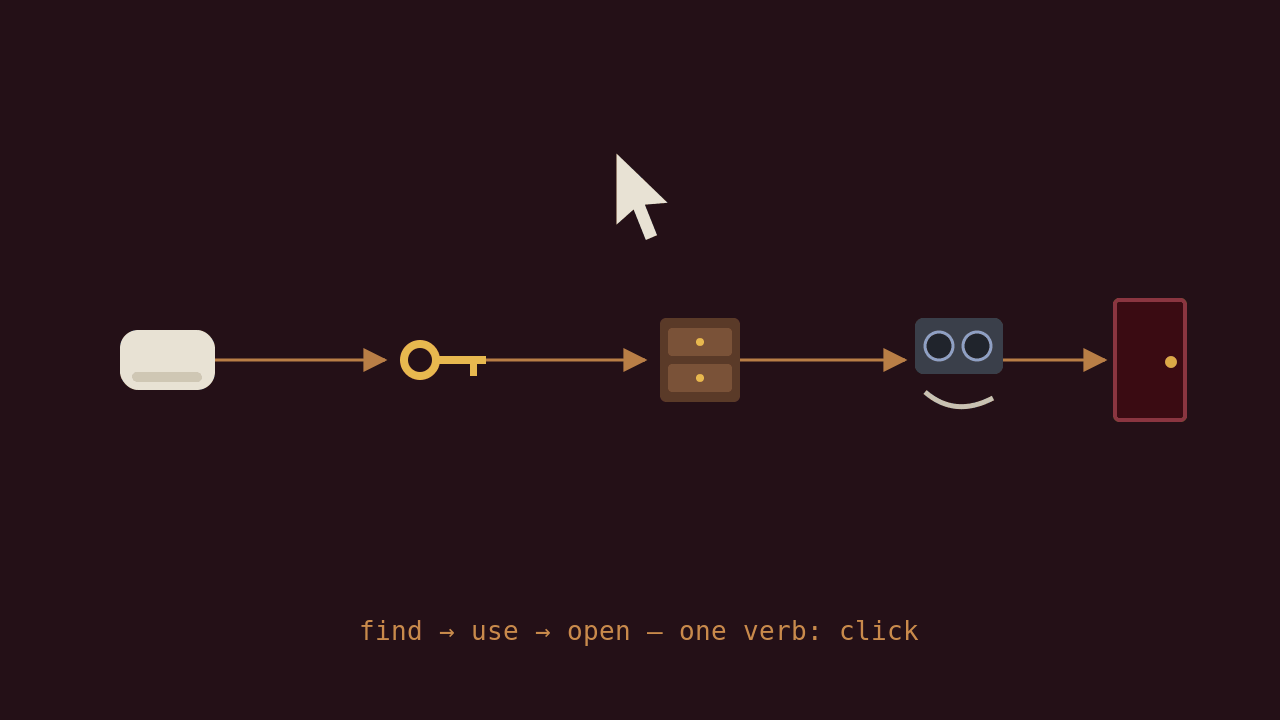 The chain of discovery and use, starting with a key under a pillow (illustration, AI-generated)
The Lineage to Today
Kyoto, 2007. Takao Kato, who published the free paper SCRAP, was struck by a staff member's remark about staying up all night hooked on web escape games — 'then let's do it in real life'. On July 7 of that year, in two rented gallery rooms, he held what is generally considered the world's first real escape game. And Kato later wrote himself that playing Crimson Room was the source of the idea, calling it 'logical, simple, and stimulating'. As genealogy goes, this is the cleanest case possible: the influence is stated by the person influenced.
The journey of the word 'Takagism' is just as interesting. Originally the brand Takagi gave his own works, it came to stand for web escape games generally, and then settled in China as the word for physical escape venues themselves. One of Beijing's earliest venues, founded in 2012, went by the English name 'Beijing Takagism Club'. I know of no other case where a Flash-era individual developer's name crossed the sea to become the genre name for a real-world pastime.
The digital lineage runs to the present as well. Submachine (2005), which I covered earlier on this site, was a browser-escape series grown from the same soil; Rusty Lake's Cube Escape series is a direct descendant that grew from free browser escape games into commercial Steam releases. Escape Simulator (2021) goes further, importing the real escape room experience back into the digital. Screen to reality, reality back to screen — at the origin of that round trip stands the red room.
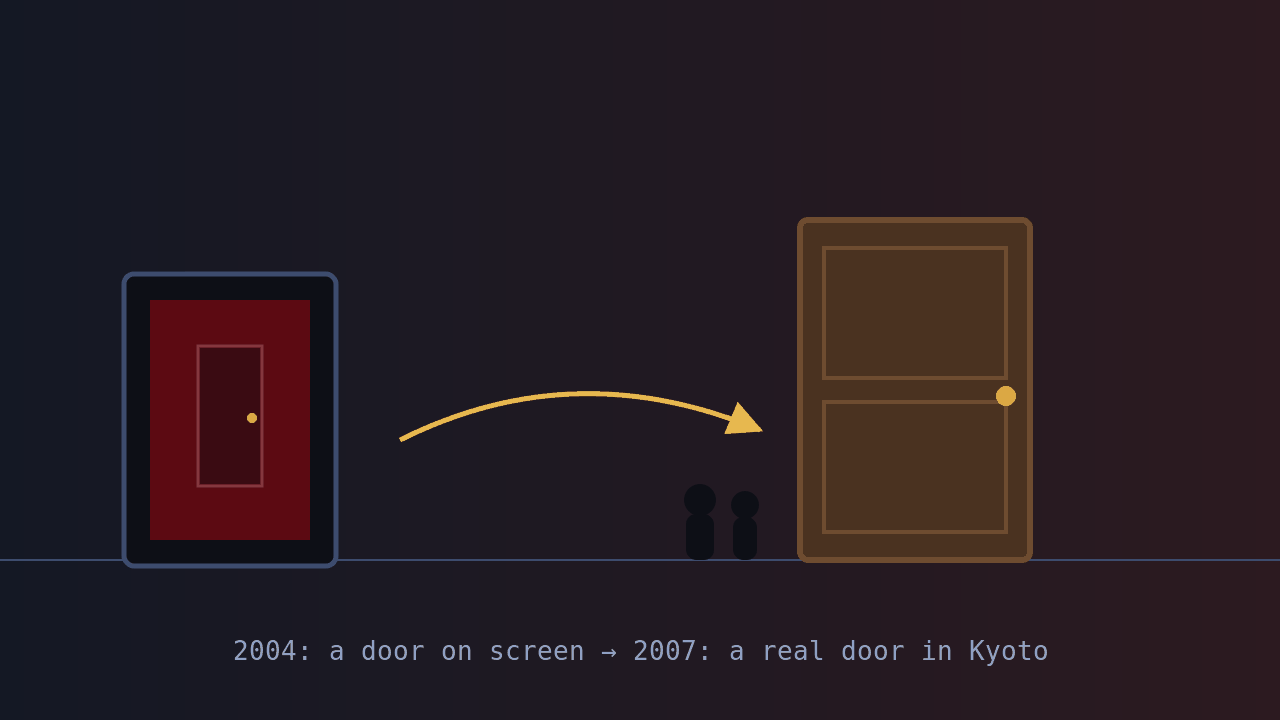 From a Flash locked room to physical escape venues — play stepped off the screen (illustration, AI-generated)
References
Sources consulted for this article:
・Wikipedia: Crimson Room (release date, sequels, reception, the 800-million-views figure, and Takagism, with citations)
・Wikipedia: MOTAS (released November 2001 by Jan Albartus)
・MOTAS official site (Jan Albartus)
・Internet Archive: Crimson Room (preserved Flash build)
・Real Escape Game 'ABOUT' (Takao Kato's own reference to Crimson Room, archived)
・Takao Kato's note essay on how the Real Escape Game came to be (the first event, July 7, 2007)
・Wikipedia (Japanese): Real Escape Game
・4Gamer: interview with SCRAP's founder (2011)
・Vox: The strange appeal of escape the room games, explained (2016)
・Siliconera: A Decade Later, Players Must Once Again Escape The Crimson Room (2016)
Closing
What this work demonstrated, historically, comes down to one point: a puzzle can be embedded in a space. No problem statement, no pieces, no board — the room itself becomes the question. Because of that turn, play could step past the frame of the screen, into two rented gallery rooms in Kyoto, and on into escape venues around the world. The red room of 2004 is the hinge of that door.
Flash reached its official end of life at the close of 2020, but this game is preserved at the Internet Archive and can still be played today. It is worth the visit, to confirm that a tiny locked room finished in a few dozen clicks had an entire genre's future folded inside it.
 The door opened — and the game went on outside the room (illustration, AI-generated)
Reactions (no login)
Anonymous • one of each per visitor per day
Learn — Curriculum
LearnPart 2 Lineage — Where Puzzles Came FromChapter 6 The 2000s Turn — Flash, Mobile, Jams2 / 15
Part of these series
Retro RevisitedEpisode 13 of 45
Read next

Related reviews
The House of Da Vinci 2
A first-person puzzle adventure in which you serve as an apprentice to Leonardo da Vinci, opening handmade mechanical contraptions one at a time across Renaissance Italy. A device called the Oculus Perpetua lets you reach into the past and change the shape of the room in the present. Blue Brain Games' sequel to The House of Da Vinci.
The Tartarus Key
A first-person puzzle adventure with no combat: a woman wakes in a mansion full of traps and puzzles and tries to escape while rescuing other captives. By Vertical Reach.
Tiny Room Stories: Town Mystery
An escape-room puzzle game in which a private detective, summoned to the deserted town of Redcliff, inspects diorama-like rooms that can be rotated and viewed from any angle, opening keys and combination locks while searching for his father. Made at a very small scale by Kiary Games and ported from mobile.


