HISTORY · 2026-07-12
Tangram (Qi Qiao Ban) — Around 1810, Seven Pieces of Lies and Truth
How a Chinese paper-cutting puzzle swept the West, and the one fabricated history that obscured it
Introduction
This is the story of the tangram, or qi qiao ban ('seven cleverness boards'), a puzzle of Chinese origin made of seven pieces. The oldest surviving text is a book published in China in 1813, but research by scholars such as Jerry Slocum suggests the toy itself took shape between 1796 and 1801. A square is cut into seven pieces, five right isosceles triangles of varying size, one square, and one parallelogram, which are rearranged to form the silhouettes of people, animals, and letters. The rule is simple, yet the possible combinations are endless.
The toy landed in the West around 1815 to 1820. Carried by trading ships out of Guangzhou, it first reached port towns in America and Europe and quickly ignited a craze. Yet the plain history of this simple toy would, in the early 20th century, be long obscured by a 'history book' written by a single puzzle maker. What I wish to dig up here is both the genealogy of the seven boards themselves and the lie that dressed it up.
 Impression of a shape forming from seven pieces (illustration, AI-generated)
The Context of the Era
Linking China and the West in the 1810s was the trade route out of Guangzhou. Under the Canton System of the time, China restricted trade with the West to that single port, and it was through the sailors and merchants passing through it that sundry goods and toys, tangram included, are believed to have traveled west. One of the earliest Western records is an English-language tangram guidebook believed published around 1817, thought to be near the first appearance of the English name 'Tangram.'
What helped fuel the craze in the West was, ironically, a religious loophole. Records suggest the Catholic Church of the time, while forbidding much sabbath recreation, tolerated quiet intellectual play such as tangram. A 1820 Paris guidebook, Le Véritable casse-tête, ou Énigmes chinoises, attests to the craze in France during this period. Anecdotes claim Napoleon and Edgar Allan Poe were both fond of tangram, but these are widely repeated as color for the era's popularity and should be treated with caution absent firmer primary sourcing.
A blow to this pastoral history of popularity came in 1903, when American puzzle maker Sam Loyd published The 8th Book of Tan. In it, Loyd presented a grand and entirely invented chronicle claiming tangram was invented by a Chinese god named 'Tan' in 4000 BC. Many readers took this as fact, and the false history circulated for years. By around 1908, researchers had begun pointing out the fabrication, though the correction took time to spread. Here I see a lesson: a lie told in an authoritative form, a book, settles into fact with alarming ease.
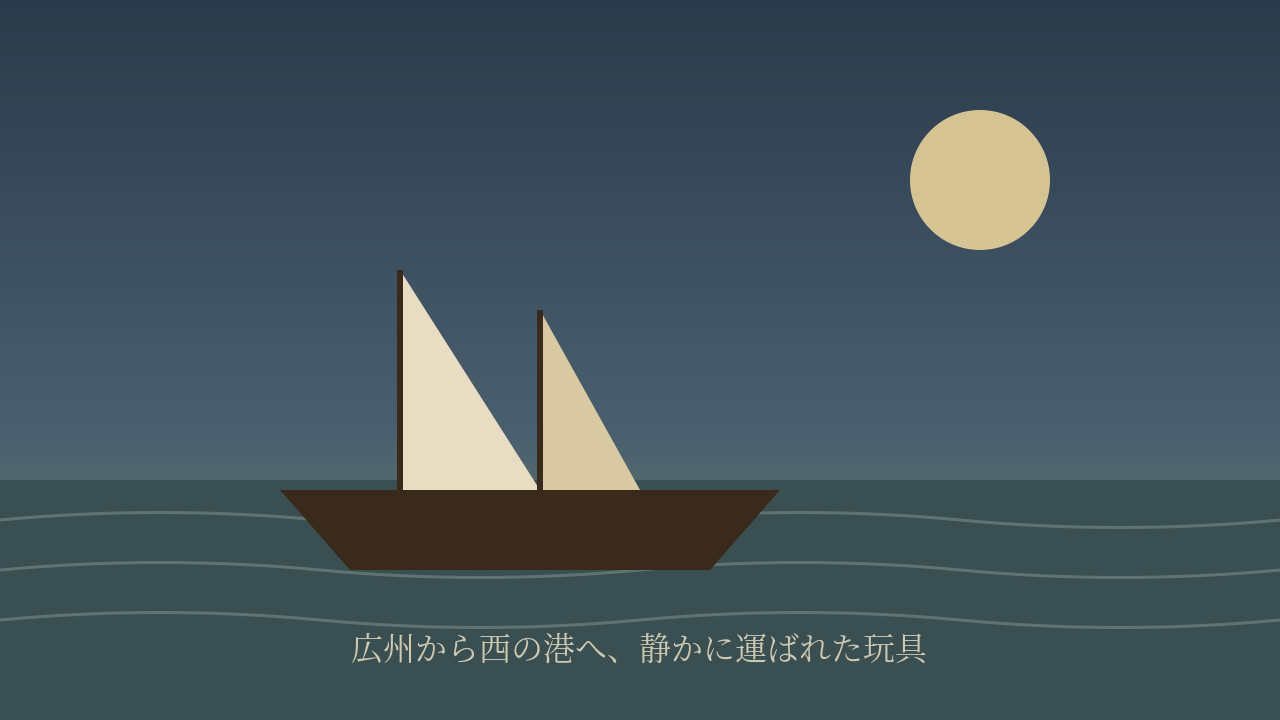 Impression of a toy crossing from a Chinese port to the West (illustration, AI-generated)
Mechanics
The rule is extremely simple. A single square is divided into seven pieces: two large right isosceles triangles, one medium right isosceles triangle, two small right isosceles triangles, one square, and one parallelogram. The player rearranges all seven, without overlap and without gaps, to reproduce a given silhouette, a person, an animal, a letter, a geometric pattern. The total area of the pieces never changes. Herein lies tangram's mathematical purity.
These three constraints, conserved area, all pieces used, no overlap, make the search space of possible answers remarkably rich. With only seven parts, mathematicians have proven that just thirteen convex polygon silhouettes are theoretically constructible, yet once non-convex silhouettes are included, the practical number of possible puzzles is effectively limitless. A design drawing vast diversity of answers from a small vocabulary, seven fixed pieces, already carried, at this early date, a structure worth calling the forerunner of every later puzzle that tries for infinite arrangement from a limited set of pieces.
What matters is that tangram has no dynamic element whatsoever: nothing vanishes, nothing moves, no clock runs. The board is given as a still image, and all trial and error happens inside the player's mind. This stands in contrast to the dynamic puzzles, chains, falling pieces, that would appear in the same and later eras, and it forms its own, independent lineage, one that should be called the silhouette puzzle, or the form puzzle.
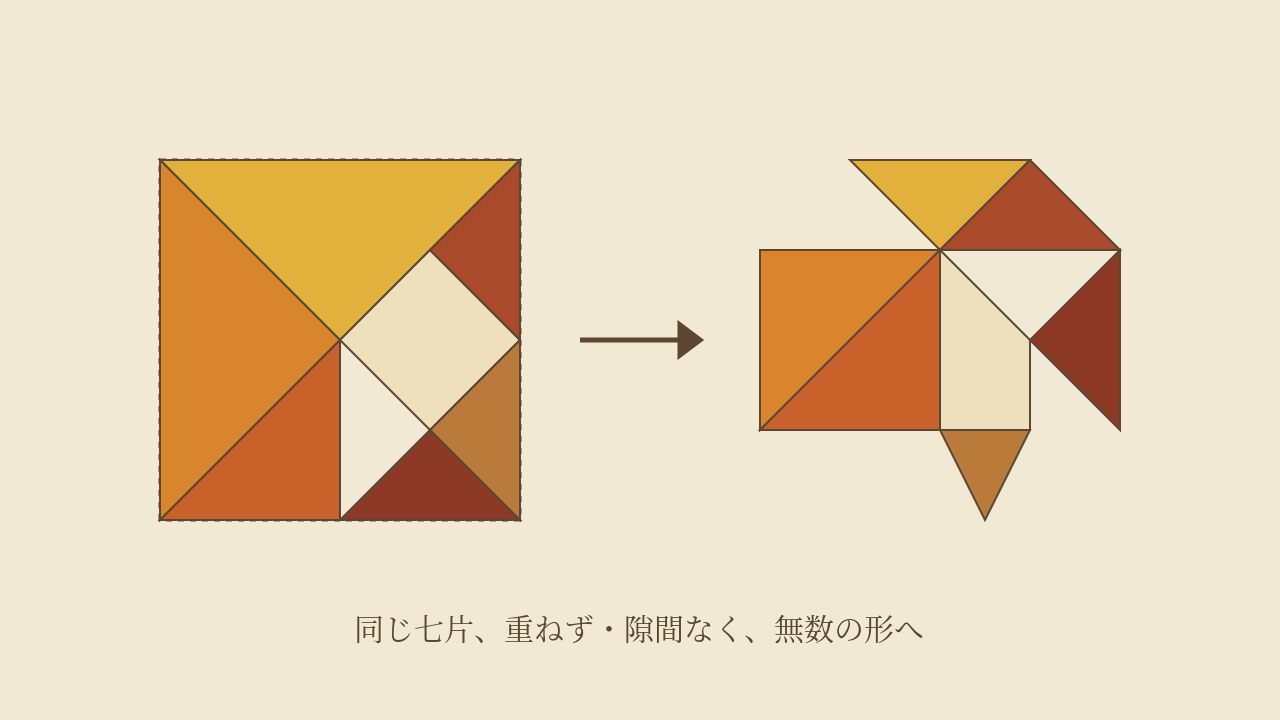 Impression of the structure by which rearranged pieces yield a silhouette (illustration, AI-generated)
Legacy to the Present
What tangram historically established was an archetype of the combination puzzle: a small fixed set of pieces, conserved area, static silhouette matching. This rule set chooses no era and no medium. Indeed, the rule has been carried into digital media entirely unaltered. For instance, Tangrams Deluxe, released by developer Vertical Reach on Steam on August 9, 2017, offers over 200 silhouette challenges using tangram's traditional seven-piece rule exactly as it stood.
I want to be careful here. I will not assert the direct causal claim that 'modern silhouette puzzles were born because tangram existed' without the creators' own testimony. What is certain, rather, is the fact itself: a rule set established more than two hundred years ago still exists today on Steam's catalog, requiring no modification at all. Where many retro works are read only indirectly as 'ancestors of modern design,' tangram is a rare case where the era's rule set circulates, almost unchanged, as an active commercial product today.
One more thing worth noting: the history of this very work embodies a lesson for the study of puzzle history itself, namely how discourse on a puzzle's origin can be distorted. Sam Loyd's fabricated history circulated for years as an amusing anecdote, and the true origin could only be recovered through patient documentary research. As one who handles history, I consider this fact to be another, and perhaps more important, legacy this toy hands down to the present.
 Impression of a lineage from a paper toy to an on-screen puzzle (illustration, AI-generated)
References
Sources referenced in this article:
・Siam Mandalay: A History of Tangrams
・British Library Asian and African Studies Blog: A popular Chinese game, the Qi Qiao Tu, or Tangram
・HowStuffWorks: How Tangrams Work
Closing
Cut in late-18th-century China and carried west from the port of Guangzhou sometime in the 1810s, seven flat boards. What tangram left to history was neither flashy technology nor an intricate mechanism, but the simplest possible rule, rearrange while conserving area, and the abundance of silhouettes it makes possible without end. And it carried one more thing besides: the bitter lesson of how thoroughly a single fabricated history book can obscure the truth.
Let me close as one who travels back through time. The rule of the seven boards holds exactly the same, on paper or on a Steam screen, more than two hundred years on. Technology has been reborn again and again, but the logic of rearranging seven pieces while conserving their area has not aged a day. In that, and in the discipline demanded of anyone who tells this toy's history, I find its quietest, surest value.
Reactions (no login)
Anonymous • one of each per visitor per day
Learn — Curriculum
LearnPart 2 Lineage — Where Puzzles Came FromChapter 3 Puzzles of Paper and Wood2 / 11
Part of these series
Puzzle Incident HistoryEpisode 10 of 54