HISTORY · 2026-07-10
The Real Escape Game (2007) — Two Rooms in Kyoto That Grew Into a Worldwide Locked Room
How a man who wanted to 'try it in real life' after watching a staffer get hooked on web escape games threw the first night, as a sideshow at a free paper's third-anniversary party
Introduction
This happened in Kyoto on July 7, 2007. Takao Kato, publisher of the free paper SCRAP, rented two rooms at the Inspiblo gallery as a sideshow for the paper's third-anniversary party, splitting roughly 100 attendees into 14 teams of seven for a puzzle-solving event titled 'A Banquet of Puzzle-Solving: Escape, Puzzles, Curry and Beer.' This is the documented first night of what would come to be called the 'Real Escape Game' — a phenomenon that grew into a worldwide commercial industry.
I want to read this night not merely as a record of a party sideshow, but as a rare junction where an on-screen puzzle walked out into physical space. Kato has said himself, in his own later writing, that the spark was his fascination with web escape games circa 2004. This is not a speculative genealogy — the bridge from digital to physical is backed by the originator's own testimony.
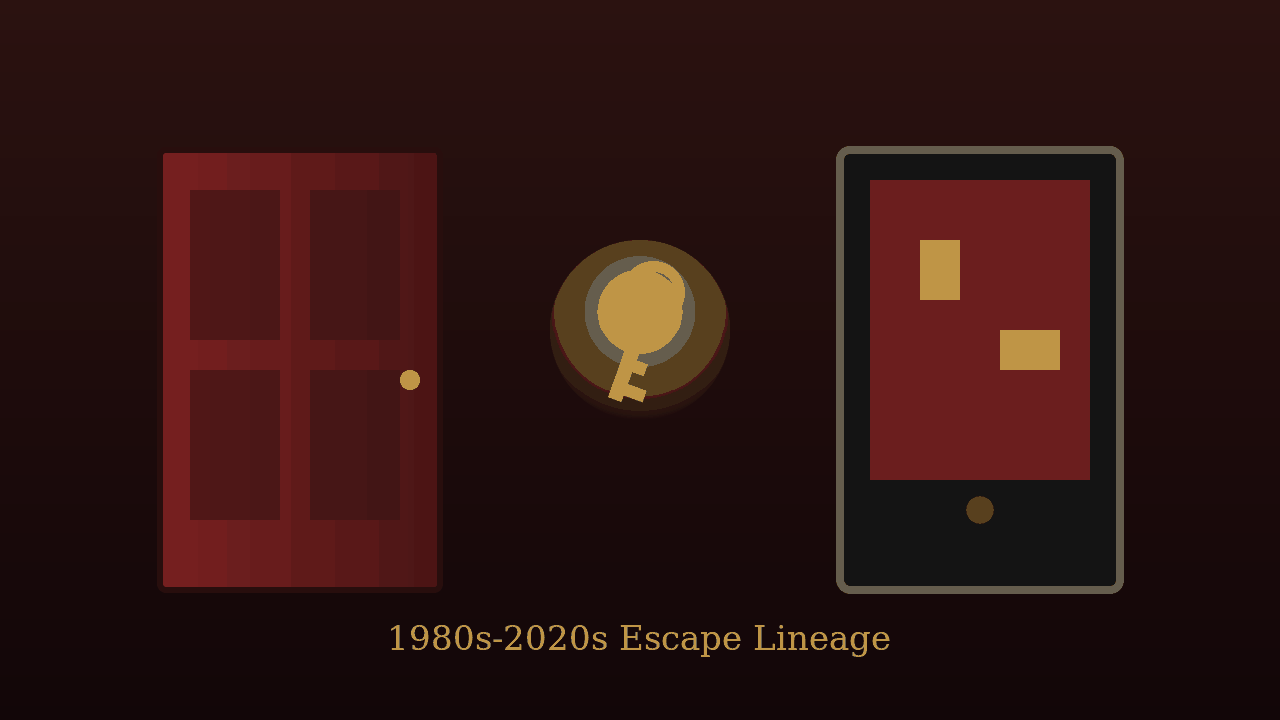 A real door and a room on a screen — two kinds of 'locked room' (illustration, AI-generated)
The Context of Its Era
In 2007, Kato was running SCRAP, the free paper he had founded in Kyoto in July 2004. Formal incorporation as a company was still ahead of him — that came on June 2, 2008. So the first night was not a corporate project but a DIY, indie-scene event. Kato was also the organizer of Borofesta, a Kyoto independent music event, and that soil nurtured a culture of 'if you think of it, try it yourselves first.'
The direct spark, by his own account, came at an editorial meeting around May 2007: a staff member mentioned staying up all night hooked on a web escape game, and Kato thought, on the spot, 'let's try that in real life.' Because the third-anniversary party offered a ready occasion, the distance from idea to a one-night event was short.
Worth noting: the following July, 2008, saw the launch of a separate, rally-style walk-the-city event called 'A Banquet of Treasure Hunting' — deliberately kept apart from the 'Real Escape Game' brand, and regarded as the origin of today's roaming puzzle-hunt events. That locked-room escape and city-rally puzzle hunting branched off from each other in parallel around this time is worth recording.
 Born as a sideshow at a free paper's third-anniversary party (illustration, AI-generated)
Mechanics
The first night's venue split into a 'literature room' and a 'science room.' About 100 participants, divided into 14 teams of seven, searched for paper clues hidden in the rooms and solved puzzles within an eight-minute time limit. What matters here is that this differed from the format we now picture when we hear 'escape game' — one team renting one room, sealed off from everyone else. At the time, multiple teams shared the same room, and information could pass between them; it was a more festive, crowded kind of puzzle-solving.
The link between this design and Crimson Room, the web escape game released in 2004, is not merely my own speculation. SCRAP's own official company profile states plainly that the Real Escape Game transposed Crimson Room's format directly into the physical world. In fairness, though, Kato's own detailed 2023 personal essay recounts the staffer's description only in generic terms — 'an internet escape game' — without naming a specific title. It is worth recording that the naming of the specific title appears only in later, official-side framing, not in Kato's own retelling.
The format we now take for granted at commercial venues — one team, one locked room, entirely private — did not solidify on this first night. It was refined gradually, as participants passed along their experiences and venues evolved into permanent escape rooms known as 'agito' (hideouts).
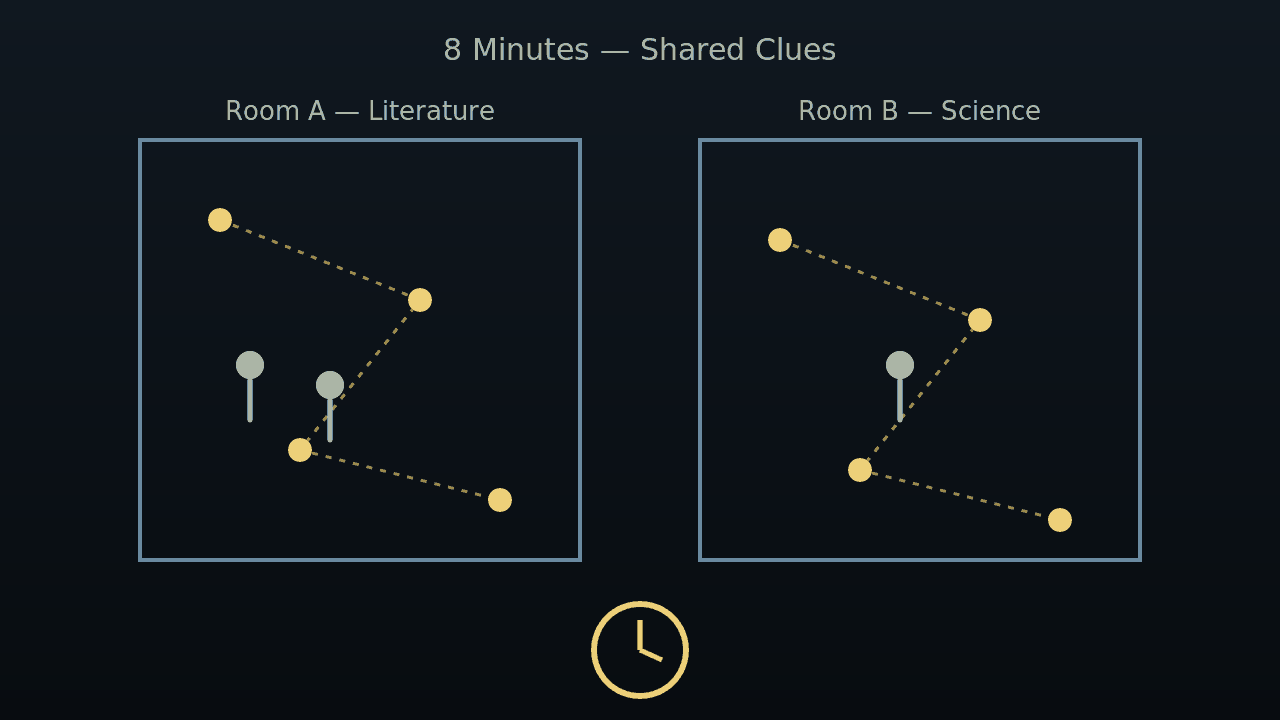 A literature room and a science room, an eight-minute limit, shared clues (illustration, AI-generated)
The Lineage to Today
After incorporating as SCRAP Co., Ltd. on June 2, 2008, the Real Escape Game expanded overseas. Wikipedia's list of overseas host cities gives Singapore in 2011, and SCRAP itself, in an interview with Room Escape Artist, has said San Francisco in 2012 was the first US event. Los Angeles and New York (Brooklyn) followed. SCRAP's own company profile states cumulative participation has now passed 15 million, and a November 2013 event at Makuhari Messe was recognized by Guinness World Records for the most participants at an escape-game-style event.
How this fits into English-language industry history is a point worth dwelling on. Room Escape Artist's 'A Quick History of Escape Rooms' places SCRAP and Kato squarely as originators of the documented escape room concept. Meanwhile, Parapark, founded in Budapest, Hungary in 2011, is often introduced as 'the first in the world.' Its founder, Attila Gyurkovics, traces his own inspiration to hidden-object games and Csikszentmihalyi's flow theory, and there is no testimony that he was aware of Japan's precedent. Room Escape Artist itself finds no solid documentation backing Budapest's 'world first' claim, and treats the two as parallel, independent developments separated by four years rather than one directly inspiring the other.
Crimson Room (2004), which I covered earlier on this site, is the work Kato has testified was the direct spark for that first night. And today, works like Escape Simulator (2021) on Steam import the real-world escape room experience back into the digital realm. Screen to reality, reality back to screen — somewhere in that round trip sit the two rooms of July 7, 2007. Here we can see the starting point of puzzle-solving's evolution into a commercially designed experience.
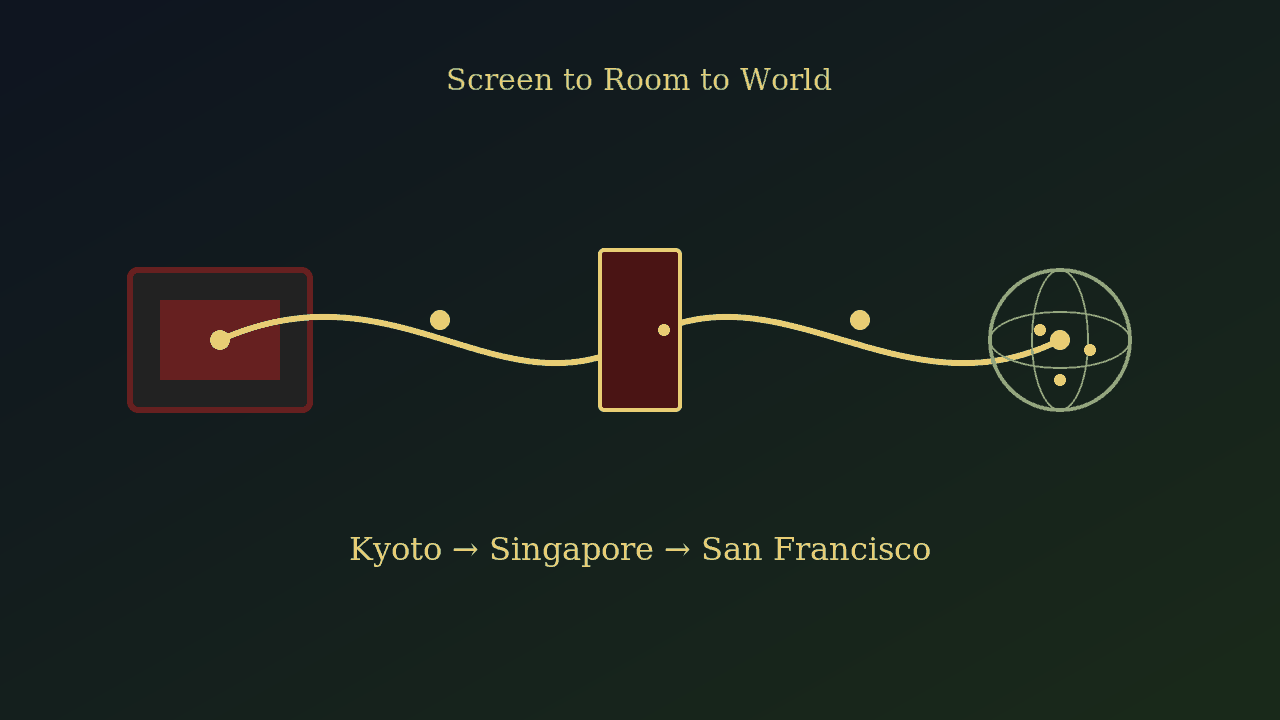 From Kyoto to Singapore, and on to San Francisco (illustration, AI-generated)
References
Sources consulted for this article:
・Wikipedia (Japanese): Takao Kato (biography, SCRAP founding)
・SCRAP official site: Company Profile (incorporation date, cumulative participants, reference to Crimson Room)
・Takao Kato's note essay on how the Real Escape Game came to be (details of the July 7, 2007 event and its origin)
・nazomap: "History of the Real Escape Game" (details of the first event, relation to the treasure-hunt sibling event)
・Wikipedia (Japanese): Real Escape Game (overseas host cities, Guinness World Record)
・Room Escape Artist: Interview with SCRAP (2021) (2008 founding, 2012 US expansion testimony)
・Room Escape Artist: A Quick History of Escape Rooms (2017) (industry-history positioning, discussion of the Parapark parallel)
・Atlas Obscura: Inside the Budapest Escape Room That Started the Worldwide Craze (Parapark and Attila Gyurkovics's testimony)
・The Japan Times: Real escape game brings its creator's wonderment to life (2009) (interview with Kato himself)
・Wikipedia: Crimson Room (2004 release details, corroborating this site's related article)
Closing
What this night demonstrated, historically, comes down to one point: a puzzle can step outside the screen and be embedded into any negotiable space. Kyoto in 2007 had no streaming infrastructure and no dedicated venue — only two rented gallery rooms and a circle of free-paper collaborators. And yet the leap happened: an experience of being hooked on a web escape game turned, through one remark, into 'let's try that in real life.' That leap remains on record today, in the originator's own words.
As a historian, I want to add that in this kind of genealogy, testimony that names the actual source of inspiration is itself rare and valuable. Most claimed 'influences' get asserted on speculation; here we have both an official record and the originator's own retrospective essay, and even the small discrepancy between them can be documented. The two rooms of July 7, 2007 now live on as escape venues across the entire world. Even so, the origin remains right here.
 The door opened. The puzzle no longer lives on a screen alone (illustration, AI-generated)
Reactions (no login)
Anonymous • one of each per visitor per day
Learn — Curriculum
LearnPart 2 Lineage — Where Puzzles Came FromChapter 6 The 2000s Turn — Flash, Mobile, Jams3 / 15
Part of these series
Puzzle Incident HistoryEpisode 9 of 54
Read next

Related reviews
The House of Da Vinci 2
A first-person puzzle adventure in which you serve as an apprentice to Leonardo da Vinci, opening handmade mechanical contraptions one at a time across Renaissance Italy. A device called the Oculus Perpetua lets you reach into the past and change the shape of the room in the present. Blue Brain Games' sequel to The House of Da Vinci.
The Tartarus Key
A first-person puzzle adventure with no combat: a woman wakes in a mansion full of traps and puzzles and tries to escape while rescuing other captives. By Vertical Reach.
Tiny Room Stories: Town Mystery
An escape-room puzzle game in which a private detective, summoned to the deserted town of Redcliff, inspects diorama-like rooms that can be rotated and viewed from any angle, opening keys and combination locks while searching for his father. Made at a very small scale by Kiary Games and ported from mobile.


