RETRO-REVIEW · 2026-07-03
Cursor*10 (2008) — Ten of Me Climb One Tower: The Origin of Self Co-op
How a Flash experiment made over a single New Year's holiday spread the puzzle grammar of cooperating with your past self
Introduction
This is a work of January 2008. Yoshio Ishii of the Japanese studio Nekogames posted a Flash game on his own site: Cursor*10, read 'cursor times ten.' The screen shows nothing but a line-drawn tower on white. There is no protagonist and no story. What you control is the mouse cursor itself, and you are given ten lives. Each cursor has a lifespan; when time runs out, the next cursor starts again from the first floor. The goal is the sixteenth floor, the top of the tower.
But past lives do not vanish. When a new cursor begins its climb, everything your previous selves did is replayed exactly. A past me holds a button down; the present me runs up the staircase it reveals. On 4 January 2008, days after release, John Walker of Rock Paper Shotgun called it 'the best possible form of co-op.' A single-player co-op game — that paradox is the invention this work left to history.
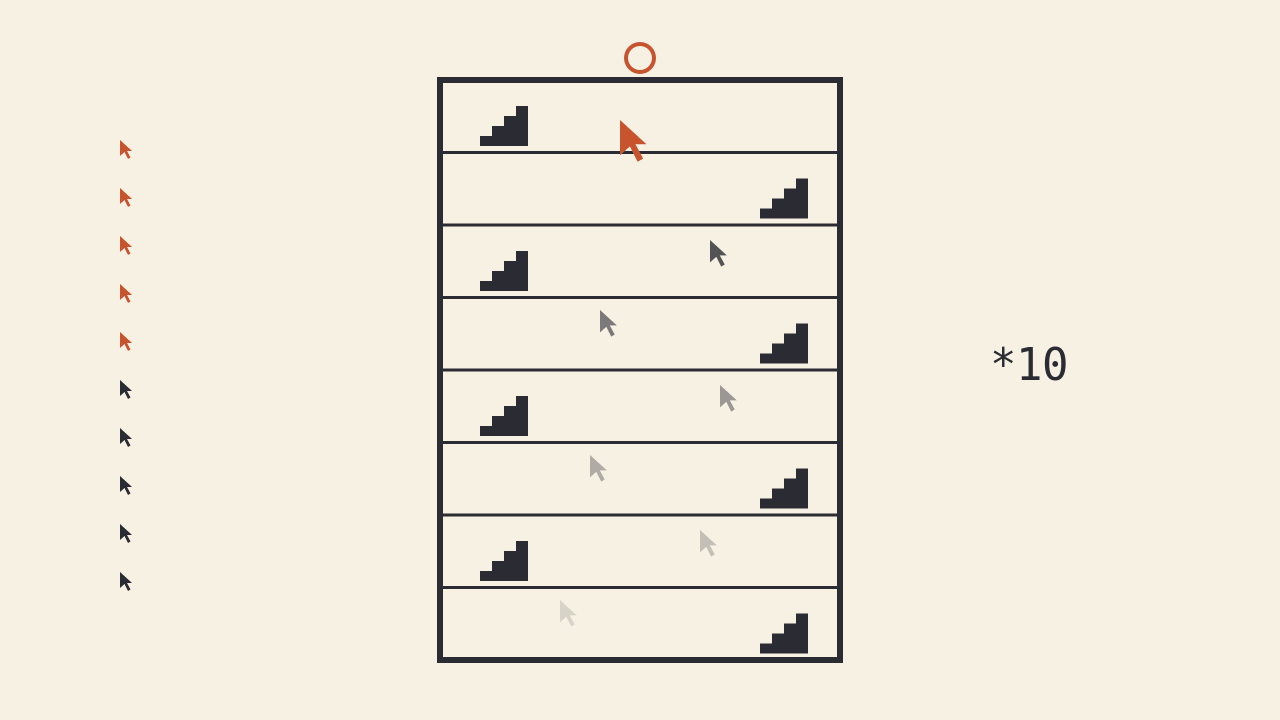 Ten cursors climb a single tower — the premise of Cursor*10 (illustration, AI-generated)
The Context of Its Era
2008 sits at the height of Flash culture. Anyone with a browser could play, and a solo author could turn an idea into a game in days and hand it to the world the next morning. Newgrounds and Kongregate served as venues, and review sites like Jay is Games unearthed new work almost daily. A unified storefront like Steam was not yet the main stage for puzzles; the cradle of experiment was inside the browser.
Cursor*10 is a product of precisely this ecosystem. According to Hardcore Gaming 101, it was inspired by Yugo Nakamura's Flash piece Finger Tracks and built over a single Japanese New Year's holiday. The hidden message that appears when you top the tower reads 'happy new year 2008' — the work testifies to its own making. Ishii, later known for the Hoshi Saga series, was one of the defining Flash authors of the period.
The game spread by word of mouth in days and was later included in the book 1001 Video Games You Must Play Before You Die (2010), which selected it while noting it was 'more a proof of concept than the finished work.' A free browser miniature made in days, shelved beside commercial epics — such was distribution in that era.
 Flash culture of 2008, reaching the world through a browser window (illustration, AI-generated)
Mechanics
The rules are terse. Click stairs to change floors, click pyramids to score, and when the life gauge empties the next cursor takes over. The trick is strung between lifespan and replay. Take the button that reveals a staircase only while held: if your current cursor holds it, that life ends without climbing. But in the next life, your past self's holding is replayed, and the present you walks up unhindered.
The resource of this game is time itself, and the player spends one cursor's lifespan as an investment in a future self. On floor nine sits a box that must be clicked ninety-nine times against a timer — impossible in one life, breakable only across several. Floor fifteen demands multiple buttons held at once, and one of them is hidden back on floor six. The whole tower becomes a single plan of divided labour.
It is a puzzle of action planning that still demands reflexes in execution — 'a fine line between a puzzle game and an arcade game,' as the Jay is Games review put it. The comment threads from those first days record players racing for the maximum score of 188 and finishes with five cursors to spare. Two colours, line art, nothing but mouse clicks — and this much depth. It is a model of design by subtraction.
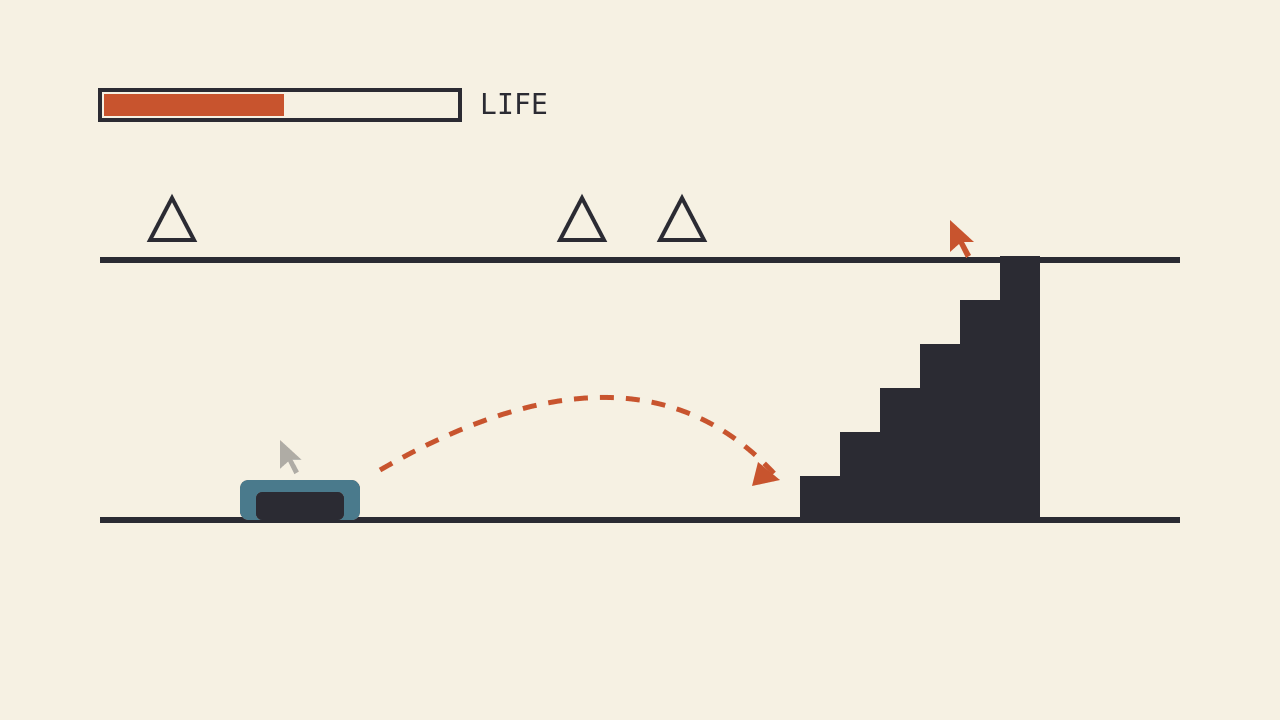 One cursor's sacrifice becomes the next one's passage — a diagram of divided labour (illustration, AI-generated)
Lineage to the Present
The grammar of cooperating with a recorded past self was budding in several places around 2008: the shadow world of Braid (2008), The Company of Myself (2009), The Misadventures of P.B. Winterbottom (2010). Among them, Cursor*10 presented the grammar in its most naked form — a pure structure stripped of character and story. Boluk and LeMieux's study Metagaming (2017) credits it with helping popularise the self co-op style.
There are cases where direct influence can be confirmed in the maker's own words: Frank Force cites Cursor*10 as an inspiration in his postmortem of A Stitch in Time (2010). The game also produced a sequel, Cursor*10 2nd Session, and in 2009 a greatly expanded PSP adaptation, Onore no Shinzuru Michi wo Yuke, developed by Silicon Studio and published by FromSoftware. A free Flash miniature flowing upstream into a console release was, for its time, a rare passage worth recording.
Look at today's Steam and puzzles that treat your past self as a piece on the board have become a staple: the recorder of The Talos Principle (2014), Induction (2017), Timelie (2020). I will not claim all of these as direct descendants. But that New Year's when ten cursors climbed one tower, this grammar was shown to the world in its purest form — and that deserves a line in the historical record.
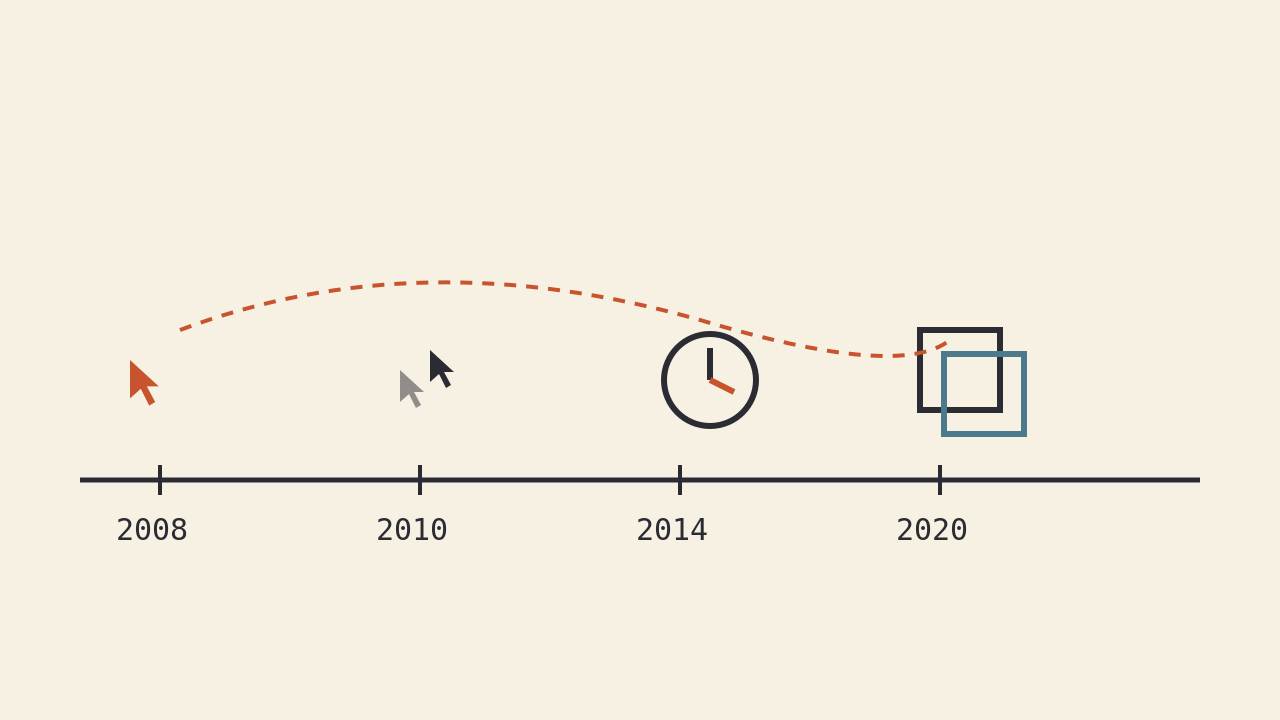 From the cursor of 2008 to the time puzzles of today (illustration, AI-generated)
References
Sources referenced in this article:
・Rock Paper Shotgun: Cursor * 10 (John Walker, 4 January 2008)
・Jay is Games: Cursor*10 review (3 January 2008)
・Hardcore Gaming 101: Onore no Shinzuru Michi wo Yuke (on the PSP version)
・Frank Force: A Stitch In Time – Postmortem (2010, citing Cursor*10)
Closing
What Cursor*10 demonstrated, historically, is that neither protagonist nor story is required. With the smallest possible being — a cursor — and a temporal device of lifespan and replay, a puzzle can acquire an entirely new grammar. And it became the world's shared property only because a single holiday's work could ride the instant distribution of the browser. The Flash plugin no longer runs, but the game is preserved at the Internet Archive and playable still. The line waiting at the top of the tower — 'happy new year 2008' — quietly testifies, eighteen years on, to the lightness of that era.
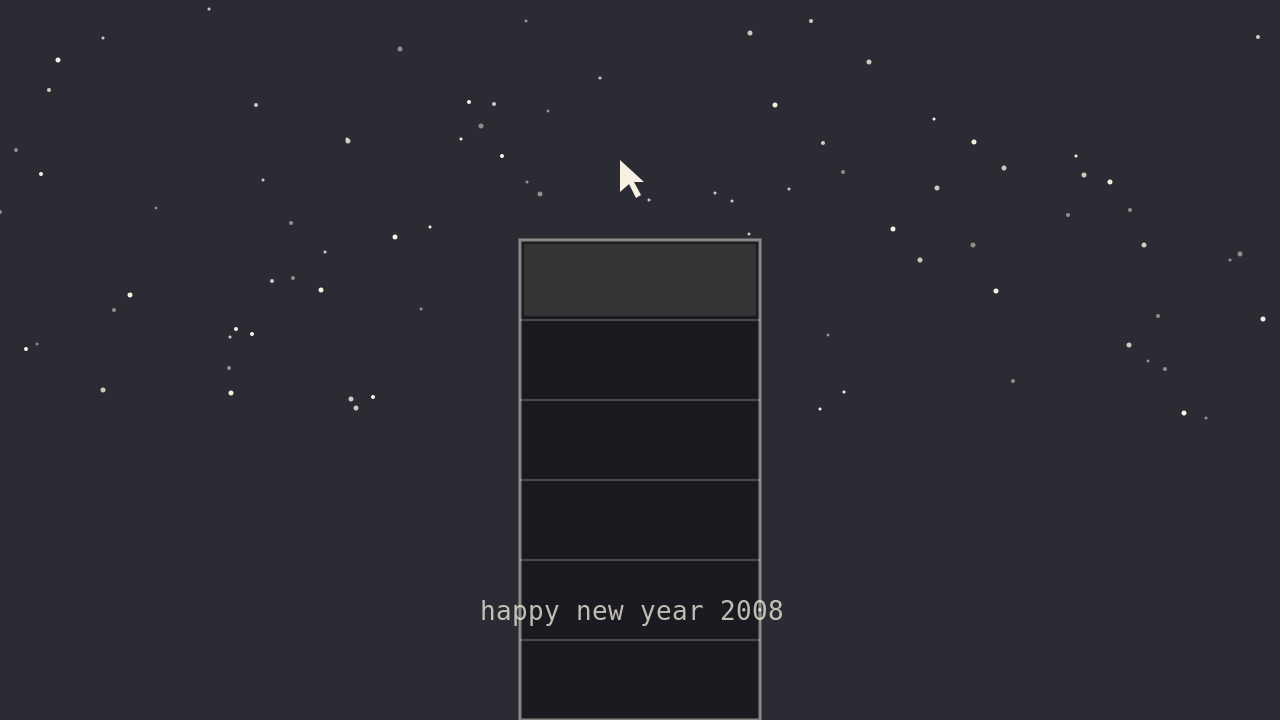 At the top of the climbed tower, a quiet close (illustration, AI-generated)
Reactions (no login)
Anonymous • one of each per visitor per day
Learn — Curriculum
LearnPart 2 Lineage — Where Puzzles Came FromChapter 6 The 2000s Turn — Flash, Mobile, Jams5 / 15
Part of these series
Retro RevisitedEpisode 10 of 45
