RETRO-REVIEW · 2026-07-21
Hitman GO (2014) — The Year an Assassin Became a Board-Game Piece
How Square Enix Montreal turned a cancelled AAA plan into a Unity turn-based board-puzzle method
Introduction
On April 17, 2014, a puzzle game arrived on iOS. Its title was Hitman GO. Built around the series' familiar assassin, Agent 47, it wasn't a stealth-action game at all — it was a turn-based board game played across a grid of nodes and connecting lines. It was developed by Square Enix Montreal, a studio founded only in 2011, for which this was the first completed release.
What I want to dig up here is not just the story of one spin-off. It's the process by which the idea of reducing a AAA brand into a board-game piece became a method — one the same studio carried forward into Lara Croft GO (2015) and later Deus Ex GO (2016). And this lineage also crossed over, eventually, to Steam: as Hitman GO: Definitive Edition in 2016. I want to trace the path a board-game piece born on mobile took before it reached Steam's shelves.
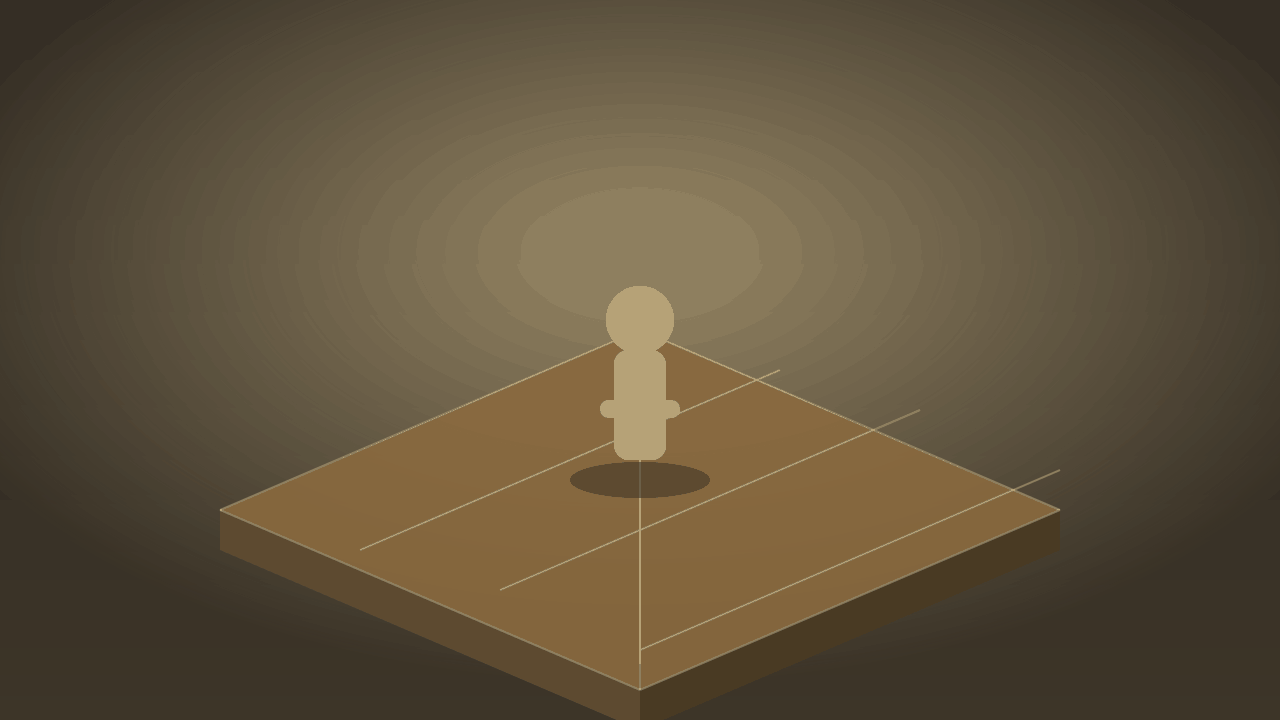 Impression of a single piece standing on a board (illustration, AI-generated)
The Context of Its Time
Square Enix Montreal was founded in 2011, staffed by people from existing Square Enix Europe studios. Its original mandate was to build a new, triple-A console Hitman game, with plans to grow the team to 150 people. But a year in, while the team was still expanding, that console project was cancelled, and the studio pivoted to mobile games — a shift that cost it roughly a third of its staff.
The pivot to mobile wasn't just a matter of scaling down; it changed the entire grammar of development. In mid-2013, designer Daniel Lutz — who had independent mobile development experience under the name Nonverbal — pitched a turn-based Hitman board game, and it was greenlit. The earliest prototypes were built the plainest way imaginable: printed-out paper cutouts of characters, arranged and rearranged by hand.
The team settled at eleven people and built the game in Unity, chosen for its low barrier to entry and support across mobile platforms. The game was announced in February 2014, released on iOS in April, and on Android in June. This scale and these constraints were the soil the 'distilling' design philosophy discussed below would grow from.
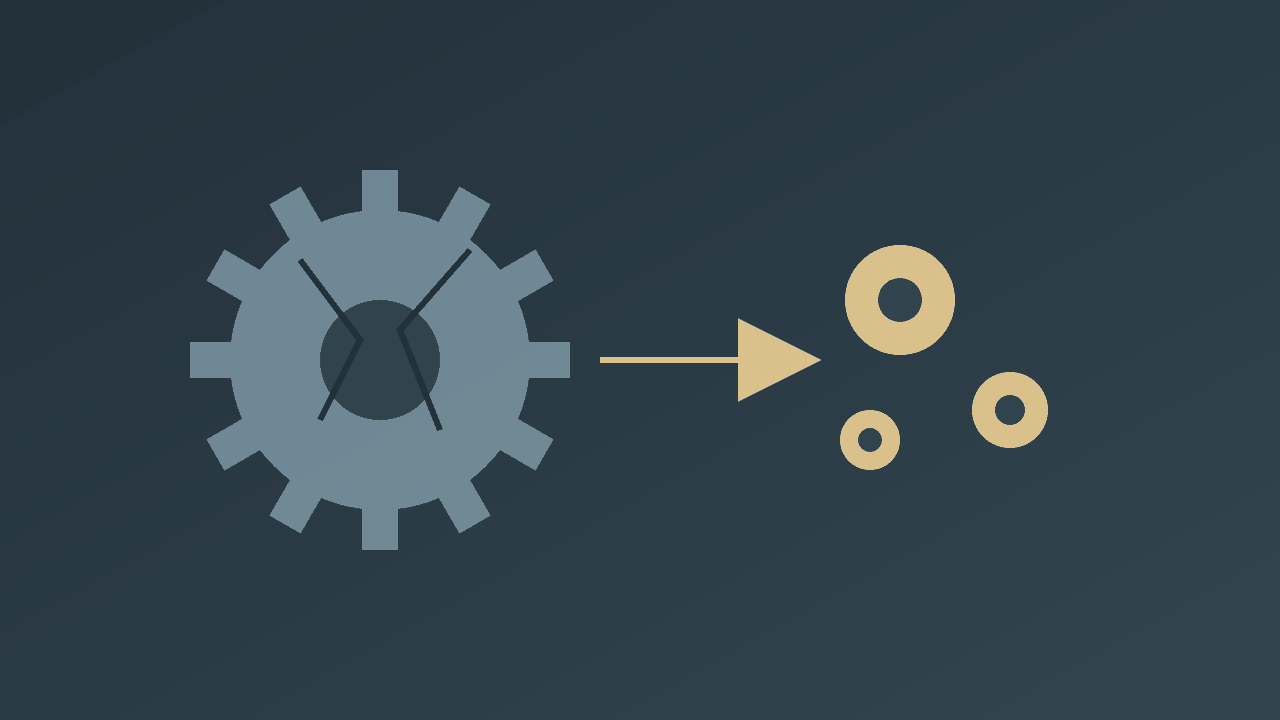 Impression of a large apparatus being rebuilt into a small one (illustration, AI-generated)
Mechanics
Hitman GO's board is made of nodes (positions) and lines (movement paths). The player swipes along a line to move Agent 47 one step to an adjacent node per turn. Once the player's turn ends, every enemy on the board moves simultaneously — a chess-like exchange, but one where both sides move at once rather than alternating single pieces.
The visual inspiration reportedly came from architectural models and dioramas, and, oddly, from the then-buzzy Tumblr Rich Kids of Instagram. According to Lutz, the sense of emptiness in photos of sprawling mansions and oversized yachts became the negative space of the board itself. Characters were built as fixed-pose pieces with no joint animation, closer to chess pieces than action-game avatars, and reused color-swatch materials kept rendering costs low while still giving each enemy type a distinct look.
The team also prototyped a waiting mechanic — letting the player lie in ambush — but cut it because it let players kill any enemy on the board, breaking the puzzles. The act of 'waiting,' so central to the original Hitman games, was sacrificed to keep each puzzle's solution unique: a small decision that marks this as a redesign, not a straight port.
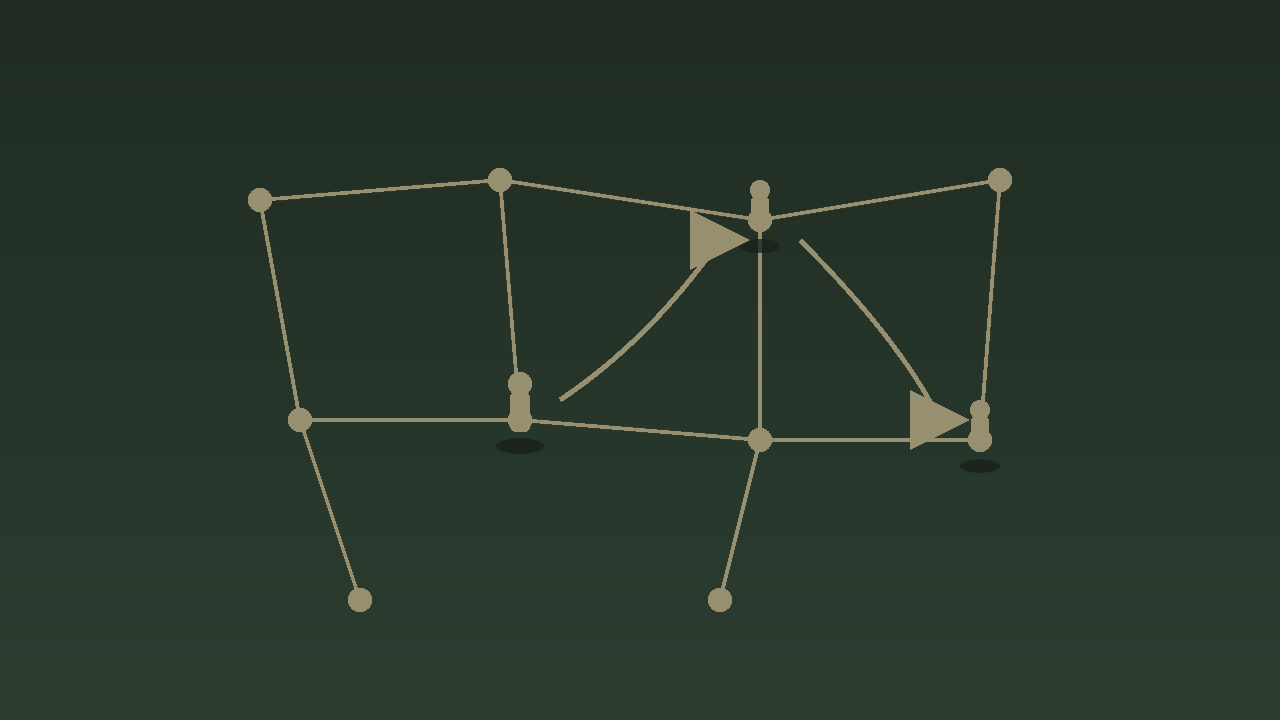 Impression of pieces taking alternating turns on a board of nodes and lines (illustration, AI-generated)
A Lineage Into the Present
Hitman GO's success carried forward into Lara Croft GO, released August 27, 2015. Technical director Antoine Routon described the method as taking a big engine apart, laying every piece out on a workbench, and rebuilding the leanest possible engine from them. He called it "a puzzle in itself" to make a Go game — the design philosophy of boiling a brand down to its minimum viable parts now had explicit language behind it.
The series continued the following year with Deus Ex GO, based on the Deus Ex franchise. By this point, the "GO series" had become a recognizable form in its own right — the act of adapting a AAA brand into a minimal, turn-based board puzzle was itself the thing being carried forward from game to game.
And this lineage also crossed outside mobile. Hitman GO landed on Steam, PS4, and PS Vita in February 2016 as its Definitive Edition, and Lara Croft GO followed with a Steam release that December. The same pattern repeats here as with Auditorium (2008), covered earlier on this site, which took a four-year detour from browser to Steam: a design method established on a platform once considered outside the mainstream later merged onto the main shelf.
There's also a critical note on lineage. USgamer's Jaz Rignall, reviewing Lara Croft GO, wrote that the game seemed influenced by Monument Valley (2014) — both being contemporaneous mobile puzzles set on overhead geometric boards. It should be said plainly that this is a critic's observation, not a developer's own testimony, but it's still one data point suggesting that mobile puzzle design in 2014-2015 was converging on similar answers without any coordination.
 Impression of several boards linking together toward a distant shelf (illustration, AI-generated)
Sources
Sources referenced in this article:
・USgamer (Jaz Rignall), "Lara Croft Go iOS Review: Pretty, Brilliant Puzzling," August 27, 2015
Closing
What Hitman GO demonstrated historically, I think, was less a single invention than the establishment of a method. Out of the backward-facing event of a cancelled AAA project came a forward-facing design philosophy: take it apart, rebuild it at its leanest. This wasn't an accident — it's a conscious method that two developers, Lutz and Routon, articulated in their own explicit words.
That method, distilling a brand down into a board puzzle, casts an indirect shadow over many mobile puzzles that followed, and eventually over titles that made their way to Steam's shelves. I haven't found primary sources proving a strict lineage of direct influence, but it remains a fact that the "GO series" form took shape within just a few years, 2014 to 2016, and merged from mobile onto Steam.
 Impression of one piece remaining alone on an empty board (illustration, AI-generated)
Reactions (no login)
Anonymous • one of each per visitor per day
Part of these series
Retro RevisitedEpisode 21 of 43