RETRO-REVIEW · 2026-07-09
Monument Valley (2014) — Walking Impossible Architecture in Mobile's Golden Hour
A six-person architectural verse, arriving in the wilderness of freemium
Introduction
This is the story of Monument Valley, whose distribution began on iOS on April 3, 2014. It was developed by ustwo games, a studio spun out of the London design agency ustwo, led by lead designer and game director Ken Wong, with Chief Creative Officer Danny Gray among a troupe of only six people. Players guide the silent princess Ida through ten chapters of floating, impossible architecture, moving blocks and shifting viewpoints to proceed.
I want to re-read this work not simply as a nostalgic hit, but as a node in a lineage of play that treats perspective itself as a building material. When I wrote about 2008's echochrome, I touched on the danger of narrating these two works as cause and effect. I will not repeat that argument here; instead I want to confirm, as far as primary testimony allows, Monument Valley's own birth, its era, and the path it took over the following decade.
Below, I first confirm the climate of the App Store in 2014 — a market ruled by freemium, into which this work arrived with the opposite bet of a single paid purchase. I then dissect how an impossible figure was translated into 'walkable' play, and finally trace the awards, the numbers, and where this work eventually drifted eight years after release.
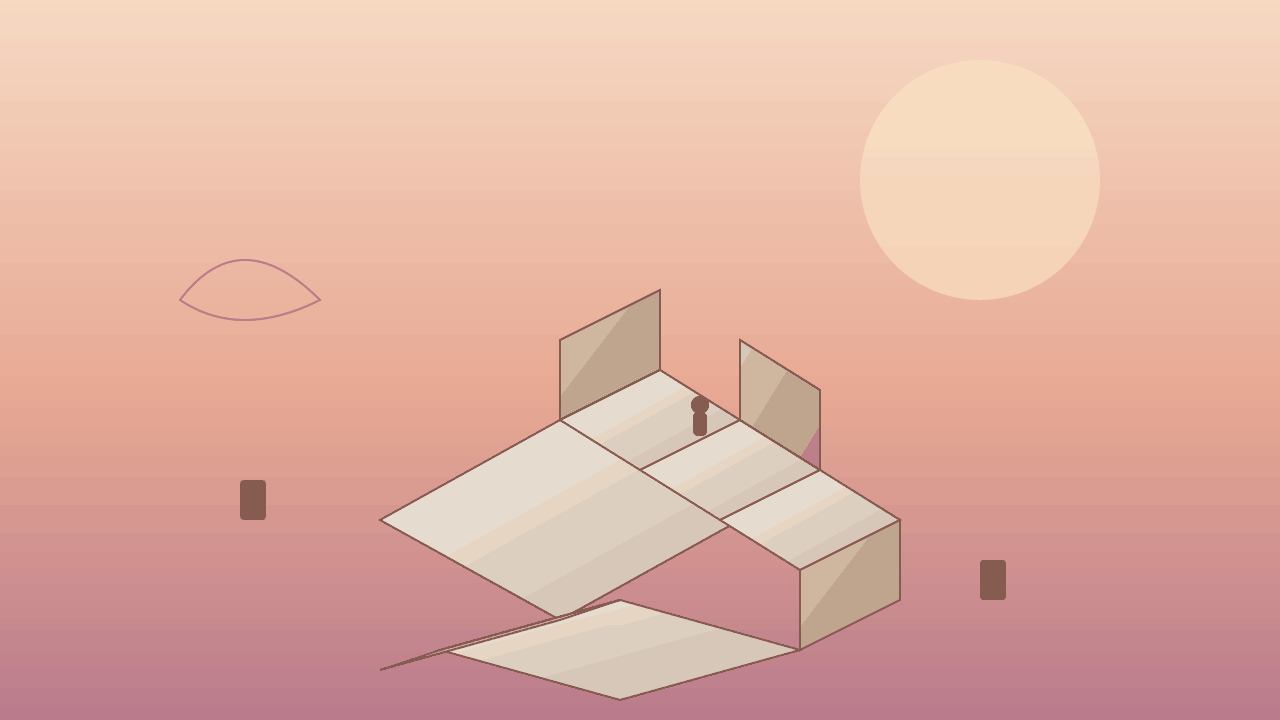 A small silhouette walking an impossible staircase (illustration, AI-generated)
The Context of Its Time
The App Store of 2014 was flooded with freemium games built on free distribution and paid items. Reviewer Steve Paris, introducing the game at the time, lamented that 'what was once a thriving and exciting revolution is giving way to me too apps... and a cataclysmic avalanche of freemium games,' and praised Monument Valley for appearing in that wilderness with 'surprise and delight.' The game launched at £2.49 ($3.99), a one-time purchase.
ustwo was a design agency founded in London in 2004 by Matt Miller and John Sinclair, and mobile games were its new venture. The small team, including Ken Wong, tried to make a game with the sensibility of a design studio rather than a traditional games background. The initial target was a modest 100,000 downloads, and the project was planned partly as a showcase for the agency — a scale befitting a team of just six.
The origin story is disarmingly plain. According to Chief Creative Officer Danny Gray, the team pinned reams of concept art on the studio walls early on and invited comments; an isometric drawing of architecture drew the most attention. From it came a single-screen prototype of guiding a character from 'point A to point B,' and a graphical glitch in which a sliding block appeared to move 'impossibly' became the seed of the game's core illusion. Right out of the gate, Apple championed the game in the App Store and even used it in its own marketing, while Gray notes Google was initially less supportive, since the app had no in-app purchases.
 A single glowing tower among countless app icons (illustration, AI-generated)
Mechanics
The seed of the idea is on record in Ken Wong's own words: 'I've always wanted to make a game about architecture, and during brainstorming sessions I came across Ascending and Descending [1960]. That's what gave me the idea for guiding a character from the bottom of a building to the top. By keeping the camera far out, using an isometric perspective, we could make the architecture the main feature of the game.' M.C. Escher's lithograph — especially its looping staircase — was the starting blueprint.
In play, tapping moves Ida, and levers or blocks are manipulated to change the structure itself. As a contemporary review put it, 'the architecture is the most fascinating part of this game, as you can only solve your problems by creating Escher-esque impossible 3D designs' — distant passages appear, from a certain angle, to join into one, and Ida crosses the seam. The work is often paired with echochrome in conversation, but Wong himself has stated plainly: 'we were aware of echochrome, but only a few of the team members have played it. Sword & Sworcery, Portal and Windosill were far more influential.' I leave the examination of that causal question to the article I wrote on echochrome.
The design philosophy is also on record. Gray recalls a standard of 'all killer, no filler,' each chapter with its own unique mechanism, whittling an original 30 chapters down to ten. Wong, too, has said there was 'more value in doing a short, very focused experience with puzzles that wouldn't overly frustrate people,' valuing the 'sense of closure' a finished game gives. Choosing a roughly two-hour experience anyone could complete, over hardcore challenge, became the watershed for how the game would later be judged.
 A rotating impossible triangle, with footprints crossing it (illustration, AI-generated)
The Lineage to the Present
About a year after launch, ustwo published what it called 'Monument Valley by the numbers': 2,440,076 units sold, revenue of $5,858,625, development costs exceeding $852,000, and a 55-week development period. Around the same time, the game received the Apple Design Award (2014), the BAFTA Games Award for Artistic Achievement (2015), and a D&AD award. It also crossed outside gaming entirely, appearing as a key plot device in Netflix's House of Cards.
The work kept branching afterward. The Forgotten Shores expansion restored some of the originally cut content, and a sequel, Monument Valley 2, arrived in 2017. In a 2024 interview, Chief Creative Officer Danny Gray said the series had by then exceeded 160 million installs combined — a scale that speaks to how far a project begun by six people had grown after a decade.
Industry commentary has positioned this work as the benchmark for a minimal, quiet 'art game' genre. Fracter, which arrived in 2019, was described in the press as 'the isometric puzzler following in Monument Valley's footsteps.' And on July 12, 2022, a PC version arrived as the Panoramic Edition, eventually distributed on Steam as well, bundled as the Monument Valley Panoramic Collection. Born in 2014 as a mobile work that never lined up on Steam, this game, eight years later, quietly crossed the very boundary I usually dig around.
 Streams branching outward from a single wellspring (illustration, AI-generated)
References
Sources referenced in this article:
・Wikipedia: Monument Valley (video game)
・TechCrunch: Monument Valley, ustwo's Sumptuous Escher-Inspired iOS Game, Lands Globally On April 3
・Wallpaper*: Monument Valley at 10
・Steve Paris: Monument Valley - Interview with Ustwo
・Kill Screen: How M.C. Escher's "little worlds" inspired Monument Valley
・Architizer: Building Beautiful Worlds — A Conversation With Ken Wong
・iPhoneHacks: Monument Valley by the numbers
・The Indie Game Website: Fracter is the isometric puzzler following in Monument Valley's footsteps
・Steam: Monument Valley Panoramic Collection
・Related: this site's "echochrome (2008)" (see there for the examination of the echochrome influence question)
Closing
After lining up the numbers and awards, what I find myself remembering last is a quieter scene than any of those achievements: Ida, walking ten chapters without a word. On floating white architecture, a path appears and vanishes with nothing more than a shift in viewpoint. Those ten unshowy but carefully made chapters fit into the palms of millions of hands who made a single, one-time purchase, in the wilderness of 2014 where free-to-play and in-app purchases ruled.
Seen historically, this work's place can be put this way: it took the twentieth-century art legacy of impossible figures and resettled it, with a troupe of just six people, into the new distribution channel of mobile. Escher's staircase is no longer confined to paper. After this one work in 2014, walking through perspective itself became something that could exist, as a matter of course, inside a phone — and by 2022, it had circled all the way to PC and Steam as well.
 A figure standing quietly on a small platform at dusk (illustration, AI-generated)
Reactions (no login)
Anonymous • one of each per visitor per day
Learn — Curriculum
LearnPart 2 Lineage — Where Puzzles Came FromChapter 6 The 2000s Turn — Flash, Mobile, Jams13 / 15
Part of these series
Retro RevisitedEpisode 14 of 45