HISTORY · 2026-07-01
Professor Layton and the Curious Village (2007) - A Vessel That Carried 1966's Riddles onto a Handheld
The genealogy by which Akira Tago's paper puzzle books, wrapped in story, returned to the living room
はじめに
This is a title released on February 15, 2007, for the Nintendo DS. It was developed by Level-5 of Fukuoka, with the company's president Akihiro Hino as producer. Professor Layton and the Curious Village follows Hershel Layton, a gentleman archaeologist, and his young assistant Luke as they visit St. Mystere, a village whose residents nearly all adore brain-teasers, chasing the riddle of a "Golden Apple" left by a late Baron. Between conversations, villagers hand you small puzzles to solve one by one with the stylus. It is a work that houses a story and self-contained logic puzzles inside a single vessel.
But what I wish to trace is less the 2007 game itself than the origin of the "riddles" poured into that vessel. The puzzles derive directly from Akira Tago's Atama no Taisou ("Head Gymnastics"), the best-selling puzzle books first published by Kobunsha in 1966, which Hino read avidly as a child. Hino himself is reported to have said that his affection for these books was the very seed of the project. Layton, in other words, was an attempt to transplant a paper puzzle collection of forty years earlier onto a handheld's twin screens.
Taking Curious Village as our entry point, this essay follows how the form of "embedding self-contained riddles within a story" passed from a 1966 book to a 2007 handheld, and onward to today's deduction puzzles. It is both a review of a single game and a genealogy of a mode of presentation.
 A journey of riddles led by top hat and lamplight (illustration, AI-generated)
その時代の文脈
The Nintendo DS, launched at the end of 2004, carried inputs no prior handheld had: two screens, a touchscreen, and a built-in microphone. Nintendo pushed the machine as a vessel for "thinking play" that could reach beyond existing gamers. The worldwide success of Brain Age in 2005 epitomized that direction. Writing with a pen, speaking aloud — the game console had stepped one pace closer to the world of stationery and workbooks.
Level-5 was then known for RPGs such as Dark Cloud. Behind Hino's wish to revive Tago's Atama no Taisou as a DS riddle collection lay the tailwind of this "brain-training" market. Yet what set Layton decisively apart from brain-training software was that it wrapped the puzzles in a "world": a story and characters, animated cutscenes by P.A. Works, and music by Tomohito Nishiura.
Akira Tago (1926-2016) was a psychologist and a professor at Chiba University. The publisher reports that the first volume of Atama no Taisou sold 2.5 million copies and the series exceeded 12 million. The books brought a "soft" kind of thinking, distinct from schoolwork, into postwar Japanese living rooms. Layton restaged that cultural memory in a form where child and adult peer together into the same small screen.
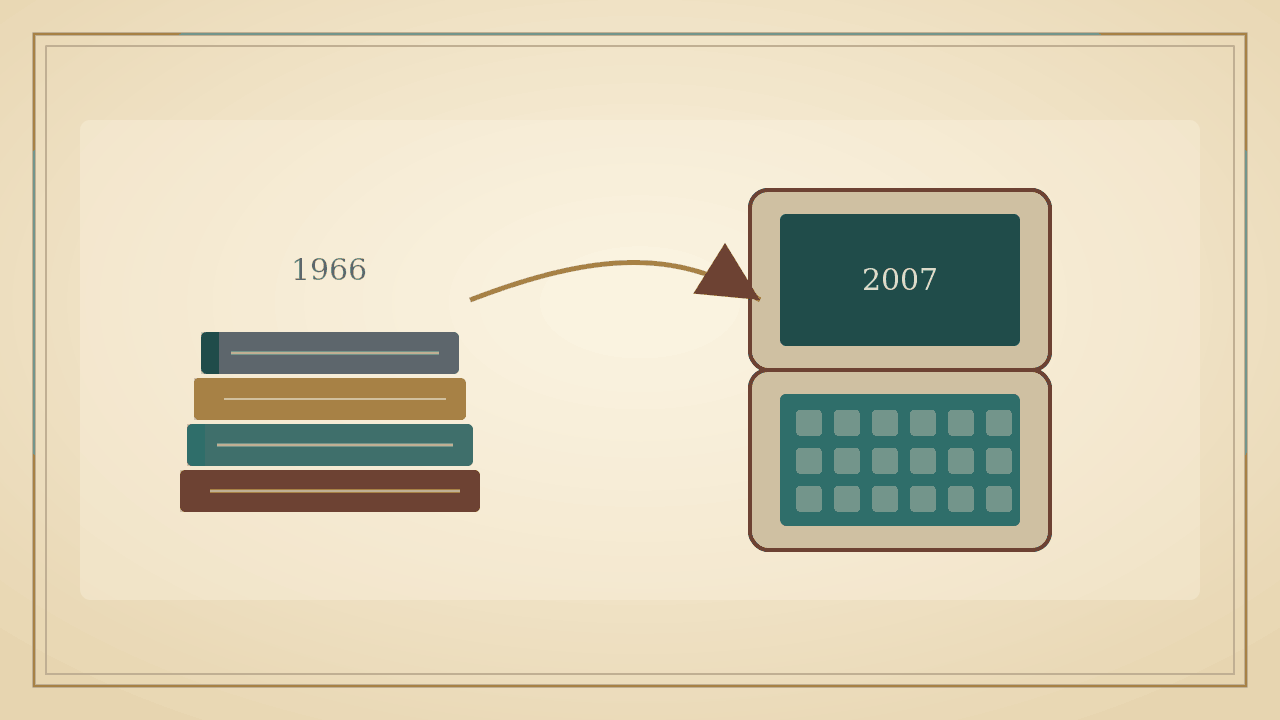 The brain-training age, when paper and screen sat side by side (illustration, AI-generated)
メカニクス
The structure of play is plain. You walk the village, talk to people, and examine objects on screen; a riddle appears. Each puzzle carries a score in "Picarats," added to your total when solved. There is no time limit. When stuck, you spend a "Hint Coin" to reveal graduated hints - but the coins are finite and must be found by searching the village. Answers are submitted by stylus in different ways per puzzle: choosing, circling, or entering numbers and letters.
What matters is that these puzzles stand almost entirely apart from the story's causality. Sliding puzzles, wolf-and-goat river crossings, matchstick rearrangements - many are classical forms drawn from Tago's books, logically unconnected to the events of the village. Tago is reported to have written thirty new puzzles for the DS and reworked existing ones for touch input. The story supplies a "pretext" for solving; the riddles become a "currency" for advancing the story.
The main game holds 120 puzzles, and for half a year after release, new puzzles were delivered every Sunday over Wi-Fi. A game cartridge updated like a weekly magazine serial - I read this as a device that reproduced, through networking, the "waiting for the next issue" rhythm that paper puzzle collections once had. The vessel is digital, but the cadence is inherited from print.
 Score, hint, input - the gears that turn a riddle (illustration, AI-generated)
現代への系譜
What Layton demonstrated historically was proof that "a bundle of self-contained riddles" and "a single story" can coexist without damaging each other. The puzzles need not serve the plot, and the plot need not be bound by puzzle difficulty. The two are loosely tied, each propelling the other. This division of labor even puzzled a fair number of reviewers back in 2006, when the game was first announced: were the small problems and the central mystery not simply sitting side by side, unconnected?
The game succeeded commercially too. According to Nintendo's financial documents, it sold 3.17 million copies worldwide, over one million in Japan alone. Famitsu awarded it 33 out of 40. These figures show that an old pastime - the puzzle collection - could, once given the modern packaging of story, again circulate at living-room scale.
Read as genealogy, Layton's stance of "sinking a logical core inside a narrative vessel" resonates with today's deduction puzzles. Return of the Obra Dinn (2018) and The Case of the Golden Idol (2022) have you assemble the truth from fragmentary scenes by logic alone. I hold no evidence that their makers cited Layton directly, so I claim no causation. But on the single point of "design in which story never obstructs the pleasure of solving," these read as descendants branching from the same question.
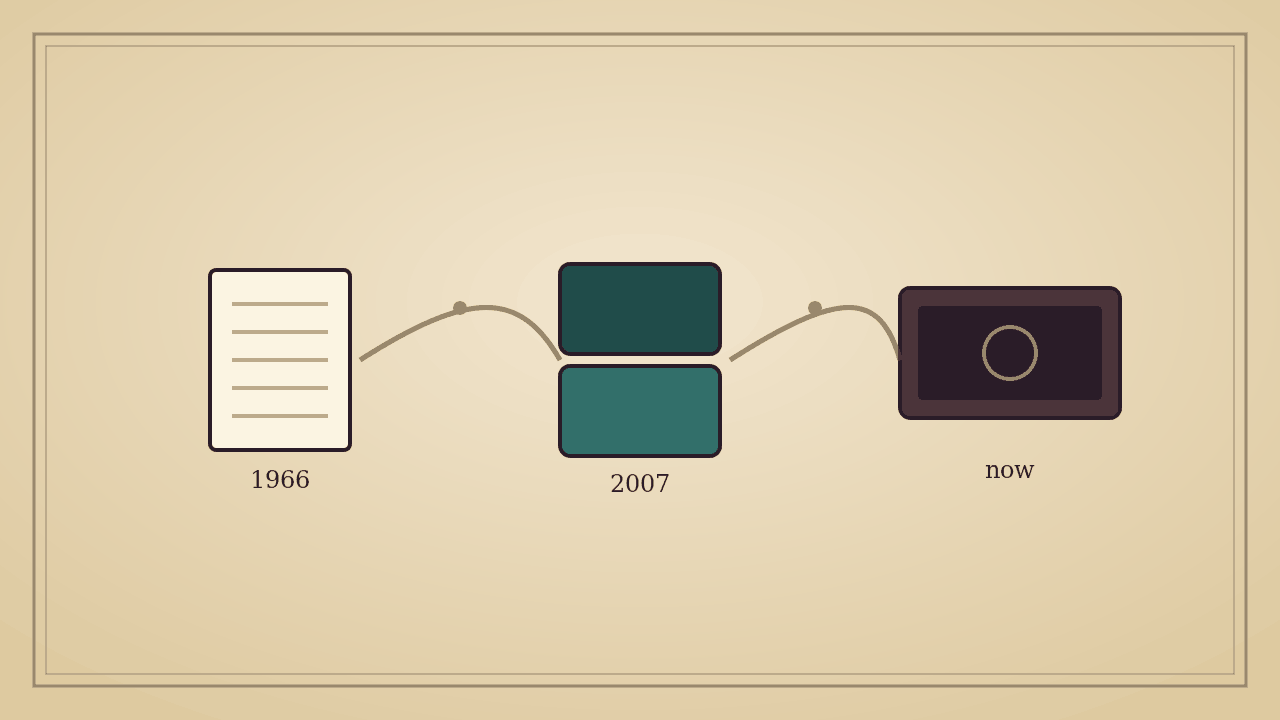 From paper to twin screens, and on to the modern screen (illustration, AI-generated)
参考文献
Sources referenced in this article:
・Wikipedia: Professor Layton and the Curious Village
・Wikipedia: Atama no Taisou (Head Gymnastics)
・Kobunsha: Atama no Taisou, Vol. 1
・Nintendo: Financial Results Briefing FY ended March 2010 (worldwide sales figure)
おわりに
What Curious Village left behind was not a new puzzle rule. It merely carried the riddles Akira Tago had established on paper in 1966 almost intact onto a twenty-first-century handheld. Yet the "manner of carrying" was precisely this work's invention. By preparing a vessel of story and characters, an old book of problems regained a motive to solve and a reason to await the next question.
Trace history back, and puzzles have often survived by changing their containers. The newspaper grid, the paperback spread, the twin-screen handheld - with each change of vessel, the same game of thought reached a new generation's living room. Layton is one node in that long lineage, and deserves to be remembered as a work that bridged the memory of paper into the digital.
 One puzzle after another, the journey continues (illustration, AI-generated)
Reactions (no login)
Anonymous • one of each per visitor per day
Learn — Curriculum
LearnPart 2 Lineage — Where Puzzles Came FromChapter 6 The 2000s Turn — Flash, Mobile, Jams4 / 15
Part of these series
Puzzle Incident HistoryEpisode 5 of 43