RETRO-REVIEW · 2026-07-05
Pipe Mania (1989) — Betting the Route Before the Flow Arrives
The Assembly Line's Amiga release cast, in 1989, the template of the real-time puzzle: spatial connection under a ticking clock.
Introduction
This is Pipe Mania, which the British studio The Assembly Line released for the Amiga in June 1989. It was designed by Akila Redmer and Stephan L. Butler. In North America, Lucasfilm Games - the forerunner of LucasArts - distributed it as Pipe Dream; in Japan, Video System built an arcade version in 1990 and Namco carried it to market. Before a stream of green slime - called "flooz" or "goo" in-game - begins to flow, you lay pipe across the board. Reduced to its skeleton, that is the whole of the play.
Yet I want to reread this seemingly humble piece as a fork in the history of puzzles. As Sokoban did in 1982 and Tetris in 1984, Pipe Mania too invented "a single verb." That verb is "to lay" - more precisely, "to lay the route before the flow arrives." Where Tetris, stacking falling pieces, fights the present, this game fights a future: the flow that is yet to come. The tense itself is different.
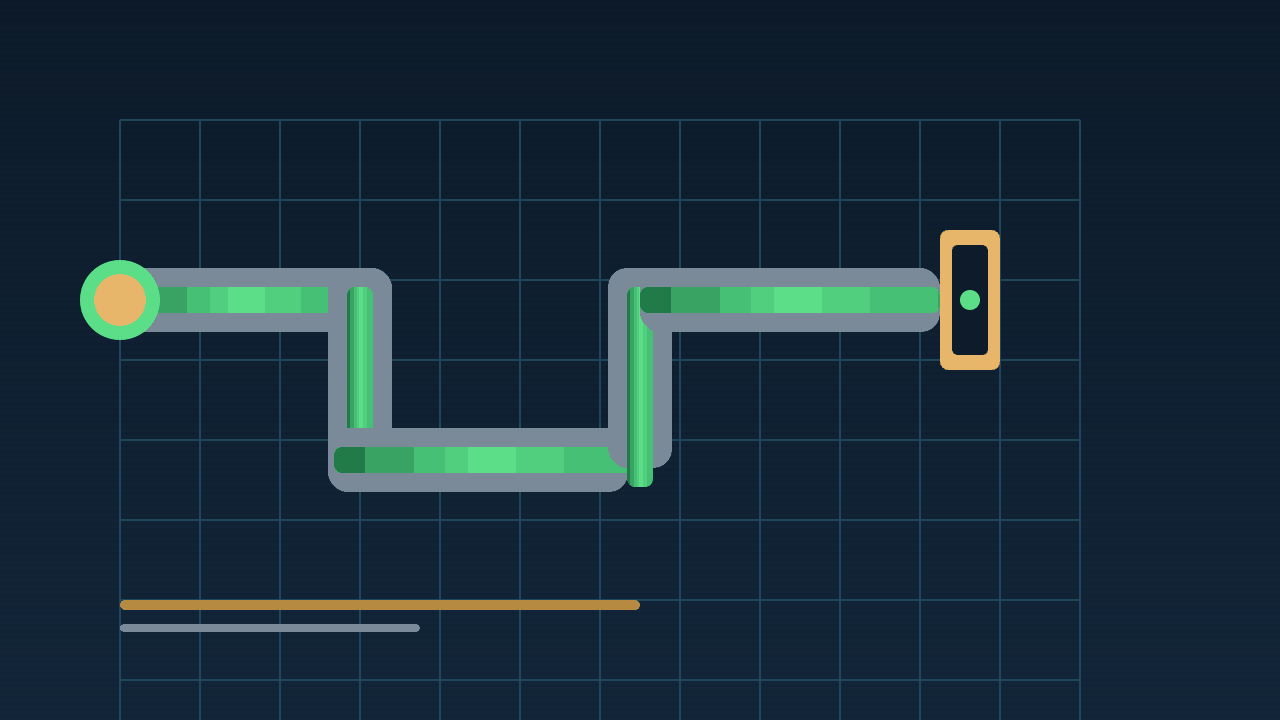 Lay the route before the flow arrives - the skeleton of Pipe Mania (illustration, AI-generated)
The Context of Its Time
Recall the year 1989. Tetris had crossed the Iron Curtain and swept the West, while at home the 16-bit Amiga and Atari ST vied over expressive power. The Assembly Line was a child of the small-team development culture then rooted across Europe - a handful of programmers finishing a title - and Pipe Mania was born in that spirit. It first appeared on Amiga, Atari ST and MS-DOS, and the following year, 1990, it was ported to more than a dozen platforms, including the Game Boy and the NES.
How the game spread bears the stamp of its era's distribution. Empire Software in Europe, Lucasfilm Games in North America, and in Japan a Video System arcade board carried by Namco. The Windows version, moreover, was bundled into the Microsoft Entertainment Pack and slipped as standard onto office PCs of the early 1990s. Alongside Solitaire and Minesweeper, countless office workers laid green pipe on their lunch breaks. Here is one of the paths by which the puzzle spread as "leisure on a desk."
Its reception in Japan is documented too. The arcade trade magazine Game Machine listed it as the top-earning table cabinet of October 1990. On coffee-shop cabinets, the green slime truly caught players' fingers. A small piece born in a single European room had, within a few years, crossed a continent and a sea.
 From one-room development to offices and coffee shops, 1989-90 (illustration, AI-generated)
Mechanics
The mechanics are trim. The board is a grid. Off to the side, a "dispenser" stacks five pieces vertically, and its bottommost is offered as the next piece to place. Click an empty square to set it there, and a new piece drops in from the top. Straights, corners in all four directions, and a cross-over that carries flow horizontally and vertically at once - the pieces can be neither rotated nor flipped. You must use them in the order they come, in the orientation they come. This very lack of freedom is the core of the design.
The constraint of not choosing your piece is precisely what forces you to read ahead. Watching the queue, you must imagine the route of a flow not yet arrived, several moves in advance, and discard unwanted pieces at the cost of a penalty and a brief freeze. As Sokoban tightened thought with the irreversibility of "once pushed, never pulled back," Pipe Mania tightened it with the time of "the flow will not wait." The kind of constraint differs, but the direction in which it corners the mind belongs to the same lineage.
In later levels, conditions stack one by one atop the rules: greater minimum lengths, faster flow, immovable pre-placed obstacles, an end piece the flow must be routed into, openings that wrap from one edge to the other, reservoirs that buy a few seconds, one-way pipes. Add a single condition to a simple base and the board grows exponentially harder. What good constraint design looks like - in 1989, this game quietly set the example.
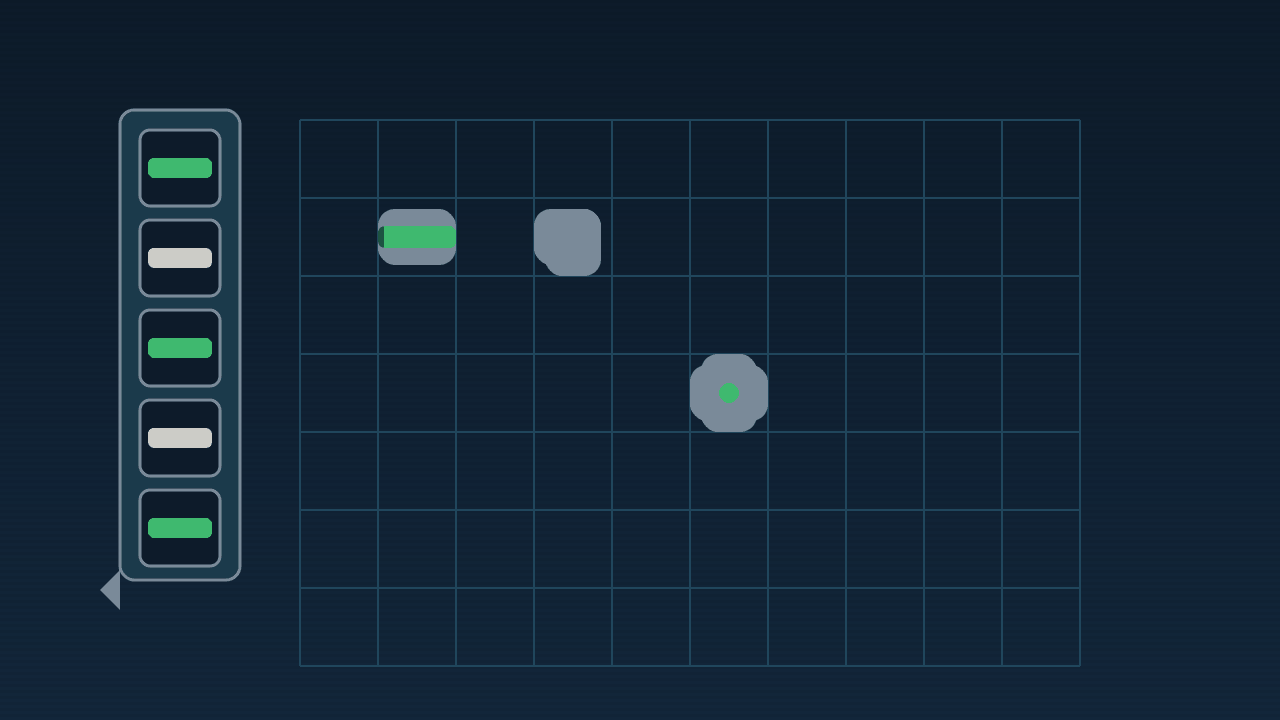 A queue you cannot choose, a flow that will not wait - the structure of play (illustration, AI-generated)
Lineage to the Present
Pipe Mania's template - "connect space under a time limit while watching what comes" - was afterward imitated far too widely. Countless clones appeared under names like Wallpipe, Oilcap and Pipeworks; in 2000 it was given 3D form on the PlayStation as Pipe Dreams 3D / Pipe Mania 3D; and in 2008 Empire Interactive itself released a remake developed by Razorworks. The green slime kept flowing across platforms and generations.
Its point of contact with games now on Steam is a matter of record, not conjecture. In 2007's BioShock, the minigame for hacking vending machines, robots and security cameras was implemented as a variant of Pipe Mania - a fact noted, with a citation, on the English Wikipedia. The verb of joining pipe to carry a "flow" thus survived as a mechanism inside a first-person shooter. I read this as one piece of evidence that the lineage genuinely continues.
Of course, not every later spatial-connection puzzle descends directly from this one, and I hold no proof to claim so. But it is beyond dispute that the form of thought "prepare, now, a road for a flow that will come" was once properly crystallized on the 1989 Amiga. If the falling-block line (Tetris and kin) is about "stacking," Pipe Mania is about "laying." These two verbs were handed to posterity as the twin wheels of the real-time puzzle.
 The green flow of 1989, running on across the generations (illustration, AI-generated)
References
Sources referenced in this article:
・Wikipedia: Pipe Mania (release year, developer/publisher structure, designer names, mechanics, and the cited note on BioShock)
・Wikipedia (Japanese): Pipe Dream (the Japanese arcade version; Video System / Namco distribution)
・KLOV / Arcade Museum: Pipe Dream (arcade) (basic data on the arcade release)
・Spectrum Computing: Pipe Mania (bibliography of the ZX Spectrum version)
・The Internet Archive: Pipe Mania (1989, Empire) (period software preservation)
Closing
Even now, start Pipe Mania and the green slime still flows out without mercy. If there is a condition for a classic, it is the gap between the fewness of its rules and the abundance of judgment they produce. Seven pieces, the unfreedom of no rotation, a flow that will not wait. On this slender base alone, a player desperately sketches the space several moves ahead. Drawing deep thought from few parts - this is a virtue of design that has not faded.
As a historian I would say: what this small 1989 piece showed is a single thing - that constraint is not an enemy but a vessel for thought. Before the flow arrives, what do we bet? That question lingers quietly even after the board has filled with green. Each time we lay a single length of pipe, we are choosing, just a little, the future.
 The quiet question that remains after the flow has filled the board (illustration, AI-generated)
Reactions (no login)
Anonymous • one of each per visitor per day
Learn — Curriculum
LearnPart 2 Lineage — Where Puzzles Came FromChapter 5 Origins of the Digital Puzzle10 / 13
Part of these series
Retro RevisitedEpisode 12 of 45