RETRO-REVIEW · 2026-08-07
Klax (1990) — The Idea of "Matching Three" Was Invented Twice
Atari Games placed this cabinet right beside Tetris, and it is often called the origin of match-three — but the developers' own testimony cuts that lineage
Introduction
This is Klax, which Atari Games released to North American arcades in February 1990. It was designed and animated by Mark Stephen Pierce, with software by Dave Akers. Catch colored tiles as they slide down a conveyor with a paddle, drop them into a five-by-five well, and line up three or more of the same color horizontally, vertically, or diagonally to clear them and score. That is the whole of the play. A few months later, Namco carried it to Japan, and within the same year it was ported to one home and handheld system after another.
This cabinet is often cited as the origin of the "match-three" genre - a distant ancestor of the color-clearing puzzles that now fill Steam and every phone's app store. But as a historian, I don't want to swallow the word "origin" whole. Does the bloodline from Klax to today actually hold? I want to trace that back to the developers' own testimony.
 Catch what flows, line up three, watch it vanish - the skeleton of Klax (illustration, AI-generated)
The Context of Its Time
Recall the year 1990. The year before, Atari Games had lost a lawsuit to Nintendo - Tengen v. Nintendo - and with it the right to supply its own version of Tetris to the NES market. Right after that, Atari Games put Klax into arcades, a title the English Wikipedia frames as a follow-up to Tetris. The same company, having just lost the rights to one falling-block puzzle, tried to reach the top again with the next one. That is the circumstance into which this cabinet was born.
Klax became a major arcade hit, and within a few months Namco carried it to Japan. Within that same year it became the first title ported to all three of the era's leading home consoles - the NES, the Genesis, and the TurboGrafx-16 - and it also appeared on the Game Boy, the Atari Lynx, and even the Atari 2600 just before that console's production ended. Puzzle games around 1990 existed in the middle of a distribution speed where a single hit could be copied across a dozen-odd platforms within a year.
 Right after the Tetris lawsuit, the next cabinet takes its place on the floor (illustration, AI-generated)
Mechanics
The controls are startlingly simple. Tiles slide down a conveyor at the top of the screen, and a paddle below catches them. The paddle can hold up to five tiles; pressing the button drops the foremost one straight down into the well. The well is five columns by five rows. Line up three or more tiles of the same color horizontally, vertically, or diagonally, and a "Klax" is formed, clearing that line. Forming several lines with a single tile spikes the score, across a structure of 100 waves in which the objective shifts every five.
In a 1990 interview, designer Dave Akers described his own aim as wanting to "produce something playable, compact and relatively quick to develop." The influences he named were Tetris - and tic-tac-toe. He carried the grammar of Tetris, stacking falling shapes, and the grammar of tic-tac-toe, lining three up in a row, into a new vessel: the conveyor and the paddle. That transposition was Klax's invention.
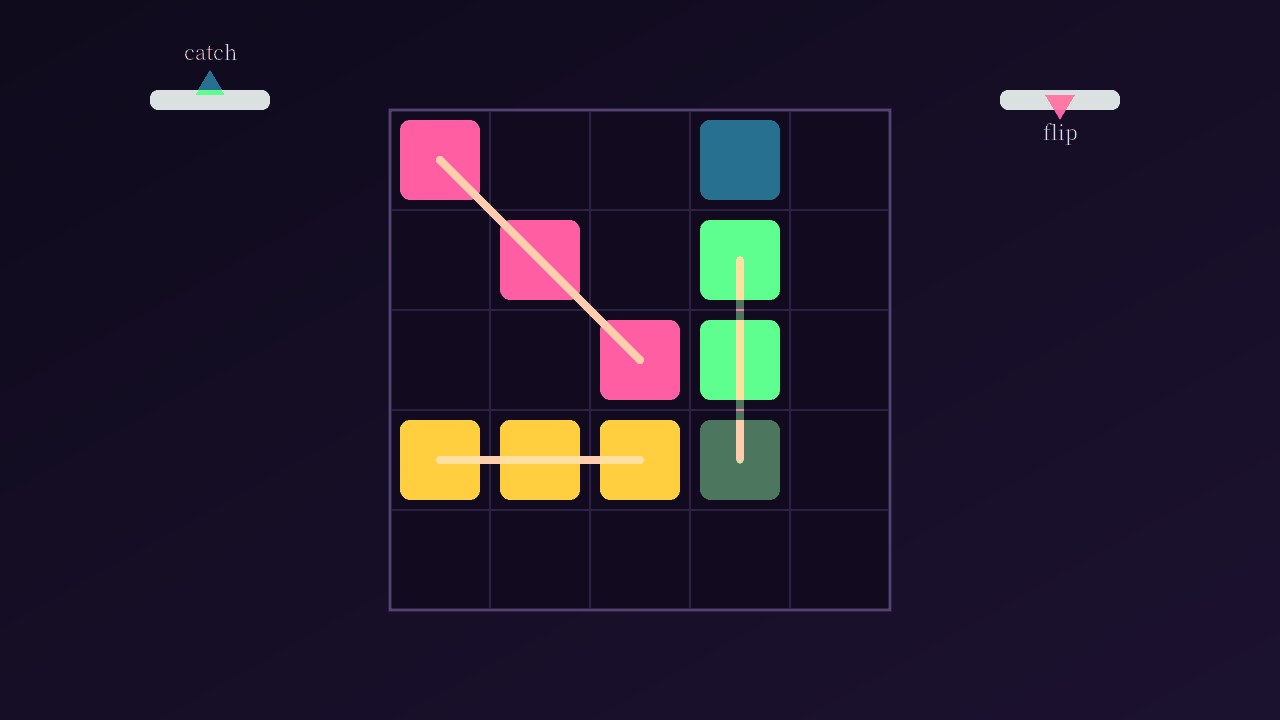 No choosing the order they come, only how you line them up - the structure of play (illustration, AI-generated)
Lineage to the Present
In genre histories such as TV Tropes, Klax is often counted as "tied for the Ur-Example" of match-three games. Looking only at the core mechanic - clear three same-colored pieces in a row - it is indeed an early instance. But the same entry also states that the genre's true "Trope Codifier" was 2001's Bejeweled. Being an origin and being what later generations actually inherited are not necessarily the same lineage.
The most direct account of that break comes from Jason Kapalka, co-founder of PopCap, the studio that made Bejeweled. In a 2020 Kotaku interview, he recalled: "The original was, I think, a game called Shariki. A Russian game. But to be honest we weren't aware of that. What we were aware of was someone had found a really crappy Javascript game. It was called Colors Game, this really primitive game, it didn't have sound effects, animation, didn't even really have graphics. It was just a bunch of colored squares that you could swap, and if you made a row of three they disappeared." Shariki was created independently in 1994 by Russian developer Eugene Alemzhin, and has no genealogical connection to Klax whatsoever.
In other words, the actual route of what we now call "match-three" runs not through Klax (1990) but through Shariki (1994) - an anonymous JavaScript imitation called Colors Game - PopCap's Diamond Mine (2000) - Bejeweled (2001), a branch that never touched Klax at all. What I want to say here, as a historian, is simple. The idea of "clear by lining up three" was invented twice, in 1990 and in 1994, in places with no relation to each other. One branch quietly died out; the other came to cover the world. Lineage diagrams are usually drawn as a single tree, but in practice, branches that never meet again may be the more common shape.
 The same idea invented twice - only one branch went on to cover the world (illustration, AI-generated)
References
Sources referenced in this article:
・Wikipedia: Klax (video game) (release date, designer credits, development background, the Tetris lawsuit connection, port list, and the source for Akers's quoted remarks)
・Wikipedia: Shariki (the 1994 origin of the game, created by Eugene Alemzhin)
・Kotaku: From Bejeweled To Plants Vs Zombies — How PopCap Got Just About Everyone To Play Their Games (primary testimony from PopCap co-founder Jason Kapalka regarding Shariki and Colors Game)
・TV Tropes: Match-Three Game (genre-history framing of Klax as Ur-Example and Bejeweled as Trope Codifier)
・MobyGames: Klax (platform-by-platform release data)
・Internet Archive: Klax (MS-DOS, 1990) (period software preserved and playable in-browser)
Closing
Start Klax today, and the conveyor still carries its tiles at the same speed. The single move of clearing three in a row was, in 1990, on an arcade floor, already fully and properly completed. But being completed and being inherited by later generations are two different events - that is what this cabinet's fate teaches.
What I have learned as a historian is the importance of resisting the comfort of the story "this begat that." When a developer himself testifies "we weren't aware of that," that is precisely where history's actual shape lies - not a single lineage, but the same idea arising independently in more than one place, with only one of them, by chance, carried far and wide. Klax is not the branch that lost. It is simply the branch that was never carried onward.
 Matched, cleared, and forgotten - yet once, fully complete (illustration, AI-generated)
Reactions (no login)
Anonymous • one of each per visitor per day
Part of these series
Retro RevisitedEpisode 26 of 43