RETRO-REVIEW · 2026-08-09
Panel de Pon (1995) — The Name Was Taken Away Again and Again, But the Grammar of Play Survived
The SNES fairy Lip was replaced by Yoshi, then by Pokémon, in the West. But the skeleton of adjacent-swap and chain combos reached all the way to a 2025 Steam release.
Introduction
On October 27, 1995, Nintendo and Intelligent Systems jointly released Panel de Pon for the Super Famicom. Its producer was Gunpei Yokoi - the same Yokoi who created the Game Boy and the cross-shaped D-pad. The protagonist is a flower fairy named Lip. A bracket-shaped cursor reaches into a wall of colored panels rising from the bottom of the screen and swaps two panels sitting side by side. That single action is the whole of it: line up three or more panels of the same color, horizontally or vertically, and they clear; if panels left floating above a cleared line fall and form another match, a chain triggers, sending "garbage" panels onto an opponent's board.
This cabinet is often named as a prototype of the competitive puzzle genre. What I want to confirm here is which route its bloodline actually took to reach the present - because for nearly three decades after its release, this work itself was never once able to hold onto a stable name of its own. To trace history is often to trace the record of whichever side had its name taken away.
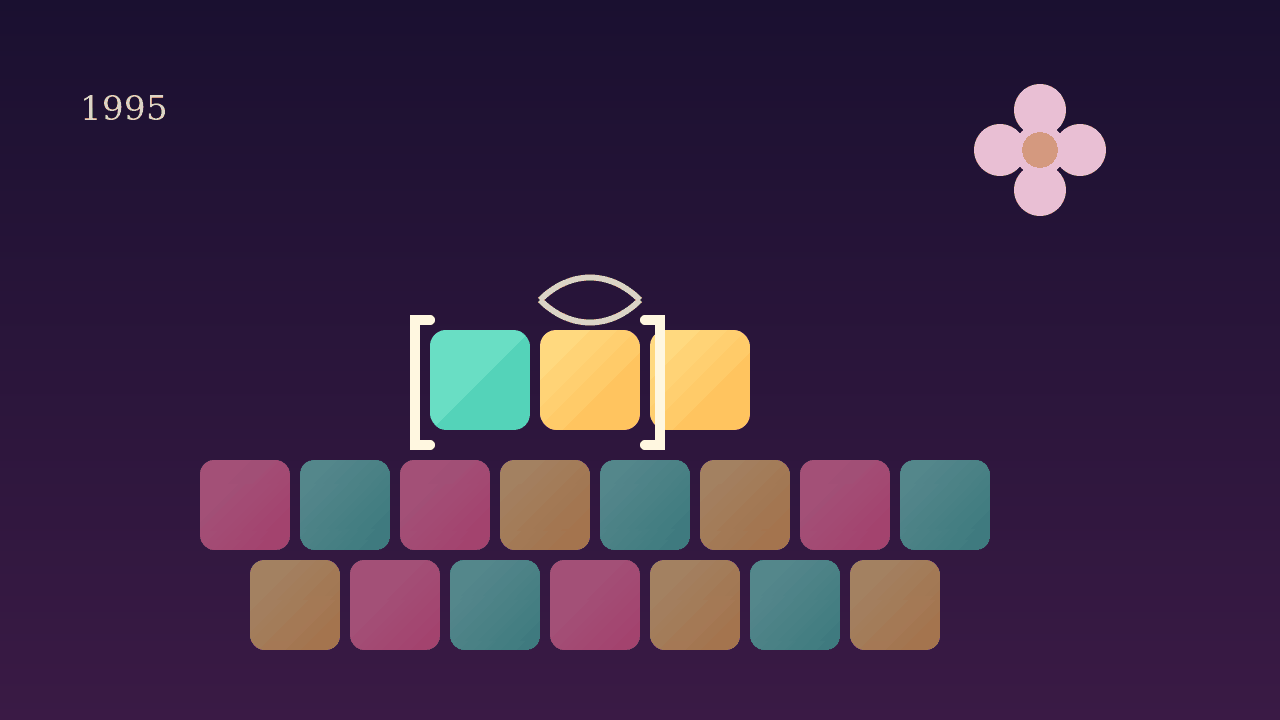 Swap, line up, clear — the skeleton completed in 1995 (illustration, AI-generated)
The Context of Its Time
Recall the year 1995. That same year, Nintendo released Super Mario World 2: Yoshi's Island, whose round, pastel art would later be borrowed wholesale for Panel de Pon's overseas release. Intelligent Systems, the developer, had until then grown mainly as an in-house-adjacent studio for Nintendo, working on the Fire Emblem series among other titles; Panel de Pon was a title the studio pushed hard as one of its own original projects.
At this point, producer Gunpei Yokoi was seeing through the completion of the VR32 project he had long led, later released as the Virtual Boy. On August 15, 1996, Yokoi left Nintendo and founded his own company, Koto Laboratory. The following year, on October 4, 1997, he died at age 56 in a traffic accident on the Hokuriku Expressway. Panel de Pon is one of the last pieces of work Yokoi completed while still at Nintendo.
 1995 - the year of Yoshi's Island, and of a producer's quiet final chapter (illustration, AI-generated)
Mechanics
The core action is remarkably simple. A wall of panels rises from the bottom of the screen at a steady pace. The player selects two adjacent panels with a bracket-shaped cursor and swaps them. That is all. But line up three or more same-colored panels in a row or column and they clear; any panels left floating above then fall, and if that fall forms another same-colored line, a "chain" triggers, spiking the score and, in versus mode, dropping garbage panels onto the opponent's board.
What matters is that the panels themselves never fall. Rather than the "fall and stack" grammar of Tetris or Sokoban, Panel de Pon dismantles a wall rising from below using nothing but the single action of swapping - that inversion is the skeleton that clearly separates it from Tetris-style falling-block puzzles. Its chain-and-garbage versus structure staked out a distinct swap-based branch within a competitive puzzle grammar that was still taking shape at the time.
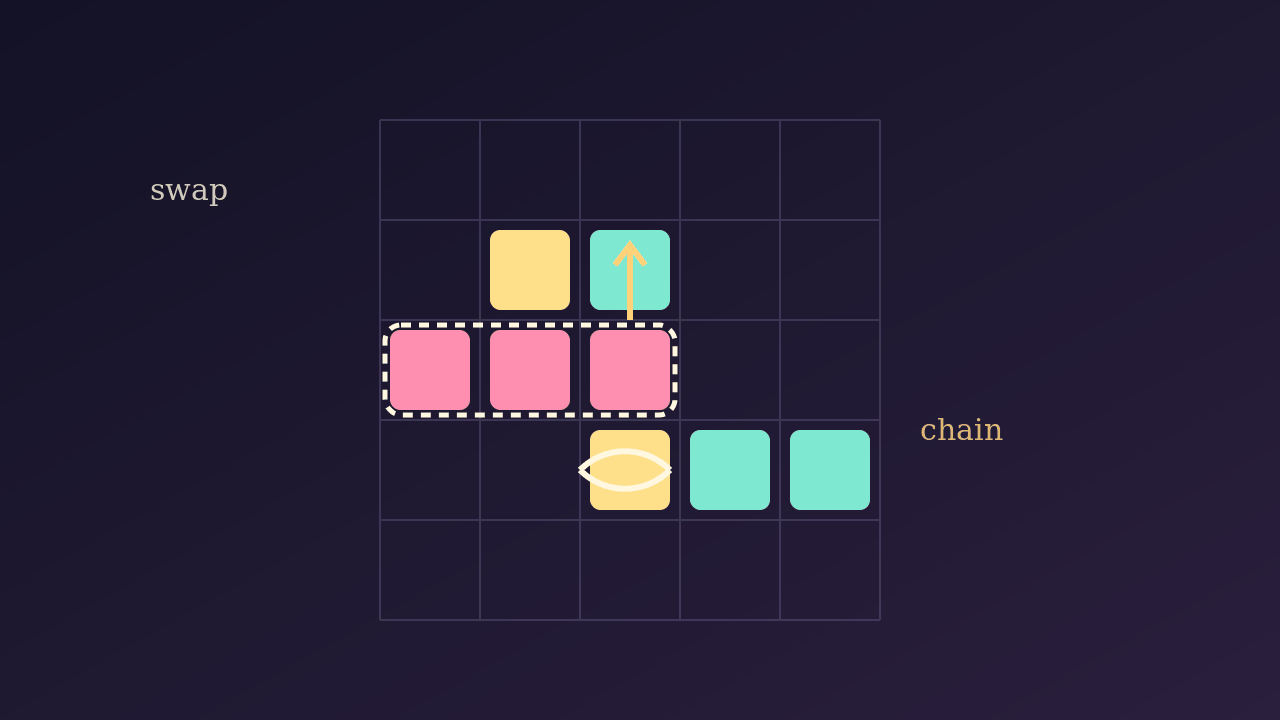 Not falling, but rising - dismantling the wall with nothing but a swap (illustration, AI-generated)
Lineage to the Present
For its overseas release, Nintendo stripped out Lip and her fairy world entirely, replacing it with the art of Yoshi's Island, and changed the name to Tetris Attack - despite the gameplay having nothing to do with Tetris. In a 2009 interview, Tetris Company co-founder Henk Rogers said he regretted letting Nintendo use the Tetris name for the game; he liked the game itself, but felt that carrying the Tetris brand caused it to "get lost in history."
But the work did not disappear. In 2000 it resurfaced with Pokémon artwork as Pokémon Puzzle Challenge (Game Boy Color) and Pokémon Puzzle League (Nintendo 64) - the latter the first to settle on "Puzzle League" as the series' official Western name going forward. Dr. Mario & Puzzle League followed on Game Boy Advance in 2005, and Planet Puzzle League on Nintendo DS in 2007 (released in Japan as Chotto Panel de Pon). Lip's weapon, the Lip's Stick, has remained an item in the Super Smash Bros. series ever since Melee. In 2016, an amiibo update to Animal Crossing: New Leaf turned it into a minigame, and on May 20, 2020, the unaltered original was released worldwide through Nintendo Classics - a full quarter-century later, Lip finally appeared before Western players under her own name for the first time.
Then, on December 15, 2025, a free title called Panel Attack launched on Steam. Its developer, OLR Games, wrote directly on the store page: "A modern twist on classic Panel de Pon / Tetris Attack-style match-3 action." This is not speculation - it is the developer's own description, naming the thirty-year-old cabinet as its direct ancestor. A similar bloodline appears in the 2020 commercial title Petal Crash (developed by Friend & Fairy, released on Steam, Switch, and PS4); per TV Tropes, it was explicitly designed to evoke "action puzzle games from the mid-90s, especially those that came out on the Game Boy Color." However many times its name was taken away, the grammar itself - adjacent swaps and chain reactions - survived, and has now reached a corner of today's Steam.
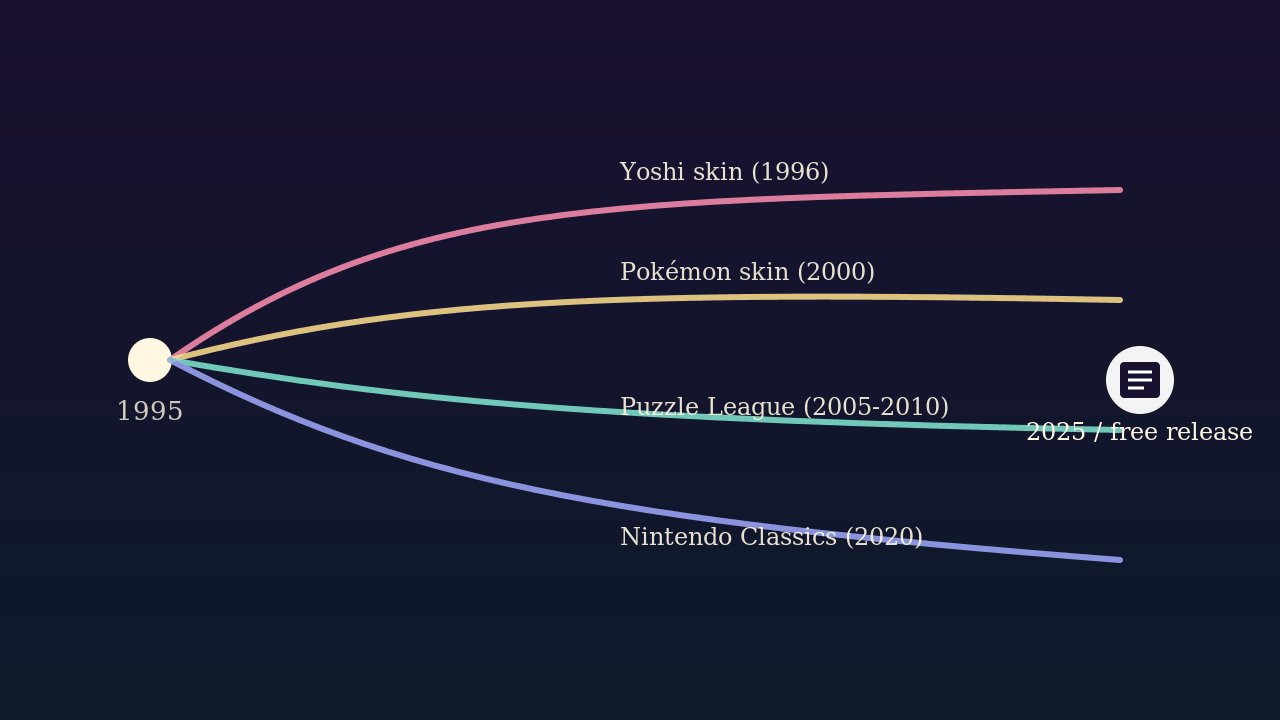 From fairy, to Yoshi, to Pokémon - the name changed, but the skeleton traveled a single branch (illustration, AI-generated)
References
Sources referenced in this article:
・Wikipedia: Tetris Attack (release dates, development credits, producer Gunpei Yokoi, the Western retitling, Henk Rogers's remarks, and the source series' later expansion)
・Japanese Wikipedia: Panel de Pon (Japanese release date and development credits)
・Wikipedia: Gunpei Yokoi (dates of Yokoi's departure from Nintendo and his death)
・Time Extension: The Puzzling Legacy of Panel de Pon And Puzzle League (the series' rebranding history, the Pokémon versions, Smash Bros., and the Animal Crossing minigame)
・Steam: Panel Attack (self-described lineage from developer OLR Games; December 15, 2025 release date)
・TV Tropes: Petal Crash (2020 release, designed to evoke mid-90s Game Boy Color-era action puzzle games)
・MobyGames: Tetris Attack (platform-by-platform release data)
・MobyGames: Panel de Pon (Japanese-version platform data)
Closing
Start Panel de Pon today, and the same wall of panels still rises at the same pace. The same bracket still swaps two adjacent tiles. The single move completed in 1995 has never once changed since. What changed was only the art and the name wrapped around it.
What I want to confirm, as a historian, is the fact that a game's skeleton and the commercial name wrapped around it often follow separate fates. For nearly thirty years, Lip wandered from place to place without her own name. But the grammar she gave rise to - swap and chain - kept working just the same, under Yoshi's art, under Pokémon's art, and inside a nameless, artless piece of freeware from 2025. That grammar survives even when the name is lost - Panel de Pon is one instance of that.
 Matched, cleared, and gone - yet the skeleton alone remains (illustration, AI-generated)
Reactions (no login)
Anonymous • one of each per visitor per day
Part of these series
Retro RevisitedEpisode 28 of 43