REVIEW · 2022-07-12
Monument Valley
Behind the 98%, only one question splits the pool: is this a puzzle game?
Introduction
You walk Ida, a silent princess, across isometric stone monuments. Stairways don't actually connect — but rotate the view until they look connected and the connection becomes real. Each scene is an Escher print you can operate. Released on mobile in 2014, it arrived on Steam as the Panoramic Edition on 12 July 2022, developed and published by ustwo games.
I am writing this from the review pool on that store page: 8,632 reviews in all languages, 8,465 of them positive, labelled 'Overwhelmingly Positive' (snapshot 2026-08-08). The last 30 days sit at 96% of 141. By the numbers, there is barely an argument here.
Read the text, though, and the pool splits — not into praise and complaint, but around a single question: is this a puzzle game? Most of the positives never raise it. Nearly all of the 167 negatives write about nothing else. That fork is what I want to translate into design terms.
 A slender tower rising from water under a crescent moon — Steam store screenshot
First Impressions
Line up the helpful positives and the vocabulary rhymes: beautiful, relaxing, chill, art. A one-line review saying roughly 'this is not a game, this is art' has collected dozens of votes. Reported playtimes cluster between 2.5 and 5.7 hours, and shortness usually appears as regret that it ended — praise, in other words.
The negative vocabulary is just as consistent: short, auto-pilot, gimmick, style over gameplay. One says no real thinking is required until the very last move of the very last level. Another calls it a pretty storyboard with good sound, but a visual novel rather than a puzzle game. Several name a price at which they would relent — two euros on sale.
What strikes me is that both sides report the same facts. It is short. It is easy. You rarely get stuck. Nobody disputes that. They differ only in whether those three go in the credit column or the debit column. My job isn't to settle it but to find where the scorecard flips.
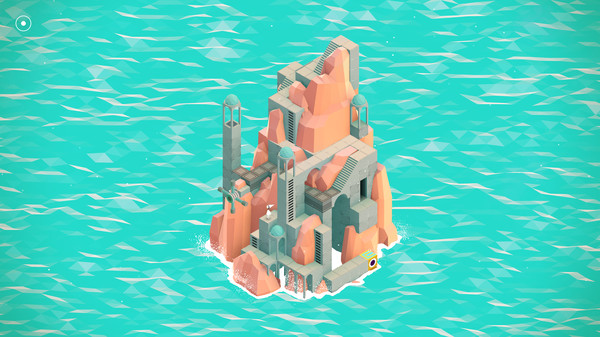 A salmon-pink rock monument standing like an island in a turquoise sea — Steam store screenshot
Putting the Mechanics into Words
When reviewers say you cannot mis-input anything, what they mean is the verb count. Click to walk Ida. Turn a crank, pull a column, rotate the board, rotate the view. There is no failure and no death. In Puzzlebyrinth terms this is verb subtraction taken to its limit — so complete that the game needs no tutorial text.
With so few verbs, the grammar moves into the eye. Two ends that are physically apart touch from one specific angle, and here looking connected is the connection test. What you actually manipulate is your own observational resolution. I sketched this vocabulary in the vocabulary of perspective puzzles; Monument Valley is usually placed at the head of that lineage.
The recurring complaint — good ideas that are never developed or combined — is aimed exactly at that grammar. Illusion rules, rotating mechanisms, the crow people, changing water levels: elements accumulate chapter by chapter, yet two of them are rarely asked to be read at once. The combinatorial explosion is deliberately never lit, and that is the watershed.
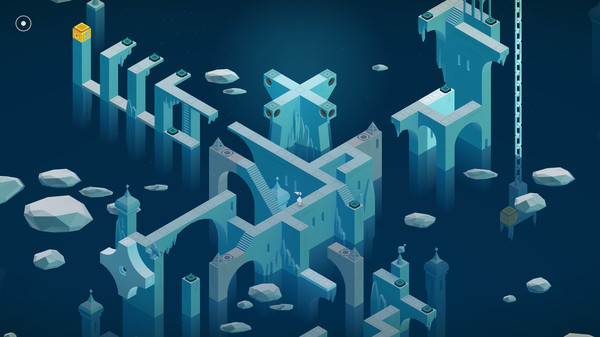 Pale blue arches and pillars in a deep blue night, a yellow cube at upper left — Steam store screenshot
The Texture of Difficulty
Testimony about difficulty disagrees on kind, not amount. The negatives say auto-pilot; recent reviews say relaxing yet genuinely challenging at times. Both are honest, because sorting the stuck-points yields only three flavours.
One: missing the illusion — you fail to find the angle where two ends meet, and stall for half a minute. Two: ordering the mechanisms, when two cranks must be turned in sequence. Three: waiting out a crow person or a moving platform. The overwhelming majority are the first kind, and they resolve fast. The reviewer who claims only the final level held them for more than thirty seconds is probably close to accurate.
What I read here is that the easiness is a constraint, not laziness. If every scene must stand as a single picture, there is no room on the board for decoys, dead branches or traps. Difficulty has been traded for pictorial finish. So 'I wish it were harder' really means 'I wish it were a different game.' Some players are left outside the intended range — that is a line drawn, not a mistake.
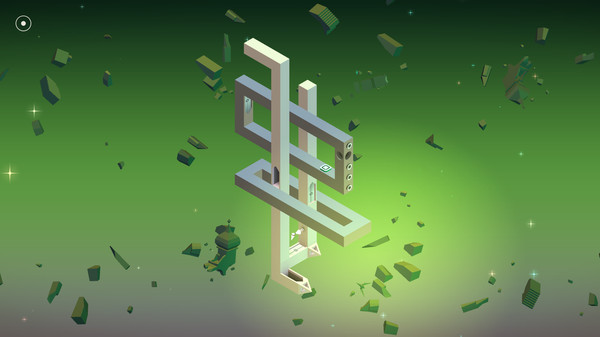 A lattice of interlocking white beams against green, debris drifting around it — Steam store screenshot
The World
Colour and sound are the one thing the pool agrees on. Pastel planes, a different dominant hue per chapter, quiet title cards between them, and small musical tones that answer every input. 'Play it with headphones' recurs as advice. I found almost no complaints here.
What stands out among the helpful reviews is how much space the yellow totem gets. One says they haven't been this attached to an I-shaped block since Tetris. Another confesses affection for a 4×1×1 yellow box. A third admits crying a little when the totem follows Ida into the sea — all this for a wordless companion, in a game whose story is elsewhere called vague and abstract.
As design, that is the flip side of the verb count. With no dialogue and no choices, the emotional load is concentrated in a single object. The fewer things a player can operate, the heavier the things they cannot — following, parting, sinking. Subtraction shapes the feeling, not just the difficulty.
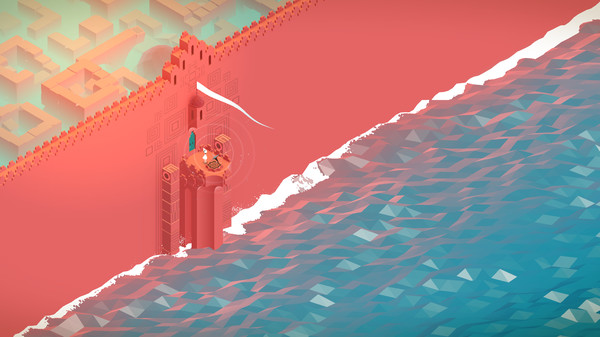 A vermilion sea wall cutting diagonally across the frame, teal water and white surf to the right — Steam store screenshot
Sources
This article was written from the Steam store page and community hub review pool as of 2026-08-08.
· Steam: Monument Valley (8,465 positive of 8,632 across all languages, labelled 'Overwhelmingly Positive'; English 1,965 at 96%, last 30 days 141 at 96%)
· Top 10 by helpfulness (all), top 7 helpful negatives, and 6 most recent — 23 reviews in total
· Metadata (developer, release date, achievement count, price, tags) cross-checked against the store page and SteamDB
Closing
Steam's overall sits at 98%; I land on 8.0. The gap is easy to name. Presenting one grammar — optical illusion as connection — this cleanly is a real achievement. Almost never layering that grammar two or three deep is, from a design standpoint, a deduction. That is what the 167 negatives are pointing at, and being outvoted doesn't make the point weak.
Reported playtimes centre on roughly three hours, or about five with the extra chapters. It lists at $7.99, and the pool holds a steady share of people calling that steep and a steady share calling it cheap for the density. One reviewer records the game failing to launch after an April 2025 update and being fixed in June; recent reviews no longer mention it.
It suits players buying the moment a view resolves rather than the hours spent stuck. It does not suit players buying resistance by volume. For the branch of the lineage that pushes illusion toward genuine solving, see Manifold Garden; for this game's own history, Monument Valley (2014). Even at 98%, there is still text worth reading.
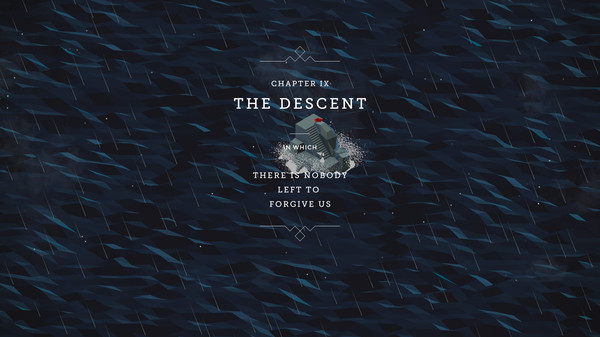 A chapter title card reading 'CHAPTER IX — THE DESCENT' over dark water — Steam store screenshot
Where are you with this game?
Press one and the game goes on your shelf. You can see it on your account page.
Reactions (no login)
Anonymous • one of each per visitor per day
Read next
Related reviews
Happy Game
A point-and-click adventure that walks a sleeping boy through three chapters of nightmare. You pull, turn and pick at the screen to open the way forward, and what waits there is smiley faces, pink bunnies and rooms the colour of blood. Amanita Design's first turn toward horror, scored by the Czech band DVA.
Syberia: The World Before
A third-person adventure in which lawyer Kate Walker moves between two timelines — a girl named Dana in the 1930s and Kate's own present — retracing the history of the city of Vaghen alongside the automaton Oscar. Progress comes through assembling mechanisms and hint-assisted exploration. Microids' fourth entry in the series.
Somerville
A 2.5D narrative puzzle-adventure in which a nameless father crosses a British countryside broken by an alien invasion, a dog and a small son at his side. Light in hand, he melts alien matter and lets it set again to open a path. Jumpship's first game, told without a single line of dialogue.


