REVIEW · 2022-11-14
Somerville
Reading 1,879 reviews that came expecting more INSIDE
Introduction
A father with no name walks a British countryside broken overnight by an alien invasion, a dog and a small son at his side. There is no dialogue and no subtitle; partway through he gains a light that melts alien matter and lets it set again, and with it he opens a path. It is a 2.5D narrative puzzle-adventure, made and released on 14 November 2022 by Britain's Jumpship, a studio announced as founded around Chris Olsen's original IP in collaboration with Dino Patti, ex-CEO and co-founder of Playdead.
I write this from the Steam review pool. The label is 'Mostly Positive' — 1,324 positive against 555 negative across 1,879 reviews in all languages, roughly 70% (snapshot 2026-08-04). The last thirty days sit at 73% of 15, so the number has barely moved in four years. The press went higher: VG247 gave a perfect ten, The Gamer a nine. That gap is itself the thing worth reading.
And the most frequent proper noun in the pool is neither the developer nor a genre: it is INSIDE. Praise and complaint alike are laid down after that word, with LIMBO often appended. The shape of the expectation was finished before the game arrived — I want to read that situation along with the game.
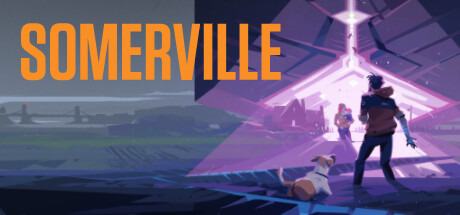 The orange logotype beside a man and his dog facing a violet column of light — Steam store key art
First Impressions
Line up the top helpful positives and the praise converges on one target: atmosphere, sound design, breathtaking, art, cinematic. One reviewer calls it a work of art; another calls it their favourite depiction of an alien invasion. Support for the audiovisual side runs far thicker than 70% would suggest.
The negative vocabulary is equally tidy: controls, jank, invisible walls, slow, padding, readability — and the flat denial, 'these aren't puzzles.' Yet the same reviewers praise the look and the sound in almost the words the positives use.
So the split here is not two readings of one property. Both sides agree the picture and the sound are superb, and disagree only on whether the friction in front of them is tolerable. A disagreement running on a single axis is unusual, and it makes the structure easy to see. My interest goes to what that friction is made of.
 Running across a fog-drowned pasture with a white dog, dark slabs hanging in the sky — Steam store screenshot
Putting the Mechanics into Words
Reviewers describe one central device. Shine light on the alien matter and it melts into liquid; cut the light and it sets. The positives call it a unique gimmick and a pleasure to watch; the negatives call it repetitive and say it never builds past its foundation. Counted as verbs, the game really has one: light, on or off.
In Puzzlebyrinth's terms that is a bold subtraction of verbs. The trouble is not the subtraction but that no grammar was built on top of it. Where ChromaGun raised a grammar of colour mixing out of the single verb 'paint,' Somerville keeps melt-and-set as a one-step operation to the end. Nothing combinatorial ignites, so the learning curve runs almost flat.
That flatness is the fork. A flat curve thins out the satisfaction of solving, but it also keeps the puzzles from crowding the picture and the sound. When one reviewer writes that the puzzles never get in the way and another writes that there are no puzzles, they are touching two faces of one decision: the author took the puzzle off the lead role.
 In a darkened shop, a man in a red jacket carries a glowing object and leads a child past standing mannequins — Steam store screenshot
The Feel of the Controls
The most repeated subject on the negative side is the controls. Grab points are narrow, so you shuffle in front of a lever until it takes. Collision volumes read larger than the objects look, and you stop where there is nothing. Walking is slow and there is no run outside scripted chases. Stick direction is relative to a rotating camera, so moving straight left can require a diagonal. And the character is small enough on screen that people report losing him.
I would file this as difficulty of input rather than difficulty of puzzle. As I argued in the essay on control schemes, the same board becomes a different problem when the input changes. Here players repeatedly cannot tell whether the idea was wrong or the press was wrong, and with that separation gone, observation resolution stops rising and search collapses into brute force.
The positive side reads the same slowness as time to sit inside the view, and the pace was surely chosen for exactly that. But low readability and narrow interaction windows sit at a different level from that choice. The line the authors drew was 'move slowly', not 'fail to grab'.
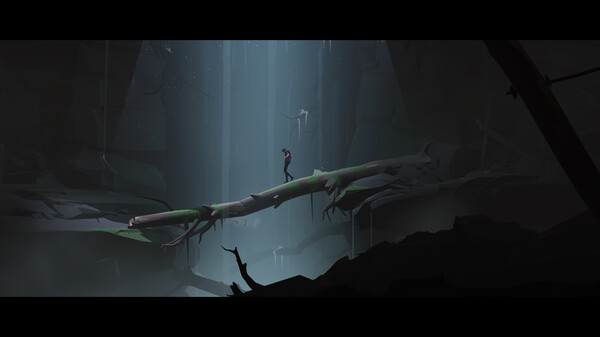 A dim rock shaft; under thin light from above, a very small figure walks along a mossy fallen trunk — Steam store screenshot
The Feel of the Story
No dialogue, no explanation, and several endings waiting at the close. The negatives write that it is coy and unresolved, that a first run all but guarantees a 'bad' ending. The positives write that language and communication are the theme, and that you should watch the drawings and the alien script because you will need them. Both are pointing at one place: the final moment, where comprehension has to be converted into input.
Formally that is the same design as Chants of Sennaar or Return of the Obra Dinn — observation turned into an answer sheet. But those two handed the player a way to record and a way to cross-check. Somerville does not. The complaint 'I was looking and still could not answer' is not about memory; it is about missing instruments.
Recent reviews have barely shifted, and still advise newcomers to watch the pictures. Rather than four years of changing opinion, what happened is that the entrance to understanding moved outside the game as guides circulated. The scaffolding for observation that the design owed the player is being carried by the community instead.
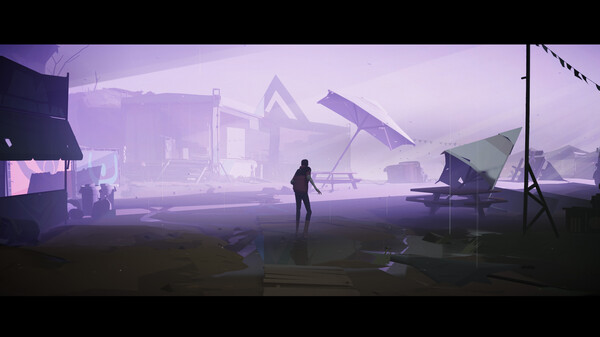 A deserted outdoor ground drowned in violet haze — a toppled parasol, picnic tables, a line of bunting, and the man standing with his back to us — Steam store screenshot
Sources
This piece was written by reading the user reviews on the Steam store page as of 2026-08-04. No review text is quoted directly; typical claims are reconstructed.
- Steam: Somerville (Mostly Positive; 1,879 reviews across all languages, 1,324 positive against 555 negative, about 70%; 73% of 15 in the last thirty days)
- Read: the top 10 helpful positive reviews, the top 8 helpful negative reviews, and the 6 most recent reviews across all languages — 24 in total
- Press, as quoted on the store page: VG247 (10/10), The Gamer (9/10), God is a Geek (9/10)
Closing
Steam reads about 70% positive; the press gave nines and tens. My design-critique score is 6.8 — a little under the users, well under the press. The reason is plain: I scored the picture and the sound separately from whether a grammar rose out of the verb, and the second column stayed near zero.
The marks go on for the nerve of cutting down to a single verb and for putting landscape and sound into the space that opened. They come off twice: no grammar was built past melt-and-set, and the finale asks observation to become an answer without handing the player any instrument for observing. Reviewers report finishing in roughly three to seven hours, with a median near four and a half.
Who it is for is clear enough. It is for someone who wants four hours of walking a dog through unexplained scenery and giving themselves to the pictures and the sound. Anyone after verbs accumulating into combinable rules is outside its reach. The disappointment of players who arrived expecting more INSIDE is partly a consequence of an expectation finished before the game was. But the friction of not grabbing and not seeing survives regardless of expectation, and that part, I think, spilled past the line the authors drew.
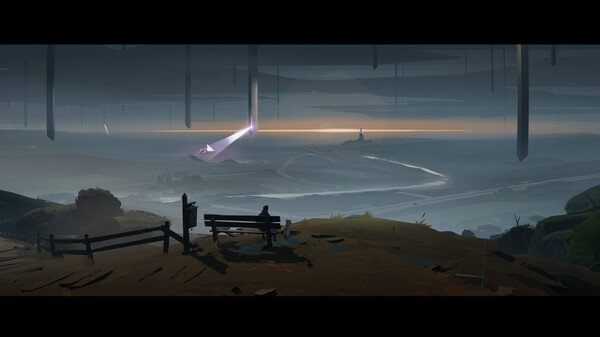 A figure sits on a hilltop bench with a dog beside them; a violet beam descends into the misty valley while dark columns hang from the sky — Steam store screenshot
Where are you with this game?
Press one and the game goes on your shelf. You can see it on your account page.
Reactions (no login)
Anonymous • one of each per visitor per day
Read next
Related reviews
Happy Game
A point-and-click adventure that walks a sleeping boy through three chapters of nightmare. You pull, turn and pick at the screen to open the way forward, and what waits there is smiley faces, pink bunnies and rooms the colour of blood. Amanita Design's first turn toward horror, scored by the Czech band DVA.
Syberia: The World Before
A third-person adventure in which lawyer Kate Walker moves between two timelines — a girl named Dana in the 1930s and Kate's own present — retracing the history of the city of Vaghen alongside the automaton Oscar. Progress comes through assembling mechanisms and hint-assisted exploration. Microids' fourth entry in the series.
Return to Monkey Island
A point-and-click adventure in which series creator Ron Gilbert returns, three decades on, to the pirate comedy he left unfinished. It replaces the old verb menu with a single context-sensitive interaction, adds an in-world hint book that opens solutions in stages, and sends Guybrush Threepwood after the Secret of Monkey Island once more.


