REVIEW · 2016-07-07
INSIDE
Reading a near-unanimous review pool, and its 3%
Introduction
Hunted and alone, a boy is drawn toward the center of a dark facility. With no dialogue and no on-screen prompts, you push, pull, wade through water, and even take remote control of other bodies as you move ever rightward. It is a 2.5D narrative puzzle-platformer, released in 2016 by Denmark's Playdead as the follow-up to LIMBO, and recorded as built in Unity.
I write this from the Steam review pool. The label is 'Overwhelmingly Positive' — 71,351 positive against 2,217 negative across 73,568 reviews in all languages, roughly 97% (snapshot 2026-07-03). Even Japanese alone gathers 287, 'Very Positive.' Metacritic sits at 87; IGN gave a perfect score. When the numbers agree this much, the interesting question becomes what that remaining 3% is pointing at.
The proper noun the positive side reaches for is almost always one: LIMBO. Those who know the predecessor talk of evolution; those who don't talk of raw shock. I want to read both the near-unanimous praise and the small dissent tucked inside it, in design terms.
 INSIDE — Steam store
First Impressions
Line up the top helpful positives and the vocabulary rhymes to an uncanny degree: atmosphere, masterpiece, art, and the noun-ified 'the ending.' Most cite being pulled in without explanation, the use of sound and silence, and never once drifting off the screen.
The minority and the qualified voices keep returning to: short, easy, 'walking simulator,' and overhyped. The complaint that a 3-5 hour game doesn't justify the price sits here too. Years on, even recent reviews barely move these talking points.
What interests me is that praise and reservation often name the same property. One reviewer's 'beautifully pared down' is another's 'thin.' My job is to translate where that fork sits into design terms — not to rule on who is right.
 INSIDE — Steam store
The World
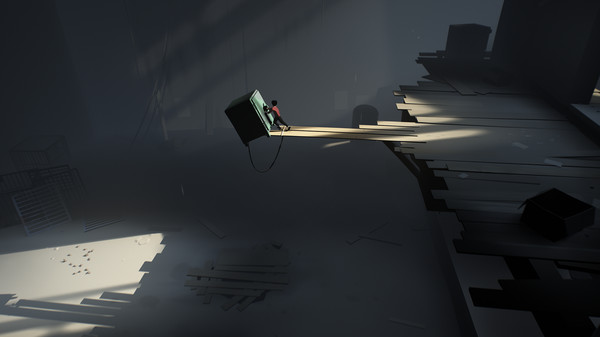
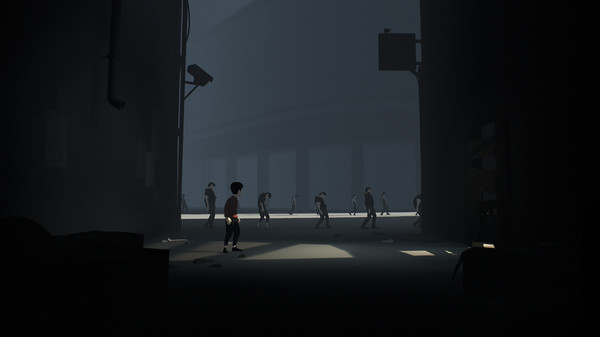
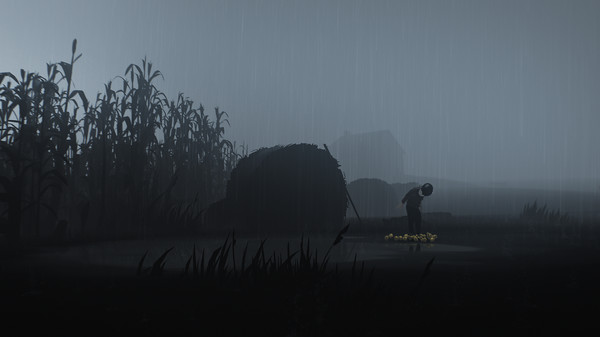
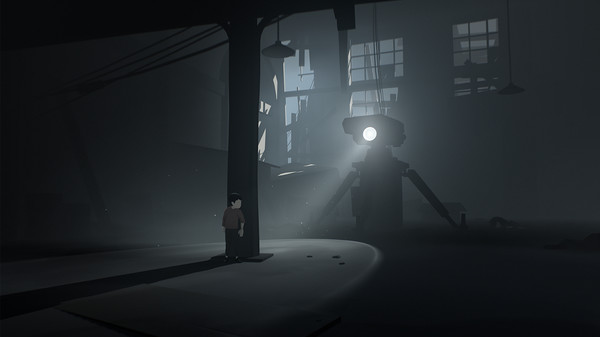
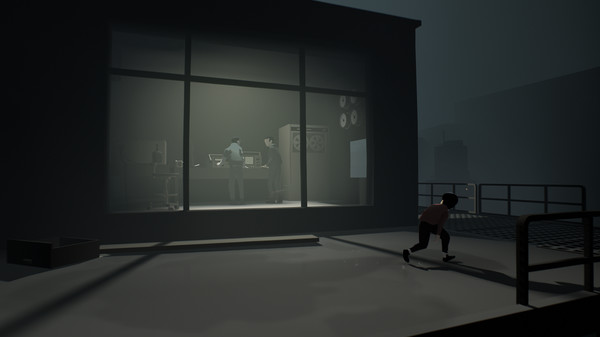
What the positive reviews orbit is less the puzzles than the texture of the world: the muted palette, shapes stirring in the distance, the weight of water, an audio mix where music and ambience dissolve into each other. When reviewers write 'the air swallowed me' or 'I was too uneasy to move on,' they are responding to the information density of the space, not to a mechanism.
In Puzzlebyrinth terms, this is design that raises your observation resolution. With no HUD and no dialogue, every cue — where to go, what will kill you, how a device works — is embedded in the backdrop itself. The world doubles as the UI. It is a more total version of the 'silence carrying the explanation' I described in The Swapper.
The negative side reads that same design as an 'atmosphere game' or 'interactive art' — staging outrunning play. But I see allocation, not absence. Playdead moved the information load that text and icons usually carry entirely onto the environment. The split in verdicts is really the temperature of that bet paying off, or not.
 INSIDE — Steam store
Putting the Mechanics into Words
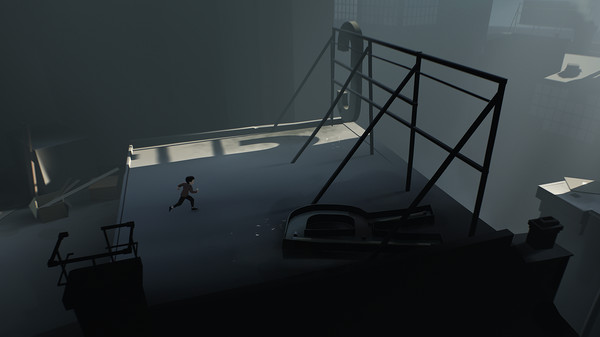
The verbs are few: run, jump, push and pull, swim. One sharper verb is grafted on like a foreign body — remote-controlling other bodies through a helmet. Much of what positives call 'satisfying to solve' and 'fused with the environment' comes from wiring those few verbs carefully into space: rows of bodies moving in unison, a shockwave, a presence underwater. Each is a re-contextualising of an existing verb, not a new button.
Which is why the negative 'too easy, never once stuck' is also accurate. The game deliberately refuses combinatorial explosion. The puzzles aren't there to trap you; they are punctuation for the story, offering just enough resistance to keep the single solution path from feeling automatic.
So I read 'easy' as the result of subtraction, not failure. Add puzzle difficulty and you bleed narrative momentum; Playdead chose momentum without hesitation. Anyone who bought it for a challenge is fairly let down — but that is a question of the machine's intended reach, not of its build quality.
 INSIDE — Steam store
Pacing and Length
Length is where opinion splits hardest. The median completion time cited in reviews is roughly 3-4 hours, at a $24.99 list price. The positive side calls this 'the perfect length, not a minute of padding' — outside retrying death sequences, there is little wasted travel or repetition, and the density reads high.
The negative side reads the same figure backward: '$25 for three hours is steep,' 'too short,' 'the substance doesn't last as long as the hype.' One fact — the runtime — cleaves neatly into praise for density and complaint about value. Steam also bundles it with LIMBO, and many recommend taking the pair together.
To me this is a disagreement over whether quantity or density is the value. The information per hour is very high; the total is small. A design that pours concentrated rather than diluted will always look overpriced to anyone who measures length by the wallet. This runtime only lands correctly for those content to buy density, not duration.
 INSIDE — Steam store
Sources
This piece was written by reading the Steam store review breakdown and publicly available scores and discourse as of 2026-07-03. No review text is quoted directly; typical claims are reconstructed. Because individual review bodies were behind the store's age gate, I worked from the aggregate counts (positive/negative), the review label, press scores, and representative pro/con arguments visible in published articles.
- Steam: INSIDE (Overwhelmingly Positive; 71,351 positive vs 2,217 negative of 73,568 all-language reviews; Japanese 287, 'Very Positive')
- Verified on the Steam store: the Positive/Negative type breakdown and Recent (591 in the last 30 days, 96%)
- Press and discourse: Metacritic (87), IGN (10/10), Giant Bomb (5/5), Polygon (9.5/10), and, for the dissent, Trusted Reviews, 'massively overhyped'
Closing
Steam reads about 97% positive; my design-critique score is 9.0, and the two don't diverge. If marks come off, it is for shallow puzzle depth and thin reason to replay or explore — but that is a price the author paid on purpose to protect density and momentum. The world-as-UI observation design and the re-contextualising of a few verbs are among the cleanest I've seen in this genre.
The minority reservation — short, easy, overhyped — isn't wrong. It names a mismatch of expectation, not a lack of craft. Out of reach for anyone wanting chewy puzzles or long play; an easy recommendation for anyone after wordless storytelling and a dense few hours, especially played straight after LIMBO. What the near-unanimous pool really teaches is the one thing it is sharpened for: who it is for.
 INSIDE — Steam store
Where are you with this game?
Press one and the game goes on your shelf. You can see it on your account page.
Reactions (no login)
Anonymous • one of each per visitor per day
Read next
Related reviews
Sethian
A first-person language puzzle in which you play a far-future archaeologist typing questions into an ancient terminal on a depopulated planet, in a constructed tongue with its own grammar. You build sentences from a handwritten journal and dictionary, and how well you write decides which ending you reach. From Duang! Games.
Event[0]
A first-person narrative exploration game aboard a retrofuturist spaceship, where you type your own sentences into the ship's terminals to talk with its AI, Kaizen-85, and look for a way back to Earth. Free text rather than dialogue options is the central mechanism, and how you speak changes the AI's attitude and your ending. A 2016 work by Ocelot Society.
Human Fall Flat
A physics puzzle platformer about Bob, a wobbly figure you steer by grabbing, climbing and dragging your way through buildings that float in a dreamscape. Each arm is controlled separately, and no puzzle has a single fixed solution. Made by Lithuania's No Brakes Games, with online co-op for up to eight players.


