REVIEW · 2013-05-30
The Swapper
Cloning, consciousness, and a lonely space station
First Impressions
I write this review from the pile of Steam user reviews for The Swapper. A single-player puzzler released by Facepalm Games in 2013, it carries a 'Very Positive' label — 93% of 3,403 English reviews, and roughly 91% across 7,000+ in all languages (snapshot 2026-06-20). Metacritic 87. By the numbers, near-unanimous praise.
Line up the helpful positive reviews and the vocabulary rhymes: atmospheric, clever, unique, haunting, and 'the last few puzzles broke me.' Most praise the restraint of carrying a whole game on one idea — cloning and swapping minds — and the clay-modeled look.
Yet caveats live inside even the recommending reviews: short, derivative, and 'only the late game demands reflexes.' The 4-5 hour length, the thin mechanical growth, the save overwritten after the ending. My job is to translate where those opinions fork into design terms — verb, grammar, subtraction, learning curve.
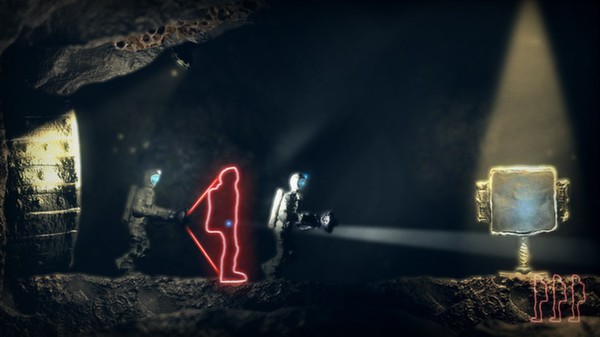 The Swapper — Steam store
Putting the Mechanics into Words
What positive reviews praise most is how few verbs the device has. The gun does two things: spawn up to four clones, and swap your consciousness into one of them. Clones mirror your every move. When reviewers say it 'carries the whole game on one idea,' they mean these two verbs. In Puzzlebyrinth terms, the verb set is heavily subtracted.
But two verbs don't mean loose rules. Red light blocks the swap; blue light blocks cloning; gravity switches and lethal falls prune the moves further. Many note it 'adds no new abilities, like Portal — the obstacles change instead.' I traced the same shape in The Talos Principle: fix the verb, grow the grammar.
Even fans add a caveat: 'little changes from the first puzzle to the last,' 'no gameplay innovation.' The two verbs never grow, so the combinatorial space stays narrow. The restraint and the under-development sit in the same recommendation — that honesty is the review pool.
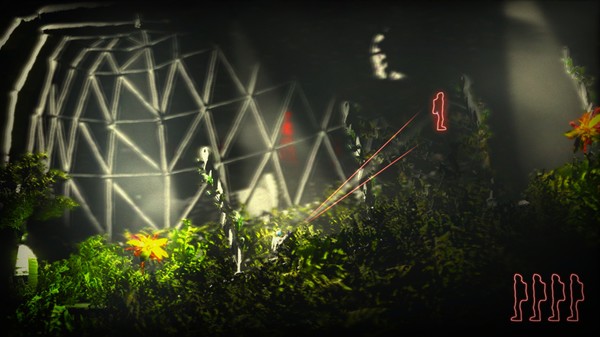 The cloning-and-swapping device — Steam store
The World
In these reviews, the world runs hotter than the mechanics. Shapes molded from clay and household objects, hard light-and-dark contrast, the loneliness of the derelict station Theseus. One reviewer reaches for John Carpenter's The Thing — 'cold, alone, uneasy' — to name the air.
The sound earns the same praise: an ambient score that 'plays so naturally you only later notice it's lovely,' fragmentary radio, whispering rocks. Many advise 'headphones, lights off.' In Puzzlebyrinth terms this is a design of observational resolution — light hides the rough edges and aims your attention at the space itself.
What interests me is that world and verb are continuous. A clone is an empty, disposable body whose husk drops to the floor; the act of moving your mind carries the theme of what the self is. Like Cocoon or LIMBO, it belongs to the lineage where space doubles as narration.
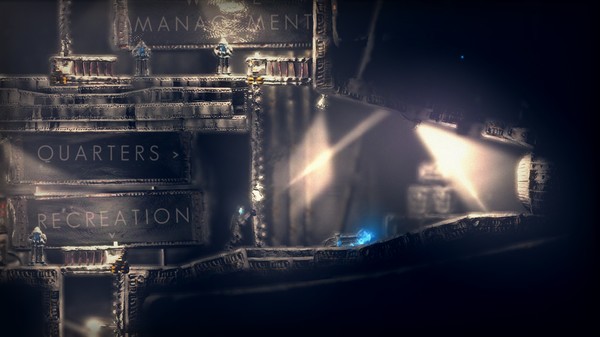 The space station Theseus — Steam store
The Feel of the Story
The story is never forced on you. The top helpful reviews agree it is 'narration you gather yourself — from radio, terminal logs, whispering rocks.' The script is by Tom Jubert (said to be known for FTL and Driver: San Francisco). Like Dark Souls, only the curious go deep.
Two things recur: the single late-game choice, and the metaphysical theme — what is a self, can consciousness be moved. One reviewer calls it 'one of the heaviest single decisions in any game'; another warns 'turn subtitles off and you'd miss the core of the story.'
Cooler voices add 'standard sci-fi tropes,' 'thought-provoking without overreaching.' To me that is not a flaw but a design of reach: dissolving narration into the environment lets the same game run deep for story-readers and light for puzzle-solvers. Which is why praise and 'a bit thin' share one shelf.
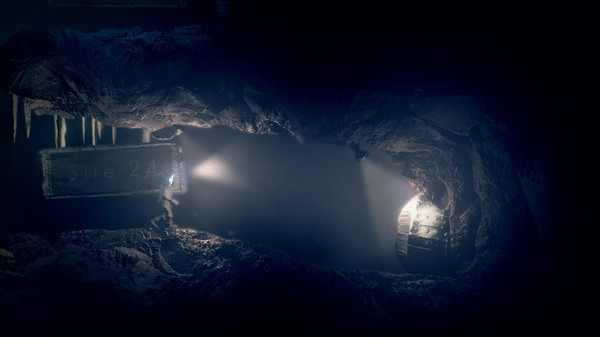 Terminal logs and whispering rocks — Steam store
The Texture of Difficulty
On difficulty the pool says two clean things. The early and middle stretch is mostly 'fair' and 'just right.' The trouble is the end: several reviewers report being 'stuck for hours on the last few,' and 'one puzzle I couldn't clear even with a walkthrough.'
The other fork is reflexes. Some late rooms demand hand speed — swapping into a clone mid-fall, for instance. One reviewer enjoys 'the panic and snap decisions'; another writes 'I know the answer, my fingers can't keep up — I bought a puzzle game.' Several add they thought it impossible 'until I found the slow-time function.'
To me this is kind, not amount. A spatial-logic verb suddenly gets a twitch-timing grammar grafted on near the end. The learning curve steps rather than rises. Most of the negative isn't 'too hard' but 'it changed kind' — the author put the calm, logic-only player outside the line at the finish. A choice of reach, not a flaw.
 Light bars cloning and swapping — Steam store
Sources
This piece was written by reading the user reviews on the Steam store page as of 2026-06-20. No review text is quoted directly; typical claims are reconstructed.
- Steam: The Swapper (Very Positive, 93% of 3,403 English reviews, ~91% across 7,000+ in all languages)
- Read via WebFetch: the ~10 most helpful positive reviews, and the caveats living inside those recommendations
- Press: Metacritic 87 — Destructoid (10/10), IGN (9.3), Game Informer (9.25), Rock, Paper, Shotgun
Closing
Steam reads 'Very Positive,' 93% in English; my design-critique score is 8.4, and the two don't diverge much. The restraint of two verbs, the patient grammar-only teaching, the continuity of world and verb — all top-shelf design. Marks come off for never developing those verbs (a narrow combinatorial space) and for the late twitch-timing that briefly muddies an otherwise pure design.
The pool's near-unanimous verdict: 'essential for anyone who wants atmosphere and story, a letdown for anyone wanting flashy challenge.' For a 4-5 hour game (HowLongToBeat puts the main story near 4 hours) that mixes quiet logic with a hurried finish, that's fair. Read the small verb as restraint or as thinness — the split itself tells you which player you are.
 The Swapper — Steam store
Where are you with this game?
Press one and the game goes on your shelf. You can see it on your account page.
Reactions (no login)
Anonymous • one of each per visitor per day
Read next
Related reviews
The Bridge
A 2D puzzle game where you rotate the entire stage to change which way gravity pulls, threading M.C. Escher-style impossible architecture to reach the exit key. From a single verb — turn the world — grow vortexes, a rolling boulder and full inversion, all in hand-inked black-and-white lithograph. A 2013 game by Ty Taylor and Mario Castañeda.
Ittle Dew
A top-down puzzle adventure in which a castaway adventurer works through block-pushing rooms using only the items she picked up — a fire sword, an ice wand, a portal wand. Released by Ludosity in 2013.
Brothers - A Tale of Two Sons
Two brothers set out to find the Water of Life for their dying father. The left stick moves the older brother and the right the younger, both at once, and you cross ravines, waterways and the bones of giants by pairing what each of them can do. Every line is spoken in an invented language. Directed by Josef Fares at Starbreeze Studios, released in 2013.


