REVIEW · 2018-02-27
Into the Breach
“This is a puzzle, not a strategy game” — reading the verdict on a perfect-information 8×8
First Impressions
Into the Breach is a top-down tactical puzzle: three mechs on an 8×8 grid, defending a city. Made and released by Subset Games, the FTL studio, on 27 February 2018. I am writing this from the Steam user review pool rather than from my own playthrough.
The numbers first. Of 22,003 reviews, 20,737 are positive and 1,266 negative; the 18,661 Steam-purchaser reviews carry the label 'Very Positive'; the 12,478 English reviews sit at 93% (snapshot 2026-07-31). The last 30 days: 104 reviews, 89%. Metacritic shows 90 from the press against a 7.8 user score. Nothing here is contested.
So the interesting thing about this pool is not the ratio but the name. The store's first sentence says 'turn-based strategy game', the tag list leads with Strategy and puts Puzzle ninth. Yet read the helpful positives in order and the same correction keeps arriving: do not be fooled, this is not grid tactics and not a roguelite, it is first of all a puzzle game. Author and readers disagree by exactly one genre word.
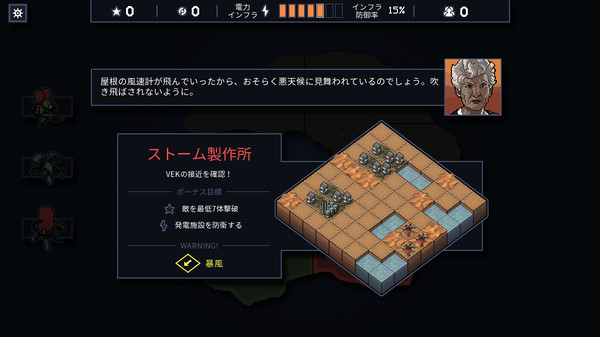 The pre-mission briefing; a storm warning sits under the bonus objectives — Steam store screenshot
Putting the Mechanics into Words
The metaphor the positives reach for most is chess, usually on four grounds: an 8×8 board, fixed movement, no luck, and nobody to blame but yourself. What is actually doing the work, though, is not the shape of the board but the way information is released. The Vek move first and announce, with arrows on the board, exactly who will hit what next turn.
In Puzzlebyrinth's vocabulary, the author has raised the observation resolution to maximum on your behalf. Most puzzles begin their difficulty at the reading stage; this one gives reading away for free and keeps only the question of what to do about it. The recurrence of 'complete knowledge' and 'telegraphed' in the pool is the evidence that the subtraction lands.
The verbs are few too: move, shoot, and shove. It is the third one the positives keep illustrating — pushing a Vek into water, into lava, into another Vek, or into the tile a building was about to be hit from. Almost nobody writes about damage numbers; everybody writes about placement. As in designing with fewer verbs, shoving turns terrain into part of the answer: the ground deals the damage, and what you are doing is sorting.
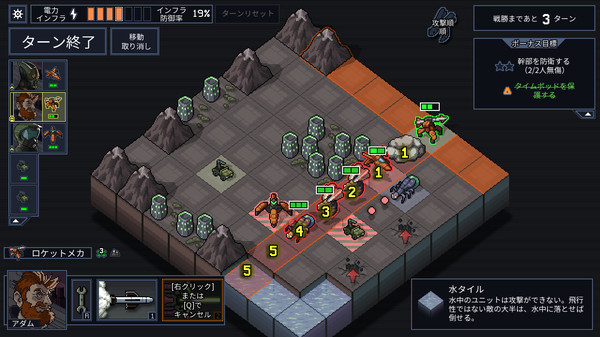 A rocket mech selected, its red attack range and numbered markers drawn over the board — Steam store screenshot
The Texture of Difficulty
The testimony looks contradictory. 'Normal plays like hard mode' and 'you get flattened without being able to anticipate anything' sit on the same shelf as 'no reflexes required, which is a relief' and 'I spent ten minutes on one turn.' Sort by where people got stuck and three different difficulties separate out.
First, the difficulty of reading the turn out to the end — finding this turn's best move. Both camps mostly enjoy that layer; one positive describes agonising for ten minutes, slipping with the mouse, and stumbling onto a better move than the one he had planned. Second, the difficulty of cutting losses: three mechs cannot cover everything, so every turn you choose what to abandon. That is where 'trolley problem simulator' comes from. Third, the difficulty of the run — island order, weapons drawn, pilots lost. Most of the negative side quits at the third layer.
The collision happens when the first two get swallowed by the third. There is no per-mission retry, so a single tile misplaced two turns ago can end a run forty minutes later. The positives read that as weight; the negatives read it as being unable to learn. In the terms of learning-curve design, this game puts the unit of learning at the run, not the mission. You cannot excerpt the problem you failed and drill it, so progress is slow and feels large when it arrives. Both accounts describe the same decision from opposite sides.
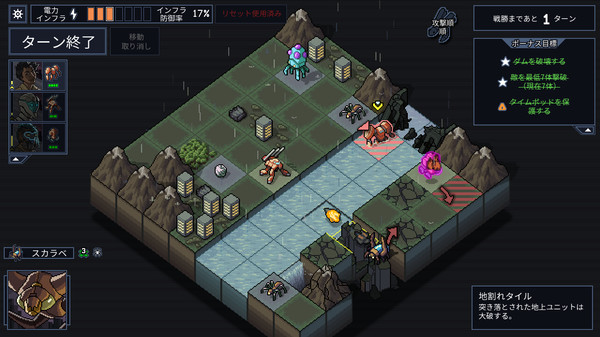 A green island with a river and a dam; the right panel shows one turn to victory and three bonus objectives — Steam store screenshot
Place in the Lineage
The most frequent proper noun in the pool is neither the studio nor a genre: it is FTL. Praise and complaint both rest on that reference line. 'I wanted another brawl with the random number generator and this was not it' and 'it got good once I stopped expecting a sequel to FTL' are the same discovery written once as disappointment and once as reappraisal.
The second reference line runs the other way: chess and Advance Wars. People arriving from chess welcome the 8×8 and the perfect information; people arriving from tactics RPGs write that the maps are too small for movement range to matter, that it is a tactics game without tactics. The same narrowness reads either as a subtraction that cuts the combinatorial explosion down to something a human can finish reading, or as thinness.
What can be said about the design is that Subset Games did not delete randomness; they moved it. Almost all probability is stripped out of the combat and relocated into a per-run draw: island order, weapons found, enemy composition. The board therefore becomes pure as a puzzle and coarse as a roguelite — the allocation problem I wrote about in handcrafted versus generated levels. When the negatives say the boards do not feel authored, they are pointing accurately at a side effect of that move.
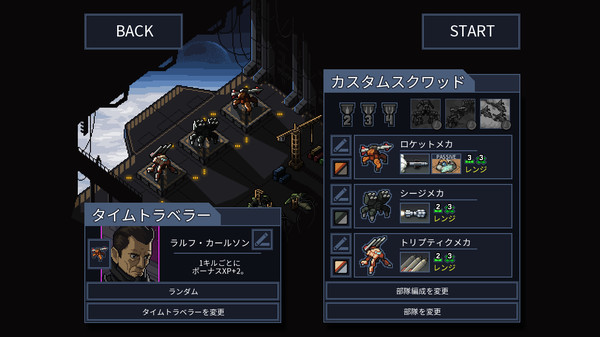 The pre-launch squad screen: pick three mechs and a time traveller, then hit START — Steam store screenshot
Sources
Written by reading the Steam user review pool as of 2026-07-31. No review text is quoted directly; typical claims are reconstructed.
- Steam: Into the Breach (Very Positive — 20,737 positive and 1,266 negative of 22,003 reviews; 18,661 Steam-purchaser reviews; 93% of 12,478 in English; 89% of the last 104 in 30 days)
- Read: the top 10 helpful positives, the top and most recent 10 negatives, and non-English (French) reviews — over 20 in total
- Metacritic: Into the Breach user reviews (user score 7.8; 465 positive, 134 mixed, 56 negative; read across postings from 2018 to 2026 to check how the verdict shifted over time)
- SteamDB: Into the Breach (release date, developer and price history)
Closing
Against Steam's 94% I give it 8.5 on design grounds, and my deduction is not about the board but about the path to it. What the recent negatives repeat is not difficulty itself but the thin tutorial and the absence of a per-mission retry — a question of legible failure. The board contains everything you need to see that you lost two turns ago; the place to review that lesson exists only outside the game.
Who it fits is clear. If searching for the best move on a fully disclosed board is the point, this belongs on the same shelf as Patrick's Parabox and Stephen's Sausage Roll. It does not fit anyone who wants to excerpt the single problem they failed and try it again and again. That is scope, not quality — though the fact remains that the store declares its scope one word off.
Reviews put a single campaign at three to six hours, while the hours logged by the top helpful reviewers run from fifteen to over five hundred. Several of those top reviews are about the 2022 Advanced Edition being given away free, which builds a kind of credit for the studio on an axis unrelated to the verdict. Against the $14.99 list price there is a steep discount running as I write. Before arguing about the price, open it once having forgotten the genre word on the store page.
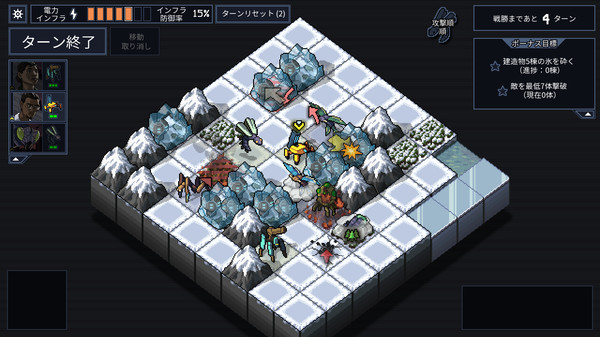 An ice island, its buildings sealed in blocks of ice; the remaining turn resets show at top left — Steam store screenshot
Where are you with this game?
Press one and the game goes on your shelf. You can see it on your account page.
Reactions (no login)
Anonymous • one of each per visitor per day
Read next
Related reviews
Pipe Push Paradise
A 3D sokoban about restoring plumbing on a lonely island: push pipes across a grid and, by their shape, they roll and stand upright to route the water. One verb — push — yet pipe shapes and gravity open a solution space with no visible floor. By Corey Martin and Teo Zamudio.
EXAPUNKS
A hacking puzzler set in a 1997 cyberpunk world: you write pseudo-assembly for tiny programs called EXAs and send them through the networks of banks and universities. With a printable underground zine as its manual, it pulls bottomless depth from a few verbs — a Zachtronics game.
7 Billion Humans
A parallel-programming puzzle where one shared instruction list runs across a crowd of workers who carry and sort data cubes to clear each level. The sequel to Human Resource Machine, built by Tomorrow Corporation from a small set of commands.


