REVIEW · 2018-01-18
Pipe Push Paradise
A sokoban that rolls into the third dimension
Introduction
The plumbing on a lonely island has failed and its plumber is asleep, so you push the pipes lying on the floor to route the water again — that is the whole of it. Depending on shape (I, L, S), a pushed pipe rolls and sometimes stands upright, so a two-dimensional grid asks you to read a three-dimensional pose. It is a 3D sokoban by Corey Martin and Teo Zamudio, built in Unity, released January 2018.
I wrote this from the Steam review pool, not from playing it myself. The label is Very Positive — 96% of 158 Steam-purchaser reviews, and 199 of all 208 reviews are positive (2026-07-15 snapshot). It lists at $9.99 and has fallen as low as $0.99. The numbers read as overwhelming support, yet the reviews themselves do not speak with one voice.
The proper noun the pool reaches for most is not the studio or 'pipes' but Stephen's Sausage Roll. Praise and complaint both sit on two words: lineage and difficulty. This piece follows those two words to read what the game subtracts, where it makes you stall, and whom it is for.
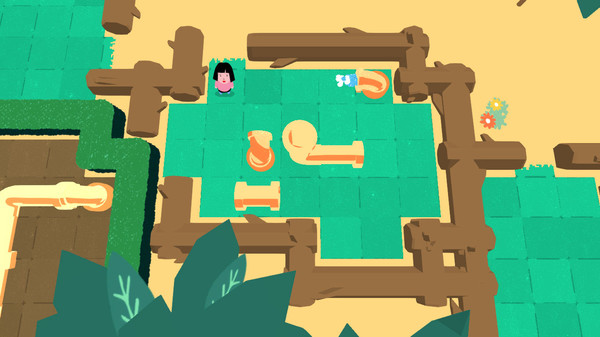 Pushing floor pipes to route the water in a 3D sokoban — Steam store
First Impressions
The top positive reviews land on two first impressions. One is how simple the input is: no mouse, just arrow keys to push a pipe, learned in seconds. The other is the look — the pale island art, like an old travel guide to Puerto Rico, and a quiet bossa-nova guitar, called 'elegant' and 'relaxing.' The threshold is low and the surface is gentle.
But many brace at that same door. 'Coast through the first few and level five stops your hands' is the recurring warning, and PC Gamer summed the game up in one word: 'Infuriating.' The gap between the calm surface and the bite beneath it is, for many, the real first impression.
So the resolution of observation splits within minutes. The same fact — 'this looks easy' — reads as accessibility to one side and as a bait to the other. Both are right. What hides under that subtracted surface of pale art and arrow-key input does not show at first; it resolves only after you roll a few pipes.
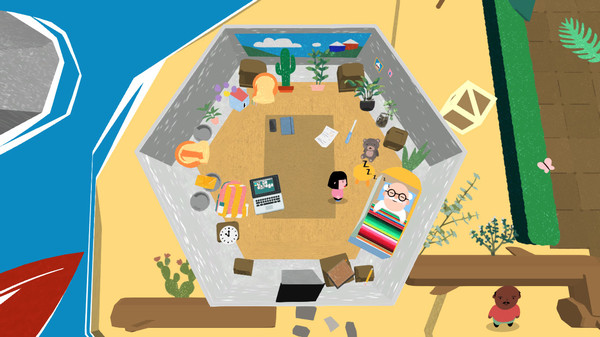 A calm surface of pale art and arrow-key-only input — Steam store
Putting the Mechanics into Words
What positive reviews praise in unison is how few verbs there are. All you do is push — no shooting, no grabbing, no jumping. In this site's terms, the verb is subtracted to one. But because the pushed pipe has a shape, it rolls, and an L or S stands upright depending on direction. From a single verb, a third axis — height — grows on its own.
So the object of thought is grammar, not verbs. Pipe shape, floor level, gravity. Add pressure plates that rotate a pipe, ditches you drop a pipe into to make a bridge, magnetic pipes that pull from a distance, and the solution space swells with each. 'Brain melt,' the reviewers write — the feel of combinatorial explosion, a solution space opening exponentially from a few verbs.
Many of the top recommendations share one line: 'each level asks a single idea.' That is subtraction working. No extra gadgets; one property stated fully in one room. To me the craft here lives not in the count of verbs but in how many distinct 'aha's one verb is made to yield.
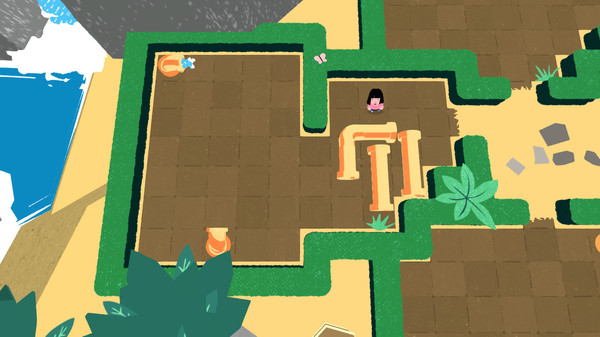 A pushed pipe rolls and stands according to its shape — Steam store
The Texture of Difficulty
Difficulty is where the split is sharpest. The positive side writes 'pleasantly maddening' and 'the click is tremendous'; the negative side writes 'infuriating' and 'almost quit.' What's striking is that both are looking at the same wall — thin hints and steep difficulty — read as a virtue by one and as unkindness by the other. Less a flaw than a question of reach: whom it is for.
I'd sort the 'stalls' into three. First, good difficulty: stalls that test understanding of a mechanic, leaving an insight when solved. Second, difficulty of legibility: reviews and outlets note that later on the viewpoint makes a pipe's height hard to read, so 'I thought I'd solved it, but I'd misread the elevation.' Third, difficulty of labeling: per-level difficulty markers that don't match how hard a level feels.
The first is a virtue; the second and third I read as legibility flaws. A pure logic puzzle assumes the board states its information plainly. When height is hard to read, you fight the camera rather than the logic. Sorting the stalls this way shows where the temperature gap inside a 96% score comes from: a difficulty that is welcomed and a difficulty that is merely endured, living side by side.
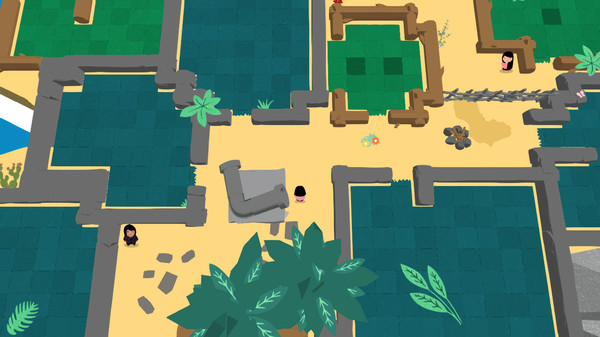 Later on, reading a pipe's height becomes part of the difficulty — Steam store
Place in the Lineage
The ruler the pool uses is, almost always, Stephen's Sausage Roll. Several say they enjoyed it first and only later noticed the source, and the developer is said to acknowledge the influence. A pushed object rolls on a grid and changes pose, and that pose is the key — this 3D-sokoban skeleton the game inherits openly.
But its pushed object — a pipe with a continuous shape — is its own. Beside Sausage Roll's skewered rolling, the stretching bodies of Snakebird Primer, or the reassembled islands of A Monster's Expedition, this game differs on one point: it makes you read a shape's pose. Same 'push,' but what pose you read changes the observation entirely.
The 'derivative' complaint is the fate of any game that names its lineage. I read it as a reach placed between the brutal Sausage Roll and the welcoming A Monster's Expedition — near the former in pure mechanical bite, short of the latter in accessibility. In between, the feel of the pipe as material is like nothing else. Its place is defined by choice of material, not amount of novelty.
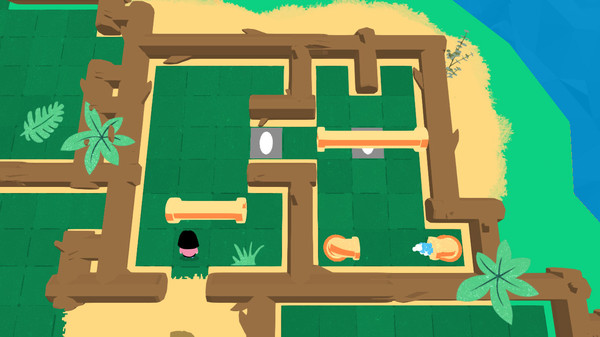 A 3D-sokoban lineage built on the pipe as its own material — Steam store
Sources
This piece was written from the Steam store's user reviews as of 2026-07-15.
・Steam: Pipe Push Paradise (96% of 158 Steam-purchaser reviews positive; 199 of 208 overall; 'Very Positive'; 2026-07-15 snapshot).
・Read the top helpful positive and negative reviews plus recent ones. Positive clusters on the single verb, the one-idea-per-level restraint, and the reward of the click; negative on the sharp difficulty spike, height that is hard to read from the viewpoint, short length, and the resemblance to Stephen's Sausage Roll.
・Critic context via GGS Gamer and the store-quoted lines from TouchArcade, PC Gamer ('Infuriating') and TechRadar ('a superb, sunny brain-smasher').
Closing
96% of purchasers, 199 of 208 overall. My design-critique score is 8.0. Subtracting the verb to a single push while drawing a third axis — height — out of pipe shape and gravity, with each level stating one idea fully: that density earns a high mark. The deductions are the legibility flaw where the later viewpoint hides height, the short length, and per-level difficulty labels that don't match how a level feels.
That is also why my score sits below Steam's 96%. Steam's reviewers self-select as fans of this kind of puzzle and can swallow the hard-to-read viewpoint as 'bite.' From a design view, though, a pure logic puzzle whose board is hard to read is a real deduction. Reported clear times run roughly 4 to 12 hours depending on skill — a spread that itself says the stalls are not all of one kind.
The verdict is clean. Well worth it for anyone who wants bite, or who wants to taste the Stephen's Sausage Roll lineage quietly. It sits outside the reach of anyone who dislikes unfairness, or who wants story and guidance. The clean split, the pool teaches, comes down to whether you accepted the 'kind of difficulty' at the door. One verb — push — is still melting someone's brain today.
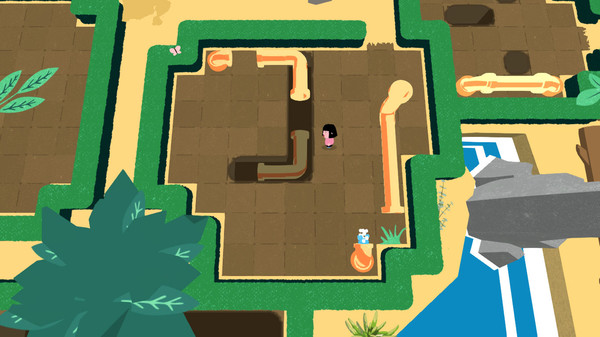 The bite inside one verb still chooses its player — Steam store
Reactions (no login)
Anonymous • one of each per visitor per day
Read next
Related reviews
Into the Breach
A top-down tactical puzzle: three mechs on an 8×8 grid, every enemy attack for the coming turn shown to you in advance, and a city to keep standing. Subset Games, makers of FTL, stripped almost all randomness out of the combat itself.
Rusty Lake Paradise
As Jakob, eldest son of the Eilander family, you return to the island of Paradise after your mother's death to lift the ten plagues through her hidden memories and strange family rituals: a hand-drawn point-and-click of macabre, surreal puzzles from Rusty Lake, makers of the Cube Escape series.
Kine
Roll and rotate three musical machines — Quat the drum, Roo the accordion, Euler the trombone — through 120-plus 3D puzzles across a theatrical city, reading how each body tumbles like a weighted die. A spatial puzzle from Chump Squad (Gwen Frey).


