REVIEW · 2019-02-20
Snakebird Primer
A gentler front door to the snakebird's grammar
First Impressions
Snakebird Primer calls itself, unusually, a 'primer' for the original Snakebird. I'm writing this from the Steam review pool and the forums, not from my own save file — reading the reviews, not playing the game.
The verdict is quietly high: 93% of 230 user reviews are positive ('Very Positive'), 243 up against 20 down across 263 counted reviews (2026-07-07 snapshot). Same developer as the original, Noumenon Games; English only; one extra yellow snakebird and a gentler island.
Line up the top reviews and the praise collapses into 'I finally got to enjoy Snakebird,' the caveats into 'too easy, too short.' The same easiness reads as rescue for one crowd and as thinness for another. My job is to translate that split, not to inflame it.
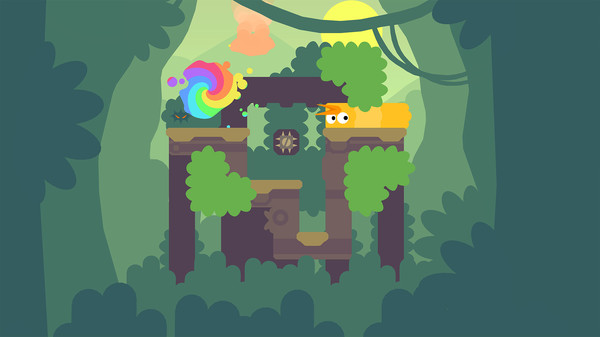 A gentle island before the original's cruelty — Steam store
Putting the Mechanics into Words
Reviewers keep naming two things: how little there is, and how good it feels. The snakebird eats fruit to grow, falls under gravity, and uses its own length like a bridge to reach the exit; you push blocks, slip through portals, dodge spikes. The top reviews call the set 'elegant,' 'intuitive,' 'carefully chosen'; one invokes Fish Fillets NG and says this is 'far more elegant.'
In Puzzlebyrinth terms the verbs subtract to three — crawl, fall, eat — over a single law, gravity. The materials are almost identical to the original's; the one addition is linked pushable blocks. From that subtracted set the board still explodes into a different trap each level, the same combinatorial shape I traced in Snakebird.
So what Primer subtracts from the original isn't the mechanics. The grammar is intact; only the difficulty is thinned out by hand. That's why 'easy but not cheap' is an accurate review: the foundation is continuous with the original, and what's been cut is the depth of observation it demands.
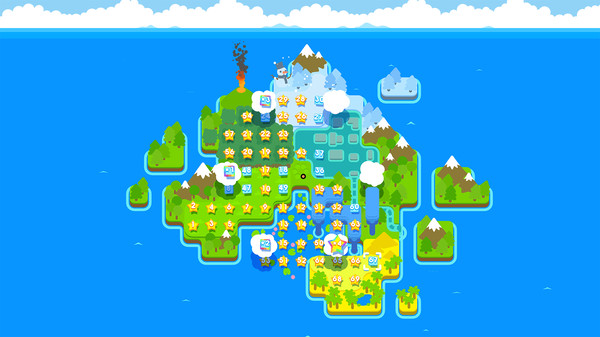 A board built from gravity and body length alone — Steam store
Designing the Learning Curve
Talk about this game and both reviews and forums circle back to teaching. On the forum the developer says plainly that anyone who has beaten Snakebird will find Primer too easy — it's a running start for people who bounced off the original, or who never touched it because it was too hard. The store's 'a primer for the serious challenges of the original' matches that word for word.
The top reviews confirm the intent landed: 'introduces each mechanic gradually,' 'smoother learning curve,' 'a running start into the real thing.' In Puzzlebyrinth terms it's a rare game that carves out the learning curve itself as the product. Where Snakebird throws walls at you from the start, Primer lays the same mechanics on the floor one step at a time.
Easy to miss: the unlimited undo is part of the design. 'Easy undo meant mistakes weren't punished,' one review notes — reading undo correctly as a device that lowers the cost of trying and raises the resolution at which you can read a board. Teaching design, this one point shows, isn't leading you to the answer; it's making the wrong turns safe.
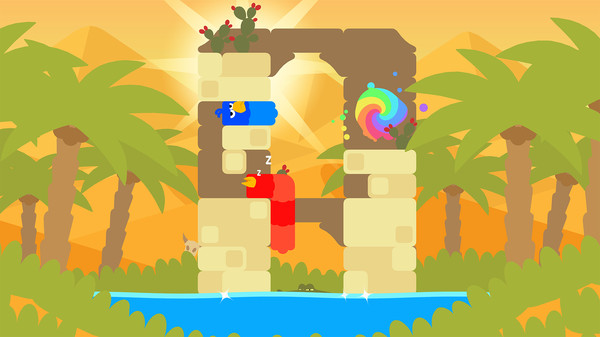 The same mechanics, laid out one step at a time — Steam store
The Texture of Difficulty
Difficulty splits cleanly, as expected. Players who finished the original are merciless: 'not worth $8 if you liked the original's difficulty — too easy, watered down,' 'done in two evenings (about five hours),' 'a tenth of the time the original took.' One says only 5-10 of some 70 levels gave any resistance.
Arrive from another door and the feel is different. A reviewer who came to it humbled by Baba Is You says the late levels looked impossible at first but soon clicked, with the desert and star levels the real head-scratchers. The same board is a warm-up for one player and a fever for another; to eyes that know the wall of Baba Is You, Primer's slope looks just right.
My read: it's not the amount of difficulty but the resolution you bring to the foot of the slope. Star levels lift the ceiling a little; the floor is set very low on purpose. So the split is a statement of range, not a defect. Even the forum grumble — 'same price bracket, far shorter' — misreads the axis once you see you're buying the on-ramp, not more content.
 A low floor; only the star levels raise the ceiling — Steam store
Place in the Lineage
The first yardstick reviews reach for is the original Snakebird — Primer sits as a deliberate cushion against a game 'built for the most hardcore puzzle players.' The next are Baba Is You and Fish Fillets NG: the movement-and-undo lineage with gravity added. Lay the difficulty of movement puzzles on one axis, from the gentle A Good Snowman to the brutal Stephen's Sausage Roll, and Primer plants itself firmly on the gentle end, as a teacher.
Inseparable from that is Primer's paradox. The people who recommend it most warmly all want the next thing: 'imagine four-bird levels at the original's difficulty,' 'give us a level editor,' 'a harder DLC or Snakebird 2.' The better the door, the more you want the room behind it. That wish is, I think, the most honest proof that Primer works as an on-ramp.
A small detail: several posts note the game is treated as 'not a real game' on Steam (no trading cards or badges). It has nothing to do with quality — it's a Steam classification — but it rhymes oddly with the modest 'primer' stance, and captures the mood of the review pool.
 A teaching entry planted on the gentle end — Steam store
Sources
This piece was written by reading the Steam user reviews and community posts as they stood on 2026-07-07. No review text is quoted directly; typical claims are reconstructed.
・Steam: Snakebird Primer (93% of 230 positive, 'Very Positive'; 243 up / 20 down across 263; English only)
・Read the top helpful recommendations and caveats, plus forum threads including the developer's own note on difficulty in 'A question about the difficulty' and 'Should've started with this..' via WebFetch
・(Reference) indie outlets such as Pocket Gamer and TouchArcade framing it as a beginner-friendly way into Snakebird, and the SteamDB aggregate
Closing
Steam sits at 93% positive; my design score is 7.8 — same direction, a touch lower. The mark off isn't difficulty but modesty of length. The hand that lays the learning curve out one step at a time is excellent, and the unlimited undo and careful material set are faultless. But precisely because the door opens perfectly, the room beyond is outsourced to the original — as a standalone, it is deliberately small.
The review pool's verdict doubles as a statement of range. For anyone who bounced off the original, who dreads a Baba-sized wall, or who wants to play with kids and family, this is not a shortcut but the right front door. If instead you want the original's cruelty for $8, it's off-target — 'buy the original first, or wait for a sale' is the honest advice. Reviews put completion around four to five hours; walk in knowing that and you won't be let down.
In the end the value is set by the eyes you bring to the foot of the slope. Lower the difficulty by exactly one step and hand over the snakebird's grammar safely — Snakebird Primer still, gently, delivers the first step its name promises.
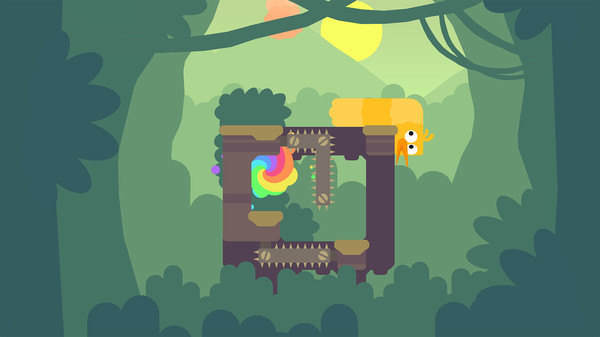 The first step its name promises — Steam store
Where are you with this game?
Press one and the game goes on your shelf. You can see it on your account page.
Reactions (no login)
Anonymous • one of each per visitor per day
Read next
Related reviews
Snakebird
A snakebird grows by eating fruit, and must use its lengthening body to solve grid-based puzzles. A thoughtful sokoban-like about shape and constraint.
Felix The Reaper
An isometric puzzle game in which Felix, a reaper who never stops dancing, may only walk where there is shade. You flip the sun between two positions to reshape the shadows, push and pull props to cast new ones, and arrange each mortal's fatal accident. Made by Kong Orange, narrated by Patrick Stewart.
Trüberbrook
A point-and-click adventure in which Hans Tannhauser, an American physicist who has won a trip to a remote West German village in 1967, chases a stolen physics paper and walks into a story about another dimension. Made by the German studio btf, with sets built as real miniatures and photographed.


