REVIEW · 2019-04-16
Heaven's Vault
Reading the split verdict on inkle's archaeology-and-language adventure
First Impressions
Start reading the Steam reviews and the first thing you notice is how evenly the positive vocabulary is pitched: wonder, beautiful, meditative, masterpiece, and praise for the score and the art. Most single out the rare thing of learning to read an invented language with your own hands.
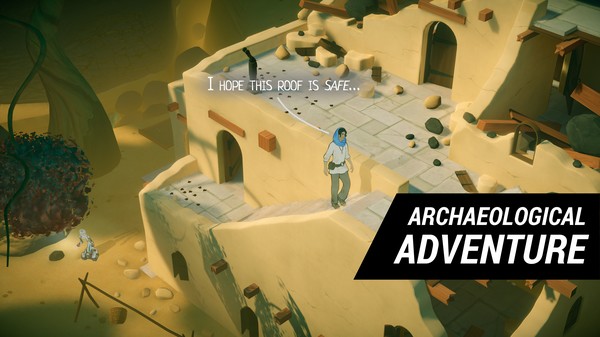
The negative side, and the qualified positives, keep returning to a different cluster: slow, clunky, tedious, 'the sailing is boring.' Slow walking, no quick travel, a camera that snags — the friction lives entirely in movement and controls. One reviewer says he wants to give it a 9, but the walking speed won't let him.
What interests me is that the same slowness is 'meditative' to one side and 'agonizingly slow' to the other. Steam is Very Positive — 85% of 1,925 reviews (snapshot 2026-06-21) — yet the last 30 days sit at Mixed, 60% of 40. Old and new verdicts diverge. My job is to translate that fork into design terms.
 Heaven's Vault — Steam store
The Feel of the Story
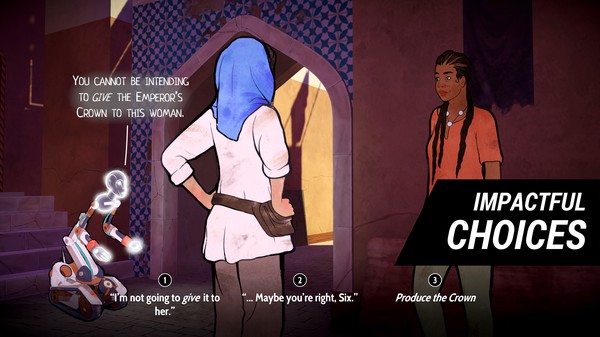
When reviewers talk about the story, the tone heats up. The chemistry between archaeologist Aliya and her robot Six, the branching that remembers choices, the slow excavation of a 5,000-year-old secret. 'Rarely a duo with this much chemistry,' 'peeling back the layers of history one at a time.' inkle's ink engine — the one behind 80 Days — keeps remembering what you do and reshuffling the thread.
But the story draws complaints too: 'choices don't really change the ending,' 'branching that lands in the same place.' A fair number found the late choices weightless, or never warmed to the cast. Even critics who adored the worldbuilding noted it can feel 'cold as drama.'
In Puzzlebyrinth's terms this is a question of narrative observation resolution. inkle's design records what you found and in what order, but that difference often never surfaces as something you can feel. Branch below the grain the player can perceive and a choice becomes 'present but invisible.' Where the leaner Chants of Sennaar minimised its story, this game thickened it — and carries the weight that brings.
 Sailing the rivers of space — Steam store
Putting the Mechanics into Words
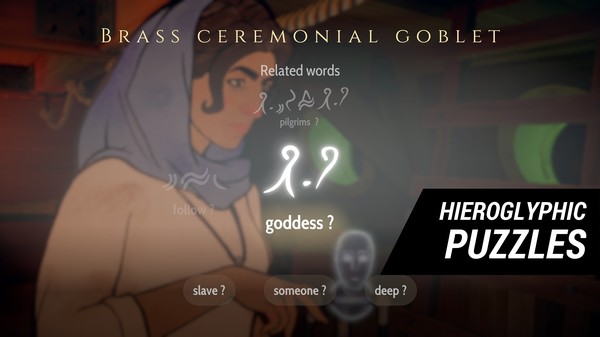
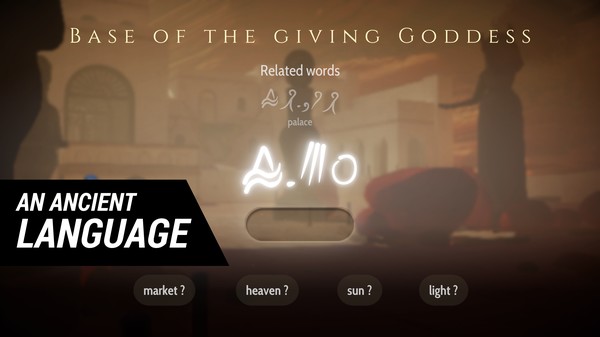
The heart of the game is deciphering an ancient script. Faced with a string of unknown glyphs on an artefact, you pick candidate words from context and build the vocabulary up by plausibility. The positive reviews keep saying it makes them 'feel like a genius,' call it 'the best implementation in 35 years of gaming.' One praises the touch: 'enough freedom, while gently nudging you toward the answer.'
The same system reads in reverse on the negative side: 'no penalty for being wrong, no need to think,' 'the language puzzle is a waste of time.' Because a mistranslation never breaks the story and lets you proceed, there's no puzzle tension — and a few critics dismissed it as 'playing at linguistics.'
This isn't a flaw; it's a choice. The game subtracts failure from decoding. Nothing stops you when you're wrong; instead a later artefact quietly destabilises an earlier reading and you update your own grammar. It's built not as a pass/fail puzzle but as a learning curve that raises observation resolution by degrees. A different philosophy from the hard cross-check of Return of the Obra Dinn — not better or worse, just aimed elsewhere.
 Reading the glyphs on an artefact — Steam store
Design Craft
On the store page the developer sells 'sailing fast-flowing rivers of space' as a marquee feature. Yet across the helpful reviews, that sailing is the single most disliked element — 'you just trace the riverbed,' 'there's no quick travel.' A post-launch update added fast travel, and reviewers who started afterward say the movement barely bothered them. The verdict already moved once, via a patch.
It's striking, then, that the last 30 days have slipped to Mixed. The movement friction should be lower, yet new reviews press a different point — the invisibility of the branching, the length. When the first complaint is solved and a second steps forward, it usually means the foundation is sound.
The gap between a developer's self-description and what players feel is a good critical handle. inkle designed the sailing as a line to savour the world; many players lived it as waiting time between decodes. The same traversal is both an atmosphere device and a wall of busywork. That's less a failure than the reach of a design that put mood first.
 Exploring a forgotten ruin — Steam store
Sources
This piece was written by reading the user reviews on the Steam store page and the press reviews as of 2026-06-21. No review text is quoted directly; typical claims are reconstructed.
・Steam: Heaven's Vault (Overall Very Positive, 85% of 1,925; 2,447 total. Last 30 days Mixed, 60% of 40. 2026-06-21 snapshot)
・Helpful positive and negative plus recent user reviews, and press reviews (PC Gamer 88, USgamer 70, GameCritics 70, Screen Rant 50, Edge 80, and others)
・(ref) Metacritic: Heaven's Vault (Metascore 76 / User 6.9)
Closing
Steam reads 85% positive; my score as design criticism is 7.5. After all the reading, the work feels less monolithic than 85% suggests. The novelty of decoding, and the hand that dissolves it into story, are achievements there's no docking points for.
Two deductions. First, subtracting failure from the decode leaves the puzzle itself short on bite. Second, the slow traversal chosen for mood turns, for some, into busywork. Neither is a flaw; both are choices — which is exactly why this isn't a game for everyone.
It suits the player who can savour the act of an unknown language slowly taking on meaning, more than the one chasing efficiency or resistance. The recent reviews split not because the game changed, but because the right and wrong audiences keep meeting it on the same shelf. I wouldn't recommend it outside its reach; inside it, there's nothing quite like it.
 An unknown language slowly taking on meaning — Steam store
Where are you with this game?
Press one and the game goes on your shelf. You can see it on your account page.
Reactions (no login)
Anonymous • one of each per visitor per day
Read next
Related reviews
Eliza
A visual novel about a woman who returns to work as the human voice of an AI counseling app, reading its scripted lines aloud to clients. Written by Matthew Seiji Burns and made by Zachtronics, the studio behind Opus Magnum, it ships with a kabufuda solitaire game on the side.
Trüberbrook
A point-and-click adventure in which Hans Tannhauser, an American physicist who has won a trip to a remote West German village in 1967, chases a stolen physics paper and walks into a story about another dimension. Made by the German studio btf, with sets built as real miniatures and photographed.
Unheard - Voices of Crime
A deduction adventure played over a top-down floor plan: you move between rooms and scrub a recording of the day back and forth, listening. There are no subtitles — you name the figures and answer the case questions using only what you heard. From NExT Studios.


