REVIEW · 2018-08-23
7 Billion Humans
A parallel-programming puzzle that runs a crowd at once
First Impressions
Line up the helpful positive reviews and the words rhyme: a-ha, variety, and 'it tickles the brain.' Most welcome it as a sequel to Human Resource Machine and cheerfully note that the plot makes even less sense this time — and that they love it for exactly that.
The qualified positives and the negatives reach for other words: esoteric, opaque, clunky, and 'the drag-and-drop is a pain.' Even reviewers who adore the game flag the friction of placing commands. Steam sits at 93% positive across 1,839 reviews (snapshot 2026-07-08), 'Very Positive' — yet praise and gripes split along a clean line.
What interests me is how often both sides point at the same thing. One reviewer's 'it makes you think' is another's 'unfair.' My job isn't to stage that as a fight but to translate where the opinions fork into design terms.
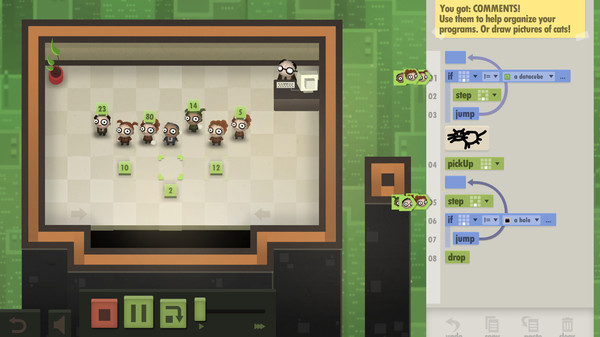 Key art for 7 Billion Humans — Steam store
Putting the Mechanics into Words
The recurring positive note is the pleasure of 'thinking like a computer.' Each worker knows only its neighboring tiles and the nearest object, and everyone in the room runs the exact same instruction list. Press coverage agreed the tasks — line up cubes, feed a shredder — feel concrete rather than abstract, more tangible than sorting a string.
In Puzzlebyrinth's terms, the predecessor's subtraction of verbs now carries a new grammar: one shared program executed by N bodies. The design question shifts from 'which verb to add' to 'what single procedure survives every starting position.' More workers means combinatorial blow-up, and folding that blow-up into one piece of code is where the joy lives.
The negative side keeps calling the language half-finished: assembly-like low-level commands mixed with high-level ones like pathfind, but no while, for, functions, or types. One reviewer notes there's 'no learning once you build a while-loop for the twelfth time.' To me this is a missing landing on the learning curve — the middle rung between basics and mastery.
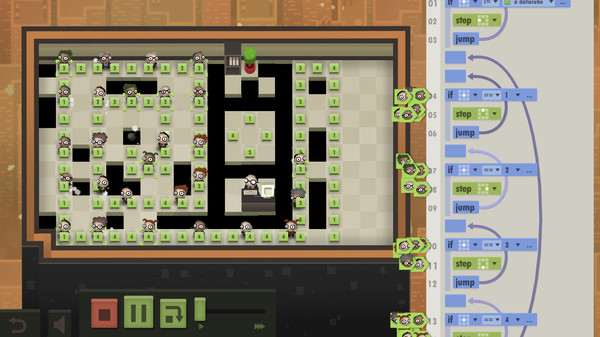 One shared instruction list, run by everyone at once — Steam store
Feel of the Controls
The most repeated complaint isn't difficulty or the puzzle of parallelism — it's the friction of authoring commands. No hotkeys, five clicks for a single if, no partial copy-paste (all or nothing), and debugging a long program described as 'hunting one coin across ten blocks of New York.' Even fans of the first game say dragging gets unwieldy as code grows and ask for a zoom-out view.
Translated into design terms, the UI itself blocks observation resolution. The logic is clear in your head, but the bandwidth to transcribe it into code is narrow. The focus slides from 'can you solve it' to 'can you type it out,' and when puzzle difficulty becomes transcription difficulty, the a-ha gets eaten by friction.
Notably, recent reviews (2025-2026) raise the same control gripes verbatim. No update seems to have widened that bandwidth, so the friction is a fixed property of the work, not a bug you outlast. This is one of the rare points where nearly everyone complains in the same direction.
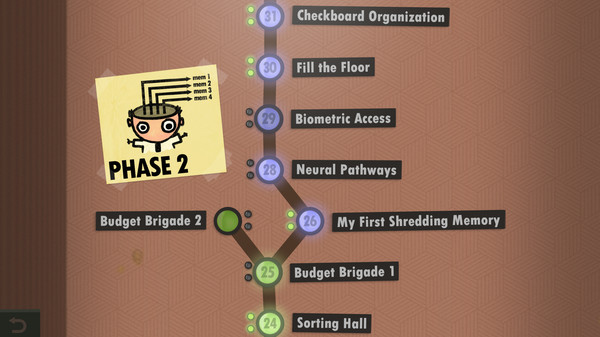 Commands are built one at a time by drag-and-drop — Steam store
The Texture of Difficulty
Opinions on difficulty split cleanly. One parent says a six-year-old enjoys the early levels; the optional speed and size challenges get called 'unfair' and 'chaos.' One reviewer who finished all of TIS-100 couldn't face these; another calls it 'frustrating rather than challenging.' A review cites a sub-5% completion rate as of 2020.
Gather the places players stall and the difficulty sorts into three kinds: transcription friction on the basic levels, the unfairness of the speed challenges (per-command timings are undocumented, so synchronization is guesswork), and the pure optimization of the size challenges. The positive a-ha lands mostly on the third; the negative frustration on the first two.
So the difficulty owes more to transcription and an opaque execution model than to the logic itself. On that basis I rate it Hard (4/5) — not because the logic outclasses the predecessor, but because the path to a confirmed answer is murky. This is where the design's intended audience shows most clearly.
 The speed and size optimization challenges divide opinion — Steam store
Place in the Lineage
The negative reviews land on nearly identical advice: 'play Human Resource Machine first,' and 'play the well-documented Zachtronics games (TIS-100 and friends).' One sums it up as 'decent concept, annoying execution'; another says the tasks feel 'more like factory conveyor automation than algorithms.' The lineage question is one the reviews already argue for you.
In design terms it stands between the predecessor's single-worker pure assembly and the manual-in-the-box thoroughness of the Zachlikes. Its signature is the physicality of parallelism — workers as bodies on a grid, run at once. That physicality also pulls the tasks toward bundles of if-then-else rather than true concurrency, which fuels the 'automation, not algorithms' critique.
Yet the physicality is exactly what the positive side values. Visible, trackable parallelism is something the abstract Zachlikes don't offer, and for the readers it suits, nothing substitutes. This is a game judged less by which shelf it sits on than by whose shelf it reaches.
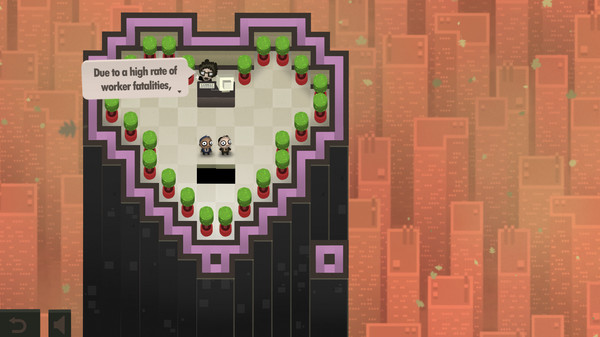 A parallel puzzle standing between its predecessor and the Zachlikes — Steam store
Sources
This piece was written by reading the user reviews on the Steam store page as of 2026-07-08. No review text is quoted directly; typical claims are reconstructed.
- Steam: 7 Billion Humans (Very Positive, 93% of 1,839 overall reviews; 2,117 total)
- Read via WebFetch: the top helpful positive, negative, and recent reviews (positive / negative)
- Press: Destructoid review (7.5/10)
Closing
Read across the reviews and you see a game with a clear intended audience. Almost everyone grants the fun of 'thinking like a computer' and the Tomorrow Corporation polish — music, art, and dry, funny writing. It lands for players who want to track parallelism with their eyes; it doesn't for those who can't stand transcription friction and an opaque execution model.
Against Steam's 93% positive, I give it 7.5 on design grounds. That's not a contradiction: the Steam figure is a vote on 'would you recommend,' while I'm grading design completeness. The concept is sharp and the presentation strong, but the narrow authoring bandwidth and the half-finished grammar — a learning curve missing its middle rung — shave the a-ha down. The score reflects that subtraction.
In short, a sharp core in a slightly rough vessel. If you've come through Human Resource Machine and still want visible parallelism, it's worth it even knowing the roughness. Until that appeal is clear, start with the predecessor.
 A sharp core in a slightly rough vessel — Steam store
Where are you with this game?
Press one and the game goes on your shelf. You can see it on your account page.
Reactions (no login)
Anonymous • one of each per visitor per day
Read next
Related reviews
Human Resource Machine
A puzzle game where you feed a dozen commands to a tiny office worker between an inbox and an outbox, building 'programs' from sorts to multiplication to prime factorization. From World of Goo's Tomorrow Corporation, it hands you assembly-style thinking via drag-and-drop.
EXAPUNKS
A hacking puzzler set in a 1997 cyberpunk world: you write pseudo-assembly for tiny programs called EXAs and send them through the networks of banks and universities. With a printable underground zine as its manual, it pulls bottomless depth from a few verbs — a Zachtronics game.
Into the Breach
A top-down tactical puzzle: three mechs on an 8×8 grid, every enemy attack for the coming turn shown to you in advance, and a city to keep standing. Subset Games, makers of FTL, stripped almost all randomness out of the combat itself.


