REVIEW · 2017-10-18
Tametsi
Minesweeper with the Luck Removed, Logic by Hand
Introduction
Hidden mines on a board of tiles; you flag them using only the adjacency clues each tile shows. It is Minesweeper with the luck (RNG) removed, replaced by 100 hand-designed levels plus 60 extras. Made and released by Grip Top Games in October 2017. No music, Windows only.
I write this from the Steam review pool. The label is 'Overwhelmingly Positive,' 96% of 1,366 reviews positive, only 43 negative (snapshot 2026-06-26). Press scores are scarce; almost the entire verdict is built from players' voices.
And positive and negative stare at the same spot. The recurring praise is "no guessing, no luck." The sharpest complaint is an objection to that very promise — that pure logic solves every level. One side calls the feature a virtue, the other false advertising. I read the game from that single point.
 Tametsi — Steam store
First Impressions
The top helpful positives all draw the same line: "this is not Minesweeper." One calls it "non-Cartesian Minesweeper," another writes "0% luck, 100% logic." What they share is relief — the relief of never losing to chance — stated first, before anything else.
In Puzzlebyrinth's vocabulary this is a first impression of subtraction. From a base everyone knows, one element — random generation — is removed. What remains is a guarantee: every board is uniquely solvable. That guarantee is what the relief points at.
The negative side's opening line, meanwhile, is "buy Hexcells instead." It is constantly placed beside Hexcells Infinite, sometimes as a derivative. Even at first glance the game does not stand alone; it sits inside a coordinate system of existing logic puzzles.
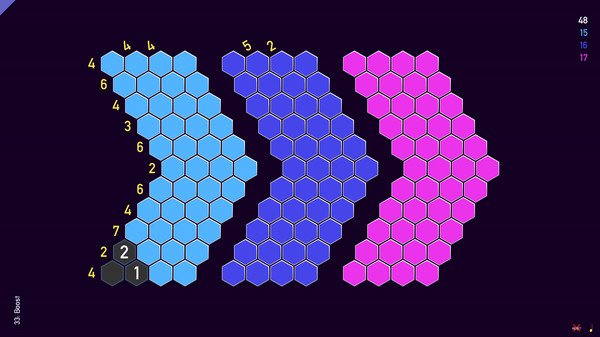 A board with non-square tilings — Steam store
Putting the Mechanics into Words
When positives describe the mechanics, three extensions always appear: row/column totals, colour-coded regions, and non-square tilings (the "rho" sets). Onto Minesweeper's single grammar — "the count of neighbours" — other clue systems are layered. "Varied" is the word for that stacking.
The split lives in one place: the definition of adjacency. The representative complaint is that whether corner-touching cells count as neighbours is arbitrary per level, breaking consistent deduction and the visual intuition built in Minesweeper. The sharpest review goes further: some boards have two valid states, so logic alone can't decide — "false advertising."
Yet from the positive side, a per-level adjacency rule is not a flaw but a device that forces you to re-read the grammar each time. You can't carry the last board's intuition forward — which keeps raising your observation resolution. The same spec reads as "intuition betrayed" or "intuition retired."
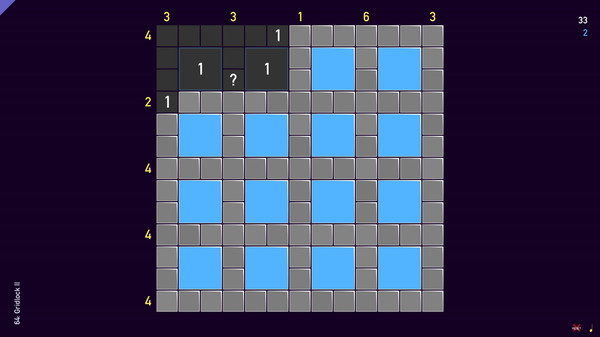 Row/column totals and colour clues — Steam store
Place in the Lineage
Lay the reviews side by side and the game is triangulated by three predecessors: Minesweeper (luck removed), Sudoku (a guaranteed unique solution), and Hexcells (the minimalist logic-puzzle dress). Positives call it "the best of all three"; negatives call it "a lesser Hexcells."
Tellingly, recent negatives bring a new coordinate: "these days I'd recommend 14 Minesweeper Variants." A design fresh in 2017 now sits next to later siblings — time adding an axis to the verdict, which a meta-reading can't ignore.
To me the signature is simply "hand-built." Where rivals compete on breadth of generation or rule variants, Tametsi has a person assembling 100-plus boards one at a time. The "it feels like a curriculum" reviewers report is a learning curve no random generator can make — kin to the rule-discovery of Understand.
 A level using coloured region clues — Steam store
The Texture of Difficulty
On difficulty, the positives themselves write "it breaks you," "vicious." Completion times of 240 or even 818 hours are not rare. Players report the first ~50 boards solve cleanly, then combinatorial explosion sets in and a single deduction can take ten-plus minutes. That is the "wall."
The quality of the difficulty splits three ways: raw step count (wide boards, long chains), compound grammar (colour, totals, adjacency at once), and the "rule ambiguity" the negatives stab at. The first two are designed hard; the third is where an author's choice can backfire, and the fault line runs through it.
One more recurring friction is the "no-mistake" mark: hit a mine once and the perfect-clear badge is gone — you can undo and finish, but a reset is needed to earn it. One misclick on a twenty-minute board erases it. I wrote about showing failure in Legible Failure; here the weight of the penalty breeds both tension and irritation.
 A large board with long chains of deduction — Steam store
Sources
This piece was written by reading the user reviews on the Steam store page as of 2026-06-26. No review text is quoted directly; typical claims are reconstructed.
- Steam: Tametsi (Overwhelmingly Positive, 96% of 1,366 reviews, 43 negative)
- Read via WebFetch / official API: the top ~10 helpful positives, top 5 negatives, and several recent reviews
- Developer, release date, level count, and the "guessing is never required" claim confirmed on the Steam store page
Closing
I don't convert Steam's 96% straight into 8.5. The aggregate measures "did buyers regret it"; design criticism measures "which choices landed and which backfired." Subtraction (luck removed) and the hand-built curve clearly land. The per-level wobble in adjacency and the heavy no-mistake penalty shave half a point to a point. Hence 8.5.
As a question of range: it cuts deep for people who enjoy re-reading the grammar each time, and misfires for those who want to reuse built intuition. Most negatives read less as the game failing than as honest reports from outside that range — even "false advertising" looks like the flip side of taking the promise literally.
To close: reported completion times stretch from ~40 to 200-plus hours, because people stall in different places. For $2.99 it offers bottomless time built from pure logic alone — and on that one point it's a solid recommendation for deduction fans. A game that trusted, to the end, what remains once luck is gone.
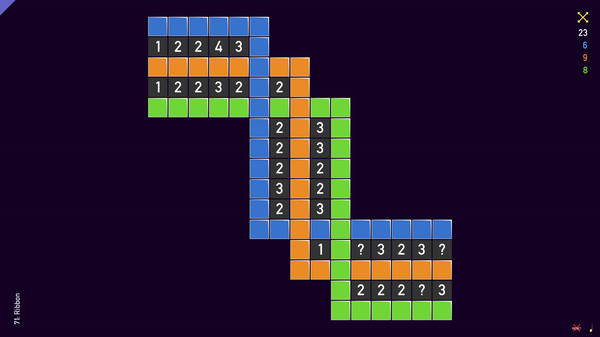 A fully cleared board — Steam store
Where are you with this game?
Press one and the game goes on your shelf. You can see it on your account page.
Reactions (no login)
Anonymous • one of each per visitor per day
Read next
Related reviews
MHRD
A text-only puzzle game that starts you with a single NAND gate and has you write hardware in a small description language: ANDs, adders, and finally the design of a working CPU. You play a new hire at a fictional company called Microhard, filling twenty-odd specifications in order. Made by Funghisoft.
Silicon Zeroes
An open-ended puzzle set in a 1960s Silicon Valley startup, where you wire simple parts — adders, multiplexers, latches — into a working CPU with instruction decoding and pipelining. From PleasingFungus Games, maker of Manufactoria, a CPU-design game that hides the bits and shows only how the parts behave.
SquareCells
A tiny logic puzzle that crosses Picross with Minesweeper: fill or break each square in a hidden grid using only the surrounding clues, where a number in a cell tells you how many cells it connects to. No guessing — every solution is reachable by pure deduction. By Matthew Brown, creator of Hexcells.


