REVIEW · 2014-09-01
Hexcells Infinite
On Designing the Guess Away
Introduction
Find the hidden blue cells on a hexagonal grid using only numeric clues, one deduction at a time — a distant relative of Minesweeper. Released in September 2014 by Matthew Brown, reportedly a British indie developer, this third entry in the series adds an endless puzzle generator and 8-digit shareable seeds on top of 36 hand-made boards. The store calls it an 'ambient logic puzzle game.'
I write this not as a player but as a reader of the Steam review pool. The label is 'Overwhelmingly Positive': 97% of 2,522 English reviews are positive (4,076 across all languages, 2026-06-22 snapshot), and all 11 reviews in the last 30 days are positive. The number has barely moved in over a decade.
By the numbers it looks unanimous. But sort the bodies and the many compliments and the few complaints point at the same word — 'guessing' — from opposite sides. The majority praise 'zero luck'; a minority insist they 'had to guess in the end.' That small disagreement is the doorway into the design.
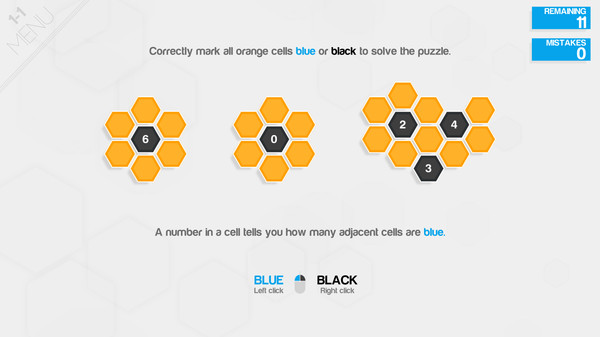 A pared-down screen: numbers on a 2D hex lattice — Steam store
First Impressions
Sort the positive reviews by helpfulness and the opening line is almost fixed: 'Minesweeper but better,' 'no luck involved,' 'always solvable with logic alone.' Layered on top are notes about relaxation, the ambient soundtrack, and addictiveness. One reviewer calls it 'what happens when Minesweeper and Picross have a drunken affair'; another likes that 'a misclick never kills you.'
What strikes me is that the praise centers on what was removed, not what was added. The recurring 'no luck' is, in Puzzlebyrinth's terms, an act of subtraction — applause for the decision to strip out the last bit of chance Minesweeper still carried (the corner 50:50). The pleasant first impression grows from an absence, not an ornament.
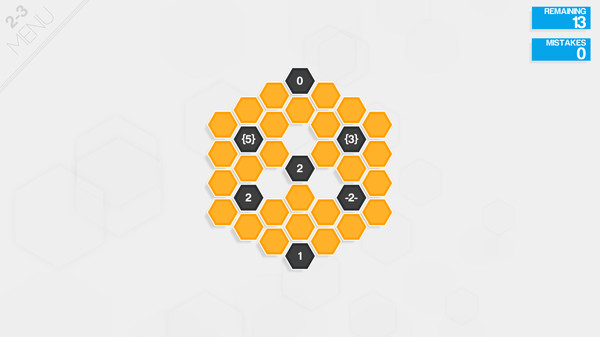 Each click adds a note as the board quietly clears — Steam store
Putting the Mechanics into Words
Reviewers describe the rules with remarkable uniformity: a number for how many adjacent cells are blue, Picross-style edge totals for a whole line, and special markers like {2} for 'consecutive' and -2- for 'non-consecutive.' Many compress it into a three-way pitch: 'Minesweeper x Picross x Sudoku.'
In design terms the game has only two verbs — reveal a cell, flag it as blue. The reason it never runs dry is not the verb count but the depth of its grammar. The moment adjacency clues, line totals and consecutive/non-consecutive markers intersect on one board, the casework explodes. It does on a numeric grid what The Witness and Taiji did on line-drawn panels.
When a negative review dismisses it as 'Minesweeper Jr,' it sees the thin verb set and misses the grammar. When a positive review says it 'works your brain harder than Sudoku,' it feels the combinatorial blow-up the grammar produces. The same board looks like two different games at two different resolutions of observation.
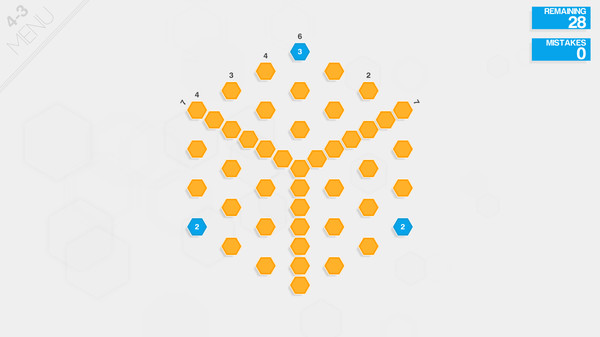 Few verbs, deep grammar — the more markers overlap, the more reading it takes — Steam store
Design Craft
The 'guessing' debate is all but settled on the community boards. The generator starts from a finished solution and adds clues until the board is uniquely solvable — so in principle every board yields to logic alone. Every seed ever reported as 'unsolvable' has turned out to be solvable. The majority's 'zero luck' correctly names a design fact.
So is the minority's 'I was forced to guess' a lie? No — what they slipped on was not the board but their own resolution of observation. The needed clue is always somewhere on the grid; their gaze just didn't reach it. The stall is an oversight, not an injustice — a miss inside the design's reach mistaken for a flaw outside it. It is the question of where information sits and how the eye is led, which I touched on in one-screen puzzle design.
Still, the unique-solution guarantee has a price. One top helpful review calls the 36 hand-made boards 'a one-on-one with the designer' and the generated ones 'cold and uninviting.' The generator tends to over-supply clues, thinning the difficulty. Endless replayability traded for the designer's body heat — that exchange is the largest cost this craft pays.
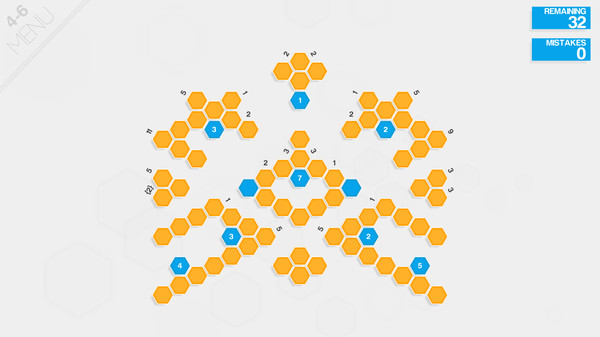 36 hand-made boards and an endless generator run at different temperatures — Steam store
The Texture of Difficulty
On difficulty the praise splits cleanly. Some write 'it melts your brain' and 'tougher than the earlier games'; just as many say 'once it clicks there's no bite left' and 'unlimited mistakes drain the tension.' The blog Choicest Games scored it 8/10 while honestly admitting a few late boards were 'too hard for me.'
I'd sort that split into three textures of difficulty: reading the grammar of the special markers; the clerical load of managing a huge board; and — a recurring complaint — the pressure of the 'gates' that lock later boards behind efficient solving. Which one you meet decides whether the same game feels like 'bite,' 'busywork,' or 'unfairness.'
So the difficulty is not one steep slope but three different gradients overlaid. Those who find the curve gentle are climbing the grammar slope with ease; those who find it steep are caught on the gating slope. The disagreement is not about player skill but about which slope you hit first.
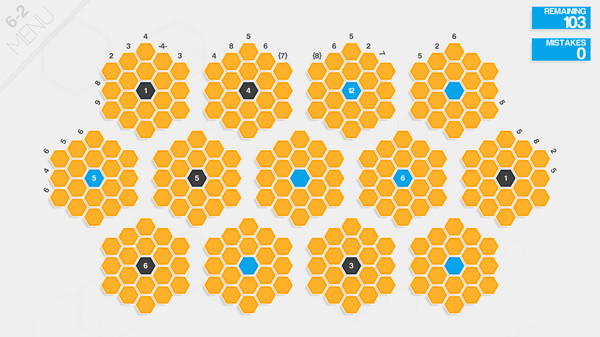 As boards grow, difficulty shifts from thinking to bookkeeping — Steam store
Sources
This piece was written by reading the user reviews on the Steam store page as of 2026-06-22. No review text is quoted directly; typical claims are reconstructed.
- Steam: Hexcells Infinite (Overwhelmingly Positive, 97% of 2,522 English reviews; 4,076 across all languages; recent 100% of 11)
- Read via WebFetch: top helpful positive reviews, representative negative/low reviews, several recent reviews, plus community threads on whether guessing is required and a no-mistake walkthrough guide
- Press: Rock Paper Shotgun's review and Choicest Games (8/10)
Closing
Reading across the pool, what emerges is that Hexcells Infinite carries a single design idea — subtract all luck, leave only logic — to an almost excessive extreme. The overwhelming praise is a vote for that cleanness. The few complaints are not the idea breaking but observation slipping at the edge of the line the idea drew.
Steam's overall sits at 97%; from a design standpoint I give it 8.5. The gap is the scarcity of upside: the unique-solution guarantee is beautiful but narrow, and the endless generator secures quantity at the cost of the designer's warmth. Reviews put the 36 hand-made boards at roughly 3 hours, with the infinite mode pushing some players past 10–30 hours. Because difficulty genuinely splits by player, I've kept the rating in the middle.
Even so, as a logic puzzle that shaves off the last sliver of luck, it remains a reference point for the genre. Depth made by removing elements rather than adding ornament — as a textbook case of that, I want this one kept where I can reach it.
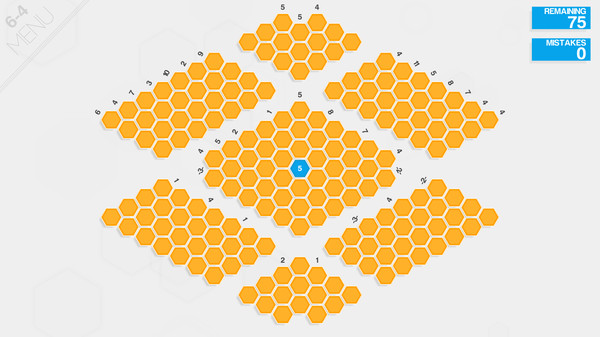 What remains once luck is subtracted away: pure logic — Steam store
Where are you with this game?
Press one and the game goes on your shelf. You can see it on your account page.
Reactions (no login)
Anonymous • one of each per visitor per day
Read next
Related reviews
SquareCells
A tiny logic puzzle that crosses Picross with Minesweeper: fill or break each square in a hidden grid using only the surrounding clues, where a number in a cell tells you how many cells it connects to. No guessing — every solution is reachable by pure deduction. By Matthew Brown, creator of Hexcells.
Cypher
A first-person puzzle game about cryptography. You walk white exhibition rooms and decode the ciphertexts hung on their walls, from simple substitution through polyalphabetic ciphers to machine ciphers. A solo work by Matthew Brown of the Hexcells trilogy, and it assumes you have paper and a pencil.
LYNE
A minimalist logic puzzle: join same-coloured shapes with a single non-crossing line and fill every tile on the board. From octagonal crossing tiles and lines fighting over space, solo developer Thomas Bowker draws bottomless difficulty out of almost nothing — 650 handcrafted puzzles plus an infinite daily generator.


