REVIEW · 2015-07-20
TIS-100
A parallel programming puzzle cut down to the barest instruction set
Introduction
TIS-100 is an assembly-language programming puzzle: you rewrite corrupted code across a grid of tiny parallel nodes to repair a broken machine. Zachtronics, makers of SpaceChem and Infinifactory, shipped it in 2015. Its own tagline calls it 'the assembly language programming game you never asked for.'
I am writing this not as a play diary but by reading the Steam review pool. English reviews sit at 97% positive of 2,537, with 3,334 across all languages, rated Overwhelmingly Positive (2026-07-07 snapshot). On the numbers alone, it looks like a near-unanimous classic.
Yet as you read on, praise and warnings converge on the same point: 'this isn't for everyone.' How can a 97% rating and a chorus of 'not for everyone' coexist? That coexistence is what I want to read out here.
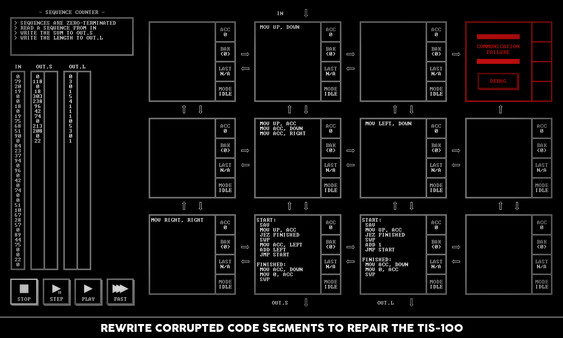 TIS-100, a programming puzzle about repairing corrupted segments — Steam store
First Impressions
The review pool's opening notes are short. Top positives read 'my favourite Zachtronics game' and 'it actually makes you a better programmer.' Press (Diabolical Plots) is blunt about the look: 'visuals basically nonexistent, almost no audio, just text and coloured bars.' The absence of decoration is everyone's first impression.
What is telling is that the positive side never lists this bareness as a flaw. With nothing to look at but your own code and the node states, reviewers keep saying they can 'focus' or 'play with the sound off.' That praise is the scarcity of information turned inside out.
In my vocabulary this is a first impression of thorough subtraction. Where many puzzlers spend their opening on atmosphere, TIS-100 narrows the object of attention to computation itself from the first screen. The plainness is a design choice for raising observation resolution.
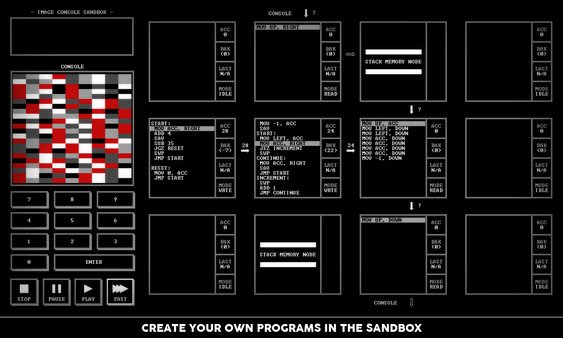 All that is on screen is a grid of text and register values — Steam store
Putting the Mechanics into Words
Reconstructing the core from reviewers' words: the board is a grid of small nodes. Each holds two registers (ACC and BAK) and barely a dozen lines of instructions, drawn from a handful of verbs — MOV, ADD, SUB, JMP, SWP. The recurring praise is that 'the instruction set is small and beautiful.'
What turns that smallness into difficulty is that node-to-node transfers are synchronous. As the press explains, a node handing a value to its neighbour waits forever until the neighbour takes it; two nodes sending to each other deadlock. Few registers plus this blocking make the whole board one parallel machine.
The praise that 'there are only a few verbs' is exactly what Puzzlebyrinth calls subtraction of verbs. Put few verbs on the grammar of nodes and blocking, and combinatorial explosion appears. Where SHENZHEN I/O pushes with richness, TIS-100 finds depth by cutting the vocabulary to the bone.
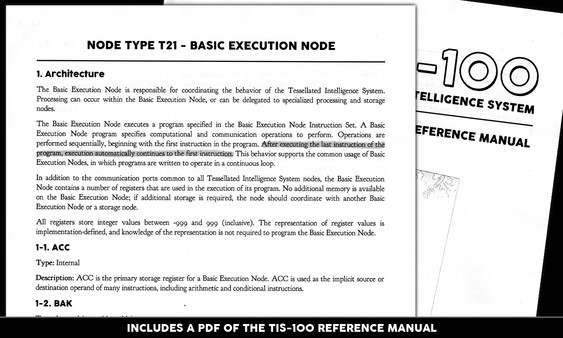 Each node holds two registers and about a dozen instructions — Steam store
Place in the Lineage
The most frequent proper nouns in the pool are not a genre or a developer — they are other Zachtronics games. In the advice threads, veterans agree that 'TIS-100 is plainer and ramps up more steeply than Opus Magnum or Infinifactory' and that 'SHENZHEN I/O is far gentler.' Most users frame it as one point in a lineage.
The placement is clear. Where Opus Magnum widened the door with spectacle and satisfying machinery, TIS-100 is the studio's most extreme act of subtraction. That its rating barely differs suggests it reaches a narrow, deep audience on purpose.
In the lineage, TIS-100 is not the entry point but the destination — where players who sharpened their observation resolution elsewhere come to taste scarcity itself. Reviewers who say 'start with another Zachtronics first' understand that placement in their bones.
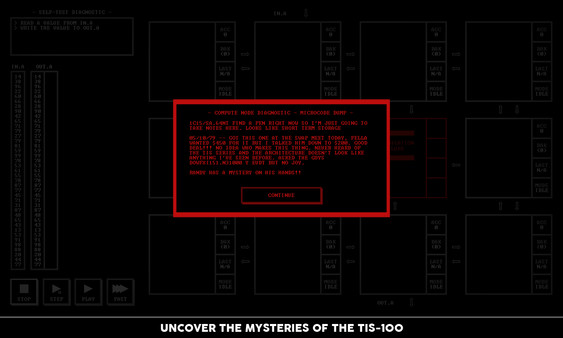 Within the studio's catalogue, the most extreme act of subtraction — Steam store
The Texture of Difficulty
Negatives, and cautious positives, point at the same thing: the height of the entrance. 'You must read a dozen-plus pages of manual (some say 27) before you can start.' 'Most people bounce off around the first three puzzles.' Press agrees it is 'hard even for an experienced engineer, and far harder for a non-programmer.'
Yet the positive side reads that same steepness as a virtue. They point to the three leaderboards per puzzle — cycles, instructions, nodes. One writes that 'out-optimising your friends list will keep you busy for years.' After a solve, the search for a better solution begins, and combinatorial explosion flips into pleasure.
The texture of difficulty splits in two: a steep entrance (the manual and first puzzles — the learning curve) and a bottomless exit (the optimisation leaderboards). People leave at the first and settle at the second. Reported playtimes swing from 11 hours to over 50. The 97% carries the tint of survivorship — only those past the entrance write reviews. That is not a flaw; it is the reach of the design.
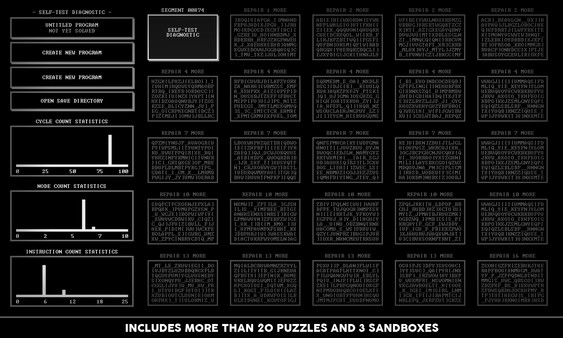 Three leaderboards — cycles, instructions, nodes — open a bottomless depth — Steam store
Sources
This piece was written by reading the user reviews and community discussions on the Steam store page as of 2026-07-07. No review text is quoted directly; typical claims are reconstructed.
- Steam: TIS-100 (Overwhelmingly Positive, 97% of 2,537 English reviews, 3,334 across all languages)
- Read via WebFetch: helpful and recent positive reviews, representative negative complaints, and the official discussion 'unsure if this game is for me'
Closing
What is left after reading is the discovery that 97% and 'not for everyone' do not contradict. They are two faces of one design. Cut the vocabulary, cut the decoration, cut the hand-holding — that subtraction narrows who it reaches and deepens the cut for those it does. The pool testifies to that clarity of reach from both sides.
Against Steam's 97% overall, from a design-critique stance I give it 8.5. The purity of the instruction set and the bottomless optimisation are near perfect. What I hold back is the way it treats its steep entrance as simply 'the way it is' — consistent as a philosophy, but there was room to widen the reach.
So the recommendation narrows to one line: for anyone who wants to peer into bottomless depth using only a few verbs and the grammar of waiting. Sharpen your observation resolution on Opus Magnum first, and TIS-100's subtraction lands even harder.
Peering into bottomless depth with only a few verbs — TIS-100 — Steam store
Where are you with this game?
Press one and the game goes on your shelf. You can see it on your account page.
Reactions (no login)
Anonymous • one of each per visitor per day
Read next
Related reviews
Infinifactory
A first-person 3D puzzle where you build factories from blocks and conveyors to assemble whatever your alien captors order. SpaceChem made three-dimensional: a tiny verb set opening onto bottomless optimisation, from Zachtronics.
SHENZHEN I/O
A programming puzzle in which you play an engineer at a fictional Shenzhen firm, writing terse assembly for cramped virtual microcontrollers and wiring circuits onto a board to build client products. Zachtronics ships no tutorial — its 30-plus-page datasheet manual is the first puzzle.
SpaceChem
A 2D puzzle where you program two 'waldos' to grab, carry, and bond atoms, building factories that turn raw molecules into products. You don't find a solution — you build one. The design-based puzzle that launched Zachtronics.


