REVIEW · 2011-03-02
SpaceChem
Reading the Steam reviews of a puzzle you build, not solve
Introduction
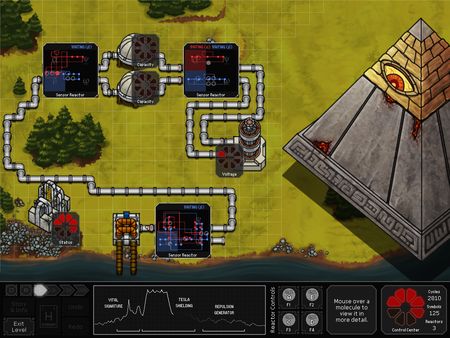
Grab an atom, carry it, rotate it, bond it — you program two little arms called 'waldos' to rebuild raw molecules into products. Made and self-published by Zachtronics in 2011, it is the starting point of what we now call the design-based puzzle.
I write this not as someone who finished it, but from the pile of Steam user reviews. The English label is 'Overwhelmingly Positive,' 95% of 1,915 reviews; 2,612 across all languages (snapshot 2026-06-21). Metacritic sits at 84.
Yet for so high a score, the reviews are anything but calm. The most frequent word is 'hard,' and it is almost always followed by 'masterpiece.' Praise and the testimony of difficulty share the same sentence — I want to read that strange handshake in design terms.
 SpaceChem — Steam store
First Impressions
Line up the helpful positive reviews and the words rhyme: elegant, 'your own solution,' 'the dance of atoms,' eureka, and 'the best puzzle game I've played.' Many praise the soundtrack and the minimal UI in the same breath, and note you need no chemistry or maths to play.
The caveats and negatives keep returning to: hard, tedious, grind, and 'I'd honestly rather just be programming.' Late levels and boss levels run long; optimization never ends. Reviewers themselves cite a completion rate around 3-4% — proof that 'hard' is not just a figure of speech.
What interests me is that praise and complaint often point at the same thing. One reviewer's 'freedom to build your own solution' is another's 'just being made to optimize busywork.' And a 2013 review and a 2023 review barely differ. The line between who it suits and who it loses has stayed in the same place for years.
 SpaceChem — Steam store
Putting the Mechanics into Words
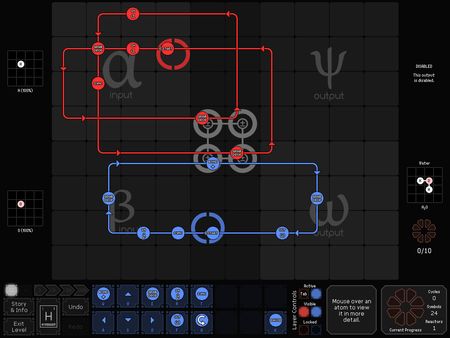
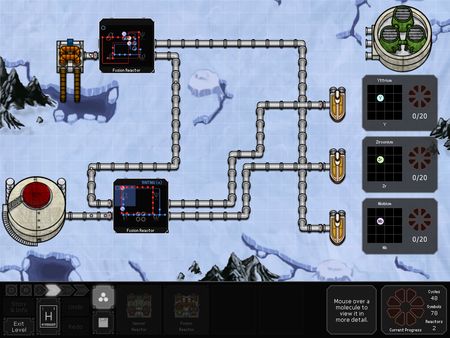
The phrase positive reviews reach for most is 'you don't find a solution, you build it.' What you're handed isn't an answer but a vocabulary of commands — grab, drop, bond, rotate, input, output — and the grammar of running two waldos at once. In Puzzlebyrinth terms, this isn't a guess-the-answer puzzle; it's writing a tiny program out of verbs.
That the two waldos run concurrently is what fixes the grammar. One carries while the other bonds, and the timing breeds its own hazards: collisions, waiting, deadlock. When reviewers say they 'simulate the atoms in their head' or 'jumped out of bed with a solution,' that is the parallel machine running in their minds.
The sharpest fork is over the nature of a solution. A negative review says 'there is one right answer, then it's optimal or not'; a long positive says 'no two people build the same one.' Both are right. The pass test is binary — does the target molecule come out — but the machine that gets there takes countless shapes, ranked along cycles, symbols, and area. One reads the pass layer; the other reads the design layer.
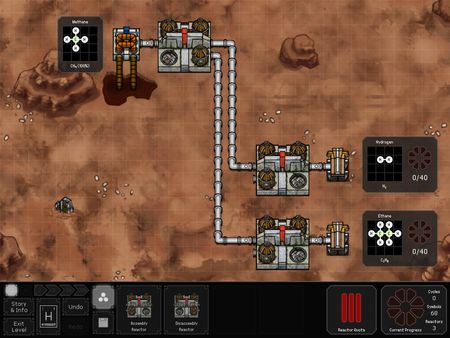 Two waldos move atoms through a reactor — Steam store
The Texture of Difficulty
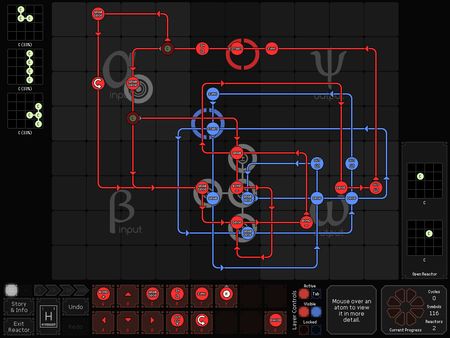
Difficulty is where opinion splits hardest — but read closely and it isn't a test of cleverness. A top review puts it plainly: 'it's hard not because you must be a genius, but because it demands enormous time and effort and is uncompromising.' Another notes there is no single eureka where the rest falls into place; you build, tear down, and rebuild inch by inch. The difficulty is engineering, not epiphany.
Here the Puzzlebyrinth vocabulary helps. Several reviewers testify the learning curve never plateaus; it climbs to the end. Two concurrent waldos hit combinatorial explosion as levels deepen, and what you debug stops being 'a puzzle' and becomes 'the machine you wrote.' Getting stuck is not missing knowledge but re-reading your own design — which is why '5-year' and '7-year' reviews exist.
And SpaceChem shows a rare thing: the Steam 'recommend' detaches from finishing. Completion sits in the low single digits, yet review after review says outright 'I never beat it' and still recommends it hard. The value arrives per level, not at the ending. The difficulty isn't a flaw but a statement of reach: anyone wanting a short, calm sit-down, or a working programmer who finds simulated programming redundant, was placed outside the line from the start.
 SpaceChem — Steam store
Design Craft
So why does so harsh a game stay 'Overwhelmingly Positive'? The reviews reveal several cushions. One is music and story: reviewers say reading the between-level narrative 'shifts the mental load elsewhere and physically relieves you,' and Evan Le Ny's soundtrack is named again and again as the accompaniment that calms the frustration. Atmosphere raises the stamina needed to endure long iteration.
Another is the optimization layered past 'pass' — cycles, symbols, area — plus leaderboards and the community ResearchNet levels. This turns 'solved' from a finish line into a doorway: 'how few cycles did your friend use?' It extends play by addition, not subtraction, and is where a reviewer's 3,000-hour record comes from. Yet even positive reviews admit the tutorials don't explain the systems well — a hard-to-defend flaw.
And the developer pre-answers the core complaint, 'I'd rather just program': this is neither a sandbox nor a real tool but a single game built on constraints, and the constraints are the point. Set beside Baba Is You, which rewrites its own rules, or The Witness, where space itself is the question, SpaceChem's signature is authoring a machine from a given vocabulary — the first blueprint for the Opus Magnum and Infinifactory lineage to come.
 SpaceChem — Steam store
Sources
This piece was written by reading the Steam store user reviews as of 2026-06-21. No review text is quoted directly; typical claims are reconstructed.
- Steam: SpaceChem (English reviews Overwhelmingly Positive, 95% of 1,915; 2,612 across all languages)
- Steam Community: top-rated reviews (read ~10 helpful positives and the negatives via WebFetch)
- Cross-checked counts, tags and release date on SteamDB (app 92800), and supplemented the difficulty / optimization / completion-rate discourse via web search (incl. Gregor Ulm's blog)
Closing
Steam's English verdict is 95% positive; my design-critique score is 8.5. The two don't diverge much, but I sit just below the near-unanimous praise on purpose, for two reasons: the learning curve never plateaus while the tutorials fail to keep up, and the reach is extremely narrow. That's less a knock on quality than an honest gauge of how sharply it picks its audience.
The reviews' conclusion is clear. For anyone who can love iteration over epiphany, authoring a machine over guessing an answer, and per-level wins over an ending, SpaceChem is probably 'the best puzzle game I've played.' For anyone wanting a short, calm sit-down, or who finds simulated programming redundant, it was never for them. A game that draws 'recommend' at a single-digit completion rate is built so its value doesn't depend on finishing — and that, I read, is why fifteen years on its score hasn't slipped.
 SpaceChem — Steam store
Where are you with this game?
Press one and the game goes on your shelf. You can see it on your account page.
Reactions (no login)
Anonymous • one of each per visitor per day
Read next
Related reviews
TIS-100
An assembly-language programming puzzle: you write code across a grid of tiny parallel nodes to repair a broken computer. Each node holds two registers and barely a dozen instructions, and passing data between nodes can deadlock — inside those constraints you compete on cycles, instructions and node count. From Zachtronics, makers of SpaceChem and Opus Magnum.
Infinifactory
A first-person 3D puzzle where you build factories from blocks and conveyors to assemble whatever your alien captors order. SpaceChem made three-dimensional: a tiny verb set opening onto bottomless optimisation, from Zachtronics.
SHENZHEN I/O
A programming puzzle in which you play an engineer at a fictional Shenzhen firm, writing terse assembly for cramped virtual microcontrollers and wiring circuits onto a board to build client products. Zachtronics ships no tutorial — its 30-plus-page datasheet manual is the first puzzle.


