REVIEW · 2019-09-16
Nauticrawl
How the review pool read a machine that comes with no manual
First Impressions
Nauticrawl arrived on September 16, 2019, developed by Spare Parts Oasis and published by Armor Games Studios. You climb into a stolen, unlabeled machine and learn to pilot it while something hunts you. Turns, not real time. No manual, no tutorial. The Steam tags read Puzzle, Simulation, Difficult.
As of my 2026-08-15 snapshot the store page shows 91% of 438 reviews positive — Very Positive — while SteamDB lists 493 across all languages. The pool is small but unusually worth reading, because the two sides do not disagree about facts. Positive and negative reviews describe what happens inside the machine in nearly the same words, then land on opposite verdicts.
The recurring positive vocabulary is 'clever', 'discovery', and some version of 'so much accomplished with so little'. Many reviews stop to praise the feel of the switches; the PC Gamer pull quote on the store page singles out the UI as well. The other pattern is how often a review opens by telling you to go in knowing nothing.
 Nauticrawl — Steam store key art
Putting the Mechanics into Words
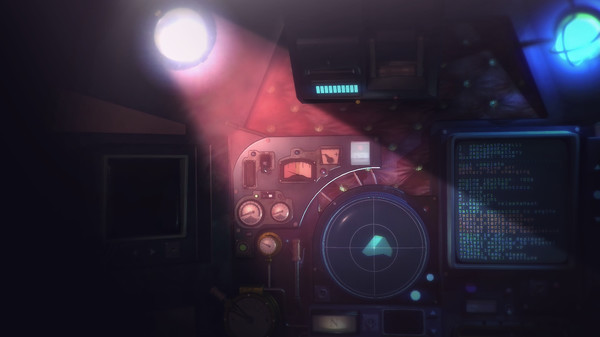
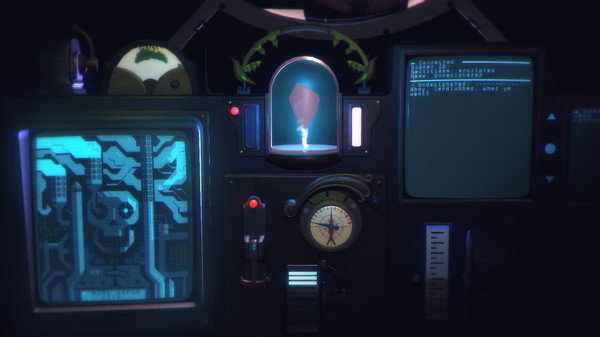
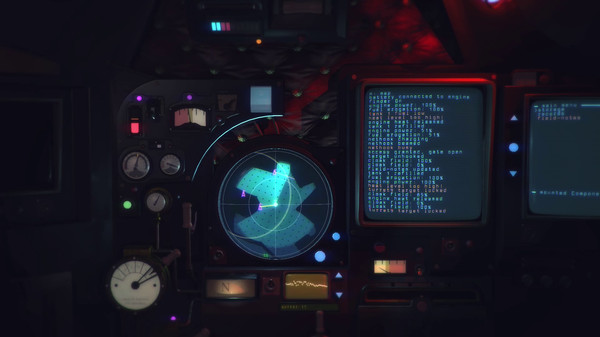
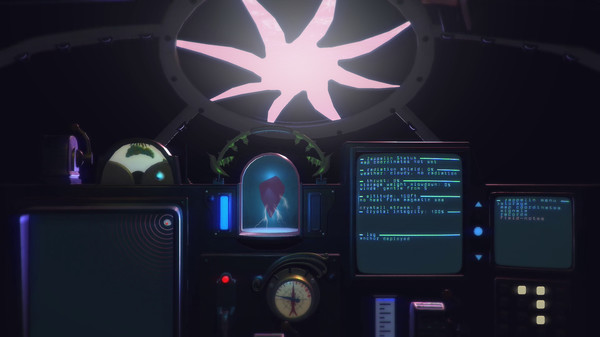
Pooling the reviewers' descriptions, the game is this: a wall of gauges and switches, none of them labeled, and no document explaining any of it. Press, pull, turn, watch, remember. Travel, exploration and trade all happen through that panel. The only verb you hold directly is 'touch'.
In Puzzlebyrinth terms, what has been subtracted here is not the number of verbs but their meanings. Every control is present from the first minute; what is withheld is the mapping between control and consequence, so the work is not acquiring verbs but naming the ones already in front of you. The shape of the task is close to Chants of Sennaar or 7 Days to End with You — except that here a misreading is answered immediately by the machine misbehaving.
The proper nouns the positive side reaches for are remarkably stable: Myst, Steel Battalion, Objects in Space. All three are games where the hardware talks more than the people do. Put differently, the resolution of observation is set on the instrument panel rather than the world; the planet outside arrives, most of the time, as a coarse image on a small monitor.
 Nauticrawl — Steam store key art
Teaching
There is no tutorial. The positive side calls this learning by doing and writes about the rush of the first time the machine obeys. One of the most-read negative reviews rejects the same decision outright: the trial and error has no logic in it, you are guessing rather than thinking. Praise and complaint are pointing at one identical design choice.
My reading is that they are standing in different stretches of the same curve. The loop runs hypothesis, action, observation — but some controls answer instantly and others answer late. A lever responds while you watch; a drain like power consumption only shows its verdict several turns downstream. Whoever meets the fast controls first calls it deduction, whoever meets the slow ones first calls it luck. As curve design, the slow-feedback variables sit too early.
The forums sharpen the seam. Faced with reports that a required structure never appeared on the finder, the developer wrote that whether it was a bug or the game failing to guide the player, it needed fixing either way — a record of a line between hiding and teaching that the author had not fully drawn either.
 Nauticrawl — Steam store key art
The Texture of Difficulty
On one point the pool agrees: the difficulty is front-loaded to an extreme. One positive review says the game becomes very easy the moment the system clicks; another concedes the challenge tapers toward the end. Gold-Plated Games, reviewing it in 2019, put it as going through the motions once the decoding is done. Almost all of the difficulty lives in the first hour.
As a texture, this is decoding difficulty with no operating difficulty behind it. Where Observation builds a second slope out of combining the controls you have learned, this machine has finished its job the moment you have learned it. The developer put the intended length at three to five hours on the forums, so the shape is deliberate — but it makes complaints about price structural rather than incidental. The headline negative calling it 'not a complete videogame' is pointing at that hollow.
There is testimony in the other direction too. A poster who reverse-engineers for a living finished after two islands and five failed runs; the developer replied that the thing is built like an actual machine, so anyone with that training will move fast. Difficulty here rests on prior knowledge rather than reflex, which is also why reported playtimes scatter from 0.9 to 21.4 hours. Finishers cluster around five or six.
 Nauticrawl — Steam store key art
Sources
This piece was written from the Steam user reviews and the official forums as of 2026-08-15. No review text is quoted verbatim; typical claims are reconstructed.
・Steam: Nauticrawl (Very Positive, 91% of 438 reviews; SteamDB lists 493 across all languages)
・Read via WebFetch: the 10 user reviews exposed on the public helpful-sorted page (7 recommended / 3 not) plus the recent listing. The total pool is small, and readable review text did not extend past that
・Supplemented with four threads from the official forums, each containing developer replies
・Gold-Plated Games review (2019); the Polygon / PC Gamer / Adventure Gamers verdicts come from the pull quotes on the store page
Closing
Against Steam's 91% I land at 7.5. The gap is not about quality but about area. On the single question of handing a player an unlabeled machine and asking them to decode it, this design is worth a nine. But the invention is doing its work for roughly the first hour, and the remaining time is spent consuming it. Sharpness of invention and the span it can hold up are better scored separately.
The reach is unusually legible. If instruments and procedure are their own reward, or if you welcome the Myst-like sensation of being left behind, this is an easy recommendation. If you buy it expecting problems to solve after the controls are learned, you land where the negative reviews land. Bought knowing it ends in five hours, it is a dense five.
What remains after reading the pool is not a fight but a question of range. Nobody is lying. The reviewer who wrote up the first hour as treasure and the reviewer who wrote up the remaining four as hollow are both reporting accurately about different stretches of the same machine. Not many games make both reports true at once.
 Nauticrawl — Steam store key art
Where are you with this game?
Press one and the game goes on your shelf. You can see it on your account page.
Reactions (no login)
Anonymous • one of each per visitor per day
Read next
Related reviews
Felix The Reaper
An isometric puzzle game in which Felix, a reaper who never stops dancing, may only walk where there is shade. You flip the sun between two positions to reshape the shadows, push and pull props to cast new ones, and arrange each mortal's fatal accident. Made by Kong Orange, narrated by Patrick Stewart.
Autonauts
An automation puzzle in which you land on an empty planet, chop and quarry by hand, and then teach robots the steps you just performed so they can do them for you. With short Scratch-style scripts and one small memory allowance per bot, you grow a production line from farming to industry. Made by Denki, in Scotland.
Wilmot's Warehouse
A 2D organisation puzzle: push the delivered goods into your warehouse and file them however you decide. No rule governs the shelves, and when the service hatch opens you retrieve orders from memory alone. By Richard Hogg and Ricky Haggett, who previously made Hohokum, with 200 kinds of pictorial tile piling up.


