REVIEW · 2019-10-17
Autonauts
The more you automate, the busier you get — inside 90% of 2,024 reviews, the split is over whether the game took work off your hands or piled more on
First Impressions
What I read is the review pool on the Steam store page for Autonauts. The store shows 90% of 2,024 reviews positive, labelled Very Positive. Recounted across all languages it becomes roughly 4,000 reviews at 86.45%, a little lower (both as of 1 September 2026). The press aggregate sits at 80, but only eight critics are in it.
The ten most helpful positive reviews say: relaxing, a calmer Factorio, a way to teach a child programming logic. Playtimes of 400 and 1,618 hours sit among them. What keeps coming back is the pleasure of watching machines work while your own hands are free.
The ten most helpful negative reviews call the same design something else. Programming with a pen and a sheet of paper. No copy function. Rebuild the whole factory every time the colonists move up a tier. What they are counting is how much manual work is left after the automating is done.
The two sides do not disagree about the facts. The bots work, the village grows. The argument is only about whether that work took labour off the player's hands or added to it. That is the one thing this piece follows.
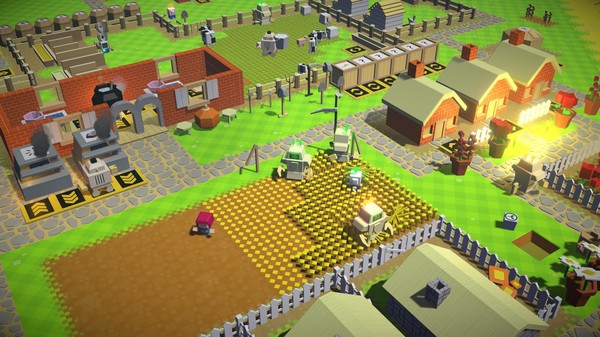
 Screenshot published on the Steam store page (image 1)
Putting the Mechanics into Words
The verb here is teach. You chop the tree yourself first. The bot records the sequence as you perform it, and what comes out is a short script made of Scratch-like blocks. From there you add loops and conditions by hand.
The positive side keeps returning to one surprise: the work you just did becomes the instruction sheet. One of the most helpful Japanese reviews points at the memory limit on a single bot, and the trimming you do to fit a routine inside it, as the pleasure of the game.
This is where it parts from the grammar of Zachtronics. The verbs never multiply. What multiplies is the number of bodies holding them. You solve; someone else performs.
So failure changes shape too. A Japanese review praises the fact that nothing can be permanently lost. Nothing can. Instead a slightly wrong script quietly copies itself across the colony until, one day, a supply line stops. That is what the 400-hour positive review means by cascading failure.
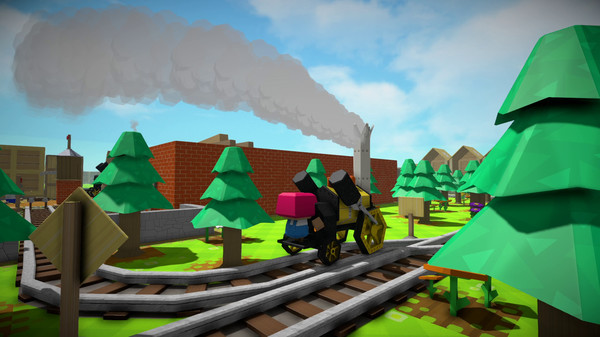
 Screenshot published on the Steam store page (image 2)
Subtraction
Subtraction is a design Puzzlebyrinth usually praises: take verbs away and the board gets deeper. What Autonauts takes away is not verbs. It is the tools you would use to reuse a script once you have written it.
That is exactly what the negative reviews name. No variables. No higher-level controller watching the whole colony. Buildings have no unique names, so nothing can be addressed. No copy, so the same routine is retyped across dozens of bots. One review counts 60 to 80 percent of every script as identical.
What is forbidden, then, is abstraction. The Zhao et al. paper Fukai read reports that people build their own reusable parts while solving puzzles, and reach for them again later. This board does not let those parts exist.
Read that as a gap and you get one sign; read it as a decision and you get the other. Keeping the blocks naive is what lets someone who has never written a line of code walk in. The TIGA educational award it is reported to have won was given for the width of that entrance.
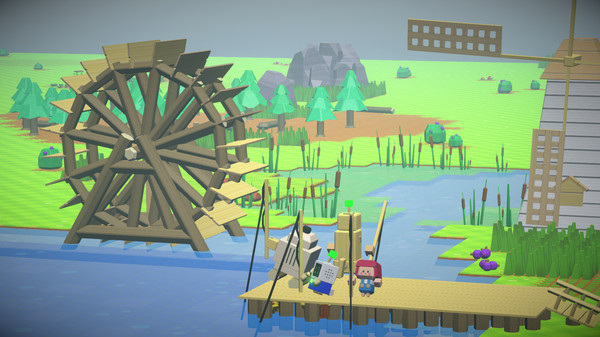
 Screenshot published on the Steam store page (image 3)
The Texture of Difficulty
The game moves where the difficulty lives. Early on, the hard part is working out how to teach. From the middle onward, the hard part is keeping what you already taught running.
The most helpful negative review (127 votes) points at rebuilding the factory each time the colonists move up a tier, and compares that with other automation games where a finished system needs only small adjustments. Another says that adding a single new item sends you back through dozens of scripts.
A Japanese review settles it in one line: the further the automation goes, the busier you get. It comes from a recommending review with 283 hours on the clock. It stands exactly between praise and complaint.
The combinatorial explosion happens somewhere unusual. Not in the width of the board, but in the number of machines you have to maintain. The currency of difficulty is neither thought nor reflex; it is the labour of re-teaching. The learning curve is drawn against the size of the colony, not the skill of the player.
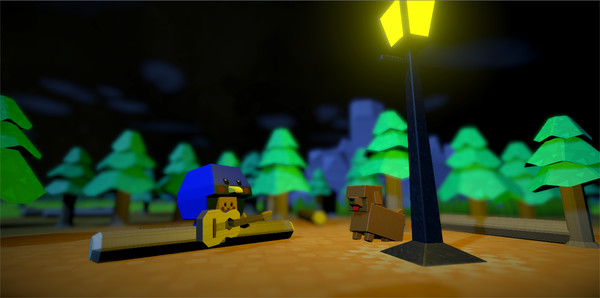
 Screenshot published on the Steam store page (image 4)
Place in the Lineage
The first comparison anyone reaches for is Factorio. The positive side calls this a calmer Factorio; the negative side calls it a Factorio where every machine has to be programmed by hand. The same comparison serves as praise and as complaint.
It is also unlike the lineage of few instructions. Human Resource Machine gives you barely a dozen commands, but what you write survives as a short, fast solution and becomes footing for the next level. Autonauts never lets a script become footing.
Factory games like shapez let you draw a line once and then leave it alone. Here you cannot leave anything alone. The feel is closer to placing each device by hand in The Incredible Machine.
There is also an argument that has nothing to do with the design. Several of the most helpful negative reviews say development moved on to a separate title, 2022's Autonauts vs Piratebots. Updates to this game stop at v140.2 on 6 March 2023, and part of the aggregate is scoring that break rather than the board.
 Screenshot published on the Steam store page (image 5)
Sources
This piece was written by reading the Steam user reviews on the store page as of 1 September 2026, together with the official update announcements, aggregate figures and press scores. No review text is quoted directly; recurring claims are reconstructed.
- Steam: Autonauts (90% of 2,024 reviews positive on the store page, Very Positive; roughly 4,000 reviews at 86.45% across all languages; 14 reviews in the last 30 days at 71%, Mostly Positive; list price $19.99; released 17 October 2019)
- Read in full: the ten most helpful positive reviews, the ten most helpful negative reviews, the ten most recent, and the ten most helpful Japanese-language reviews
- Official update announcements (the last update to the game itself is v140.2, 6 March 2023; everything after is publisher sale news)
- Metacritic: Autonauts (PC 80 from 8 critics, user score 7.8 from 16 ratings), and Wikipedia: Denki (a Dundee, Scotland studio founded in 2000; the TIGA educational award; the free build's distribution record)
- Note: the images here use screenshot URLs returned by Steam's official API, each checked individually for existence. From this execution environment the image CDN could not be reached directly, so I could not open the files and look at them. Captions therefore state only which store-page image each one is, and describe nothing about their contents.
Closing
I give it 7.0. Lower than Steam's 90% because there is a visible gap between the quality of the idea — teaching as the verb — and an implementation that will not let what you taught be reused.
The last thirty days hold 14 reviews at 71%. A small sample, but August's negative votes point at the same place the top votes did six years ago: production clogs and you end up intervening by hand; someone wants an input method other than blocks. The notes are still open.
Who it suits is clear enough. Someone who has never written a line of code and wants to watch their own procedure take shape and start moving. The play the reviews describe runs to roughly 40 to 60 hours, and the sight of a colony running itself is well inside that.
Who it does not suit is anyone for whom abstracting and writing it shorter is the game. This board withholds those tools from the start. That is less a flaw than a question of reach: of who it was built for.
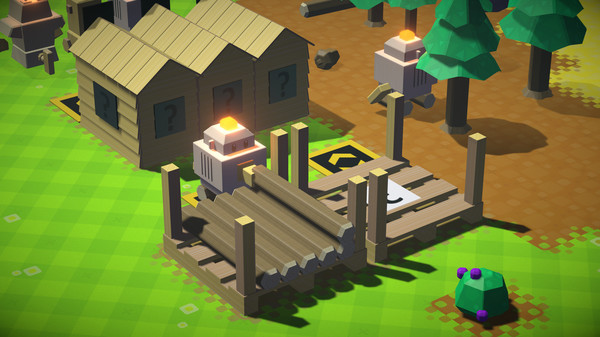 Screenshot published on the Steam store page (image 6)
Reactions (no login)
Anonymous • one of each per visitor per day
Read next
Related reviews
Wilmot's Warehouse
A 2D organisation puzzle: push the delivered goods into your warehouse and file them however you decide. No rule governs the shelves, and when the service hatch opens you retrieve orders from memory alone. By Richard Hogg and Ricky Haggett, who previously made Hohokum, with 200 kinds of pictorial tile piling up.
Mini Motorways
A minimalist 2D puzzle game in which you draw roads, one at a time, through a city that keeps sprouting colour-coded houses and destinations. Each week you are handed a motorway, a roundabout or a traffic light to spend, and you keep redrawing the network until the traffic finally seizes up. From Dinosaur Polo Club, the New Zealand studio behind Mini Metro.
Nauticrawl
A turn-based first-person puzzle game in which you climb into a stolen alien machine and learn to fly it with no manual and no tutorial, decoding a wall of unlabeled levers and switches while a hostile world hunts you. Spare Parts Oasis makes the control panel itself the puzzle.


