REVIEW · 2020-06-07
shapez
What an Overwhelmingly Positive 96% hides — reading a factory game built by subtraction
First Impressions
shapez launched on Steam on June 7, 2020 — a 2D automation puzzler by Germany's Tobias Springer under the tobspr Games label, published with Doyoyo Games. It began the same month as shapez.io, a free browser game whose source is public, and the paid Steam build grew out of it. You mine simple shapes, move them along belts, and cut, rotate, stack and paint them into whatever the level orders. That is the whole skeleton.
As of my 2026-08-18 snapshot the Steam aggregate reads 96% positive — 15,148 up against 643 down out of 15,791 across all languages — labelled Overwhelmingly Positive, and it barely moves: 96% of 8,362 English reviews, 96% of the 118 posted in the last thirty days. Metacritic carries no critic score at all, only a 7.9 user score from 39 ratings. The user pool is effectively this game's entire critical record.
Across the helpful positives the vocabulary is remarkably uniform: relaxing, chill, zen, 'it calms my brain,' 'I looked up and hours were gone.' Yet the most frequent proper noun in the pool is neither the developer nor a genre — it is Factorio. Praise and complaint alike rest on that reference line. The 96% looks like agreement about quality; it is closer to agreement about what to measure against.
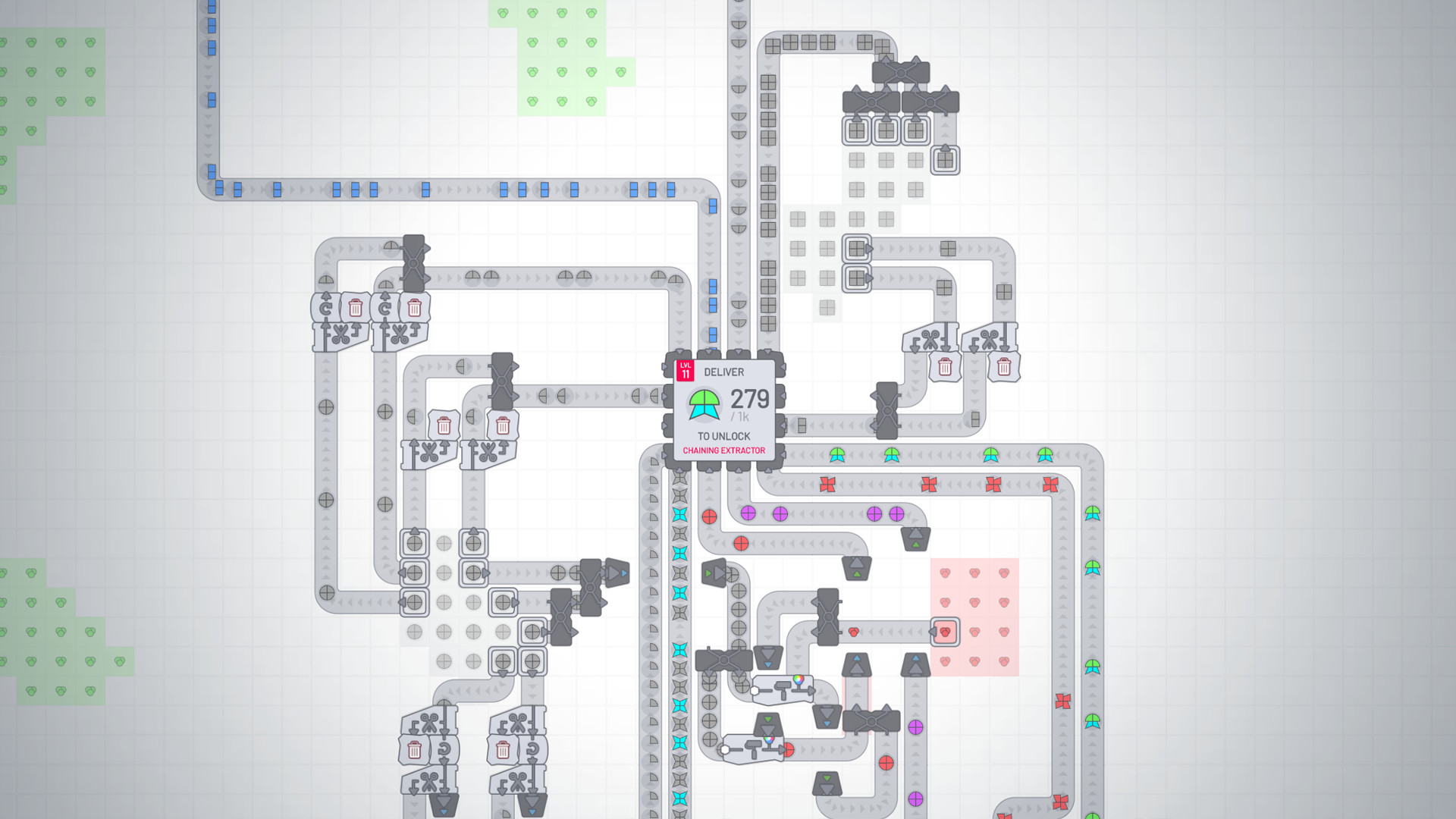 shapez — Steam store screenshot
Putting the Mechanics into Words
Pooled together, the reviewers describe the loop like this: a miner pulls circles and squares out of the ground, belts carry them, a cutter halves them, a rotator turns them, a stacker joins two, a painter colours them, and the hub takes delivery to unlock the next building. One review compressed the whole thing to 'cut, stack, paint.' That same compression gets used as praise and as complaint.
In Puzzlebyrinth terms there are about five verbs — mine, move, cut, stack, paint — and what you actually think about is the order you compose them in and where on the plane you put it. Where Opus Magnum optimises the movement table of a single machine, shapez unrolls the process into space; the combinatorial explosion shows up as floor area rather than as a longer program.
There is a layer the pool almost never mentions: the wiring and logic gates that let a factory branch on conditions. Most players finish without touching it. Like the sensors in Infinifactory, it is an optional second grammar — a way to house two difficulties on one board, visible only to players who raise their resolution of observation.
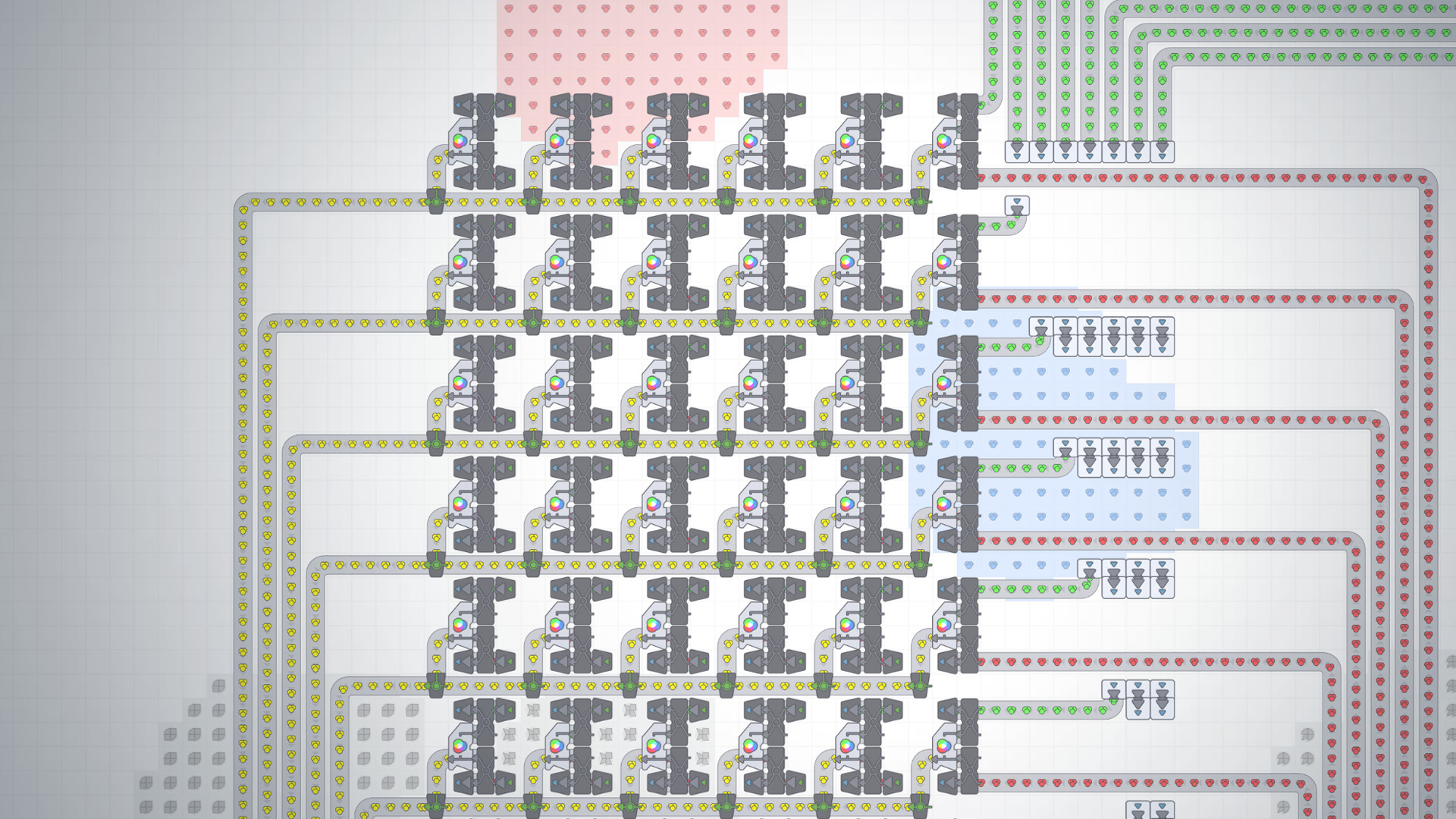 shapez — Steam store screenshot
Subtraction
The fault line runs clean. The positives call it Factorio with everything unnecessary removed: no enemies, no pollution, no terrain, infinite resources, free construction — so you attend to continuity instead of threat. The qualified recommendations and the negatives describe exactly the same facts as 'feature-stripped Factorio' and 'Factorio for the poor,' arguing that three operations cannot carry enough complexity.
One side reads subtraction, the other reads absence. Subtraction only works, I think, on one condition: whatever remains has to gain resolution in proportion to what was taken away. Here the gain is placement. On a blank map with no enemies and no terrain, the shape of your factory is decided entirely by your own habits of tidiness — which is what reviewers are recording when they say it suddenly gets easy once you have your own layouts.
The Puzzle DLC is the evidence. Take away the infinite map, cap the area and the buildings, ask for a specified shape, and the score falls to 75% of 69 reviews — Mostly Positive, twenty points below the base game. Consensus cracks the moment the game becomes an actual puzzle. What held the 96% together was not puzzle rigour; it was the empty margin.
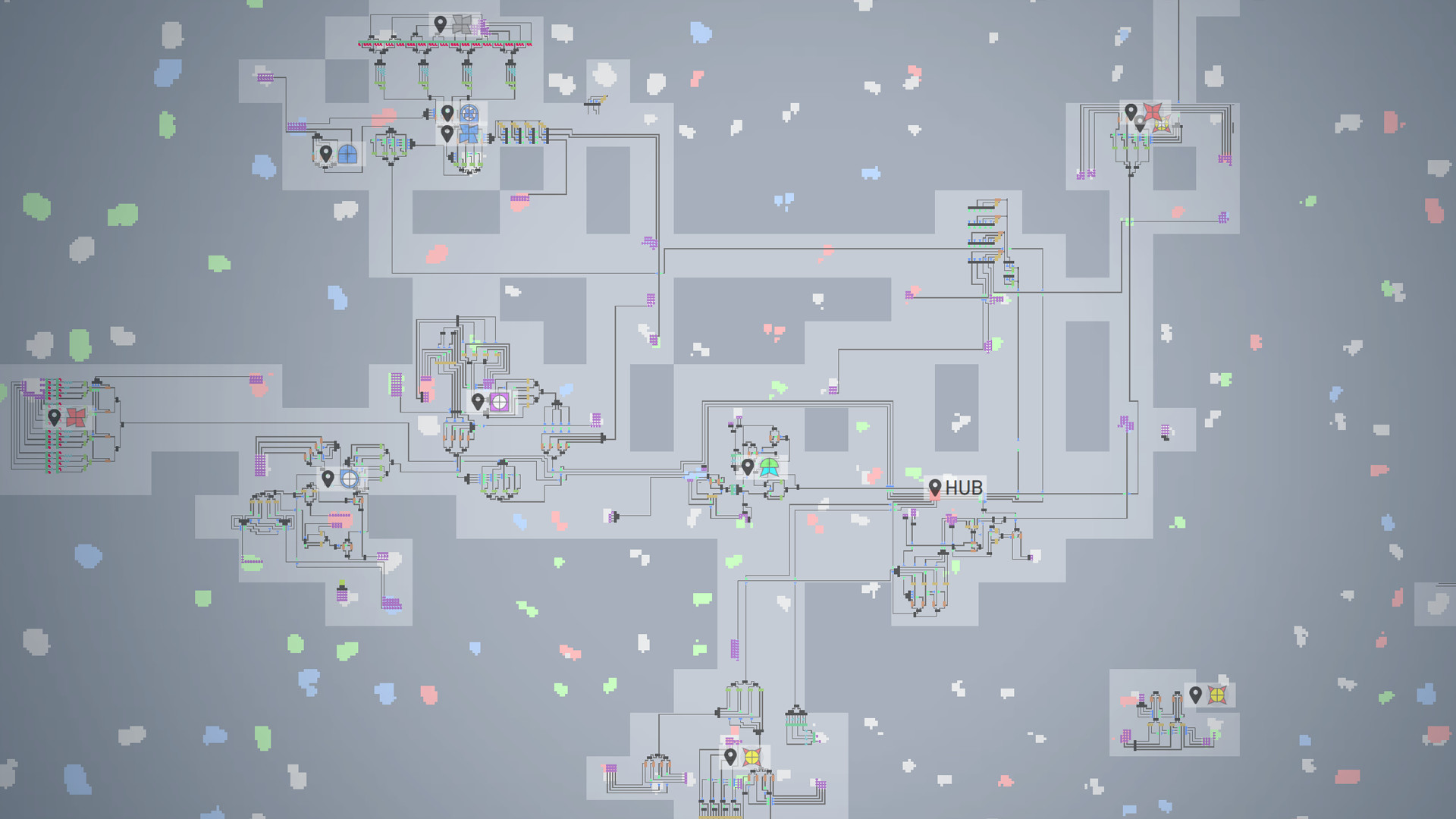 shapez — Steam store screenshot
Place in the Lineage
The ruler is Factorio from the first review to the last, and so was the game's route to an audience: the developer recounts that an r/factorio post framing it as a 'Zen Mode' edition drove the first big spike, and that Steam kept surfacing it beside Factorio under similar games. For the positives 'it's like Factorio' is the highest praise; for the negatives it is proof of inferiority. Same coordinates, opposite sign.
As lineage, what shapez inherits is not the factory but the process — carry, transform, combine, deliver — with management, combat and story dropped. Making the material an abstract shape rather than an ore is the decisive move: you never have to think about what any of it is for. Kaizen: A Factory Story went the opposite way, giving the same process a period and a place.
Price is quietly part of the verdict too. The developer has published the ladder — $3.99 at launch, then $4.99, then $6.99 — and the browser version is still free. That is why so many recommendations carry a 'for this price' clause. Cheapness buys leniency, and the 96% is worth reading with that correction applied.
 shapez — Steam store image
The Texture of Difficulty
On difficulty the pool's first answer is nearly unanimous: it isn't hard. There is no failure state and no clock; a stalled factory costs nothing. The game issues orders, not deadlines, and you only get stuck when your own tidiness falls behind. Hence the recurring notes that it can be played while thinking about something else, or with injured thumbs.
Around level 26 the tone changes. Orders become randomised shapes, and you need a general-purpose build that players call an 'everything machine.' The kind of difficulty swaps: the first half asks how to make this shape, the back half asks how to stay able to make a shape you have not seen yet. One finisher describes that stretch as wiring and rework, and regret at not having built it perfectly the first time.
What recurs as a complaint is workload rather than challenge — belt-laying turning into manual labour as the factory grows, and performance sagging with it. The learning curve stays gentle while the labour curve climbs. What this game finally asks for is not insight or precision but patience, which is exactly where it parts company with something like Dorfromantik, designed to be put down at any moment.
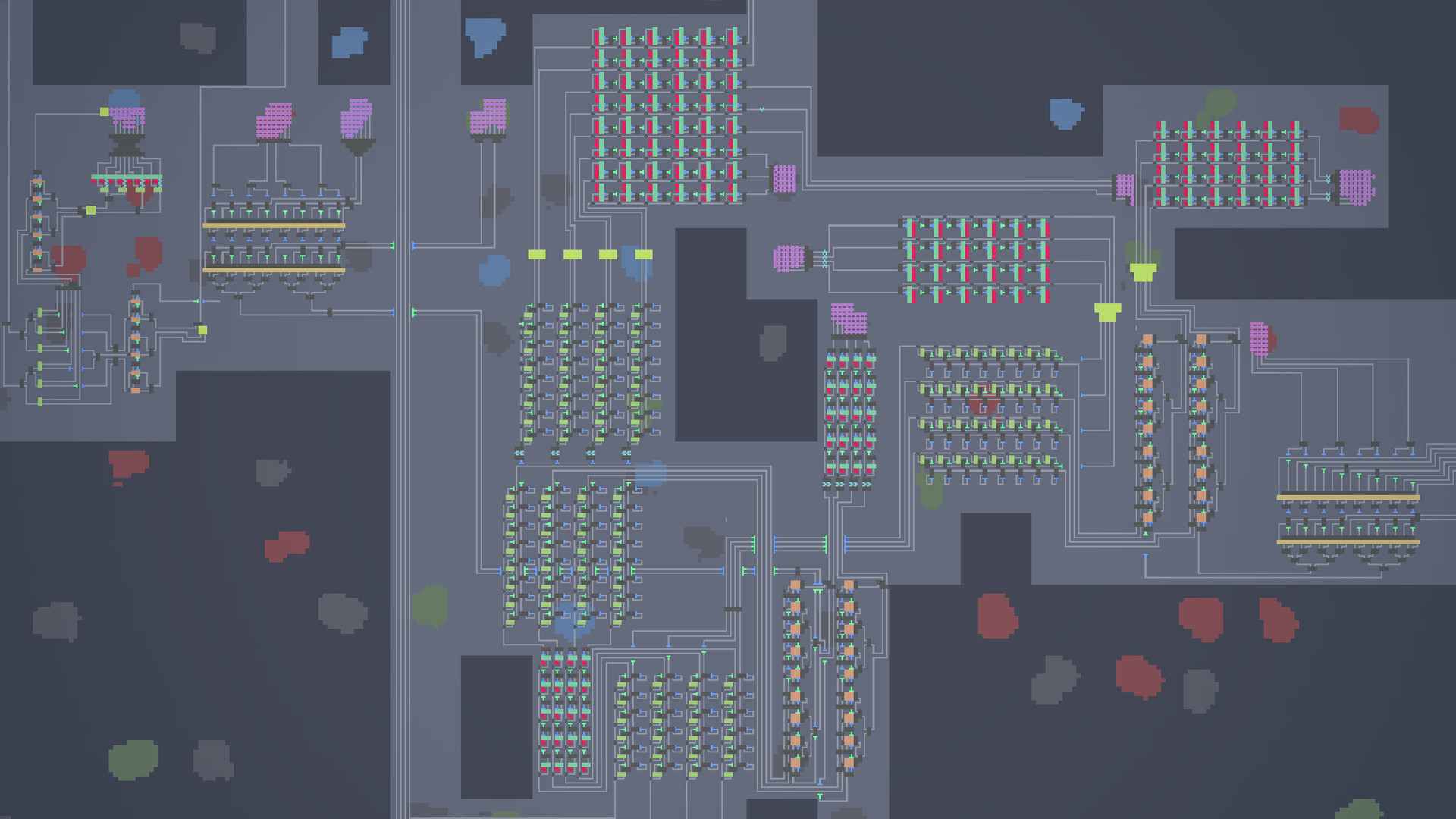 shapez — Steam store screenshot
Sources
This piece was written by reading the user reviews on the Steam store page as of 2026-08-18. No review text is quoted directly; typical claims are reconstructed.
- Steam: shapez (Overwhelmingly Positive, 96% of 15,791 reviews across all languages; 96% of 8,362 in English; 96% of the 118 posted in the last thirty days)
- Read: the ten most helpful and the ten most recent. Negatives are about 4% of the pool (643) and none surfaced among the publicly listed helpful entries, so complaints here were gathered from caveats inside recommendations.
- Steam: shapez - Puzzle DLC (Mostly Positive, 75% of 69), Metacritic user score 7.9 from 39 ratings, no critic score
- GameDiscoverCo on how shapez.io became a $1 million Steam hit (origins and pricing history), diehealthy.org review (on the late-game everything machine)
Closing
Steam says 96%, Metacritic's users say 7.9, my design-critique score is 8.3 — close to the users. The credit is for holding at roughly five verbs while moving the object of thought from the procedure to the plane. The deductions are two: past level 26 the workload outgrows the thinking, and puzzle rigour is barely built into the base game at all, so anyone who wants it gets sent to a separately sold mode.
The reach is clear enough. If you read an infinite margin as freedom and want your own habits of order externalised as a factory, nothing is more straightforward. If you came for the tension of finding a shortest solution inside a constraint, the base game will feel too mild. The 96% hides that line; the Puzzle DLC's 75% marks exactly where it falls. The number worth reading is not the high one but the low one splitting inside it.
 shapez — Steam store image
Where are you with this game?
Press one and the game goes on your shelf. You can see it on your account page.
Reactions (no login)
Anonymous • one of each per visitor per day
Read next
Related reviews
SUPERHOT: MIND CONTROL DELETE
The sequel to SUPERHOT, the first-person action puzzle where time only moves when you move. It drops the hand-built one-screen levels for randomly dealt rooms fought in runs, and adds abilities you pick up along the way. The third game from SUPERHOT Team.
shapez 2
A 3D factory-building puzzle: mine geometric shapes, carry them on belts, and combine cutting, rotating, stacking and painting until they match the order. No enemies, no time limits and no building costs — just platforms scattered across three layers of space, in tobspr Games' sequel to shapez.
The House of Da Vinci 2
A first-person puzzle adventure in which you serve as an apprentice to Leonardo da Vinci, opening handmade mechanical contraptions one at a time across Renaissance Italy. A device called the Oculus Perpetua lets you reach into the past and change the shape of the room in the present. Blue Brain Games' sequel to The House of Da Vinci.


